Introduction
An Intrusion Detection and Prevention System, or IDPS, is used to monitor network activity and identify possible attacks. It helps security teams detect suspicious traffic, understand what is happening inside the network, and in some cases, stop malicious activity before it reaches protected systems.
IDPS is a broad term that includes two closely related security systems: IDS and IPS. Both are used for threat detection, but they differ in how they respond after suspicious activity is found.
IDS: Detects suspicious activity and generates alerts.
IPS: Detects suspicious activity and actively blocks or limits it.
What Is IDS?
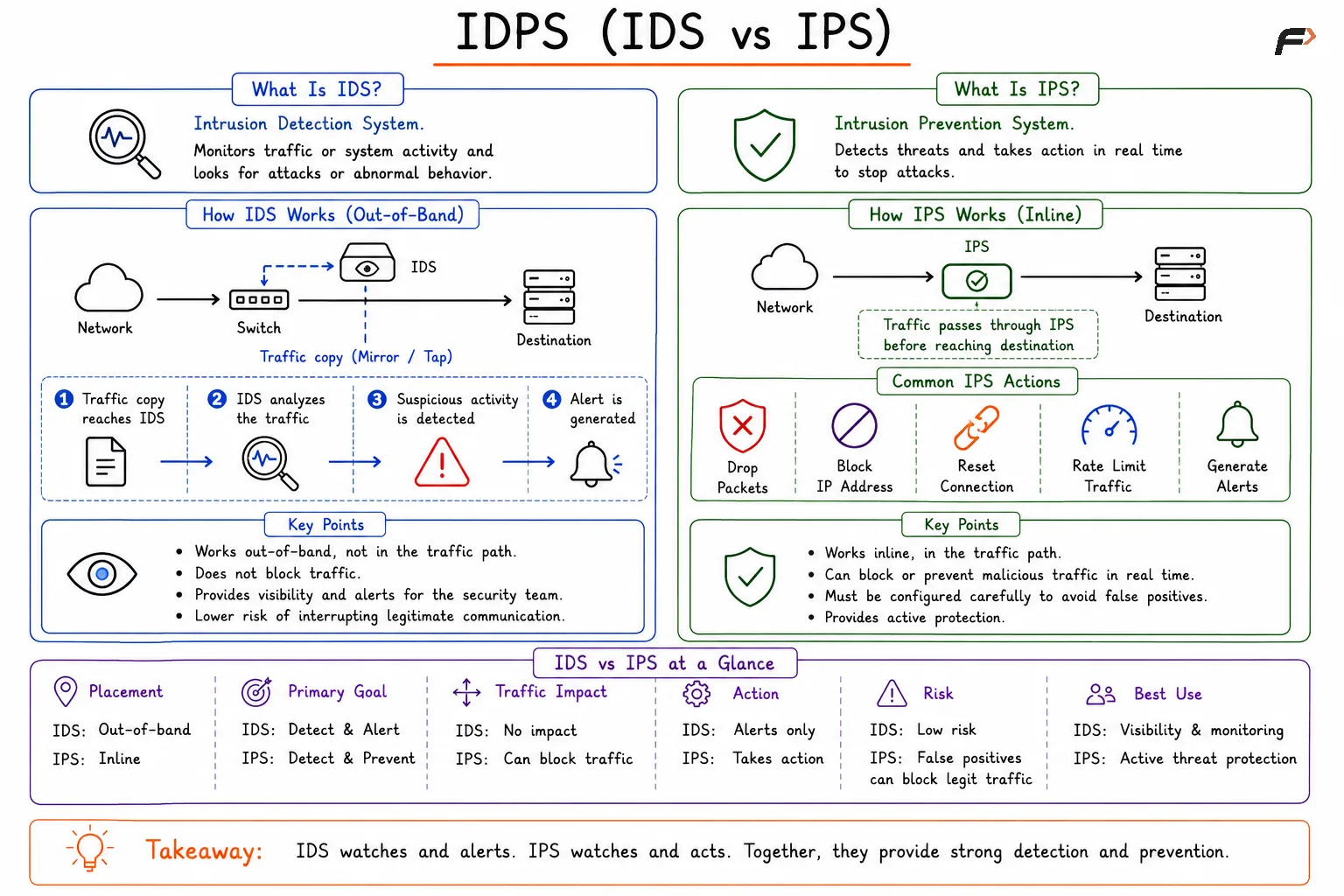
An Intrusion Detection System, or IDS, is mainly used for monitoring and alerting. It observes network traffic or system activity and looks for signs of attacks, policy violations, or abnormal behavior.
An IDS usually works out-of-band, which means it does not sit directly in the traffic path. Instead, it receives a copy of traffic through techniques such as port mirroring or network taps.
A simple IDS flow looks like:
A copy of the network traffic reaches the IDS.
The IDS analyzes the traffic.
Suspicious activity is detected.
An alert is generated.
Since IDS does not directly block traffic, it is useful when the security team wants visibility without the risk of accidentally stopping legitimate communication.
What Is IPS?
An Intrusion Prevention System, or IPS, goes one step further than IDS. It detects suspicious traffic and can take action immediately to stop it.
An IPS is usually deployed inline, meaning traffic passes through it before reaching the destination. Because it sits in the traffic path, it can block malicious packets, reset connections, or rate limit suspicious traffic in real time.
Common IPS actions include:
Drop packets: Malicious packets are discarded before they reach the target.
Block IP address: Traffic from a suspicious source can be blocked.
Reset connection: An active connection can be forcefully closed.
Rate limit traffic: Repeated or excessive requests can be slowed down.
Generate alerts: Security teams are notified about the detected activity.
IPS provides active protection, but it must be configured carefully. A false positive in IPS can block legitimate users or services.
IDPS - Intrusion Detection and Prevention System
IDS vs IPS
Aspect | IDS | IPS |
|---|---|---|
Full Form | Intrusion Detection System | Intrusion Prevention System |
Main Role | Detects and alerts | Detects and blocks |
Deployment | Usually out-of-band | Usually inline |
Traffic Impact | Does not directly interrupt traffic | Can block or modify traffic |
Response | Alerts security teams | Takes automatic action |
Risk of False Positive | Extra alerts | Legitimate traffic may be blocked |
Best Used For | Monitoring, visibility, investigation | Real-time threat prevention |
The key difference is response. IDS watches and reports, while IPS watches and acts.
Detection Techniques in IDPS
IDPS tools need a way to decide whether traffic is normal or suspicious. The two most common detection techniques are signature-based detection and anomaly-based detection.
Detection Method | How It Works | Best For | Limitation |
|---|---|---|---|
Signature-based detection | Matches traffic against known attack patterns | Known threats and common attacks | May miss new or unknown attacks |
Anomaly-based detection | Compares behavior against normal activity | Unusual behavior and unknown threats | Can produce more false positives |
Signature-based detection is similar to matching a pattern from a known threat database. If a packet, file, or request matches a known attack signature, the system can flag it as malicious.
Anomaly-based detection looks for unusual behavior. For example, if a user normally sends a small number of requests but suddenly sends thousands of requests in a few minutes, the system may treat it as suspicious.
Where IDPS Is Placed
IDPS is usually placed at important points where traffic needs monitoring or protection. The placement depends on whether the organization wants visibility, prevention, or both.
Common deployment locations include:
Network edge: To inspect traffic moving between the internal network and the internet.
Data centers: To monitor traffic between servers and critical systems.
Internal network segments: To detect suspicious movement inside the organization.
Cloud environments: To inspect traffic between virtual networks, workloads, and exposed services.
Host systems: To monitor activity on individual servers or endpoints.
IDPS works best as part of layered security. It complements firewalls, WAFs, endpoint protection, logging systems, and secure application design.
Summary
IDPS is an important network security system used to detect and prevent suspicious activity. IDS provides monitoring and alerts, while IPS provides active prevention by blocking or limiting malicious traffic.
Signature-based detection helps identify known attacks, while anomaly-based detection helps find unusual behavior. In real networks, IDPS is usually combined with firewalls, WAFs, monitoring tools, and secure configuration to create stronger layered protection.
Be the first to add a comment.