Introduction
HTTPS is the secure version of HTTP. In simple terms, it is the web communication model most people use every day when opening websites, logging in, making payments, or sending sensitive data.
The idea is straightforward. HTTP defines how the browser and server exchange requests and responses, while TLS adds security to that communication. Together, they make web traffic private, authenticated, and protected against tampering.
What HTTPS and TLS Mean
HTTP is the application layer protocol used for web communication. It defines how a client sends a request and how a server sends back a response.
TLS, which stands for Transport Layer Security, is the security protocol that protects that communication while it travels across the network.
A simple way to remember this is:
HTTP: Defines web communication
TLS: Secures that communication
HTTPS: HTTP running securely with TLS
That is why HTTPS is commonly described as secure HTTP.
Why HTTPS Is Needed
If a website uses plain HTTP, the traffic is not properly protected. Anyone on the path between client and server may be able to observe or interfere with the communication.
This creates several serious risks:
Eavesdropping: Login credentials, messages, payment details, and personal data may be visible
Tampering: Data can be modified while in transit
Man-in-the-middle attacks: An attacker may intercept and relay communication
Server impersonation: A fake server may pretend to be the real website
HTTPS exists to reduce these risks and make web communication trustworthy at the connection level.
What TLS Provides
TLS protects data in transit using three major security properties.
Encryption: Makes intercepted data unreadable to outsiders
Authentication: Helps the client verify that it is talking to the correct server
Integrity: Helps detect whether data was modified during transmission
These three ideas are the heart of secure web communication.
Encryption in TLS
Encryption converts readable data into ciphertext. If someone captures the traffic, they should not be able to understand the content without the proper keys.
This matters for things like:
Passwords
Payment details
Session cookies
Private messages
API tokens
Personal information
Without encryption, all of this could be exposed on untrusted networks.
Authentication and Server Identity
Encryption alone is not enough. A browser must also know that it is talking to the real server and not to a fake system pretending to be that website.
TLS helps solve that through authentication. During secure setup, the server proves its identity using a digital certificate. The browser then checks whether that certificate is valid and trusted.
This is what helps protect users from fake websites that imitate real ones.
Integrity Protection
TLS also protects the integrity of data. This means if someone tries to change the traffic while it is moving across the network, the receiving side can detect that the data has been altered.
So TLS is not only about secrecy. It is also about making sure the communication arrives without hidden changes.
HTTP vs HTTPS
Feature | HTTP | HTTPS |
|---|---|---|
Security | No built-in protection | Protected by TLS |
Data visibility | Traffic can be exposed | Traffic is encrypted |
Identity verification | No strong server verification | Server identity is validated |
Tamper protection | Weak | Integrity checks are provided |
Typical use | Basic or legacy communication | Modern secure web traffic |
This is why secure websites, APIs, login pages, and online payment systems rely on HTTPS rather than plain HTTP.
How HTTPS Communication Starts
Before normal HTTP data is exchanged securely, the client and server must first establish a protected channel. This happens through the TLS handshake.
For HTTP/1.1 and HTTP/2, the typical sequence is:
TCP connection => TLS handshake => Secure HTTP communication
For HTTP/3, things are a little different because HTTP/3 runs over QUIC, and QUIC integrates TLS 1.3 into its connection setup. The idea is still the same: the secure channel is established before meaningful application data is exchanged.
TLS Handshake Basics
The TLS handshake is the process that prepares secure communication between client and server. Modern systems mainly use TLS 1.3, which is faster and simpler than older versions.
A simplified handshake flow looks like this:
The client says what TLS versions and cryptographic options it supports
The server chooses compatible options and replies
The server sends its certificate
The client verifies the certificate
Both sides derive shared session keys
Secure communication begins
This setup phase is what turns an ordinary network path into a protected communication channel.
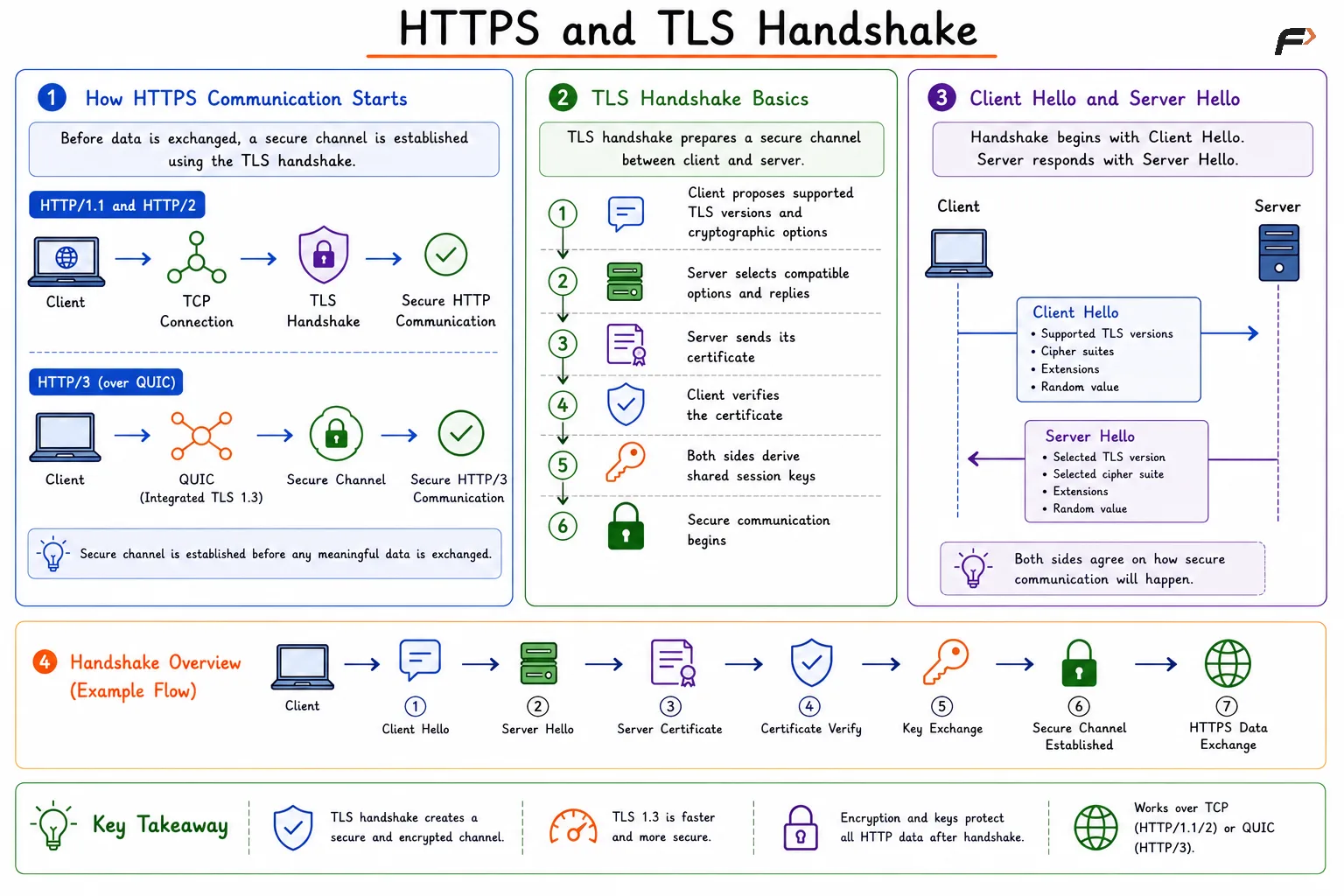
HTTPS and TLS Handshake
Client Hello and Server Hello
The handshake starts when the client sends a Client Hello message. This tells the server which TLS versions, features, and cryptographic options the client can support.
The server then responds with a Server Hello, choosing the settings that both sides can use.
These messages are important because both sides must agree on how secure communication will happen before the rest of the exchange can continue.
Public Key and Session Keys
TLS uses more than one kind of cryptographic key. In a simplified view:
Public key cryptography: Helps with identity verification and secure key exchange
Session keys: Used for the actual fast encryption of the ongoing traffic
The long-term identity of the server is tied to the certificate, while the session keys are created for the secure connection itself.
This combination gives TLS both practical speed and strong security.
TLS 1.3 and Modern Security
TLS 1.3 is the modern standard for secure web communication. It improved both performance and security compared with older TLS versions.
Important TLS 1.3 advantages include:
Fewer handshake round trips: Faster setup
Stronger default security: Simpler and safer choices
Forward secrecy: Helps protect past sessions even if long-term secrets are later compromised
Reduced protocol complexity: Easier to harden and reason about
That is why modern secure websites and APIs strongly prefer TLS 1.3.
What HTTPS Protects and What It Does Not
HTTPS protects the communication channel, not the intentions of the website owner.
HTTPS does protect:
Data in transit
Server identity verification
Resistance to many interception attacks
Protection against modification during transfer
HTTPS does not automatically guarantee:
That the website is honest
That the content is trustworthy
That the business is legitimate
That the user is safe from scams
A malicious website can still use HTTPS. The secure lock means the connection is protected, not that the site is morally trustworthy.
Where HTTPS Is Essential
HTTPS is essential anywhere sensitive or identity-linked data is exchanged.
Common examples include:
Login pages
Banking and payment systems
Email and messaging
Cloud applications
REST APIs
Admin dashboards
E-commerce websites
In modern systems, HTTPS is not optional best practice. It is the normal expectation.
Summary
HTTPS is secure web communication built by combining HTTP with TLS. HTTP handles the request-response model, while TLS adds encryption, authentication, and integrity so that data stays protected while moving across the network.
TLS uses handshakes, certificates, trusted certificate authorities, public key cryptography, and session keys to establish a secure channel. Modern systems mostly rely on TLS 1.3, and newer web stacks such as HTTP/3 use QUIC with integrated TLS setup for better performance. In short, HTTPS protects the connection, the identity of the server, and the confidentiality of data in transit, which is why it is fundamental to the modern web.
Be the first to add a comment.