Introduction
Diffie-Hellman Key Exchange is a cryptographic method that allows two parties to create the same shared secret key over an untrusted network. The important part is that the shared secret itself is never sent across the network.
This matters because symmetric encryption needs the sender and receiver to use the same secret key. The difficult question is: how do both parties get the same key without directly sending it where an attacker can capture it?
Why Diffie-Hellman Is Needed
Symmetric encryption is fast and efficient, but it depends on one shared secret key. If Alice and Bob already have the same key safely, they can use it to encrypt and decrypt data.
The problem appears when they are communicating over the internet for the first time. If Alice sends the secret key directly to Bob, an attacker may intercept it and use it to decrypt future communication.
Diffie-Hellman solves this key exchange problem by allowing both sides to calculate the same shared secret independently.
Shared key is needed: Symmetric encryption requires both parties to use the same secret key.
Direct sharing is risky: Sending the key over the internet may expose it to attackers.
DH solution: Both parties exchange public values and calculate the same secret without transmitting the secret itself.
Basic Idea Behind Diffie-Hellman
Diffie-Hellman does not encrypt the actual application data. Its main job is to help both parties establish a shared secret key.
After the shared secret is created, that secret can be used with symmetric encryption algorithms for fast and secure communication.
The core idea is:
Public values can be shared openly. Private values must never be shared. Using their own private value and the other party’s public value, both sides can calculate the same shared secret.
How Diffie-Hellman Works
Diffie-Hellman uses public numbers, private numbers, and modular arithmetic. The full mathematics can go deeper, but the high-level flow is straightforward.
Public values are selected: Alice and Bob agree on a large prime number and a generator value.
Private values are chosen: Alice chooses a private number, and Bob chooses a private number.
Public keys are generated: Each side uses the public values and its private number to create a public key.
Public keys are exchanged: Alice sends her public key to Bob, and Bob sends his public key to Alice.
Shared secret is calculated: Alice uses Bob’s public key with her private number, and Bob uses Alice’s public key with his private number.
At the end, Alice and Bob get the same shared secret. An attacker may see the public values and public keys, but the private numbers are never sent.
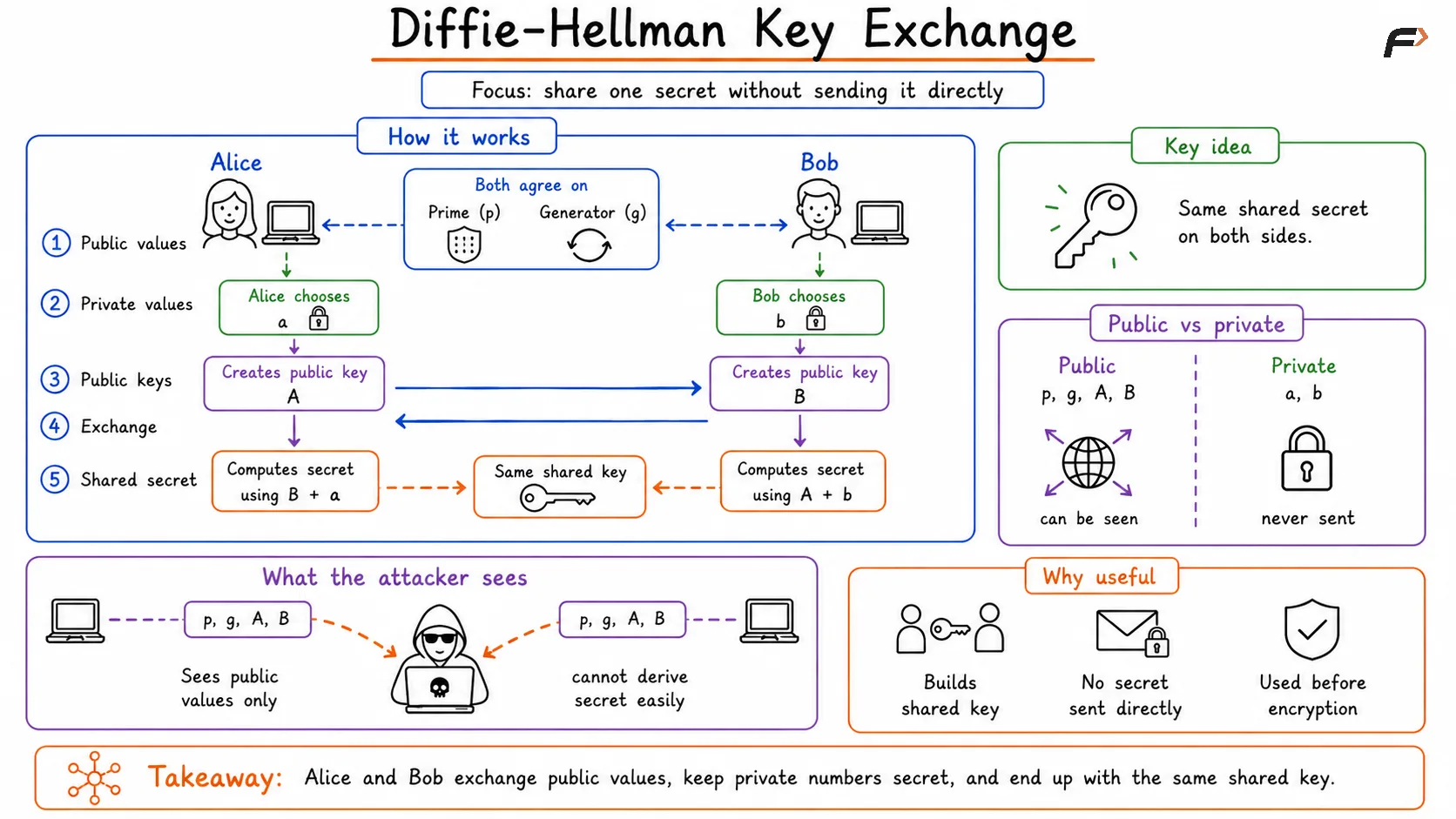
Diffie-Hellman Key Exchange
What Attackers Can See
Diffie-Hellman is designed so that some information can safely travel over the network. The attacker may observe the public setup and exchanged public keys, but that should not be enough to calculate the final shared secret.
Value | Shared Over Network? | Secret? |
|---|---|---|
Prime number | Yes | No |
Generator value | Yes | No |
Alice’s public key | Yes | No |
Bob’s public key | Yes | No |
Alice’s private number | No | Yes |
Bob’s private number | No | Yes |
Final shared secret | No | Yes |
The security comes from the fact that the private values are not transmitted. Without those private values, deriving the shared secret becomes computationally difficult when proper parameters are used.
Diffie-Hellman and Symmetric Encryption
Diffie-Hellman is usually used before symmetric encryption begins. It helps establish the shared secret, and then symmetric encryption is used for the actual data transfer.
This gives secure systems a practical combination:
Diffie-Hellman: Establishes a shared secret over an insecure network.
Symmetric encryption: Uses the shared secret to encrypt large amounts of data efficiently.
Secure protocols: TLS, HTTPS, SSH, and VPNs may use this kind of key establishment approach.
In modern secure communication, the shared secret is usually not used directly as the final encryption key. It is commonly passed through key derivation steps to create the actual session keys used for encryption and integrity protection.
Main Limitation of Diffie-Hellman
Diffie-Hellman solves the key exchange problem, but it does not automatically verify identity. This is a very important limitation.
If an attacker sits between Alice and Bob, the attacker may start one Diffie-Hellman exchange with Alice and another with Bob. Alice may think she is communicating with Bob, and Bob may think he is communicating with Alice, but both are actually communicating through the attacker.
This is called a man-in-the-middle attack.
Diffie-Hellman needs authentication mechanisms to prevent this. In real systems, authentication is provided using digital certificates, digital signatures, Certificate Authorities, and Public Key Infrastructure.
Summary
Diffie-Hellman Key Exchange allows two parties to create the same shared secret key without sending that secret key across the network. It solves the key exchange problem that appears in symmetric encryption.
The method works by exchanging public values while keeping private values secret. After both sides calculate the shared secret, they can use symmetric encryption for fast data transfer. However, Diffie-Hellman alone does not prove identity, so real-world systems combine it with authentication methods such as certificates, digital signatures, and PKI to prevent man-in-the-middle attacks.
Be the first to add a comment.