Introduction
A hash function is a cryptographic technique that takes input data and converts it into a fixed-size output called a hash value, hash digest, or message digest. The input can be very small, like a word, or very large, like a full file.
Hashing is not mainly used to hide data. Its main purpose is to create a digital fingerprint of data so systems can later check whether the data has changed.
How Hash Functions Work
A hash function accepts data as input and produces a fixed-length output. The output size depends on the hash algorithm, not on the size of the original input.
A simple flow looks like:
Input data => Hash function => Fixed-size hash digest
For example, a short message and a large document can both produce hash outputs of the same length if the same hash algorithm is used. This makes hashes useful for comparison, verification, and integrity checks.
Important Properties of Hash Functions
A secure cryptographic hash function should have certain important properties. These properties make hashing useful in security systems.
Deterministic output: The same input should always produce the same hash output.
Fixed-size digest: The output length remains fixed even if the input size changes.
One-way property: It should be practically impossible to recover the original input from only the hash.
Avalanche effect: A small change in input should create a very different hash output.
Collision resistance: It should be extremely difficult to find two different inputs with the same hash.
For example, hello and Hello may look very similar to humans, but a cryptographic hash function should produce completely different digests for them.
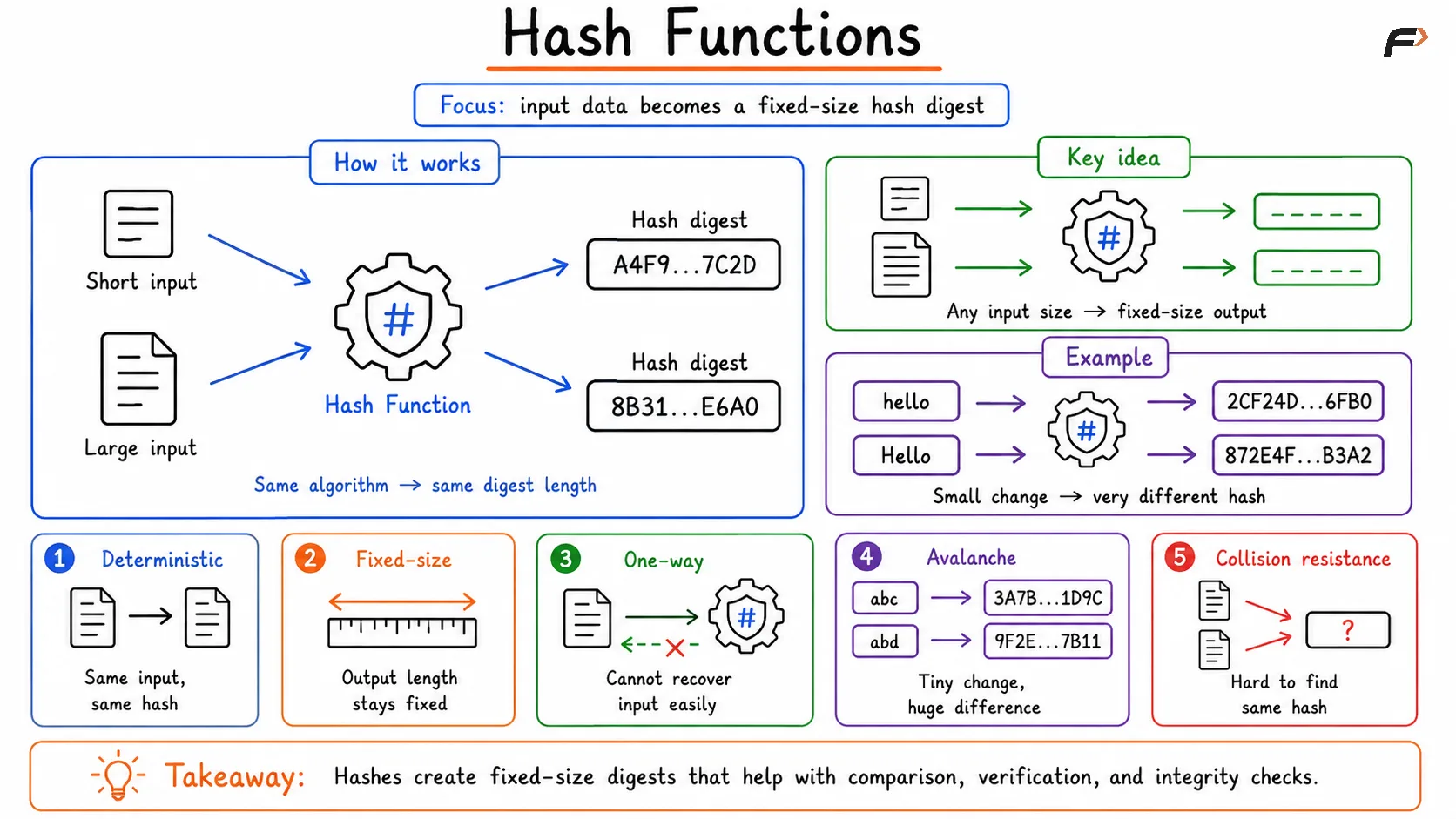
Hash Functions and its Properties
Hashing Is Not Encryption
Hashing and encryption are often confused, but they solve different problems. Encryption is used when data must be protected and later recovered. Hashing is used when data needs a fingerprint for verification.
Aspect | Hashing | Encryption |
|---|---|---|
Main Purpose | Verification and integrity | Confidentiality |
Reversible | No | Yes, with the correct key |
Output | Fixed-size hash digest | Ciphertext |
Key Required | Usually no key for plain hashing | Yes |
Common Use | Password hashes, file checks, signatures | HTTPS, VPNs, file encryption |
In simple terms, encryption hides data so it can be recovered later. Hashing fingerprints data so changes can be detected.
Where Hash Functions Are Used
Hash functions are used in many security systems because they provide a compact way to verify data.
Common uses include:
Data integrity: A receiver can compare hashes to check whether a file or message changed.
Password storage: Systems store password hashes instead of raw passwords.
Digital signatures: Large documents are hashed first, and then the hash is signed.
Certificate fingerprints: Certificates can be identified using their hash fingerprints.
File verification: Downloaded files can be checked against published SHA-256 hashes.
Message authentication: HMAC combines hashing with a secret key to verify integrity and authenticity.
Password storage needs extra care. Normal fast hashes are not enough for passwords, so modern systems use salts and password-hashing algorithms designed to slow down brute-force attacks.
Plain Hashes and Authenticity
A plain hash can help detect whether data changed, but it does not prove who created the data. If an attacker replaces both a file and its published hash, the receiver may still see a matching hash.
This is why security systems often combine hashes with other mechanisms.
HMAC: Uses a secret key with hashing to verify message authenticity.
Digital signatures: Sign the hash so the receiver can verify the sender.
Trusted sources: The hash value itself must come from a trusted location.
So, hashing is excellent for integrity, but authenticity usually requires HMAC, digital signatures, or a trusted verification process.
Common Hash Algorithms
Several hash algorithms have been used over time. Some older algorithms are no longer recommended for security-sensitive use because practical weaknesses have been found.
Algorithm | Current Security Use |
|---|---|
MD5 | Not recommended for secure systems |
SHA-1 | Not recommended for secure systems |
SHA-256 | Widely used and commonly recommended |
SHA-384 | Used where stronger security margins are needed |
SHA-512 | Widely used for strong hashing |
SHA-3 | Modern hash family with a different design |
SHA-256 is one of the most common cryptographic hash functions used in modern security systems, including file verification, certificates, digital signatures, and security protocols.
Summary
A hash function converts data of any size into a fixed-size hash value or digest. In cryptography, hash functions are used to create digital fingerprints that help verify data integrity.
Secure hash functions are deterministic, one-way, collision-resistant, and sensitive to even small input changes. Hashing is different from encryption because hashing is not meant to be reversed. It is widely used in password storage, file verification, digital signatures, certificate fingerprints, HMAC, and modern network security protocols.
Be the first to add a comment.