Introduction
Network security threats are risks that can damage a network, steal sensitive data, change information, or make services unavailable. These threats matter because modern networks carry everything from login credentials and payment requests to business data, API traffic, cloud communication, and internal service requests.
A secure network is not only about keeping attackers outside. It is also about protecting data while it moves, controlling who can access systems, detecting suspicious behavior, and keeping services available for legitimate users.
What Are Network Security Threats?
A network security threat is any activity, weakness, or attack that can harm the confidentiality, integrity, or availability of a network.
In simple terms, a threat may cause one of these problems:
Data exposure: Someone reads information they should not access
Data modification: Someone changes traffic, records, or requests
Service disruption: Legitimate users cannot access the system
Unauthorized access: An attacker enters systems without permission
These threats can come from outside attackers, infected devices, careless users, malicious insiders, weak configurations, or vulnerable software.
Malware and Ransomware
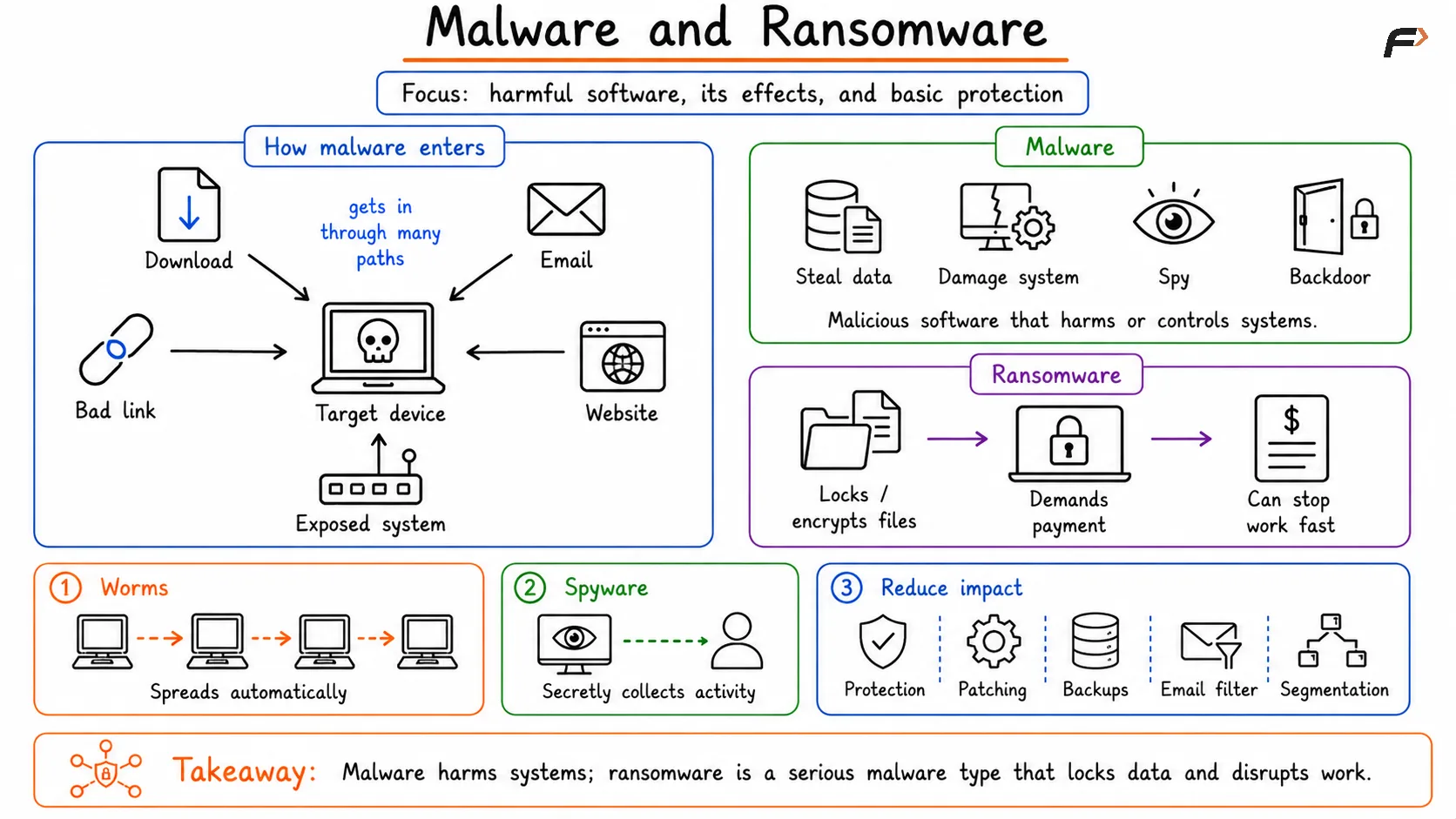
Malware is malicious software designed to damage systems, steal data, spy on users, or gain unauthorized control. It can enter through infected downloads, email attachments, malicious links, compromised websites, or exposed systems.
Ransomware is a specific type of malware that locks or encrypts files and demands payment for recovery. It is one of the most serious network security threats because it can stop business operations quickly.
Malware: Can steal data, damage systems, or create backdoors
Ransomware: Can encrypt files and make systems unusable
Worms: Can spread automatically across vulnerable network devices
Spyware: Can secretly collect user activity and sensitive information
Good endpoint protection, patching, backups, email filtering, and network segmentation help reduce malware impact.
Malware and Ransomware
Phishing and Social Engineering
Phishing is an attack where users are tricked into giving away sensitive information or clicking harmful links. The attacker may pretend to be a bank, company, cloud provider, colleague, or trusted platform.
Social engineering works because it targets human trust rather than only technical systems.
Common phishing outcomes include:
Credential theft
Malware installation
Payment fraud
Account takeover
Unauthorized access to internal systems
Security awareness, MFA, email protection, URL filtering, and careful login verification help reduce phishing risk.
Man-in-the-Middle Attacks
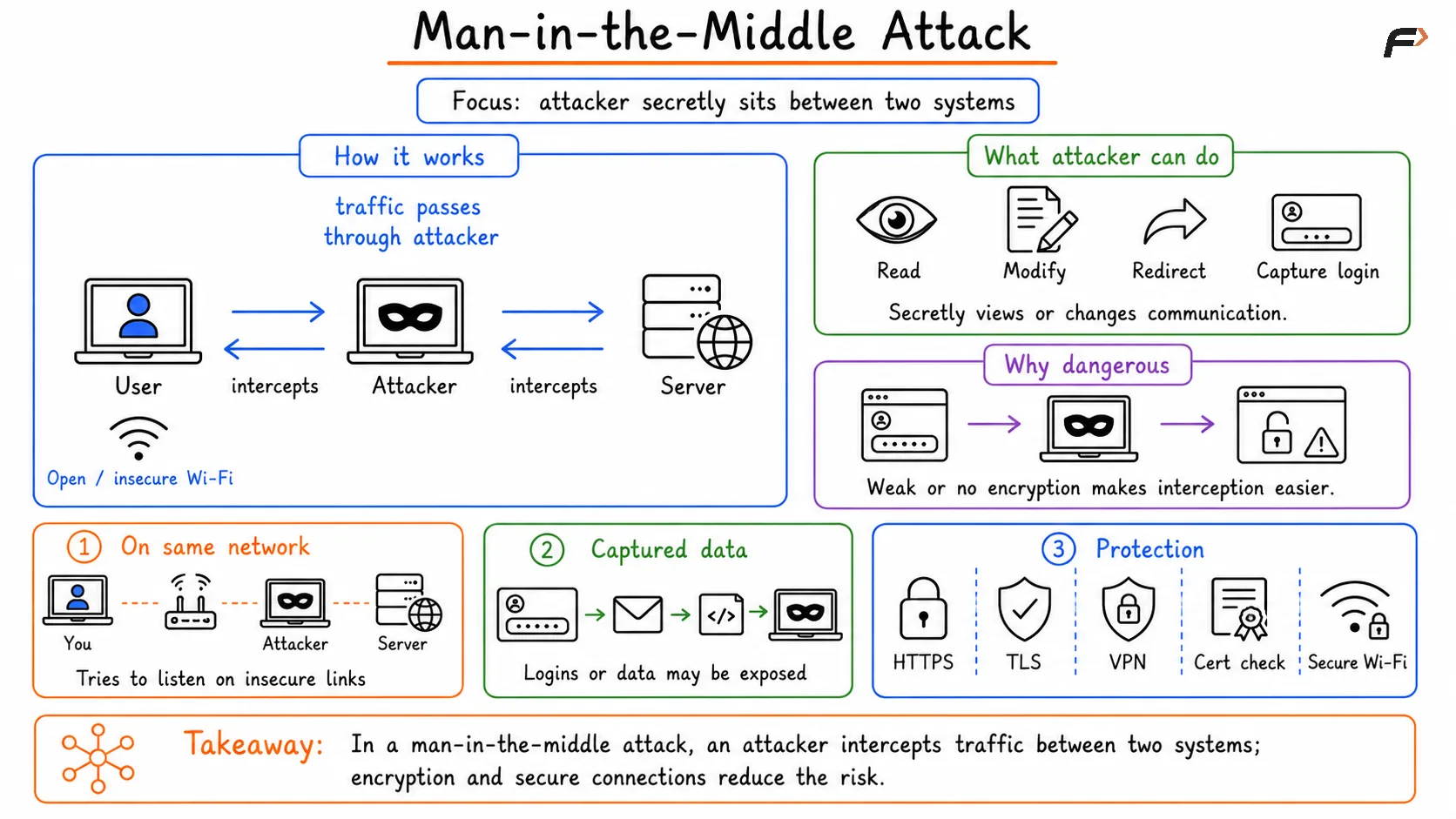
A man-in-the-middle attack happens when an attacker secretly intercepts communication between two systems. The attacker may read the traffic, modify it, or redirect it.
This is dangerous when communication is not encrypted properly.
For example, if login details travel over an insecure connection, an attacker on the same network may try to capture them. HTTPS, TLS, VPNs, certificate validation, and secure Wi-Fi help protect against this kind of threat.
Man in the Middle Attack
Password and Credential Attacks
Many network attacks begin with stolen or weak credentials. If an attacker obtains a username and password, they may access VPNs, admin panels, email accounts, cloud systems, or internal applications.
Common credential attacks include:
Brute force attack: Repeatedly trying passwords until one works
Credential stuffing: Reusing leaked passwords from other breaches
Password spraying: Trying common passwords across many accounts
Session hijacking: Stealing session tokens or cookies to impersonate a user
Strong passwords, MFA, account lockout policies, password managers, and monitoring unusual login behavior are important defenses.
DDoS and Service Disruption
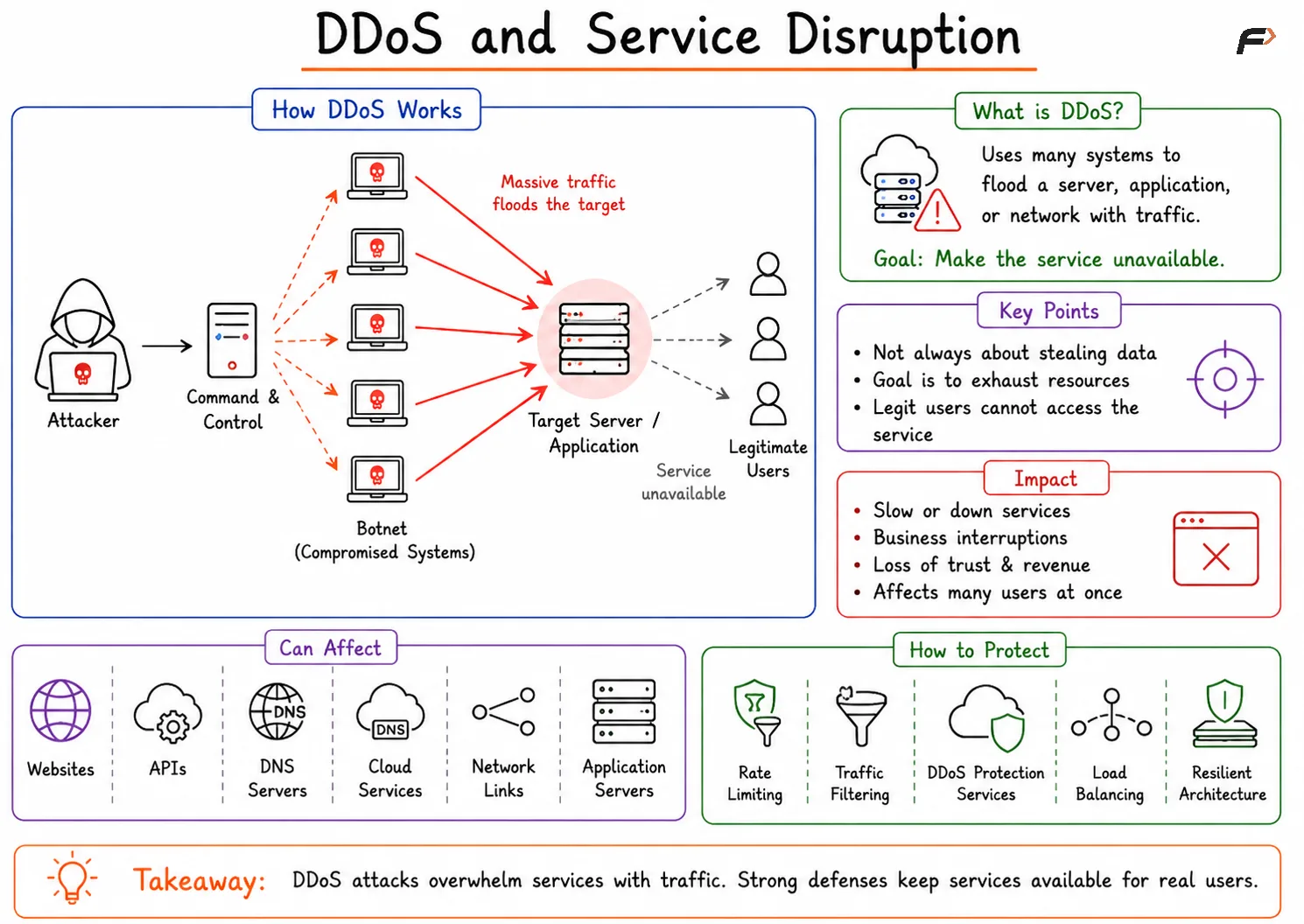
A DoS attack tries to make a service unavailable. A DDoS attack, or Distributed Denial-of-Service attack, uses many systems to flood a server, application, or network with traffic.
The goal is not always to steal data. Sometimes the goal is simply to exhaust resources so legitimate users cannot access the service.
DDoS attacks can affect:
Websites
APIs
DNS servers
Cloud services
Network links
Application servers
Rate limiting, traffic filtering, DDoS protection services, load balancing, and resilient architecture help protect availability.
DDoS and Service Disruption
Spoofing and Poisoning Attacks
Spoofing means pretending to be a trusted device, user, service, or address. Poisoning attacks involve corrupting trusted network information so traffic goes to the wrong place.
Examples include:
IP spoofing: Forging source IP addresses
ARP spoofing: Misleading devices inside a LAN
DNS spoofing: Returning fake DNS answers
DNS cache poisoning: Storing incorrect DNS records in a resolver cache
These attacks can redirect traffic, intercept communication, or help attackers impersonate trusted systems.
SQL Injection
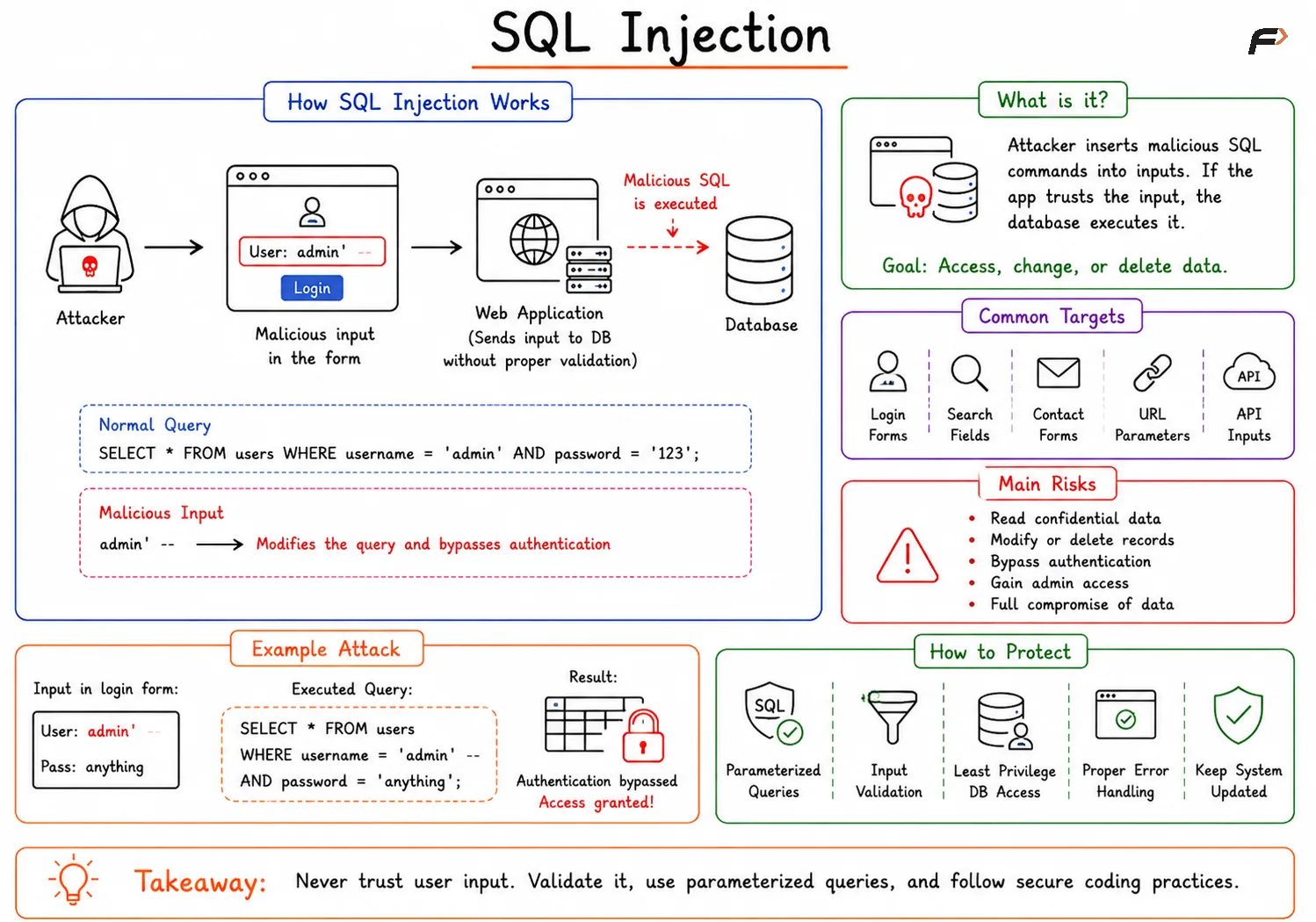
SQL Injection is a web application security threat where an attacker places malicious SQL commands inside inputs such as login forms, search boxes, URL parameters, or API requests. If the application sends this input directly to the database without proper validation or safe query handling, the attacker may be able to access, modify, or delete sensitive data.
This attack mainly targets the application and database layer, but it becomes important in network security because web applications are exposed through the network. A successful SQL injection can lead to data theft, account takeover, unauthorized admin access, or complete compromise of application records.
Common target: Login forms, search fields, contact forms, URL parameters, and API inputs.
Main risk: Attackers may read confidential data, change records, delete data, or bypass authentication.
Simple protection: Use parameterized queries, input validation, least privilege database access, and proper error handling.
SQL Injection
Common Threats at a Glance
Threat | Main Risk | Security Impact |
|---|---|---|
Malware | Infects systems or steals data | Confidentiality and availability |
Ransomware | Locks files or systems | Availability |
Phishing | Tricks users into giving access | Confidentiality |
Password attacks | Compromise accounts | Confidentiality and integrity |
Man-in-the-middle | Intercepts or changes traffic | Confidentiality and integrity |
DDoS | Overloads services | Availability |
Spoofing | Impersonates trusted entities | Integrity |
SQL Injection | Executes malicious SQL queries to access or manipulate databases | Confidentiality, Integrity, and Availability |
How Networks Defend Against Threats
Network security works best when multiple protections are used together. No single tool can block every attack.
Common defenses include:
Firewalls: Control which traffic is allowed or blocked
Encryption: Protects data while it travels
MFA: Reduces risk from stolen passwords
IDS and IPS: Detect or block suspicious traffic
Network segmentation: Limits how far attackers can move
Patch management: Fixes known vulnerabilities
Backups: Help recover from ransomware or failure
Monitoring and logs: Support detection and investigation
This layered approach is often called defense in depth.
Summary
Common network security threats include malware, ransomware, phishing, password attacks, man-in-the-middle attacks, DDoS attacks, spoofing, misconfigurations, unpatched systems, and insider threats. Each threat can affect confidentiality, integrity, availability, or all three together.
Network security is needed because data constantly moves across shared infrastructure, and every device, service, and connection can become a target. Strong protection comes from layered controls such as encryption, firewalls, access control, patching, monitoring, segmentation, and reliable backups.
Be the first to add a comment.