Introduction
The CIA Triad is one of the most important foundational models in cybersecurity and network security. It explains the three core goals every secure system tries to achieve: keeping data private, keeping data correct, and keeping services accessible.
These three goals are called Confidentiality, Integrity, and Availability. Most security controls, such as encryption, authentication, access control, firewalls, backups, and monitoring, support one or more parts of this triad.
What Is the CIA Triad?
The CIA Triad is a security model used to understand what protection really means in digital systems. It does not focus on one specific tool. Instead, it defines the three outcomes a secure system should provide.
The three parts are:
Confidentiality: Only authorized people or systems should be able to read the data
Integrity: Data should remain accurate and should not be changed without permission
Availability: Systems, services, and data should remain accessible when legitimate users need them
This is why the CIA Triad is often treated as the foundation of information security.
Why the CIA Triad Is Needed
In real networks, data is always moving between users, devices, applications, APIs, databases, and cloud services. Once data moves across shared and exposed infrastructure, different risks appear.
Some common risks are:
Unauthorized reading of data
Tampering with requests or responses
Service disruption or outages
Misuse of systems by attackers
Loss of trust in data or services
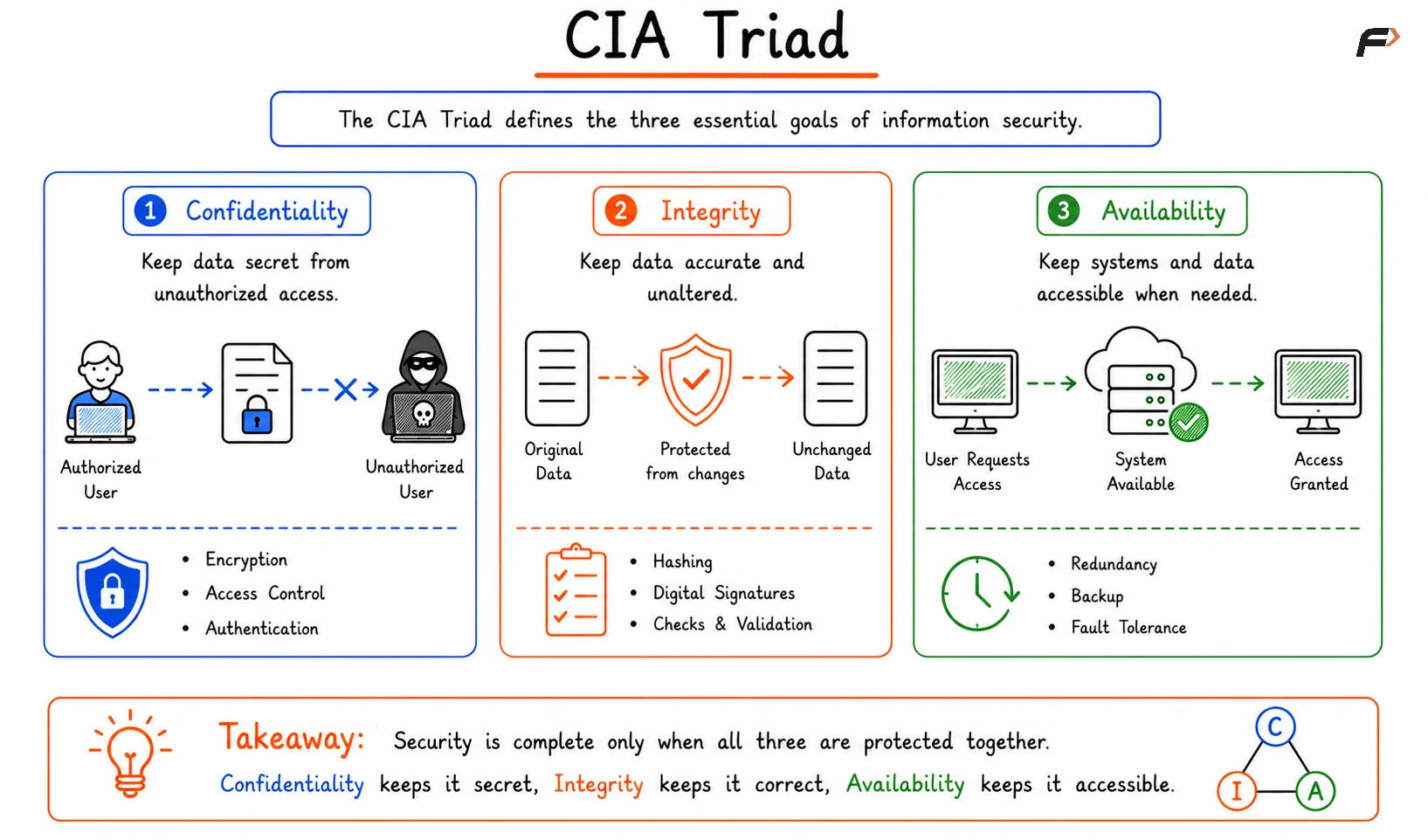
CIA Triad - Confidentiality, Integrity and Availability
Confidentiality
Confidentiality means sensitive information should only be visible to authorized users, systems, or processes. The goal is to prevent data exposure to attackers, unauthorized employees, or any other unwanted party.
This matters for things like:
Passwords and login credentials
Payment card and banking information
Private messages and emails
Internal business data
Authentication tokens and API keys
A simple example is web login. If a password travels over an unprotected connection, someone may read it. If the communication is properly encrypted, confidentiality is much better protected.
How confidentiality is protected
Encryption: Protects data in transit and at rest
Access control: Limits who can view sensitive data
Authentication: Confirms user identity
Least privilege: Gives only necessary access
Secure storage: Prevents accidental public exposure
Integrity
Integrity means data should remain correct, complete, and trustworthy. It should not be modified in an unauthorized way during storage, processing, or transmission.
For example, if a payment request for 1000 is changed to 10000, integrity has been broken. If a server response is modified before it reaches the user, integrity has also been broken.
Integrity matters in areas such as:
Financial transactions
API requests and responses
Software downloads and updates
DNS responses
System logs and audit trails
How integrity is protected
Checksums and hashes: Help detect changes
Message authentication codes: Help verify data authenticity
Digital signatures: Confirm that data was not tampered with
Access restrictions: Limit who can modify important data
Audit logging: Helps trace unauthorized changes
Availability
Availability means systems, data, and services should be usable when legitimate users need them. A system is not truly secure if it is always down, overloaded, or unreachable.
For example, a payment platform, website, API, or DNS service may be protected by strong confidentiality and integrity controls, but if users cannot access it during normal use, availability has failed.
Availability matters for:
Websites and web applications
Payment gateways
Cloud services
APIs and backend systems
DNS and authentication infrastructure
How availability is protected
Redundancy: Backup systems reduce single points of failure
Load balancing: Traffic is distributed across resources
DDoS protection: Helps defend against service flooding
Backups and disaster recovery: Support restoration after failure
Monitoring and alerting: Help detect problems early
How the Three Work Together
The three parts of the CIA Triad are connected. Real security does not come from focusing on only one of them.
Principle | Main Goal | Example Failure |
|---|---|---|
Confidentiality | Prevent unauthorized reading | Passwords exposed in plaintext |
Integrity | Prevent unauthorized modification | Payment amount changed in transit |
Availability | Keep systems accessible | Website unavailable during heavy traffic |
A system can fail even if only one of these breaks.
Strong confidentiality without availability means the system is protected but unusable
Strong availability without integrity means users may access wrong or tampered data
Strong integrity without confidentiality means correct data may still be exposed
That is why secure design always tries to balance all three.
Summary
The CIA Triad is the foundational model of information security and consists of confidentiality, integrity, and availability. Confidentiality protects data from unauthorized viewing, integrity protects it from unauthorized modification, and availability ensures that systems and services remain accessible when needed.
This model is important because modern systems are always handling data across shared and exposed networks. Whether the risk is data theft, tampering, or service disruption, the CIA Triad provides the clearest way to understand what security must protect.
Be the first to add a comment.