Introduction
The AAA Framework is a core security model used to control access in networks, applications, and enterprise systems. While the CIA Triad explains what security must protect, AAA explains how access should be verified, controlled, and recorded.
AAA stands for Authentication, Authorization, and Accounting. Together, these three steps help ensure that only legitimate users enter a system, they access only what they are allowed to use, and their important actions are logged.
What Is the AAA Framework?
The AAA Framework is an access control model used to manage identity, permissions, and activity tracking.
It answers three basic questions:
Authentication: Who are you?
Authorization: What are you allowed to do?
Accounting: What did you do?
This model is widely used in network security, VPNs, Wi-Fi access, cloud systems, admin panels, APIs, and enterprise infrastructure.
Why AAA Is Important
Security is not only about protecting data with encryption or firewalls. A system also needs to know who is accessing it, what they can access, and what actions they perform after access is granted.
AAA helps organizations:
Verify identity: Only valid users, devices, or services should enter
Enforce permissions: Users should access only what their role allows
Track activity: Important actions should be recorded for audit and investigation
Reduce misuse: Overly broad access can be limited through proper authorization
Support compliance: Logs and access records help meet security requirements
Without AAA, a system may allow unauthorized access, excessive privileges, or untraceable actions.
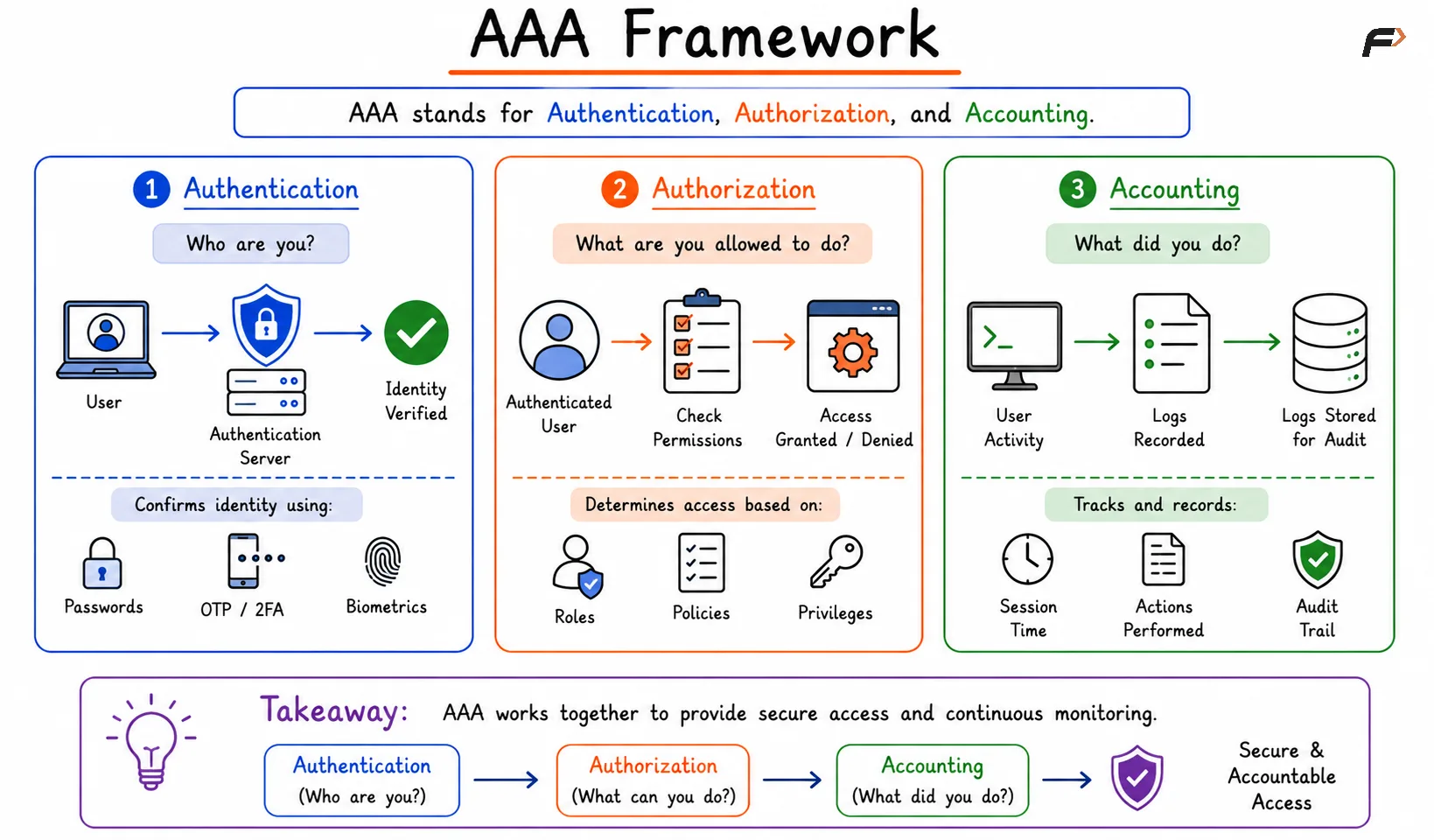
AAA Framework - Authentication, Authorization and Accounting
Authentication
Authentication is the first step in the AAA Framework. It verifies the identity of a user, device, or service before allowing access.
Common authentication methods include:
Username and password: The most common identity check
OTP or MFA: Adds an extra verification step
Biometrics: Uses fingerprint, face ID, or similar identity proof
API keys: Used by applications and services
SSH keys: Common for secure server access
Client certificates: Used in certificate-based authentication and mTLS
Authentication does not decide what a user can do. It only confirms whether the user or system is genuine.
Authorization
Authorization happens after authentication. Once identity is verified, authorization decides what actions and resources that identity is allowed to access.
For example, a normal user may be able to view purchased content, while an admin may be allowed to upload content, manage users, and change platform settings.
Authorization is usually based on security policies such as:
RBAC: Role-Based Access Control assigns permissions based on roles like user, admin, or manager
ABAC: Attribute-Based Access Control uses attributes such as department, device type, location, or time
ACL: Access Control Lists define which users or groups can access specific resources
The goal of authorization is to enforce least privilege, where every user or service receives only the access needed to do its job.
Accounting
Accounting records what users, devices, or services do after access is granted. It provides visibility, traceability, and accountability.
Accounting logs may include:
Login and logout history: Tracks when users access the system
VPN records: Shows remote access sessions
API request logs: Records service or user activity
Admin action logs: Tracks sensitive administrative changes
Firewall and network logs: Records allowed, denied, or suspicious traffic
Database audit logs: Helps trace access to sensitive data
Accounting becomes especially important during security incidents. If something goes wrong, logs help answer who accessed the system, what action was performed, when it happened, and where the request came from.
AAA in Real Networks
AAA is commonly used in enterprise networking and identity systems. Network devices, VPN gateways, Wi-Fi controllers, servers, and applications often rely on centralized AAA services.
Common AAA-related protocols include:
RADIUS: Commonly used for VPNs, Wi-Fi authentication, and network access
TACACS+: Often used for administrative access to routers, switches, and security devices
Diameter: A newer AAA protocol used in some telecom and large-scale network environments
These protocols help centralize access control instead of managing credentials separately on every device.
Summary
The AAA Framework is a security model based on authentication, authorization, and accounting. Authentication verifies identity, authorization controls what the verified user can do, and accounting records actions for monitoring, auditing, and investigation.
AAA is important because secure systems need more than data protection. They need controlled access, clear permissions, and reliable activity records. This makes AAA a foundational concept in network security, enterprise access control, VPN systems, Wi-Fi security, cloud platforms, and modern application security.
Be the first to add a comment.