Two integer arrays, weights and values, describe the weight and value of every available item type. A knapsack has a maximum carrying capacity named capacity.
Choose any non-negative number of copies from every item type. Return the maximum total value possible without making the total weight exceed capacity.
Example 1
Input: weights = [2, 4, 6], values = [5, 11, 13], capacity = 10
Output: 27
Explanation: Two copies of the weight-4 item and one copy of the weight-2 item use the full capacity. The total value equals 11 + 11 + 5 = 27.
Example 2
Input: weights = [4, 17], values = [6, 12], capacity = 3
Output: 0
Explanation: No item fits inside the knapsack, so the empty selection gives the maximum value 0.
Recursion
Every item creates two choices: skip the current item or take it. Skipping removes the current item type from further consideration, while taking earns its value and reduces the remaining capacity. Since the supply is unlimited, the same item type remains available after taking it.
The state solve(index, remainingCapacity) represents the maximum value obtainable using item types 0 through index. The initial call uses the last item and full capacity because all item types are available at the start.
Algorithm
Define
solve(index, remainingCapacity)as the maximum value obtainable from item types0throughindex, so each recursive call captures the complete decision state.Handle
index == 0by taking as many copies of the first item as the remaining capacity allows, because no other item type is available.Explore
solve(index - 1, remainingCapacity)to skip the current item, leaving the full capacity for earlier item types.Initialize the take value with a very small sentinel so an overweight item cannot become the best choice.
Explore the take branch with the same
indexafter subtractingweights[index], because unlimited supply allows another copy of the current item.Add
values[index]to the take result because one copy of the current item contributes its value.Return the larger of the take and skip results because the better valid choice gives the maximum value for the current state.
Dry Run
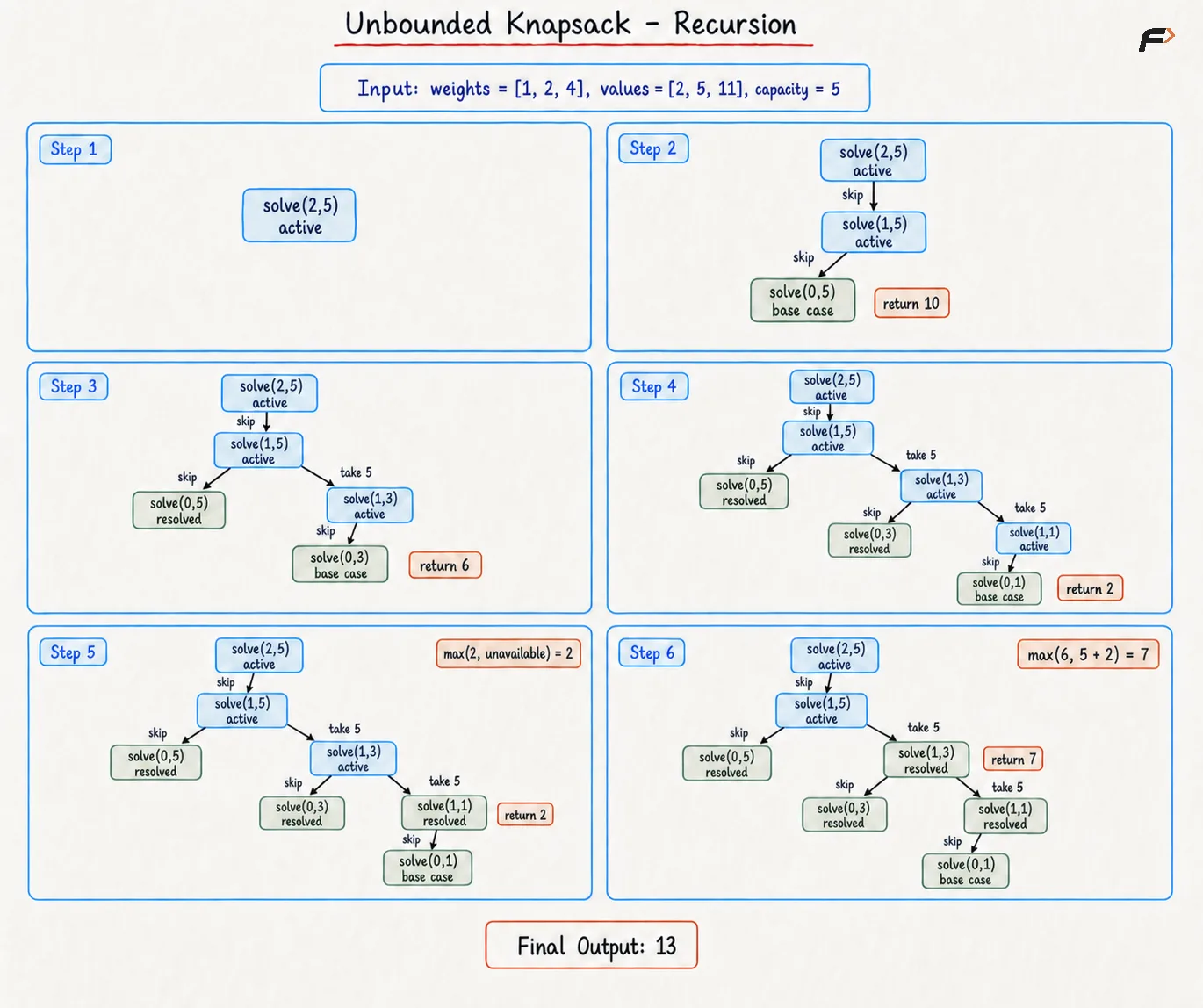
Diagram 1
Solution
#include <bits/stdc++.h>using namespace std;class Solution {private: // Finds the best value for one recursive state. int solve( int index, int capacity, vector<int>& weights, vector<int>& values ) { // The first item can fill all usable capacity. if (index == 0) { int copies = capacity / weights[0]; return copies * values[0]; } // Skipping exposes only earlier item types. int notTake = solve( index - 1, capacity, weights, values ); // The sentinel rejects an unavailable take choice. int take = -1000000000; // A fitting item leaves a valid smaller capacity. if (weights[index] <= capacity) { // The same index permits another item copy. int remainingValue = solve( index, capacity - weights[index], weights, values ); // The current copy adds value to the remainder. take = values[index] + remainingValue; } // The better valid choice maximizes the state value. return max(notTake, take); }public: // Returns the maximum value within the capacity. int unboundedKnapsack( vector<int>& weights, vector<int>& values, int capacity ) { int n = weights.size(); // The last index exposes every available item type. return solve(n - 1, capacity, weights, values); }};// Driver codeint main() { vector<int> weights = {2, 4, 6}; vector<int> values = {5, 11, 13}; int capacity = 10; Solution obj; cout << obj.unboundedKnapsack(weights, values, capacity); return 0;}Complexity Analysis
Time Complexity: O(2D), where D = N + ⌊capacity / minWeight⌋ is the maximum recursion depth, because each recursive state can branch into take and skip choices.
Space Complexity: O(D), because the deepest active recursion path can contain at most D stack frames.
Memoization
Direct recursion can reach the same (index, remainingCapacity) state through different decision paths. Since the same state always produces the same maximum revenue, recalculating its entire subtree only repeats work.
Memoization keeps the same recursive decisions and adds a two-dimensional dp table. Each calculated state is stored using its item index and remaining capacity, allowing future calls to return the saved answer immediately. The take and skip choices remain unchanged.
Algorithm
Create a
dptable withNrows andcapacity + 1columns, filled with-1, so every uncalculated state has a clear marker.Keep the first-item base case unchanged because unlimited copies of the first item can still fill the remaining capacity.
Return
dp[index][remainingCapacity]on a cache hit because the same state always has the same maximum revenue.Evaluate the skip branch with
index - 1because the current item is excluded and only earlier item types remain available.Evaluate the take branch at the same index after checking that the item fits, because unlimited supply allows another copy of the current item.
Store the maximum of the take and skip results in
dp[index][remainingCapacity]so the completed state can be reused.Start from the last item and full capacity because the initial state must consider every available item type.
Dry Run
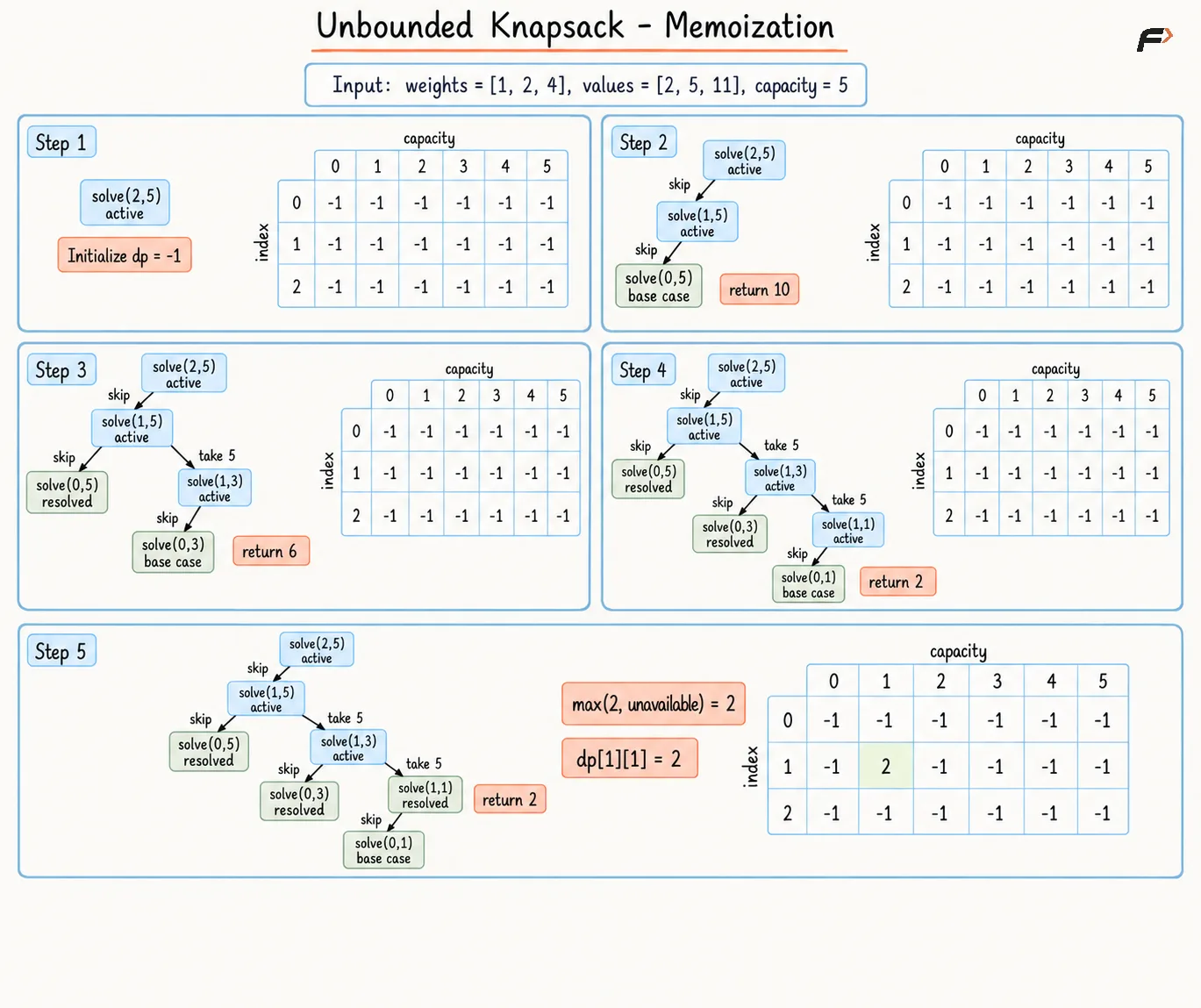
Diagram 1
Solution
#include <bits/stdc++.h>using namespace std;class Solution {private: // Finds and stores one item-capacity state. int solve( int index, int capacity, vector<int>& weights, vector<int>& values, vector<vector<int>>& dp ) { // The first item can fill all usable capacity. if (index == 0) { int copies = capacity / weights[0]; return copies * values[0]; } // A saved state avoids repeated recursive work. if (dp[index][capacity] != -1) { return dp[index][capacity]; } // Skipping exposes only earlier item types. int notTake = solve( index - 1, capacity, weights, values, dp ); // The sentinel rejects an unavailable take choice. int take = -1000000000; // A fitting item leaves a valid smaller capacity. if (weights[index] <= capacity) { // The same index permits another item copy. int remainingValue = solve( index, capacity - weights[index], weights, values, dp ); // The current copy adds value to the remainder. take = values[index] + remainingValue; } // Saving the maximum prevents later recalculation. dp[index][capacity] = max(notTake, take); return dp[index][capacity]; }public: // Returns the maximum value within the capacity. int unboundedKnapsack( vector<int>& weights, vector<int>& values, int capacity ) { int n = weights.size(); // Negative markers identify uncalculated states. vector<vector<int>> dp( n, vector<int>(capacity + 1, -1) ); // The last index exposes every available item type. return solve(n - 1, capacity, weights, values, dp); }};// Driver codeint main() { vector<int> weights = {2, 4, 6}; vector<int> values = {5, 11, 13}; int capacity = 10; Solution obj; cout << obj.unboundedKnapsack(weights, values, capacity); return 0;}Complexity Analysis
Time Complexity: O(N × capacity), where N is the number of piece lengths, because at most N × (capacity + 1) states are calculated once with constant work per state.
Space Complexity: O(N × capacity + D), where D = N + ⌊capacity / minWeight⌋ is the maximum recursion depth, accounting for the dp table and recursion stack.
Tabulation
Memoization proves every answer depends on smaller item-capacity states. Tabulation computes the same states in a fixed order, removing recursive calls and the recursion stack.
The first row records values obtainable from unlimited copies of item 0. Later rows use the previous row for skipping and the current row at a smaller capacity for taking. Increasing capacity order makes every same-row take dependency ready before use.
Algorithm
Create a
dptable withnrows andcapacity + 1columns, because each cell represents the original(index, remainingCapacity)state.Fill row
0with as many first-item copies as each capacity permits because every later skip transition needs a complete recursive base.Process item indices from
1throughn - 1, so the previous row already contains every skip answer.Scan capacities from
0throughcapacity, because a take reads a smaller capacity from the current row.Read
dp[index - 1][currentCapacity]as the skip value, preserving the answer formed without the current item.Read
values[index] + dp[index][currentCapacity - weights[index]]after a fit check, allowing repeated current-item copies through the same row.Store the larger choice in
dp[index][currentCapacity]so later states can reuse the optimum, then return the full-capacity cell from the last row.
Dry Run
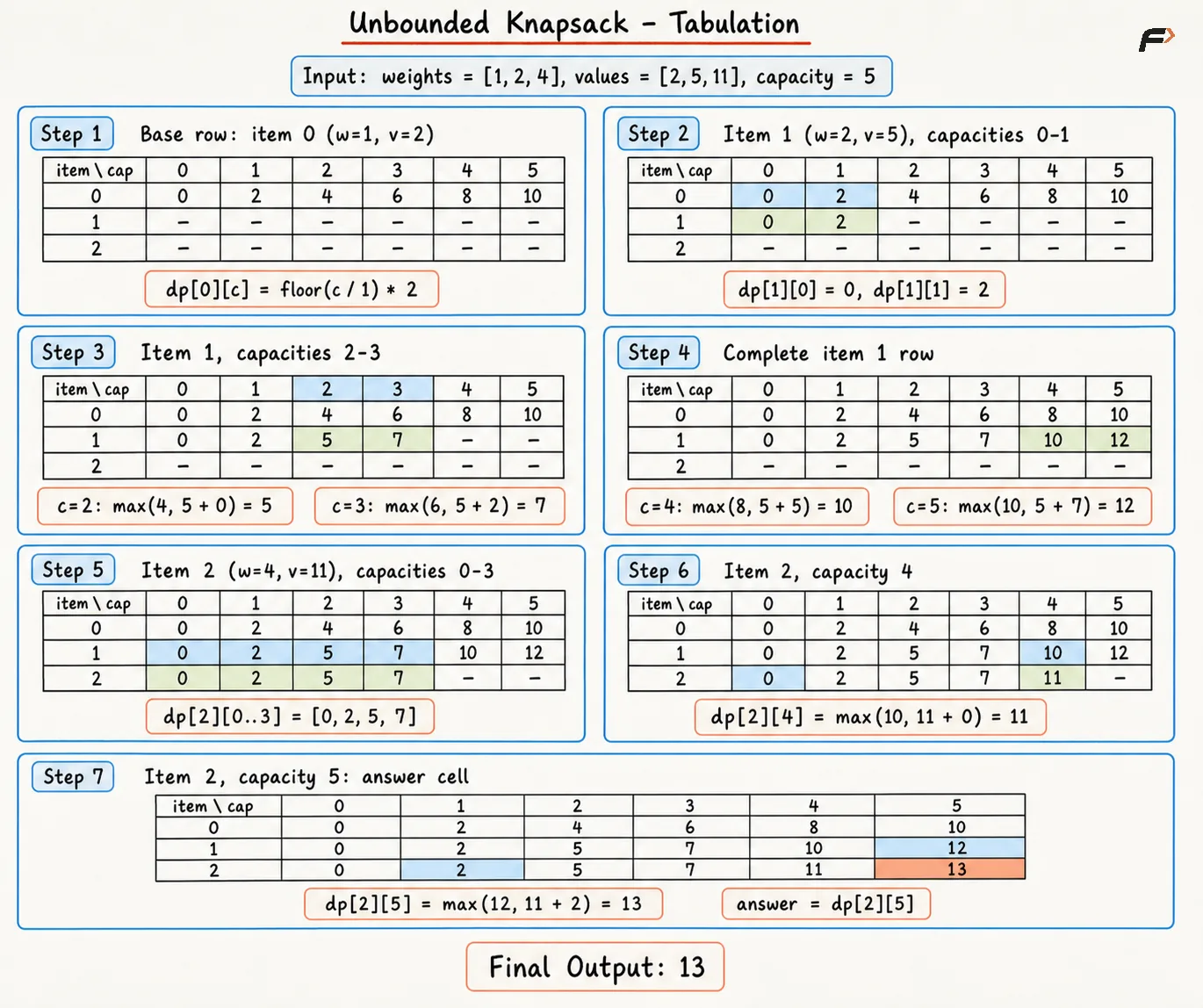
Unbounded Knapsack Tabulation
Solution
#include <bits/stdc++.h>using namespace std;class Solution {public: // Returns the maximum value within the capacity. int unboundedKnapsack( vector<int>& weights, vector<int>& values, int capacity ) { int n = weights.size(); // Each cell stores one item-capacity answer. vector<vector<int>> dp( n, vector<int>(capacity + 1, 0) ); // The first row uses unlimited first-item copies. for (int currentCapacity = 0; currentCapacity <= capacity; currentCapacity++) { int copies = currentCapacity / weights[0]; dp[0][currentCapacity] = copies * values[0]; } // Each later row introduces one more item type. for (int index = 1; index < n; index++) { // Ascending capacity enables same-row reuse. for (int currentCapacity = 0; currentCapacity <= capacity; currentCapacity++) { // The previous row represents skipping. int notTake = dp[index - 1][currentCapacity]; // The sentinel rejects an unavailable take. int take = -1000000000; // A fitting item reads a smaller same-row state. if (weights[index] <= currentCapacity) { int remainingValue = dp[ index ][currentCapacity - weights[index]]; // The current copy adds to the remainder. take = values[index] + remainingValue; } // The larger choice completes the current state. dp[index][currentCapacity] = max( notTake, take ); } } // The final cell represents the complete problem. return dp[n - 1][capacity]; }};// Driver codeint main() { vector<int> weights = {2, 4, 6}; vector<int> values = {5, 11, 13}; int capacity = 10; Solution obj; cout << obj.unboundedKnapsack(weights, values, capacity); return 0;}Complexity Analysis
Time Complexity: O(N × capacity), where N is the number of piece lengths, because the N × (capacity + 1) table states each perform constant work.
Space Complexity: O(N × capacity), because the iterative dp table stores one answer for every piece-length and capacity pair, with no recursion stack.
Space Optimization
The tabulation transition needs a previous-row skip value and a current-row value at a smaller capacity. A single dp array can hold both pieces of information during an ascending capacity scan.
Before each update, dp[currentCapacity] still stores the previous-row skip value. A smaller array position already stores the current-row take remainder. Calculating current before replacing dp[currentCapacity] preserves both choices in the required order.
Algorithm
Create a one-dimensional
dparray of sizecapacity + 1, because only one value per capacity remains necessary during a row update.Fill
dpwith unlimited copies of item0, preserving the tabulation base row before later item types are introduced.Process item indices from
1throughn - 1, so each pass transforms the previous logical row into the current logical row.Scan capacities in increasing order, allowing
dp[currentCapacity - weights[index]]to contain the updated current-row remainder.Read
dp[currentCapacity]before replacement as the skip value, because the old entry still represents the previous row.Calculate
currentas the larger skip or valid take value, preserving both choices before any state replacement occurs.Store
currentback intodp[currentCapacity]so the logical row advances safely, then returndp[capacity]as the full-capacity optimum.
Dry Run
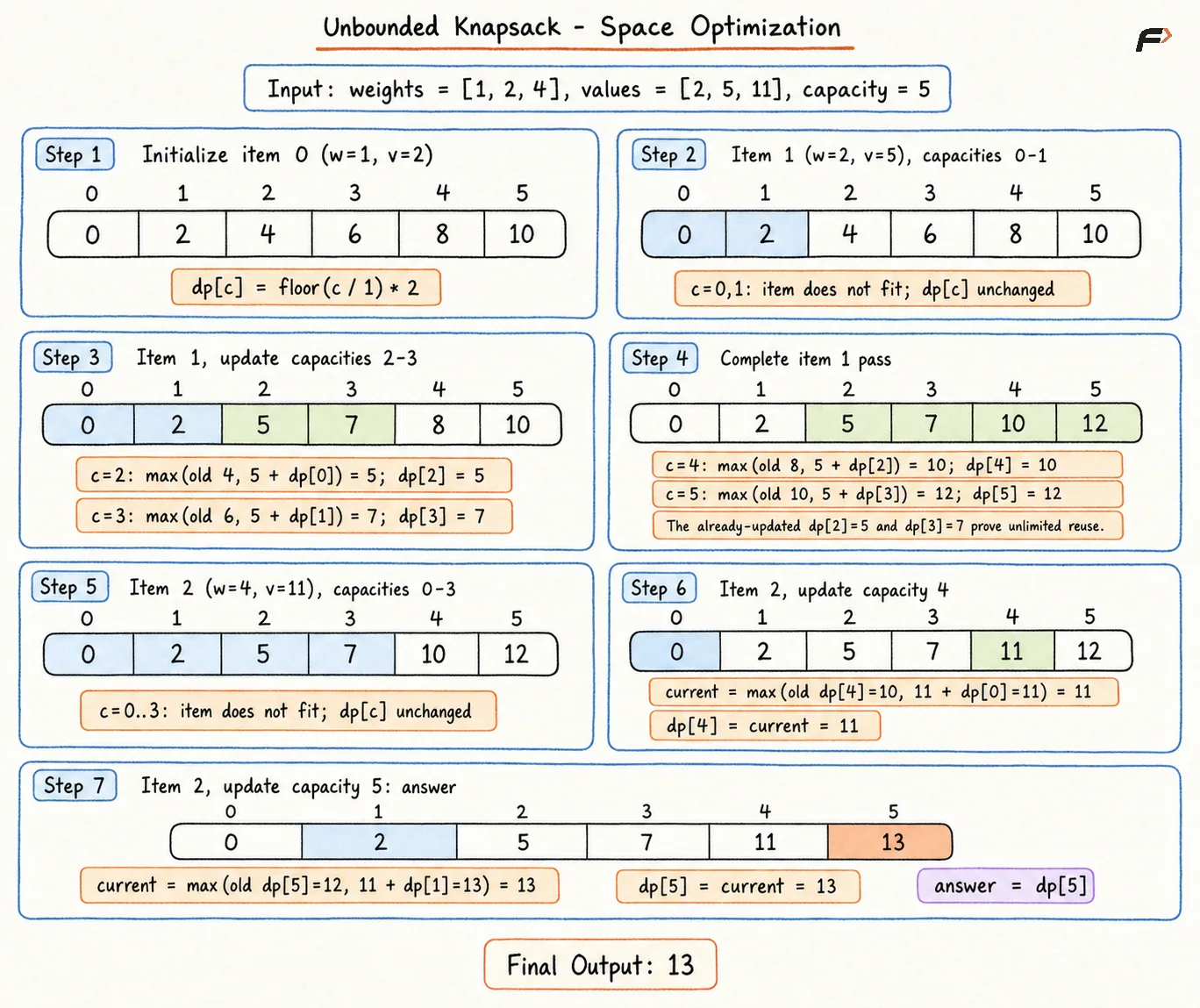
Unbounded Knapsack Space Optimization
Solution
#include <bits/stdc++.h>using namespace std;class Solution {public: // Returns the maximum value within the capacity. int unboundedKnapsack( vector<int>& weights, vector<int>& values, int capacity ) { int n = weights.size(); // One entry stores the best value per capacity. vector<int> dp(capacity + 1, 0); // The initial row uses unlimited first-item copies. for (int currentCapacity = 0; currentCapacity <= capacity; currentCapacity++) { int copies = currentCapacity / weights[0]; dp[currentCapacity] = copies * values[0]; } // Each pass replaces one logical table row. for (int index = 1; index < n; index++) { // Ascending capacity enables current-item reuse. for (int currentCapacity = 0; currentCapacity <= capacity; currentCapacity++) { // The old entry preserves the skip value. int notTake = dp[currentCapacity]; // The sentinel rejects an unavailable take. int take = -1000000000; // A fitting item reads an updated remainder. if (weights[index] <= currentCapacity) { int remainingValue = dp[ currentCapacity - weights[index] ]; // The current copy adds to the remainder. take = values[index] + remainingValue; } // Current combines choices before replacement. int current = max(notTake, take); // The state shift advances the logical row. dp[currentCapacity] = current; } } // Full capacity stores the complete answer. return dp[capacity]; }};// Driver codeint main() { vector<int> weights = {2, 4, 6}; vector<int> values = {5, 11, 13}; int capacity = 10; Solution obj; cout << obj.unboundedKnapsack(weights, values, capacity); return 0;}Complexity Analysis
Time Complexity: O(N × capacity), where N is the number of piece lengths, because each piece length processes every capacity once with constant work per state.
Space Complexity: O(capacity), because a single dp array stores the best value for each capacity, with previous logical rows overwritten.
Interview follow-up Questions
Unbounded Knapsack permits unlimited copies of every item type. The 0/1 variant permits at most one copy of every item.
Be the first to add a comment.