Given an integer k and an array prices, prices[day] stores the stock price on a particular day. At most k transactions may be completed.
One transaction contains one buy followed by one sell. A second stock cannot be bought before the current stock has been sold. Return the maximum possible profit, with zero profit allowed.
Example 1
Input: k = 2, prices = [5, 2, 4, 0, 3, 7]
Output: 9
Explanation: Buying at 2 and selling at 4 earns 2. Buying at 0 and selling at 7 earns 7, producing total profit 9.
Example 2
Input: k = 3, prices = [8, 6, 4, 2]
Output: 0
Explanation: Every later price is smaller, so skipping all transactions preserves profit 0.
Recursion
Each day presents a choice based on the current trading state. When buying is allowed, we can either buy the stock at the current price or skip the day. When already holding a stock, we can either sell it or continue holding. Exploring both choices allows us to find the maximum profit while respecting the transaction limit.
The state solve(day, canBuy, remainingTransactions) stores the maximum profit possible from that decision point onward. The initial call is solve(0, 1, k) because trading starts before Day 0, with no stock held, buying allowed, and all k transactions available.
Algorithm
Start with
solve(0, 1, k)because trading begins before the first day with buying allowed and the full transaction limit available.Stop when
dayreaches the end of the array orremainingTransactionsbecomes0, because no further profitable transaction can be completed.In the buying state, compare buying for
-prices[day]with skipping the day, because either choice may lead to the maximum profit.Keep
remainingTransactionsunchanged after buying because a transaction is completed only when the stock is sold.In the selling state, compare selling for
prices[day]with continuing to hold the stock, because either choice may produce the better profit.Decrease
remainingTransactionsafter selling because the sale completes one buy-sell transaction.Return the larger value from the two choices at each state because we want the maximum valid profit.
Dry Run
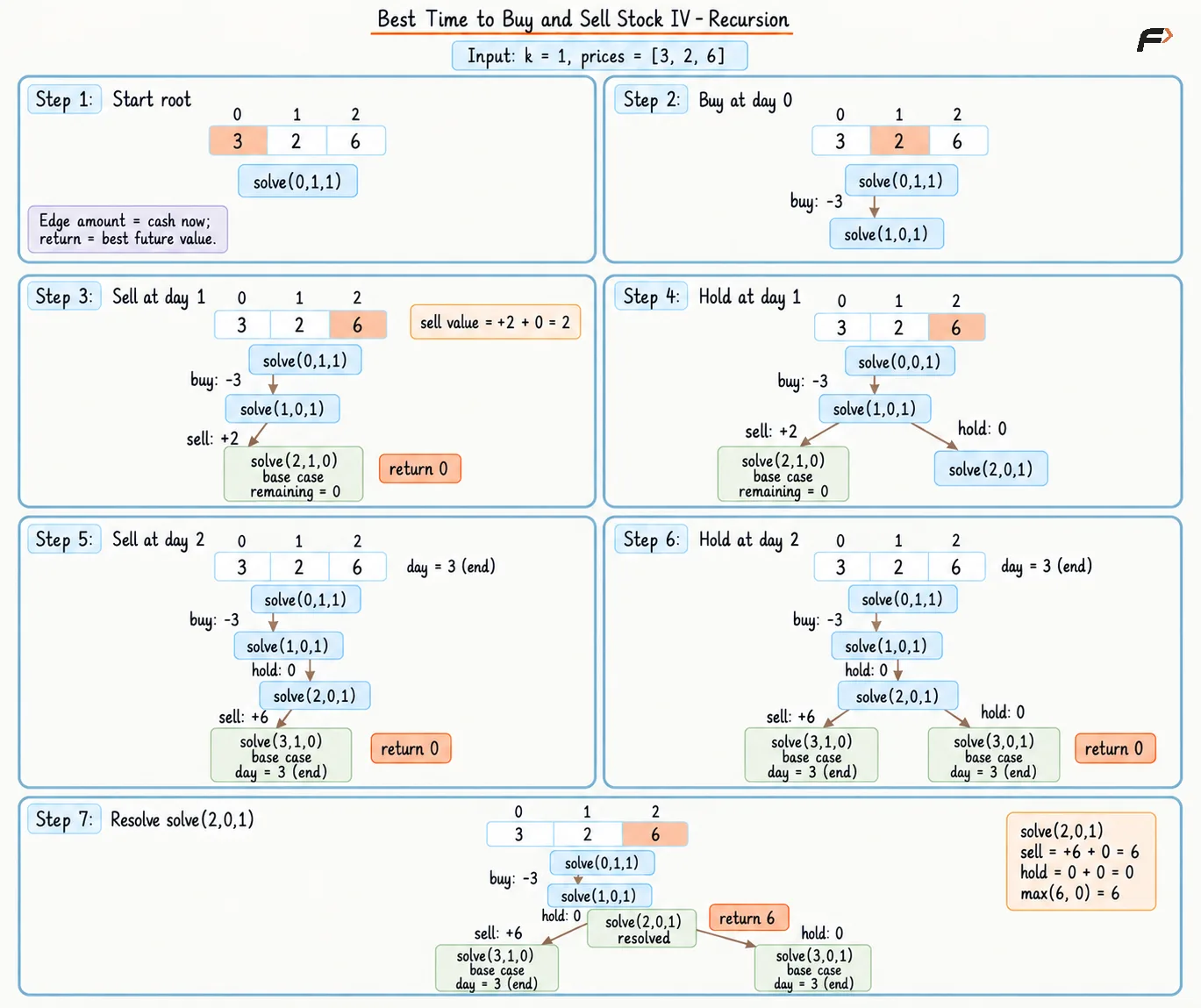
Diagram 1
Solution
#include <bits/stdc++.h>using namespace std;class Solution {private: // Finds the best profit from one trading state. int solve( int day, int canBuy, int remainingTransactions, vector<int>& prices ) { int n = prices.size(); // No completed sale remains beyond either limit. if (day == n || remainingTransactions == 0) { return 0; } // A free state can buy or wait. if (canBuy == 1) { // Buying keeps the sale capacity unchanged. int buyProfit = -prices[day] + solve( day + 1, 0, remainingTransactions, prices ); // Skipping preserves the free state. int skipProfit = solve( day + 1, 1, remainingTransactions, prices ); // The larger branch gives the best free-state profit. return max(buyProfit, skipProfit); } // Selling closes one complete transaction. int sellProfit = prices[day] + solve( day + 1, 1, remainingTransactions - 1, prices ); // Holding preserves the current stock and capacity. int holdProfit = solve( day + 1, 0, remainingTransactions, prices ); // The larger branch gives the best holding-state profit. return max(sellProfit, holdProfit); }public: // Finds the maximum profit with at most k transactions. int maxProfit(int k, vector<int>& prices) { // Trading starts free to buy with full capacity. return solve(0, 1, k, prices); }};// Driver codeint main() { int k = 2; vector<int> prices = {5, 2, 4, 0, 3, 7}; Solution obj; cout << obj.maxProfit(k, prices); return 0;}Complexity Analysis
Time Complexity: O(2N), where N is the number of days, because each day can create two recursive choices across a recursion depth of at most N.
Space Complexity: O(N), because one active recursion path contains at most one call for each day.
Note: Direct recursion may fail for large input values. Repeated subproblems create exponential work, so an online judge may report Time Limit Exceeded.
Memoization
Many recursive paths can reach the same combination of day, buying state, and remaining transactions. Without memoization, the same future choices are recalculated repeatedly, wasting recursive work.
A three-dimensional dp array stores the maximum profit for each reachable state. The recursive decisions remain unchanged, but a previously calculated state can return its saved answer immediately instead of exploring the same recursive tree again.
Algorithm
Begin with
solve(0, 1, k)because memoization preserves the same recursive state and transaction rules.Create
dp[day][canBuy][remainingTransactions]with-1entries, so every uncomputed state is distinguishable from a valid profit of0.Stop when
dayreaches the end of the array orremainingTransactionsbecomes0, because no further completed transaction is possible.Return the existing
dpvalue before exploring branches, so repeated states avoid duplicate recursive work.In a buying state, compare buying with skipping while keeping the remaining transaction count unchanged after a purchase.
In a selling state, compare selling with holding and decrease the remaining count after a sale, because one completed buy-sell pair consumes one transaction.
Store the larger branch value in
dpand return it, so future visits receive the best profit already calculated for that state.
Dry Run
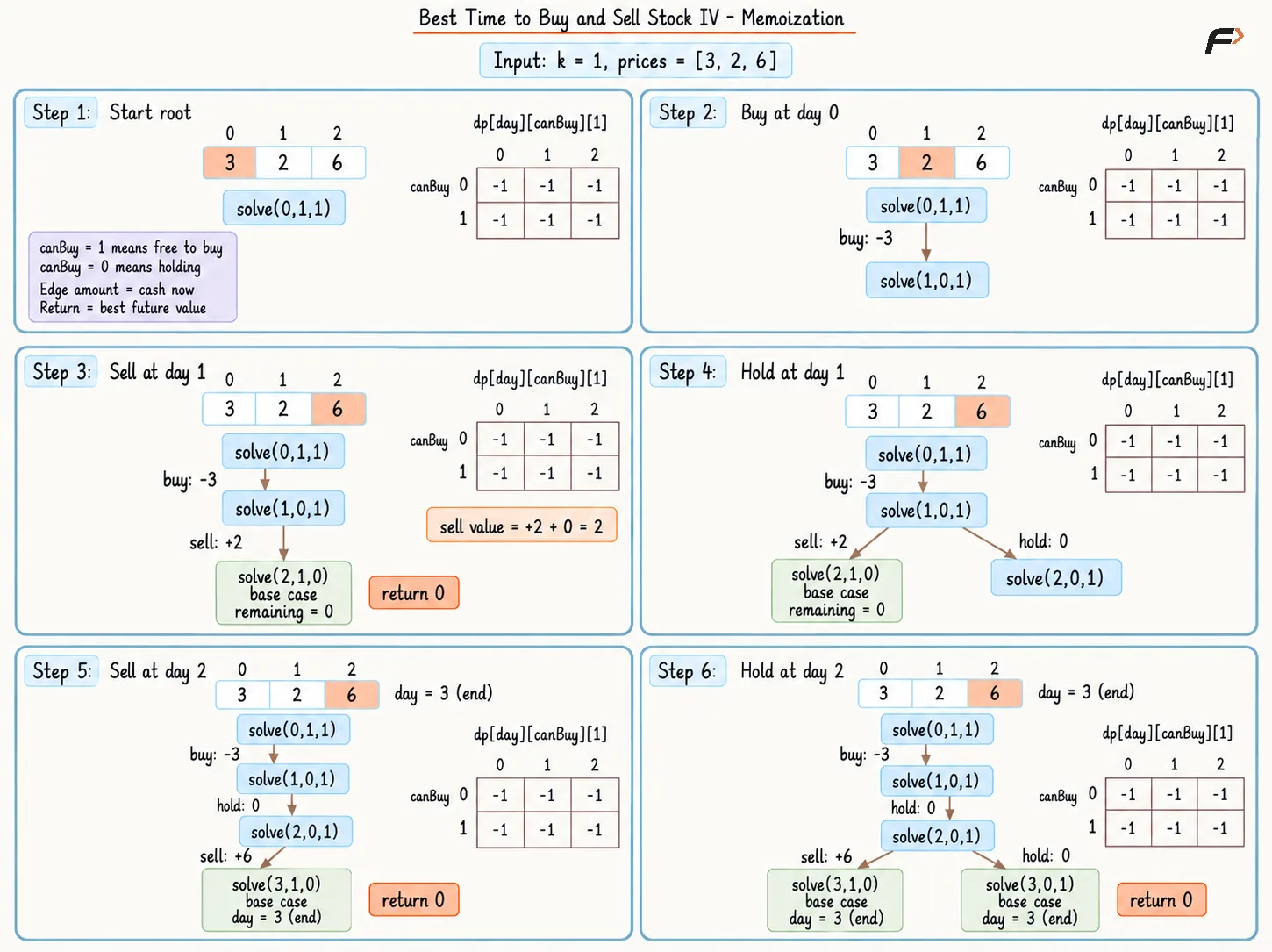
Diagram 1
Solution
#include <bits/stdc++.h>using namespace std;class Solution {private: // Finds and stores the best profit from one state. int solve( int day, int canBuy, int remainingTransactions, vector<int>& prices, vector<vector<vector<int>>>& dp ) { int n = prices.size(); // No completed sale remains beyond either limit. if (day == n || remainingTransactions == 0) { return 0; } // A stored state avoids repeated branch exploration. if (dp[day][canBuy][remainingTransactions] != -1) { return dp[day][canBuy][remainingTransactions]; } // A free state can buy or wait. if (canBuy == 1) { // Buying keeps the sale capacity unchanged. int buyProfit = -prices[day] + solve( day + 1, 0, remainingTransactions, prices, dp ); // Skipping preserves the free state. int skipProfit = solve( day + 1, 1, remainingTransactions, prices, dp ); // Cache the best free-state branch for reuse. dp[day][canBuy][remainingTransactions] = max( buyProfit, skipProfit ); return dp[day][canBuy][remainingTransactions]; } // Selling closes one complete transaction. int sellProfit = prices[day] + solve( day + 1, 1, remainingTransactions - 1, prices, dp ); // Holding preserves the current stock and capacity. int holdProfit = solve( day + 1, 0, remainingTransactions, prices, dp ); // Cache the best holding-state branch for reuse. dp[day][canBuy][remainingTransactions] = max( sellProfit, holdProfit ); return dp[day][canBuy][remainingTransactions]; }public: // Finds the maximum profit with at most k transactions. int maxProfit(int k, vector<int>& prices) { int n = prices.size(); // A negative entry marks an uncalculated state. vector<vector<vector<int>>> dp( n, vector<vector<int>>( 2, vector<int>(k + 1, -1) ) ); // Trading starts free to buy with full capacity. return solve(0, 1, k, prices, dp); }};// Driver codeint main() { int k = 2; vector<int> prices = {5, 2, 4, 0, 3, 7}; Solution obj; cout << obj.maxProfit(k, prices); return 0;}Complexity Analysis
Time Complexity: O(N × K), where N is the number of days and K is the maximum number of transactions, because at most N × 2 × K trading states are evaluated once with constant transition work.
Space Complexity: O(N × K + N), because the dp table stores every trading state, while the recursion stack can contain up to N calls.
Tabulation
Memoization still depends on recursive calls. A bottom-up table can evaluate the same states directly, beginning with the known zero-profit states after the final day.
Every state reads values from the next day, so reverse day order makes all required answers available. The table keeps the same buying flag and remaining transaction count from recursion.
Algorithm
Build
dpwithn + 1day layers, two buying states, andk + 1transaction counts so every recursive state has a matching table cell.Keep the extra final-day layer and every zero-transaction cell at
0because no completed sale can follow either base state.Traverse days from
n - 1down to0because each current transition depends only on already calculated next-day values.Process remaining transaction counts from
1throughkbecause count0must preserve the stopping value.Fill the buying cell from buy and skip choices so the better entry decision is saved without consuming a transaction.
Fill the selling cell from sell and hold choices so only a completed sale reads the smaller remaining count.
Return
dp[0][1][k]because the first day, free buying state, and full capacity represent the complete problem.
Dry Run
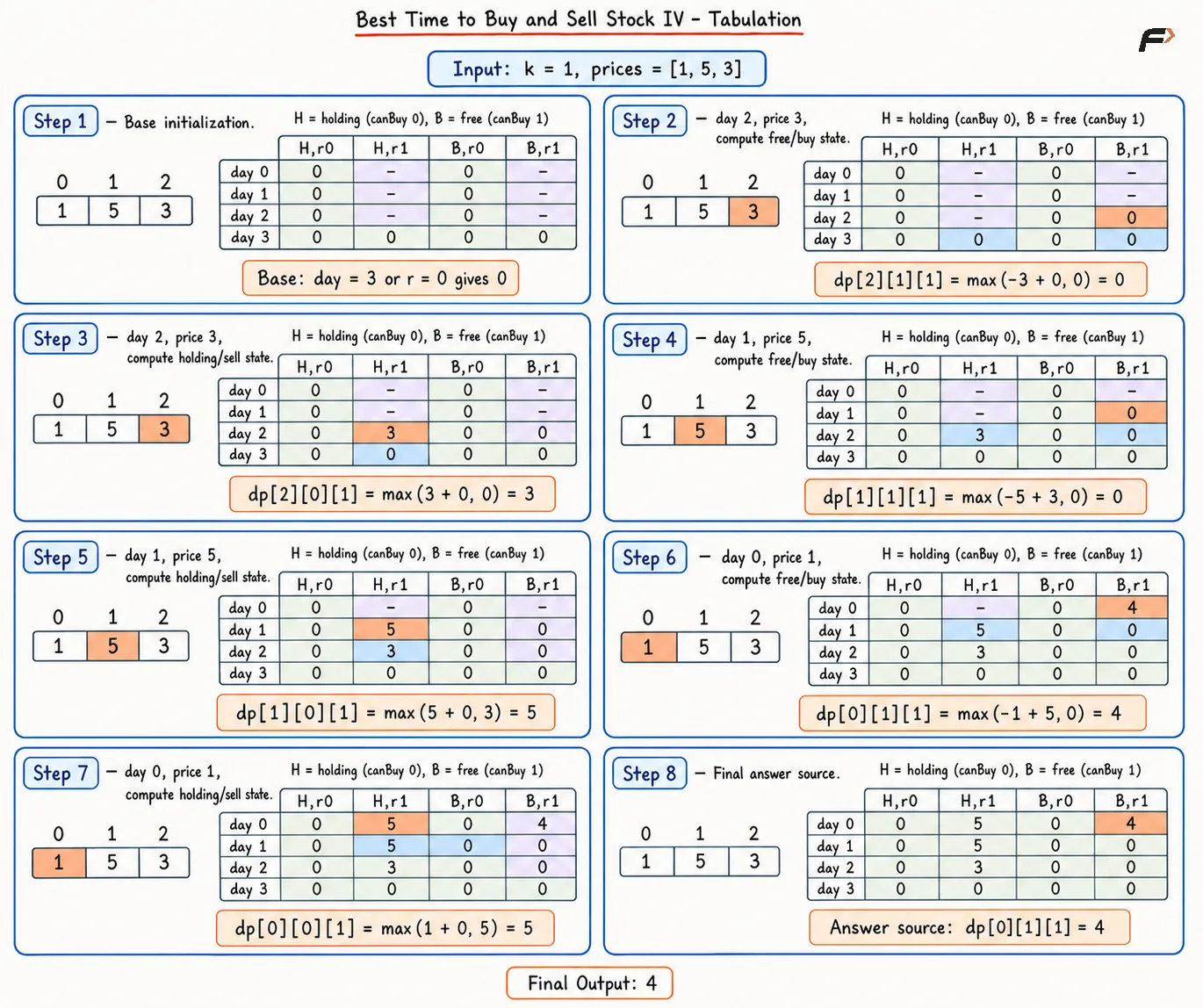
Best Time to Buy and Sell Stock IV Tabulation
Solution
#include <bits/stdc++.h>using namespace std;class Solution {public: // Finds the maximum profit with bottom-up states. int maxProfit(int k, vector<int>& prices) { int n = prices.size(); // Zero values cover both stopping conditions. vector<vector<vector<int>>> dp( n + 1, vector<vector<int>>( 2, vector<int>(k + 1, 0) ) ); // Reverse order prepares every required next-day state. for (int day = n - 1; day >= 0; day--) { // Positive counts allow a complete sale. for ( int remainingTransactions = 1; remainingTransactions <= k; remainingTransactions++ ) { // Buying compares an entry with a skipped day. int buyProfit = -prices[day] + dp[day + 1][0][remainingTransactions]; int skipProfit = dp[day + 1][1][remainingTransactions]; dp[day][1][remainingTransactions] = max( buyProfit, skipProfit ); // Selling closes one complete transaction. int sellProfit = prices[day] + dp[day + 1][1][remainingTransactions - 1]; int holdProfit = dp[day + 1][0][remainingTransactions]; dp[day][0][remainingTransactions] = max( sellProfit, holdProfit ); } } // The starting state contains the complete answer. return dp[0][1][k]; }};// Driver codeint main() { int k = 2; vector<int> prices = {5, 2, 4, 0, 3, 7}; Solution obj; cout << obj.maxProfit(k, prices); return 0;}Complexity Analysis
Time Complexity: O(N × K), where N is the number of days and K is the maximum number of transactions, because the reverse traversal evaluates N × 2 × K states with constant work per state.
Space Complexity: O(N × K), because the three-dimensional dp table stores two buying states for every day and transaction count, and no recursion stack is used.
Space Optimization
Each tabulation layer reads only the next day. Older day layers never appear in a current transition, so the full day dimension carries unnecessary history.
Two small layers are enough. ahead stores the next-day answers, while current receives both choices for the active day. After all transaction counts are finished, current becomes the new ahead layer.
Algorithm
Create
aheadandcurrentwith two buying states andk + 1transaction counts because one day transition needs only the next-day layer.Leave count
0at0in both layers because no completed sale remains after all transaction capacity is used.Traverse days from right to left so
aheadalways represents every next-day state required by the active day.Recreate
currentfor each day so values from an older day cannot leak into the active layer.Calculate buying-state values from
aheadby comparing a purchase against a skip without reducing the transaction count.Calculate selling-state values from
aheadby comparing a sale against a hold and reducing the count only for the sale.Shift
currentintoaheadonly after the full day is complete so every active transition reads a fully calculated future layer.Return
ahead[1][k]after day0becomes the saved layer because the starting state represents the complete trading problem.
Dry Run
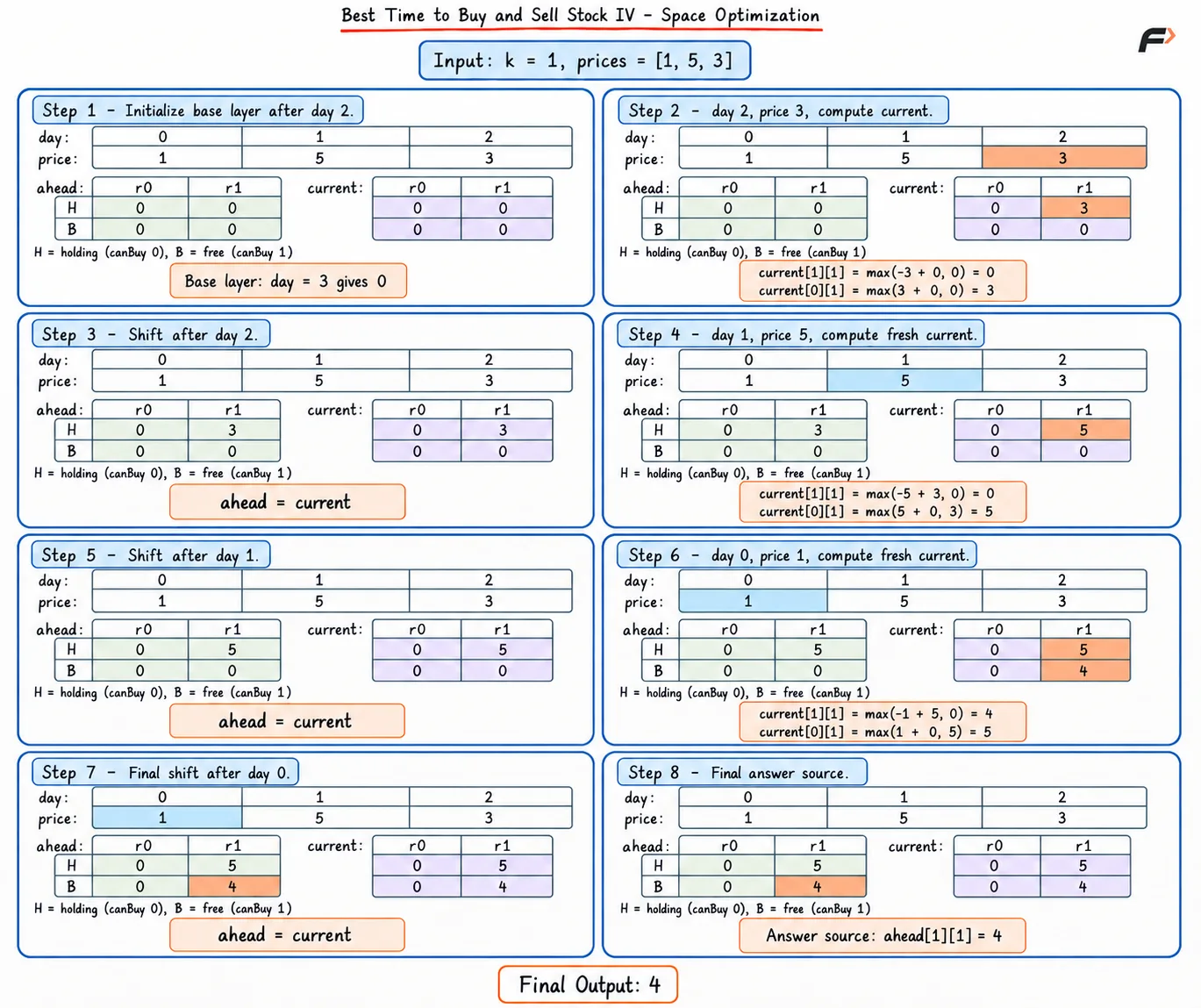
best-time-to-buy-and-sell-stock-iv-space-optimization
Solution
#include <bits/stdc++.h>using namespace std;class Solution {public: // Finds the maximum profit with rolling state layers. int maxProfit(int k, vector<int>& prices) { int n = prices.size(); // The saved layer begins at the final-day base state. vector<vector<int>> ahead( 2, vector<int>(k + 1, 0) ); // Reverse order keeps the next day available. for (int day = n - 1; day >= 0; day--) { // A fresh layer prevents stale current-day values. vector<vector<int>> current( 2, vector<int>(k + 1, 0) ); // Positive counts allow a complete sale. for ( int remainingTransactions = 1; remainingTransactions <= k; remainingTransactions++ ) { // Current buy values use the next-day layer. int buyProfit = -prices[day] + ahead[0][remainingTransactions]; int skipProfit = ahead[1][remainingTransactions]; current[1][remainingTransactions] = max( buyProfit, skipProfit ); // Current sell values use the next-day layer. int sellProfit = prices[day] + ahead[1][remainingTransactions - 1]; int holdProfit = ahead[0][remainingTransactions]; current[0][remainingTransactions] = max( sellProfit, holdProfit ); } // Shift current after every count is complete. ahead = current; } // The saved starting state contains the final answer. return ahead[1][k]; }};// Driver codeint main() { int k = 2; vector<int> prices = {5, 2, 4, 0, 3, 7}; Solution obj; cout << obj.maxProfit(k, prices); return 0;}Complexity Analysis
Time Complexity: O(N × K), where N is the number of days and K is the maximum number of transactions, because each day evaluates both trading states for every transaction count with constant work.
Space Complexity: O(K), because the ahead and current arrays each store two values for every transaction count, and no older day layer is retained.
Interview follow-up Questions
Yes. The limit allows at most k transactions, so every unprofitable trade can be skipped.
Be the first to add a comment.