Given an array arr containing n positive integers and a non-negative integer target, select each array position at most once. Return true if the sum of selected elements equals target; otherwise, return false. The empty subset has a sum of 0.
Example 1
Input: arr = [1, 2, 3, 4], target = 4
Output: true
Explanation: Subset [4] reaches the target. Subset [1, 3] also reaches the target.
Example 2
Input: arr = [2, 4, 6], target = 5
Output: false
Explanation: No subset of the array has a sum equal to 5.
Recursion
Every array value gives us two choices: exclude it from the subset or include it. We explore both choices, and because finding just one valid subset is enough, we combine their results using logical OR.
The state solve(index, remaining) represents whether a subset can be formed using elements from positions 0 through index with a required sum of remaining. The initial call starts at the last index with the complete target because the entire array and target are available. After making a choice, we move to index - 1, ensuring that each array element is considered at most once.
Algorithm
Start with
solve(index, remaining)so the available array prefix and required sum are tracked at every step.Return
truewhenremaining == 0because the selected elements already form the target sum.At
index == 0, comparearr[0]withremainingbecause only the first element is left to consider.Explore
solve(index - 1, remaining)for the choice of excluding the current element.Explore the taken choice only when
arr[index] <= remaining, because positive values cannot be used if they exceed the remaining sum.For a valid taken choice, call
solve(index - 1, remaining - arr[index])because the current value is included exactly once.Return the logical OR of the taken and not-taken results because either successful choice proves that the target sum can be formed.
Dry Run
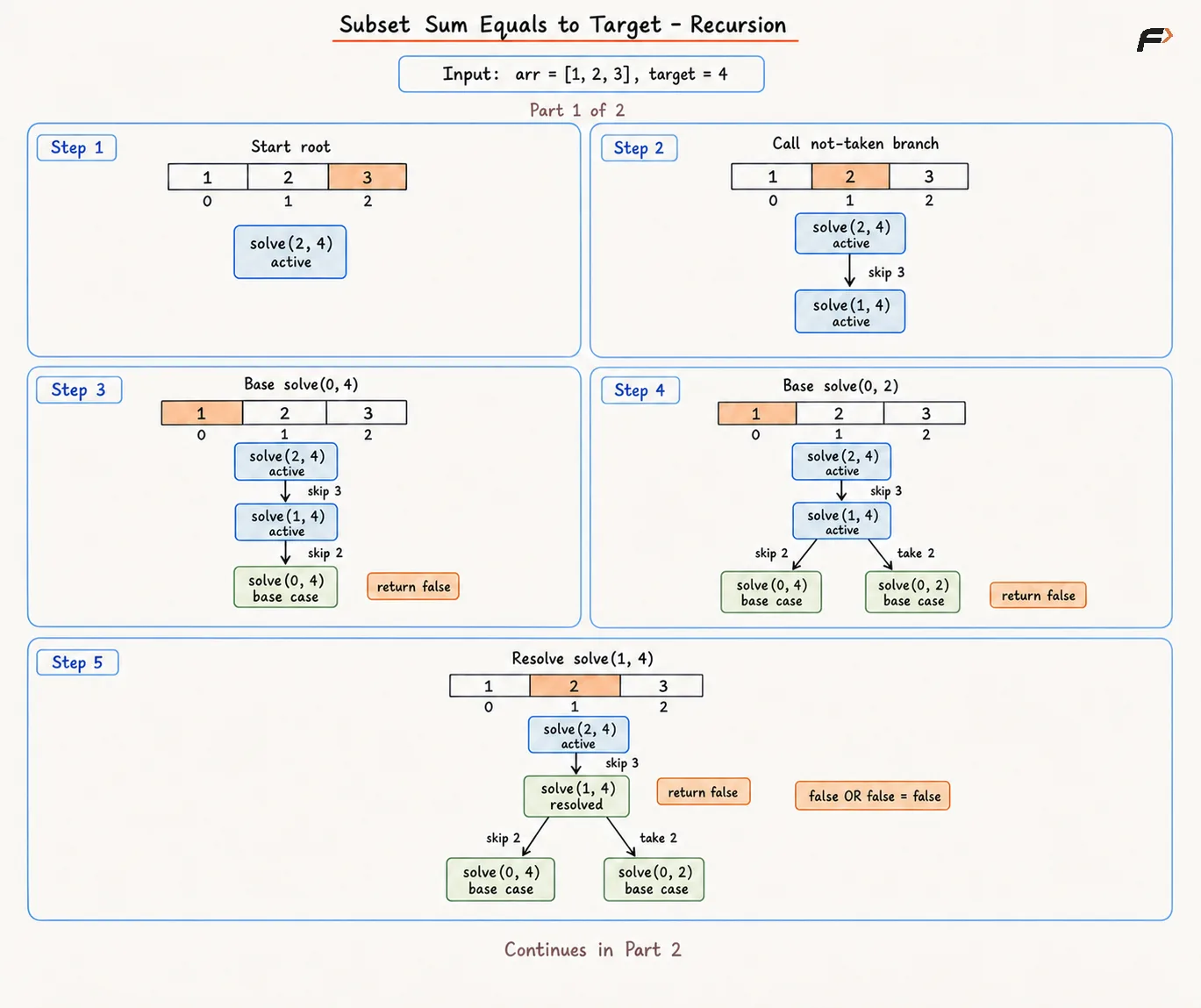
Diagram 1
Solution
#include <bits/stdc++.h>using namespace std;class Solution {private: // Checks subset existence inside one prefix. bool solve(vector<int>& arr, int index, int remaining) { // A zero remainder confirms a valid subset. if (remaining == 0) { return true; } // The first value has one possible match. if (index == 0) { return arr[0] == remaining; } // Skipping keeps the required sum unchanged. bool notTaken = solve(arr, index - 1, remaining); // A taken branch starts unavailable. bool taken = false; // Taking stays valid inside the required sum. if (arr[index] <= remaining) { // Taking removes the selected value once. taken = solve( arr, index - 1, remaining - arr[index] ); } // Either valid choice proves subset existence. return taken || notTaken; }public: // Checks the full array for the target sum. bool subsetSumToTarget(vector<int>& arr, int target) { int n = arr.size(); // The final index exposes every array value. return solve(arr, n - 1, target); }};// Driver codeint main() { vector<int> arr = {1, 2, 3, 4}; int target = 4; Solution obj; cout << boolalpha << obj.subsetSumToTarget(arr, target); return 0;}Complexity Analysis
Time Complexity: O(2N), where N is the number of elements in the array, because each element creates two choices—take or skip—resulting in an exponential number of recursive calls.
Space Complexity: O(N), where N is the number of elements in the array, because the deepest recursive path can contain at most one call for each element.
Memoization
Direct recursion can revisit the same (index, remaining) state through different take-or-skip paths. Repeating an identical state repeats an identical answer.
A 2D array named dp stores every solved state. Value -1 marks an untouched state, while 0 and 1 store false and true results. Cache reuse keeps the recursive idea unchanged and removes duplicate work.
Algorithm
Begin with the same
solve(index, remaining)state so memoization preserves every recursive choice and base case.Create
dpwithnrows andtarget + 1columns, filled with-1, so every unfinished state has a clear marker.Return
trueforremaining = 0, and compare the first value atindex = 0, because both stopping conditions already have final answers.Reuse
dp[index][remaining]after a solved-state check so another path never rebuilds the same recursion tree.Compute the not-taken state with an unchanged sum, then compute the taken state only inside the remaining-sum limit because positive values cannot repair an exceeded sum.
Store the logical OR in
dp[index][remaining]because one successful branch is enough for the current state.Return the cached result from the full state
(n - 1, target)because the state covers every allowed position and the complete target.
Dry Run
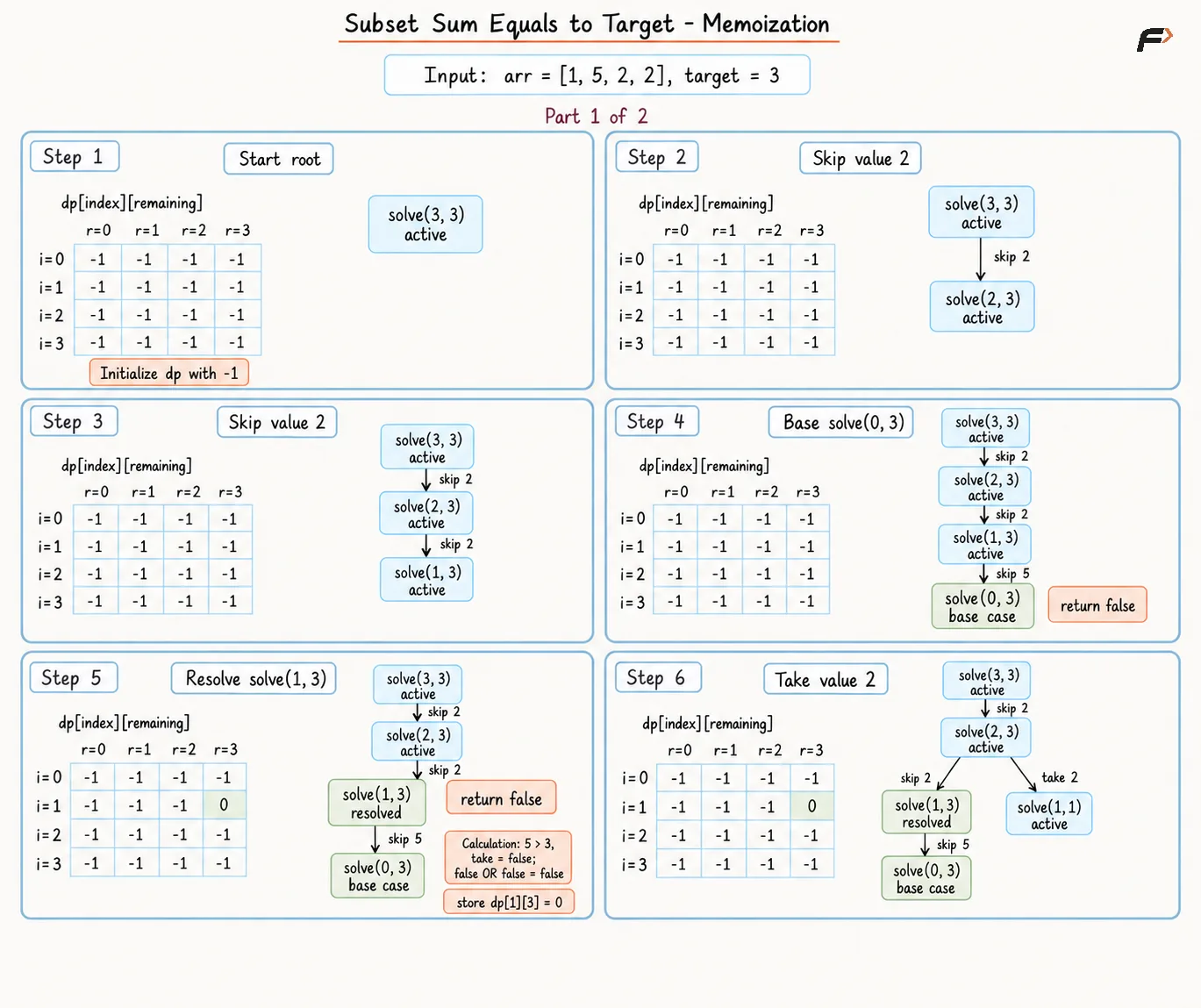
Diagram 1
Solution
#include <bits/stdc++.h>using namespace std;class Solution {private: // Checks and stores one subset-sum state. bool solve( vector<int>& arr, int index, int remaining, vector<vector<int>>& dp ) { // A zero remainder confirms a valid subset. if (remaining == 0) { return true; } // The first value has one possible match. if (index == 0) { return arr[0] == remaining; } // A stored value avoids repeated recursion. if (dp[index][remaining] != -1) { return dp[index][remaining] == 1; } // Skipping keeps the required sum unchanged. bool notTaken = solve( arr, index - 1, remaining, dp ); // A taken branch starts unavailable. bool taken = false; // Taking stays valid inside the required sum. if (arr[index] <= remaining) { // Taking removes the selected value once. taken = solve( arr, index - 1, remaining - arr[index], dp ); } // Cache the OR because either choice can work. dp[index][remaining] = taken || notTaken; // Return the stored answer for the state. return dp[index][remaining] == 1; }public: // Checks the full array with memoization. bool subsetSumToTarget(vector<int>& arr, int target) { int n = arr.size(); // Minus one marks every state as untouched. vector<vector<int>> dp( n, vector<int>(target + 1, -1) ); // The final index exposes every array value. return solve(arr, n - 1, target, dp); }};// Driver codeint main() { vector<int> arr = {1, 2, 3, 4}; int target = 4; Solution obj; cout << boolalpha << obj.subsetSumToTarget(arr, target); return 0;}Complexity Analysis
Time Complexity: O(N × target), where N is the number of elements and target is the target sum, because at most N × (target + 1) states are solved once, with constant work per state.
Space Complexity: O(N × target + N), where N is the number of elements and target is the target sum, because the dp table stores all states and the recursion stack can contain at most O(N) calls.
Tabulation
Memoization answers states on demand. Tabulation fills the same states in a fixed order, so recursive calls and call-stack storage disappear.
Row index uses only row index - 1. Every sum in the earlier row is ready before the next row begins, allowing the take and skip transitions to match the recursive choices directly.
Algorithm
Begin with a boolean table
dpcontainingnrows andtarget + 1columns so every(index, sum)state has a direct stored answer.Mark
dp[index][0] = truefor every row because the empty subset forms sum0from every usable prefix.Mark
dp[0][arr[0]] = trueinside the target limit because the first value alone forms exactly one reachable positive sum.Process rows from index
1ton - 1so every transition reads a fully prepared previous row.Read
dp[index - 1][sum]for the not-taken choice because skipping preserves the unfinished sum.Read
dp[index - 1][sum - arr[index]]only inside the sum limit because the earlier row must represent a non-negative remainder, then combine both choices with logical OR.Return
dp[n - 1][target]because the final cell represents all values and the complete required target.
Dry Run
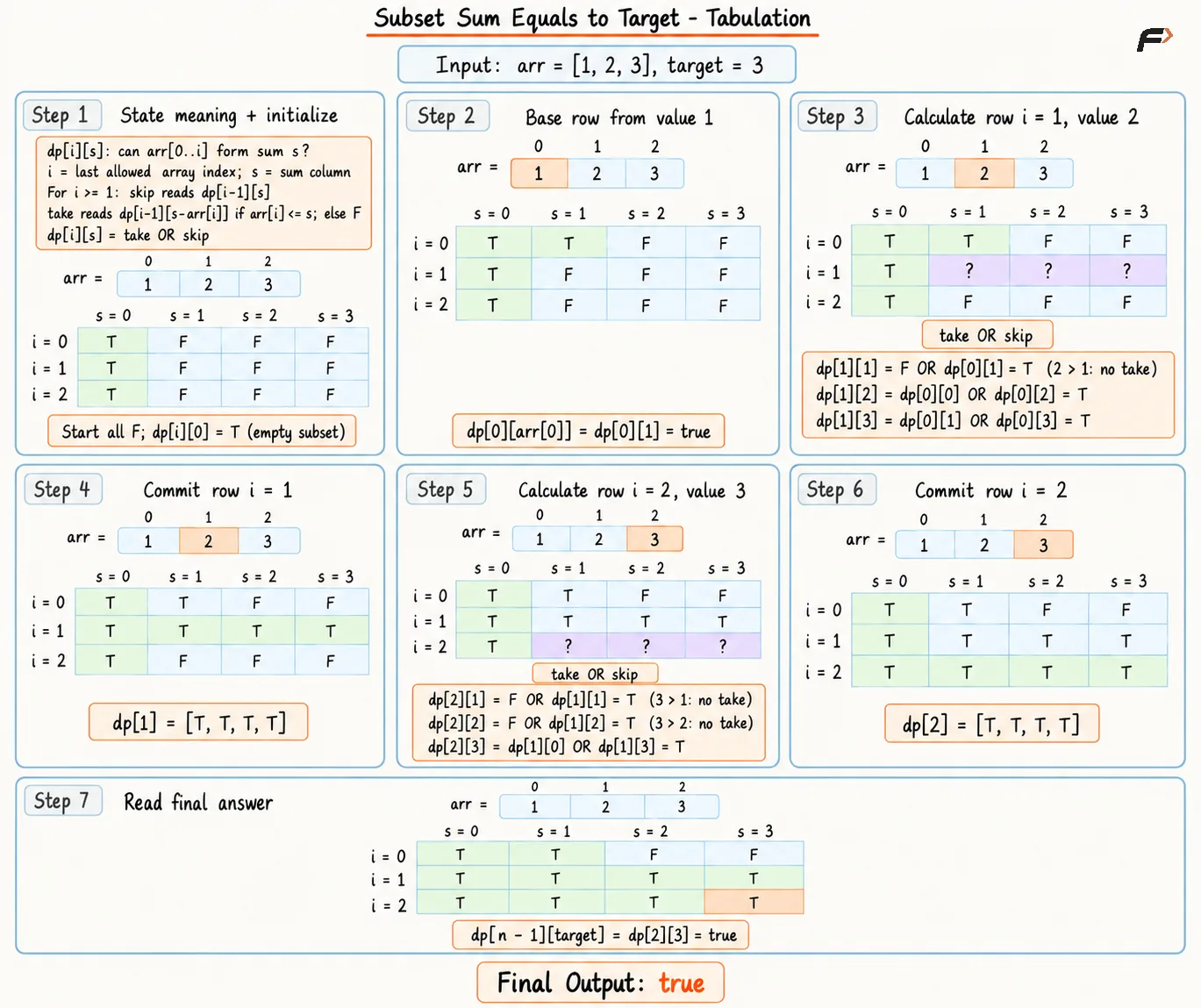
subset-sum-tabulation-state-indices
Solution
#include <bits/stdc++.h>using namespace std;class Solution {public: // Checks subset existence with a DP table. bool subsetSumToTarget(vector<int>& arr, int target) { int n = arr.size(); // Each cell records one reachable sum. vector<vector<bool>> dp( n, vector<bool>(target + 1, false) ); // Sum zero needs no selected values. for (int index = 0; index < n; index++) { dp[index][0] = true; } // The first value forms one positive sum. if (arr[0] <= target) { dp[0][arr[0]] = true; } // Later rows depend on a completed earlier row. for (int index = 1; index < n; index++) { // Every target sum receives two choices. for (int sum = 1; sum <= target; sum++) { // Skipping keeps the required sum unchanged. bool notTaken = dp[index - 1][sum]; // A taken state starts unavailable. bool taken = false; // Taking stays valid inside the current sum. if (arr[index] <= sum) { // The earlier row supplies the remainder. taken = dp[index - 1][sum - arr[index]]; } // Either choice makes the sum reachable. dp[index][sum] = taken || notTaken; } } // The final cell covers the complete problem. return dp[n - 1][target]; }};// Driver codeint main() { vector<int> arr = {1, 2, 3, 4}; int target = 4; Solution obj; cout << boolalpha << obj.subsetSumToTarget(arr, target); return 0;}Complexity Analysis
Time Complexity: O(N × target), where N is the number of elements and target is the target sum, because the table fills N × (target + 1) states, with constant work per state.
Space Complexity: O(N × target), where N is the number of elements and target is the target sum, because the table stores every prefix and target-sum state, with no recursion stack.
Space Optimization
Every tabulation row depends only on the previous row. Older rows are never used again, so the full two-dimensional table is unnecessary. We can replace it with two one-dimensional arrays.
The array previous stores the results for the already processed elements, while current stores the results for the newly processed element. After completing an entire row, current becomes previous. The shift happens only after all sums are calculated, ensuring that every transition uses values from the previous row.
Algorithm
Create a boolean array
previousof sizetarget + 1, so one row can represent whether each sum is reachable.Set
previous[0] = truebecause sum0is always possible using an empty subset.Process each array value one by one, creating a fresh
currentarray so take transitions always read from the unchangedpreviousrow.Set
current[0] = truebecause sum0remains reachable for every prefix.Calculate each
current[sum]usingprevious[sum]for the skip choice andprevious[sum - value]for the take choice, preserving the original tabulation transitions.Replace
previouswithcurrentonly after the entire row is calculated, because the next value needs the completed current row.Return
previous[target]after processing all values, because it represents the reachable sums using the complete array.
Dry Run
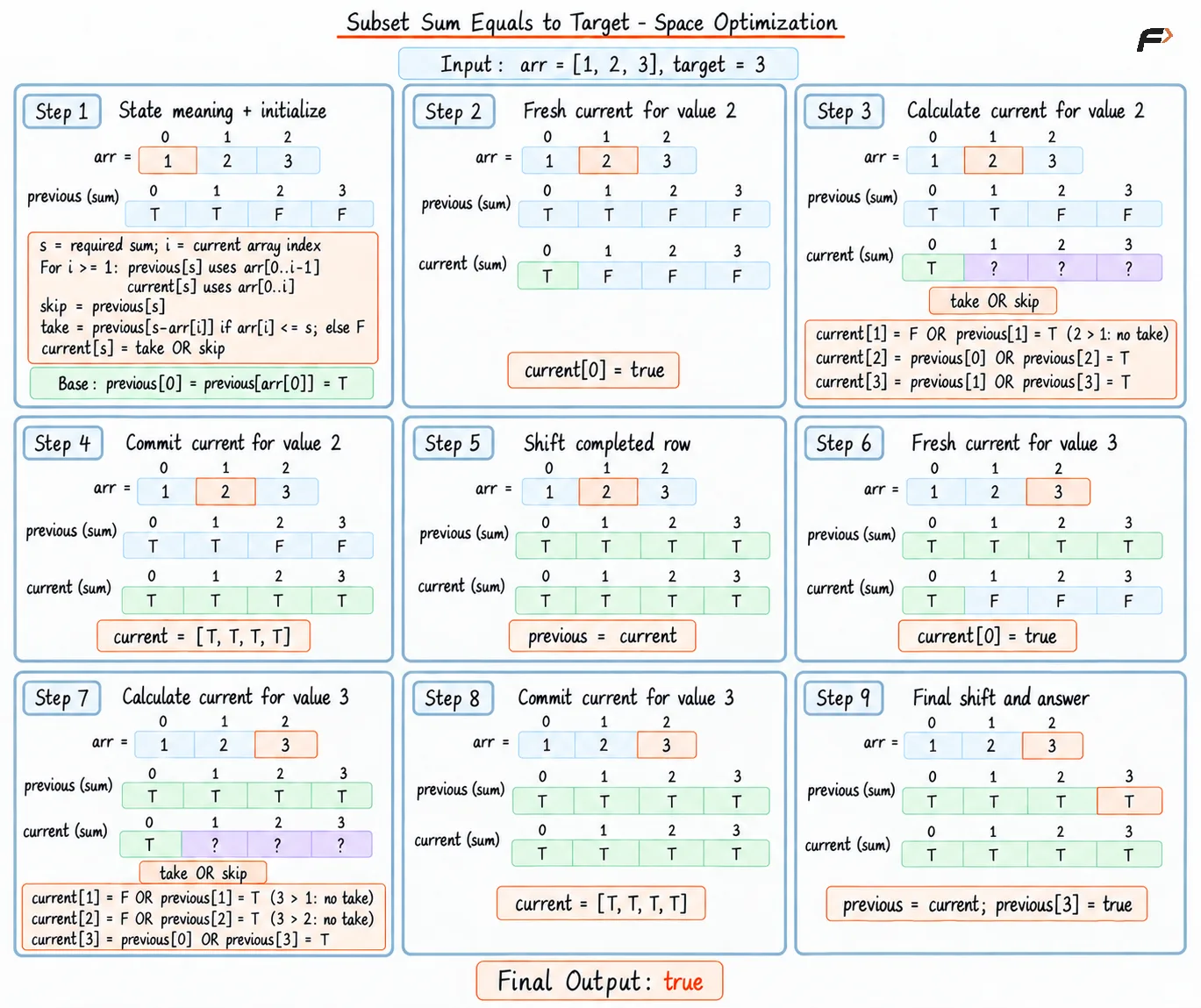
subset-sum-space-optimization-state-indices-no-logo.png
Solution
#include <bits/stdc++.h>using namespace std;class Solution {public: // Checks subset existence with two DP rows. bool subsetSumToTarget(vector<int>& arr, int target) { int n = arr.size(); // The retained row stores earlier-prefix answers. vector<bool> previous(target + 1, false); // Sum zero needs no selected values. previous[0] = true; // The first value forms one positive sum. if (arr[0] <= target) { previous[arr[0]] = true; } // Each later value builds one fresh row. for (int index = 1; index < n; index++) { // Fresh storage protects earlier-row answers. vector<bool> current(target + 1, false); // Sum zero remains reachable in every row. current[0] = true; // Every target sum receives two choices. for (int sum = 1; sum <= target; sum++) { // Skipping reads the unchanged earlier state. bool notTaken = previous[sum]; // A taken state starts unavailable. bool taken = false; // Taking stays valid inside the current sum. if (arr[index] <= sum) { // The earlier row supplies the remainder. taken = previous[sum - arr[index]]; } // Current combines take and skip answers. current[sum] = taken || notTaken; } // Shift only after the full row is complete. previous = current; } // The retained row covers the complete problem. return previous[target]; }};// Driver codeint main() { vector<int> arr = {1, 2, 3, 4}; int target = 4; Solution obj; cout << boolalpha << obj.subsetSumToTarget(arr, target); return 0;}Complexity Analysis
Time Complexity: O(N × target), where N is the number of elements and target is the target sum, because each of the N elements calculates every sum from 0 through target once.
Space Complexity: O(target), where target is the target sum, because two boolean rows of length target + 1 replace the full dp table.
Interview follow-up Questions
Yes. The empty subset has sum 0, so every approach returns true immediately for target 0.
Be the first to add a comment.