Introduction to Tree Modification
Tree modification means changing the values, nodes, or connections of an existing tree.
A modification may:
Update the value stored in a node
Insert a new node
Delete an existing node
Remove an entire subtree
Replace one subtree with another
Swap left and right children
Flatten or restructure the tree
Change the root of the tree
Unlike traversal problems, modification problems do not only read the tree. They change its state, so every pointer or reference update must preserve the remaining structure.
A valid modification should ensure that:
Every retained node remains reachable from the root.
No unintended cycle is created.
A non-root node does not accidentally receive multiple parents.
Every node still has at most two children.
Any additional ordering property remains valid.
The exact insertion or deletion rule depends on the type of tree. A general binary tree, Binary Search Tree, heap, and balanced tree cannot always use the same modification algorithm.
Types of Tree Modification
Tree modifications can be divided into several categories.
Modification Type | What Changes |
|---|---|
Value update | Only the data stored in a node |
Node insertion | A new node and connection are added |
Node deletion | A node and one of its connections are removed |
Subtree replacement | One child reference points to a different subtree |
Pruning | A node or complete subtree is removed |
Mirroring | Left and right children are exchanged |
Restructuring | Several links are changed while preserving the nodes |
Rebuilding | A new tree is constructed from the existing tree |
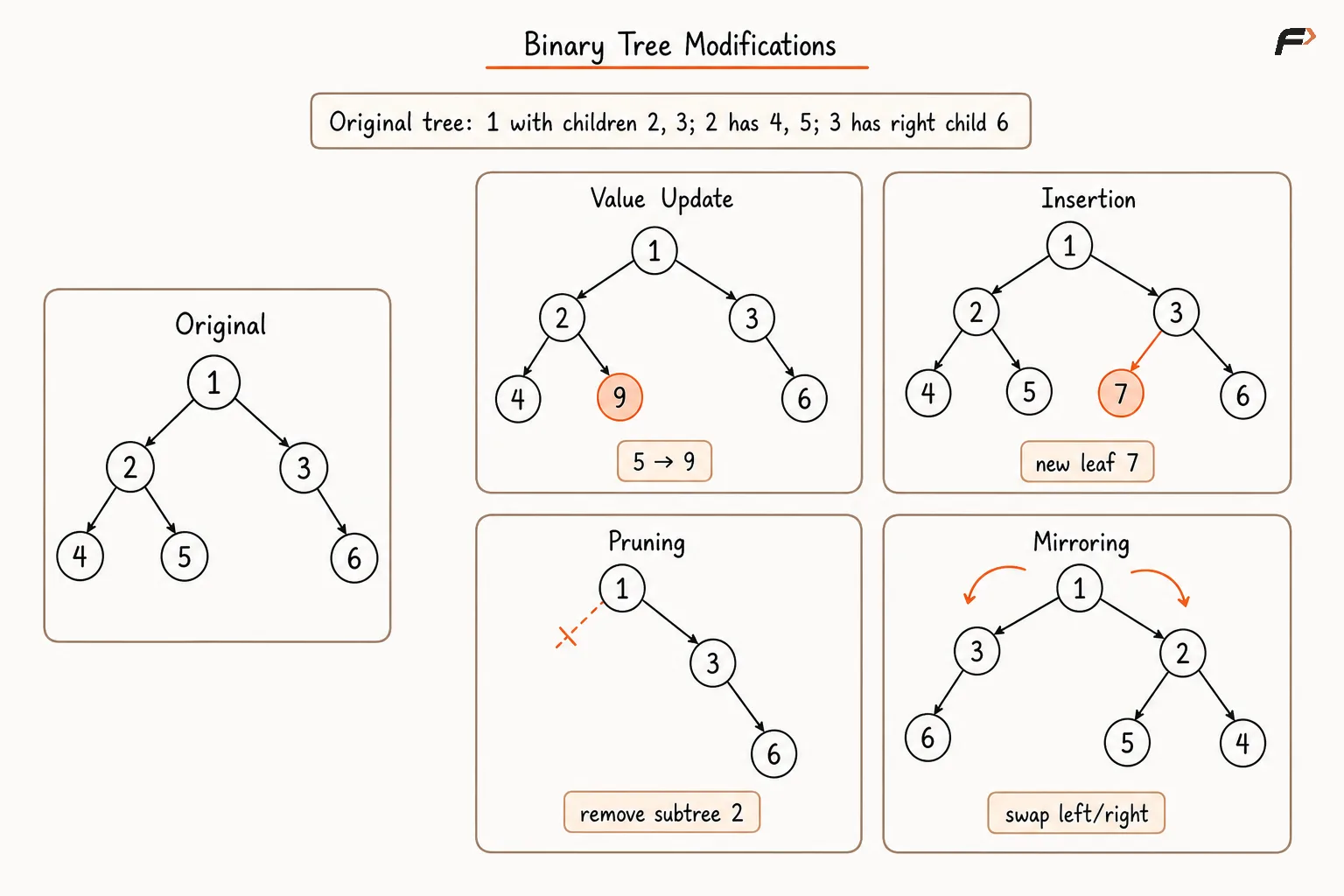
Binary Tree Modifications.png
Value Modification and Structural Modification
Value Modification
A value modification changes the data stored in a node without changing the tree’s shape.
For example:
Node value 5 → Node value 10
The node keeps:
The same parent
The same left child
The same right child
This operation takes O(1) time when a direct reference to the node is already available. If the node must first be searched, the complete operation may take O(N) time in a general binary tree.
Changing a value may still violate an additional property. For example, updating a value inside a Binary Search Tree can break its ordering rule.
Structural Modification
A structural modification changes one or more links.
Examples include:
Attaching a child
Detaching a child
Replacing a subtree
Moving a node
Swapping children
Changing the root
Structural changes require more care because an incorrect reference update can disconnect valid nodes or create a cycle.
In-Place and Out-of-Place Modification
In-Place Modification
An in-place operation changes the original tree directly.
Examples include:
Swapping child references while mirroring
Updating a node value
Detaching a deleted leaf
Reconnecting nodes while flattening
Advantages:
Usually requires less additional memory.
Avoids copying all nodes.
Changes are immediately reflected through existing references.
Limitations:
The original tree is lost.
Shared references observe the changes.
Incorrect pointer updates can corrupt the structure.
Undoing the modification may be difficult.
Out-of-Place Modification
An out-of-place operation constructs a new tree while preserving the original tree.
Advantages:
The original structure remains available.
It is safer when several consumers share the same tree.
Old and new versions can be compared.
Limitations:
Creating new nodes requires additional memory.
Every required value and connection may need to be copied.
If a new tree containing N nodes is created, the additional space may become O(N).
The Modified-Subtree Mental Model
The most useful mental model for recursive tree modification is:
Every recursive call receives the root of a subtree and returns the root of that subtree after modification.
The returned root may be:
The same node when the subtree remains rooted there
NULLwhen the complete subtree is removedA child when the current root is deleted
A newly created node when the subtree is replaced
A different existing node after restructuring
The parent must reconnect its child reference to this returned root.
For example, after modifying the left subtree:
current.left = modified left-subtree root
This pattern is important because the root of a subtree can change. Modifying a local reference without returning or reconnecting it may leave the parent pointing to the old structure.
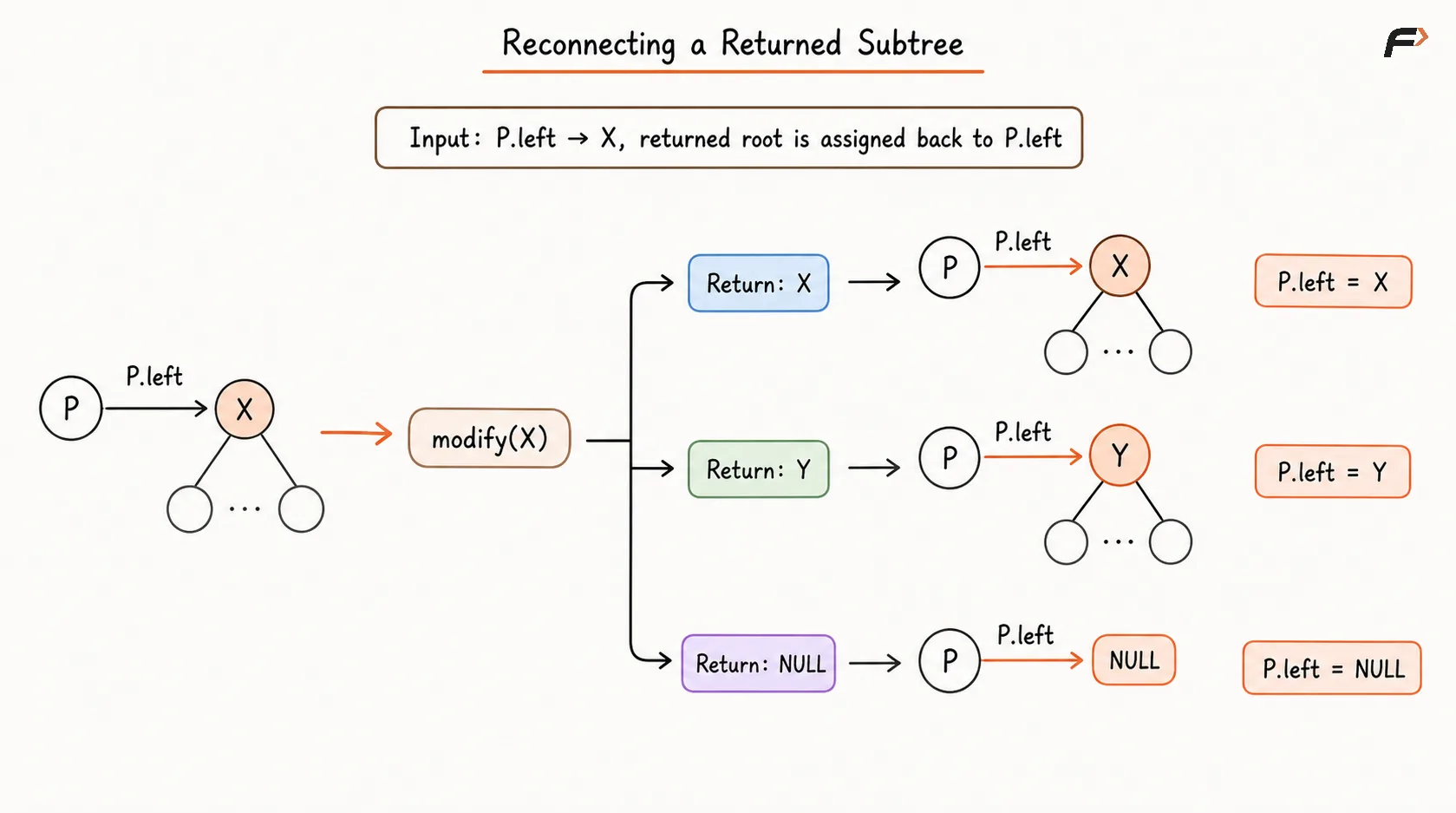
Reconnecting a Returned Subtree.png
Choosing the Correct Traversal Order
The traversal order should match the dependency of the modification.
Traversal | Suitable Modifications |
|---|---|
Preorder | Parent-first updates and passing information downward |
Inorder | Ordered transformations involving Binary Search Trees |
Postorder | Pruning, deletion, height-based changes, and child-dependent updates |
Level Order | Filling the first vacant position or locating the deepest node |
Preorder
Use preorder when the current node must be modified before its children.
Examples:
Passing an accumulated value downward
Updating every descendant using ancestor information
Performing some forms of mirroring
Postorder
Use postorder when the decision about the current node depends on its modified children.
Examples:
Removing leaf nodes
Pruning invalid subtrees
Deleting an entire tree
Recalculating subtree properties
Returning a replacement subtree root
Level Order
Use BFS when the operation depends on level position.
Examples:
Inserting into the first available position
Finding the deepest rightmost node
Preserving complete-tree shape
Insertion in a General Binary Tree
A general binary tree does not have a universal insertion rule.
One commonly used rule is level-order insertion, where the new node is placed in the first vacant child position encountered from top to bottom and left to right.
This rule keeps the tree as compact as possible.
Consider a tree with:
Root
1Children
2and3Children
4and5under2Left child
6under3
Insert:
X = 7
Nodes 1 and 2 already have two children. Node 3 has a left child but no right child.
Therefore, 7 becomes the right child of 3.
Algorithm for Level-Order Insertion
Create a new node containing the value to be inserted.
If the tree is empty, return the new node because it becomes the root.
Begin BFS from the root to inspect child positions level by level.
Attach the new node when the first missing left child is found.
Otherwise, attach it when the first missing right child is found.
Stop immediately after insertion and return the original root.
Time Complexity: O(N) in the worst case because many nodes may need to be examined.
Space Complexity: O(W) because the BFS queue may contain the widest level.
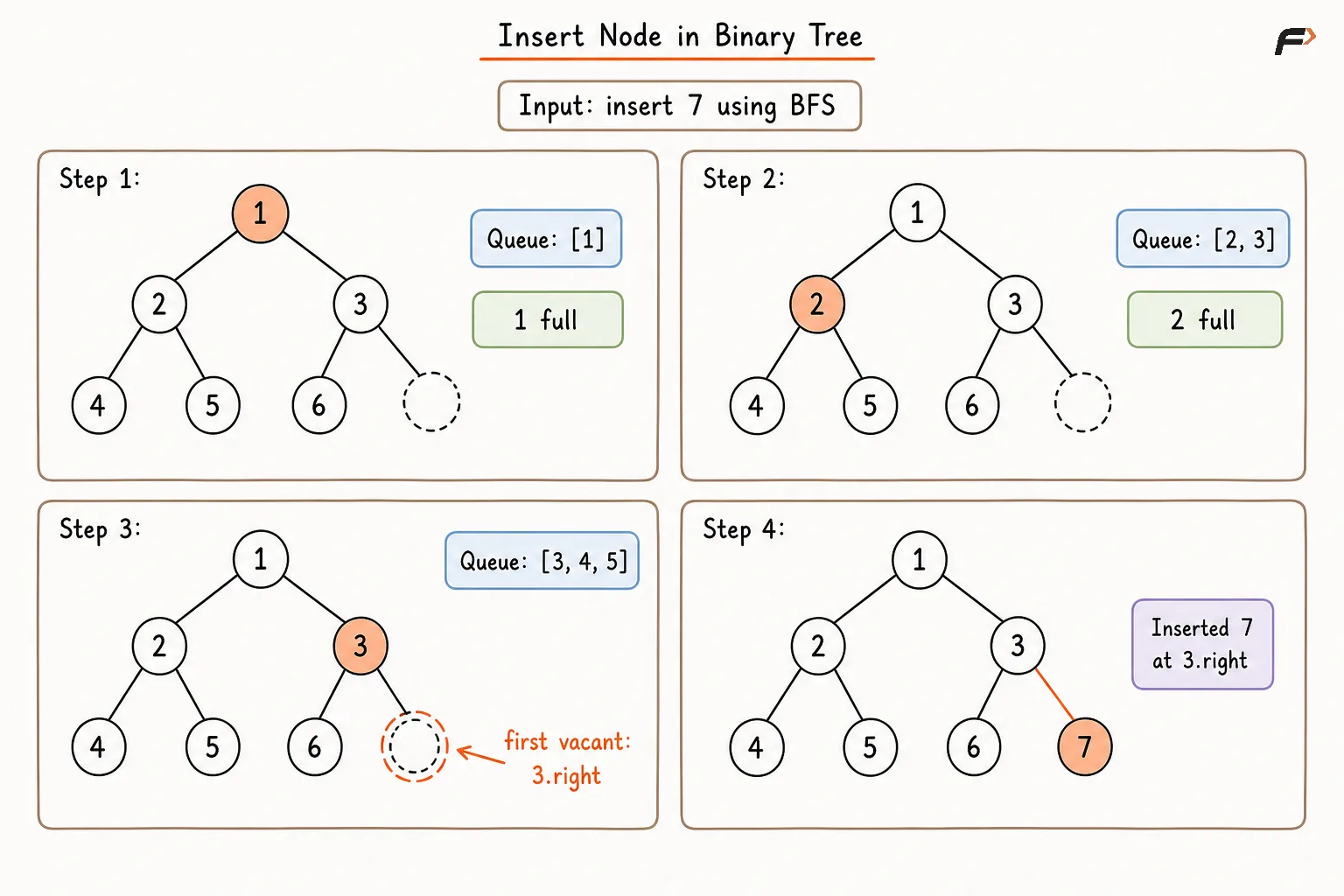
Insert Node in Binary Tree.png
Important Insertion Cases
Empty Tree
The new node becomes the root.
Known Parent
If the problem provides the exact parent and side, insertion can take O(1) time after validating that the selected child position is empty.
Occupied Child Position
Overwriting an existing child reference without preserving it disconnects the entire old subtree. The problem must explicitly define whether replacement is allowed.
Specialized Trees
A Binary Search Tree chooses the insertion path using value comparisons. A heap inserts at the next complete-tree position and then restores heap order.
The level-order rule for a general binary tree must not be used automatically for these specialized trees.
Deletion in a General Binary Tree
A general binary tree also has no universal deletion rule.
A common level-order deletion method is:
Find the target node.
Find the deepest rightmost node.
Copy the deepest node’s value into the target node.
Remove the original deepest node.
Replacing the target value prevents a hole from appearing in the middle of the level-order structure.
Consider a complete binary tree with:
Root
1Children
2and3Children
4and5under2Children
6and7under3
Delete:
Target = 2
The deepest rightmost node is 7.
Replace the target value 2 with 7, then remove the original node 7.
The modified level order becomes:
[1, 7, 3, 4, 5, 6]
Algorithm for General Binary Tree Deletion
Return the original empty tree if the root is
NULL.Traverse the tree in level order while locating the target node and tracking the deepest rightmost node.
If the target does not exist, return the tree unchanged.
Replace the target node’s value with the deepest node’s value when they are different nodes.
Detach the deepest node from its parent while preserving every other connection.
Handle the single-node case separately because deleting it makes the root
NULL.
Time Complexity: O(N) because the complete tree may need to be traversed.
Space Complexity: O(W) because level-order traversal uses a queue.
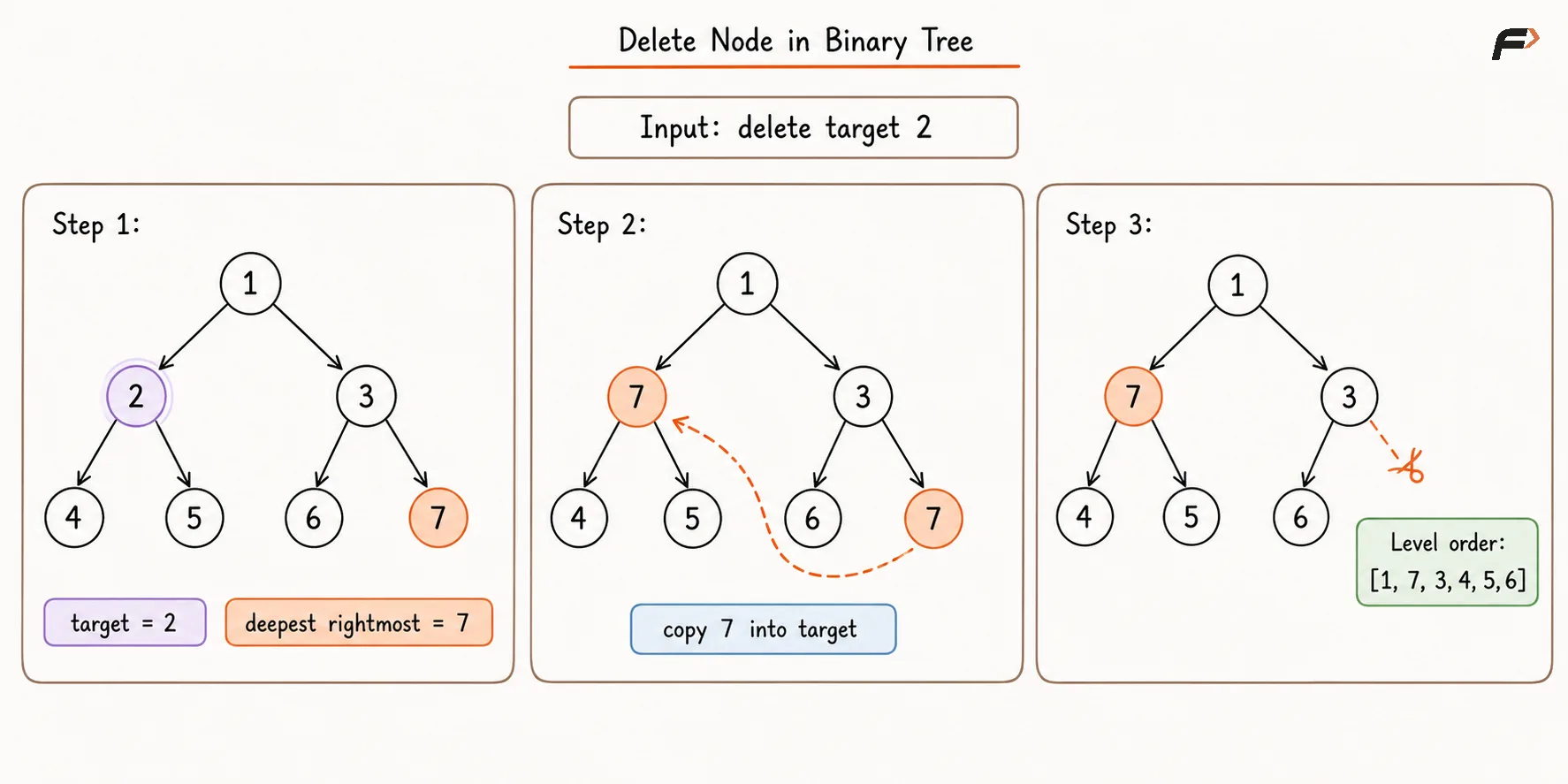
Delete Node in Binary Tree.png
Value Replacement and Node Identity
The general deletion method replaces the target node’s value rather than physically moving the deepest node into the target position.
This distinction matters when:
Other parts of the program store references to particular nodes.
Nodes have unique identities beyond their values.
Additional information is attached to each node.
Duplicate values exist.
Parent mappings or external indices are maintained.
If the problem requires deleting a specific node object rather than only removing its value, simple value replacement may not satisfy the requirement.
The deletion contract must therefore be understood before choosing the modification.
Deleting a Subtree
Deleting a subtree means removing a node and all of its descendants.
If node X is the left child of parent P, the subtree is detached by changing:
P.left → NULL
Every node previously reachable only through X becomes disconnected from the main tree.
In languages with manual memory management, those nodes must also be released safely. In garbage-collected languages, they can be reclaimed after no reachable references remain.
If the removed subtree begins at the root, the complete tree becomes empty.
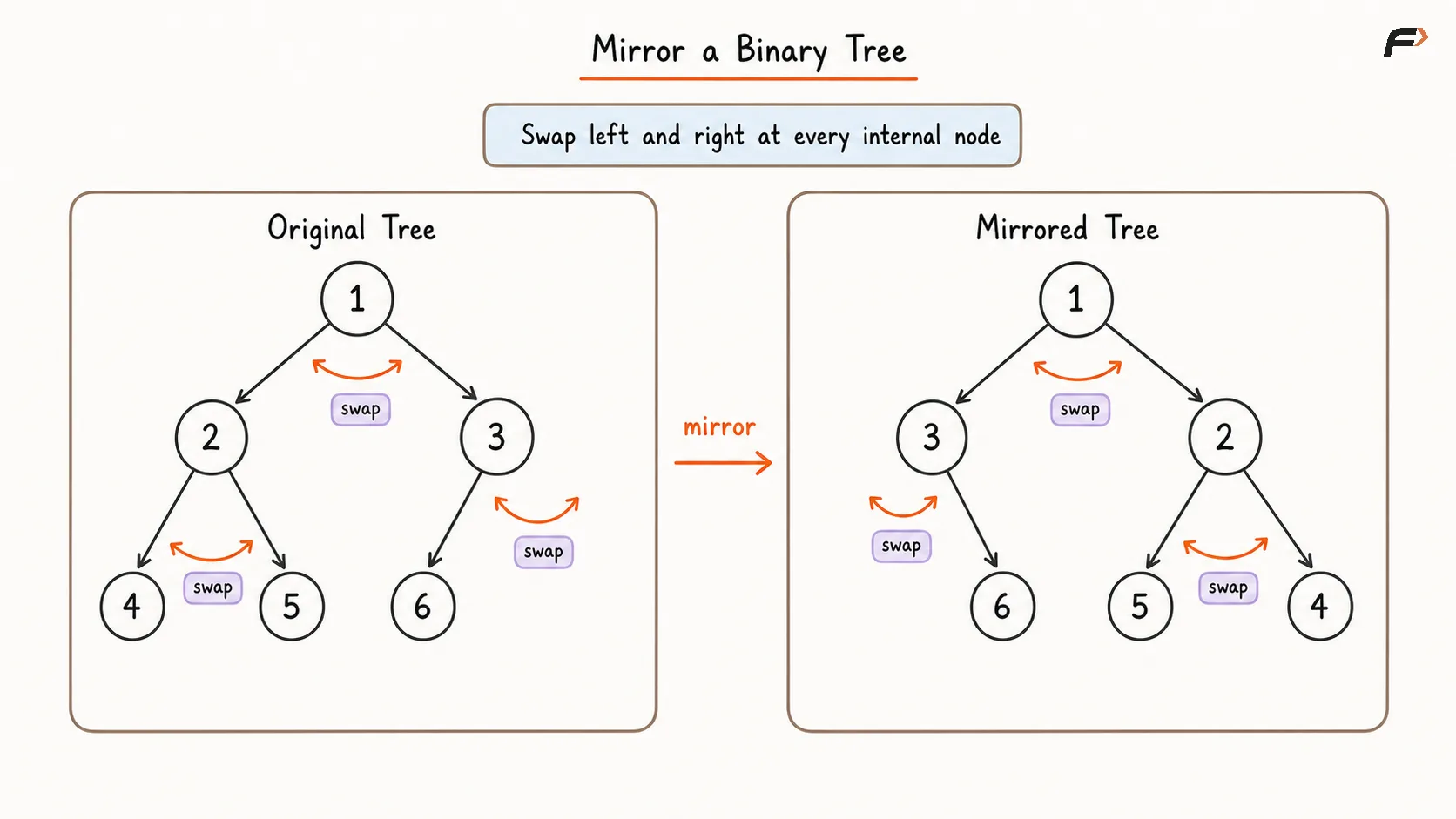
Mirroring a Binary Tree
Mirroring a binary tree means swapping the left and right subtrees of every node.
For each node:
The original left child becomes the right child.
The original right child becomes the left child.
Consider the tree:
Root
1Children
2and3Children
4and5under2Left child
6under3
After mirroring:
Children of
1become3and2.Node
3has right child6.Children of
2become5and4.
Algorithm
Return
NULLwhen the current subtree is empty.Recursively mirror the left and right subtrees.
Swap the returned left and right subtree roots.
Reconnect the swapped subtrees to the current node.
Return the current node as the root of the mirrored subtree.
Time Complexity: O(N) because every node is processed once.
Space Complexity: O(H) because recursion follows the height of the tree.
Mirror a Binary Tree.png
Why Does Mirroring Work?
Every node independently exchanges its two child subtrees.
Once both subtrees are mirrored and then swapped:
Everything originally on the left appears symmetrically on the right.
Everything originally on the right appears symmetrically on the left.
Because every node is processed, the complete tree becomes its mirror image.
Applying the same mirroring operation twice restores the original tree.
Pruning a Tree
Pruning removes nodes or subtrees that do not satisfy a required condition.
Examples include:
Removing leaf nodes with a target value
Removing paths whose sum is below a limit
Deleting subtrees that contain no valid node
Keeping only nodes that satisfy a property
Postorder traversal is usually suitable because the children are processed before deciding whether the current node should remain.
General Pruning Algorithm
Return
NULLwhen the current subtree is empty.Recursively prune the left subtree and reconnect its returned root.
Recursively prune the right subtree and reconnect its returned root.
Evaluate the current node using its modified children.
Return
NULLif the current subtree must be removed.Otherwise, return the current node as the retained subtree root.
Time Complexity: O(N) because every node is examined once.
Space Complexity: O(H) due to the recursion stack.
Why Is Postorder Useful for Pruning?
Suppose a node should be removed only when both of its subtrees become empty.
The algorithm cannot make that decision before processing the children. A child subtree that currently exists may be completely removed during recursion.
Postorder provides the required order:
Left → Right → Root
After both recursive calls return, the current node sees the final modified forms of its children and can make the correct decision.
Replacing a Subtree
A subtree can be replaced by changing one parent reference.
For example:
Create or identify a replacement subtree rooted at
Y.Disconnect the old subtree rooted at
X.Change the parent’s corresponding child reference from
XtoY.
Before overwriting the reference to X, determine whether the old subtree:
Must be preserved elsewhere
Must be deleted
Is shared by another structure
Contains resources requiring cleanup
Replacing the root subtree requires updating the tree’s root reference itself.
Structural Invariants
After every modification, verify the properties the tree is expected to maintain.
General Binary Tree
Every node has at most two children.
The structure contains no cycle.
Every non-root node has one parent.
Every retained node is reachable from the root.
Binary Search Tree
The ordering relationship between left subtree, root, and right subtree must remain valid.
Complete Binary Tree or Heap
The complete-tree shape must remain valid. A heap must also preserve its priority-ordering property.
Balanced Tree
The required height or balance condition must be restored after insertion or deletion.
A modification that is valid for a general binary tree may still be invalid for a specialized tree.
Parent Mappings After Modification
A stored parent mapping describes the tree at the time it was created.
After changing an edge:
A newly inserted node needs a parent entry.
A detached node’s old parent entry becomes invalid.
A moved subtree may require several updated relationships.
A deleted node must be removed from related structures.
The same issue applies to:
Depth arrays
Subtree sizes
Height values
Ancestor tables
Traversal order indices
These values must be updated, rebuilt, or marked invalid after structural changes.
Modification Complexity Summary
Operation | Time Complexity | Auxiliary Space |
|---|---|---|
Update a directly known node value |
|
|
Search and update a value |
| Depends on traversal |
Level-order insertion |
|
|
General level-order deletion |
|
|
Mirror the tree |
|
|
Prune using postorder |
|
|
Build a modified copy |
|
|
Here:
His the height of the tree.Wis the maximum width of the tree.
Common Mistakes
Assuming a general binary tree has one universal insertion or deletion rule.
Applying general binary-tree modification rules to a Binary Search Tree or heap.
Overwriting a child reference before preserving the existing subtree.
Forgetting that deletion may change the root.
Failing to reconnect the modified subtree returned by recursion.
Modifying only a local pointer while the parent still points to the old node.
Creating a cycle by linking a node to one of its ancestors.
Giving one node multiple parents unintentionally.
Using preorder when a pruning decision depends on modified children.
Replacing a value when the problem requires deletion of a specific node object.
Ignoring duplicate values while locating the target.
Continuing BFS after insertion and accidentally adding the node more than once.
Forgetting to detach the deepest node after copying its value during deletion.
Reusing outdated parent maps, depths, heights, or ancestor tables.
Counting output or newly constructed nodes as auxiliary space without stating the convention.
FAQs
Q1. Why is there no single insertion or deletion rule for every binary tree?
A general binary tree has no value-ordering or shape requirement. Specialized trees define their own invariants, so insertion and deletion must follow the rules of the specific structure.
Q2. Why should a recursive modification return the root of the modified subtree?
The subtree root may be deleted, replaced, rotated, or changed to one of its children. Returning the updated root allows the parent to reconnect its child reference correctly.
Q3. Why is postorder traversal commonly used for pruning?
A pruning decision often depends on whether the child subtrees remain after modification. Postorder processes both children first, allowing the current node to decide using their final states.
Q4. When should a new tree be created instead of modifying the original tree?
Create a new tree when the original version must be preserved, nodes are shared by multiple consumers, or immutable data is required. In-place modification is preferable when memory is limited and changing the original structure is acceptable.
Q5. What happens to parent maps and other preprocessed information after structural modification?
They may become stale because the relationships they describe have changed. Affected parent entries, depths, heights, subtree sizes, and ancestor tables must be updated or rebuilt before reuse.
Be the first to add a comment.