Left and Right View of a Binary Tree
The left view of a binary tree contains the nodes visible when the tree is observed from its left side.
The right view contains the nodes visible when the tree is observed from its right side.
At every level:
The first node from the left belongs to the left view.
The first node from the right belongs to the right view.
Both views contain exactly one node from every non-empty level and are returned from top to bottom.
Consider a binary tree with the following relationships:
Node
1is the root.Nodes
2and3are the children of1.Node
4is the right child of2.Node
5is the left child of3.Node
6is the right child of4.
The nodes at each level are:
Level | Nodes from Left to Right |
|---|---|
0 |
|
1 |
|
2 |
|
3 |
|
Therefore:
Left View = [1, 2, 4, 6]
Right View = [1, 3, 5, 6]
Notice that node 4 belongs to the left view even though it is a right child. Similarly, a right-view node does not always need to be connected through right-child edges.
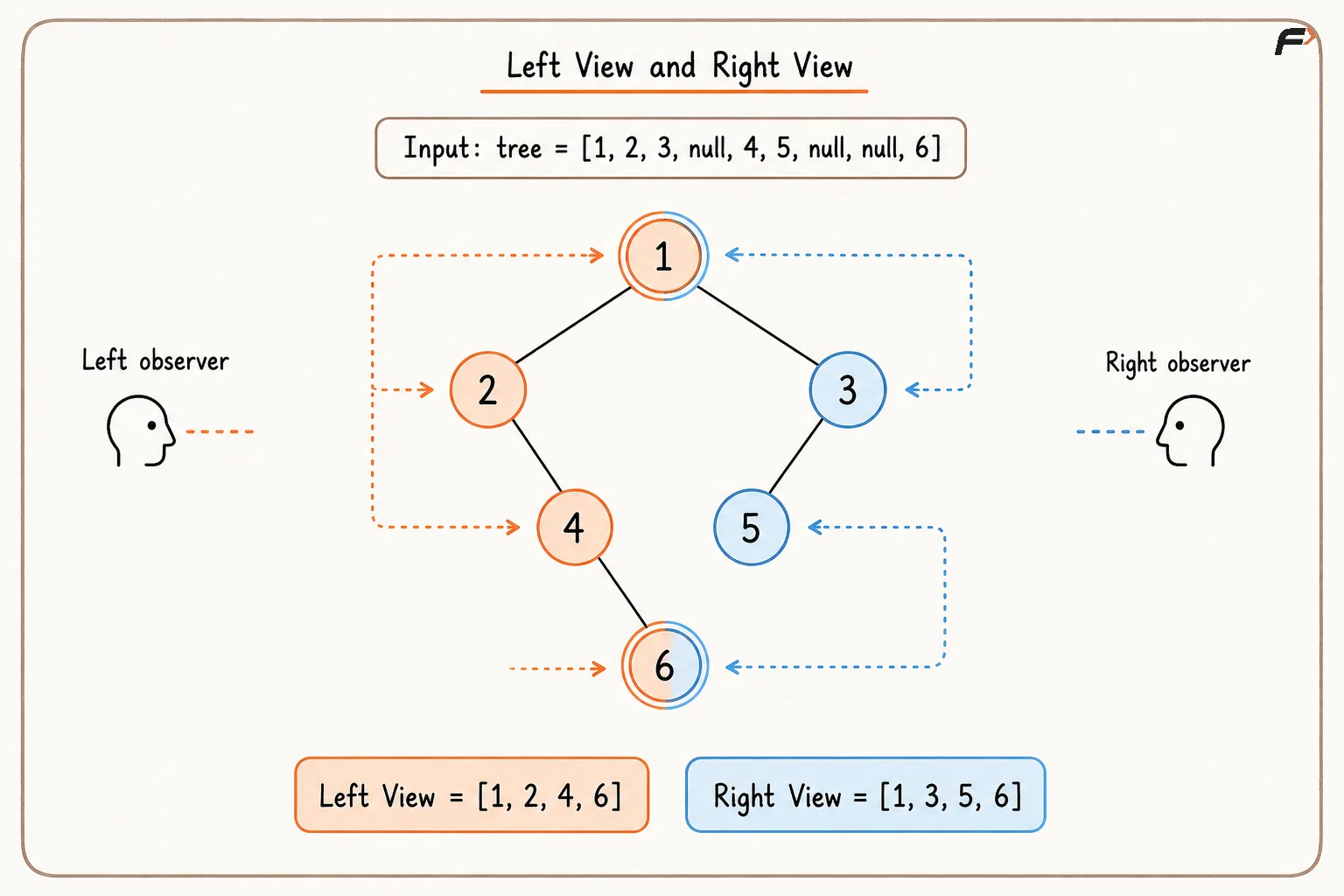
Left and Right View.png
Given the root of a binary tree, determine:
The left view of the tree
The right view of the tree
The left view should contain the leftmost node at every level, while the right view should contain the rightmost node at every level.
Return the nodes in top-to-bottom order.
If the tree is empty, both views are empty.
Examples
Example 1
Using the tree described above:
Left View = [1, 2, 4, 6]
Right View = [1, 3, 5, 6]
Example 2
Consider a tree containing only one node:
Root = 10
The root is visible from both sides.
Left View = [10]
Right View = [10]
Important Observation
The left and right views are based on the extreme node at each level.
They are not necessarily:
A path containing only left children
A path containing only right children
The complete left or right boundary of the tree
For example, if a node has no left child, its right child may still become the leftmost visible node at a deeper level.
The problem can therefore be reduced to:
Find the first and last node at every level.
This observation leads naturally to a BFS solution. The same information can also be collected using DFS by controlling the subtree visitation order.
Approach 1
Intuition
Breadth-First Search processes the tree one level at a time.
For every level:
The first node processed is the leftmost node.
The last node processed is the rightmost node.
By recording these two nodes, both views can be generated during the same level-order traversal.
A queue maintains the nodes waiting to be processed. Before processing a level, record the current queue size so that only the nodes belonging to that level are considered.
Algorithm
Return empty views if the root is
NULL; otherwise, place the root in a queue.Record the queue size before each level because it equals the number of nodes currently present at that level.
Process exactly those nodes from left to right while adding their existing children to the queue.
Add the first processed node of the level to the left view.
Add the last processed node of the level to the right view.
Continue until the queue becomes empty, then return both views.
Dry Run
Consider the example tree.
Initial state:
Queue = [1]
Left View = []
Right View = []
Level 0
Current queue:
[1]
The level contains only node 1.
First node:
1Last node:
1
Update:
Left View = [1]
Right View = [1]
Add children 2 and 3:
Queue = [2, 3]
Level 1
Current queue:
[2, 3]
First node:
2Last node:
3
Update:
Left View = [1, 2]
Right View = [1, 3]
Node 2 adds child 4, and node 3 adds child 5:
Queue = [4, 5]
Level 2
Current queue:
[4, 5]
First node:
4Last node:
5
Update:
Left View = [1, 2, 4]
Right View = [1, 3, 5]
Node 4 adds child 6:
Queue = [6]
Level 3
Current queue:
[6]
The level contains only node 6.
First node:
6Last node:
6
Update:
Left View = [1, 2, 4, 6]
Right View = [1, 3, 5, 6]
The queue becomes empty, so traversal is complete.
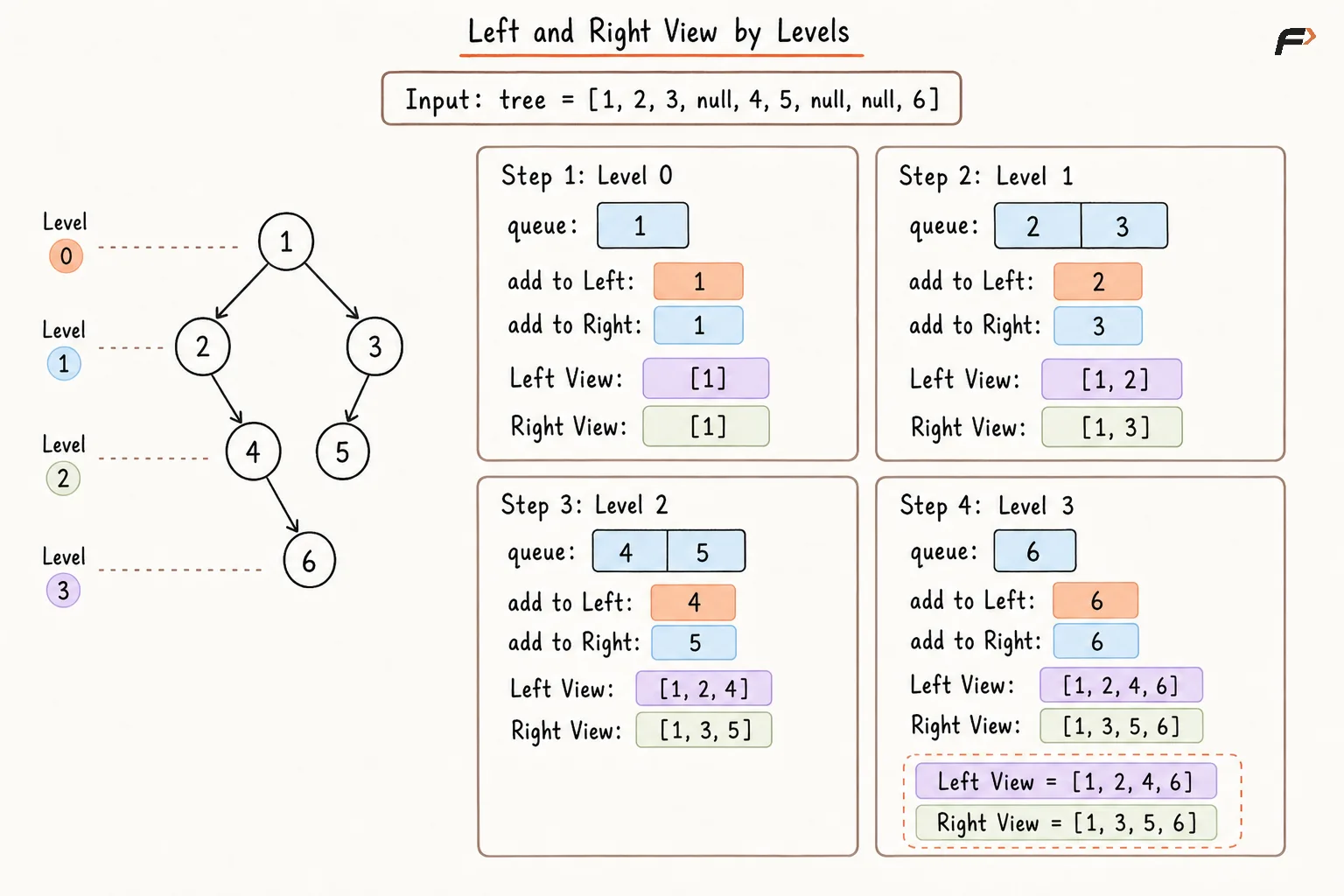
Left and Right View by Levels.png
Why Does the BFS Approach Work?
BFS processes all nodes at depth D before moving to depth D + 1.
Since children are inserted from left to right, the nodes of every level are removed from the queue in left-to-right order.
Therefore:
The first node processed at a level is its leftmost node.
The last node processed at a level is its rightmost node.
Selecting these nodes for every level produces the left and right views.
Complexity Analysis
Every node is inserted into and removed from the queue once.
Time Complexity: O(N)
The queue may contain all nodes from the widest level.
Auxiliary Space Complexity: O(W)
where W is the maximum width of the tree.
The returned views contain one value per level. For a tree of height H, their combined output space is:
O(H)
Output space is not included in auxiliary space unless stated otherwise.
Approach 2
Intuition
DFS can identify view nodes by tracking the current depth.
The view list initially contains no value for an unexplored depth. Therefore, when DFS reaches a depth for the first time, the current node is recorded.
The subtree visitation order determines which node is encountered first:
For the left view, visit the left subtree before the right subtree.
For the right view, visit the right subtree before the left subtree.
This ensures that the first node reached at every depth is the node visible from the required side.
DFS for the Left View
Use the traversal order:
Root → Left → Right
When visiting a node at depth D:
If the view already contains a value for depth
D, another node at that level was reached earlier.If the view size equals
D, this is the first node reached at that depth, so add it to the left view.
Algorithm
Begin DFS from the root at depth
0.Return when the current node is
NULLbecause the branch has ended.Add the current node when the depth equals the current left-view size.
Traverse the left subtree first so the leftmost node of each depth is encountered before other nodes.
Traverse the right subtree afterward to process levels not reached through the left subtree.
Continue until every reachable node has been examined.
For the example tree:
Left View = [1, 2, 4, 6]
DFS for the Right View
Use the traversal order:
Root → Right → Left
The depth condition remains the same, but the right subtree is explored first.
Algorithm
Begin DFS from the root at depth
0.Return when the current node is
NULL.Add the current node when the depth equals the current right-view size.
Traverse the right subtree first so the rightmost node of each depth is encountered before other nodes.
Traverse the left subtree afterward to reach levels missing from the right subtree.
Continue until all nodes have been examined.
For the example tree:
Right View = [1, 3, 5, 6]
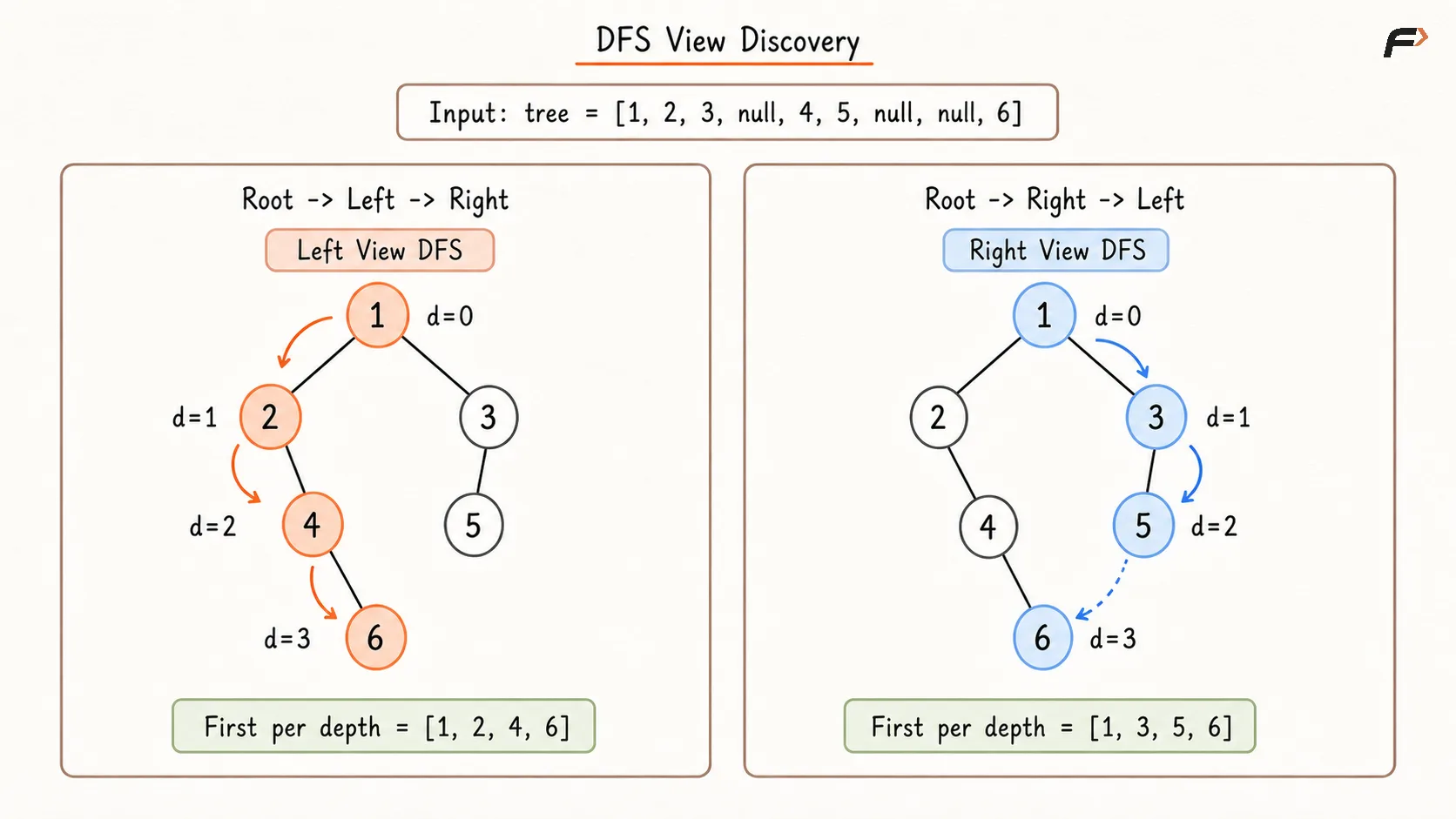
DFS View Discovery.png
DFS Dry Run for the Left View
Start with:
Left View = []
Visit Node 1 at Depth 0
Depth = Left View Size = 0
Add 1:
Left View = [1]
Visit Node 2 at Depth 1
Depth = Left View Size = 1
Add 2:
Left View = [1, 2]
Visit Node 4 at Depth 2
Depth = Left View Size = 2
Add 4:
Left View = [1, 2, 4]
Visit Node 6 at Depth 3
Depth = Left View Size = 3
Add 6:
Left View = [1, 2, 4, 6]
When DFS later reaches nodes 3 and 5, their depths already have recorded values, so they are not added.
DFS Dry Run for the Right View
Start with:
Right View = []
Visit Node 1 at Depth 0
Add 1:
Right View = [1]
Visit Node 3 at Depth 1
Add 3:
Right View = [1, 3]
Visit Node 5 at Depth 2
Add 5:
Right View = [1, 3, 5]
The right-first traversal later enters the left subtree and eventually reaches node 6 at depth 3.
Since no value has been recorded for that depth, add 6:
Right View = [1, 3, 5, 6]
This demonstrates why the right view is not limited to nodes connected only through right-child edges.
Why Does the DFS Approach Work?
For the left view, root-left-right traversal visits nodes at each depth from the left side before reaching nodes from the right side.
Therefore, the first node reached at a new depth is the leftmost visible node.
For the right view, reversing the subtree order makes the rightmost node the first one reached at every depth.
The condition:
depth == view size
ensures that exactly one node is recorded for each level.
Complexity Analysis
Every node is visited once for each required DFS traversal.
Even if the left and right views are generated using two separate traversals, the work is:
2N
Ignoring the constant factor:
Time Complexity: O(N)
The recursion stack contains nodes along the active root-to-node path.
Auxiliary Space Complexity: O(H)
where H is the height of the tree.
Balanced tree:
O(log N)Skewed tree:
O(N)
The output space for each view is O(H).
BFS and DFS Comparison
BFS | DFS |
|---|---|
Processes the tree level by level | Explores one branch deeply before backtracking |
Records the first and last node of each level | Records the first node reached at each depth |
Generates both views naturally in one traversal | Uses a different subtree order for each view |
Uses | Uses |
Avoids recursion-depth limits | Usually has a shorter recursive explanation |
Useful when level information is also required | Useful when only a side view is required |
Both approaches take O(N) time. The better space choice depends on the shape of the tree.
Calculating Both Views in One Traversal
Both views can be generated in one BFS by recording the first and last nodes of every level.
They can also be generated in one left-to-right DFS:
The first node encountered at a depth becomes the left-view node.
Every later node encountered at the same depth replaces the current right-view value.
After DFS completes, the last node visited at each depth is the rightmost node.
The BFS method is usually easier to understand when both views are required together.
Important Edge Cases
Empty Tree
Both views are empty:
Left View = []
Right View = []
Single-Node Tree
The root appears in both views.
Skewed Tree
Every level contains one node, so the left and right views are identical.
Missing Left or Right Children
The visible node may come from the opposite subtree. The algorithm must select the extreme node at each level rather than follow only one type of child reference.
Duplicate Values
Duplicate node values do not affect the traversal. Views depend on node positions, not value uniqueness.
Common Mistakes
Treating the left view as a path containing only left children.
Treating the right view as a path containing only right children.
Confusing side views with boundary traversal.
Forgetting to handle an empty tree.
Recording the changing queue size while processing a BFS level.
Adding children in an order inconsistent with the intended left-to-right traversal.
Recording every node instead of only the first or last node of a level.
Using root-right-left DFS for the left view.
Using root-left-right DFS for the right view when recording only the first node.
Adding a DFS node without checking whether its depth is already represented.
Counting output storage as auxiliary space without stating the convention.
Assuming duplicate values make the view ambiguous.
FAQs
Q1. Are the left and right views the same as the left and right boundaries of a tree?
No. A side view selects one extreme node from every level. Boundary traversal follows the outer boundary and may also include several leaf nodes from the same level.
Q2. Can both views be generated in a single traversal?
Yes. In BFS, record the first and last nodes of every level. In a left-to-right DFS, record the first node at each depth for the left view and keep replacing the value at that depth for the right view.
Q3. Can a node from the right subtree appear in the left view?
Yes. If the left subtree does not contain a node at that depth, the leftmost available node may come from the right subtree. The same reasoning applies symmetrically to the right view.
Q4. Which approach uses less auxiliary space: BFS or DFS?
It depends on the tree’s shape. BFS uses O(W) space based on maximum width, while DFS uses O(H) space based on height. DFS is often smaller for wide balanced trees, whereas BFS may be smaller for very deep narrow trees.
Q5. When are the left and right views identical?
They are identical when every level has only one node, such as in a skewed tree. They may also contain equal values in other trees, but those values can belong to different nodes.
Be the first to add a comment.