Given an R × C board containing X and O, capture every region of O cells completely surrounded by X.
A region is formed by horizontal and vertical connections between O cells. A region touching any board boundary remains safe. Every remaining enclosed region must be changed from O to X in place.
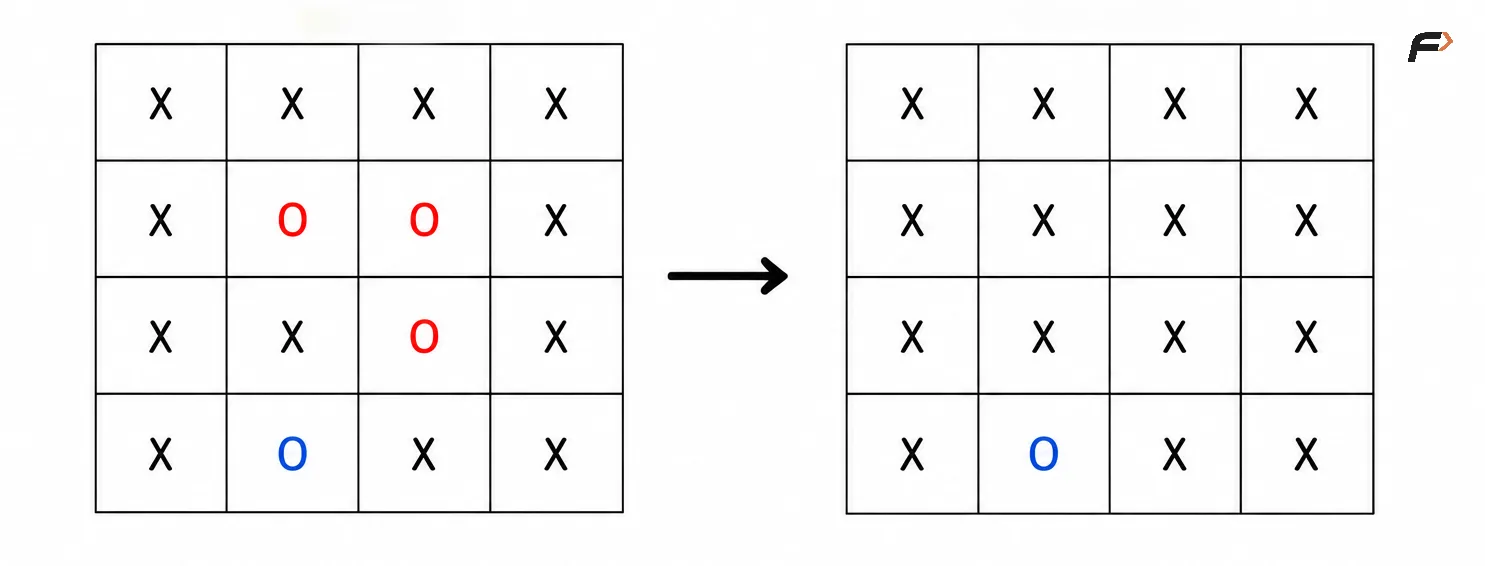
surronded regions
Example 1
Input: board = [["X","X","X","X"],["X","O","O","X"],["X","X","O","X"],["X","O","X","X"]]
Output: [["X","X","X","X"],["X","X","X","X"],["X","X","X","X"],["X","O","X","X"]]
Explanation: The bottom boundary cell remains safe. The middle region has no boundary path, so all middle O cells become X.
Example 2
Input: board = [["X","O","X"],["O","O","X"],["X","X","X"]]
Output: [["X","O","X"],["O","O","X"],["X","X","X"]]
Explanation: Every O cell connects to a boundary O, so no cell gets captured.
Approach 1
Boundary-connected O cells are safe because a surrounded region cannot touch any board border. Depth First Search begins from every boundary O and marks all reachable O cells with a temporary symbol such as #.
After all safe regions are marked, a nested traversal converts the remaining O cells into X and restores every temporary marker to O.
Algorithm
Store the row count in
Rand the column count inC, allowing boundary validation and complete board traversal.Traverse the left and right borders across all rows and start DFS from every cell containing
O, since such cells cannot belong to a surrounded region.Traverse the top and bottom borders across all columns and start DFS from every cell containing
O, ensuring that all four board borders are covered.End the current DFS call when the row or column lies outside the board or when the current cell does not contain
O, as such a cell cannot extend the safe region.Replace the current
Owith#before exploring neighboring cells. The temporary marker identifies a safe cell and prevents repeated DFS visits.Continue DFS in the upward, downward, left, and right directions to mark every
Oconnected to the boundary.Traverse the complete board using an outer loop for rows and an inner loop for columns, ensuring that every cell is processed.
Convert every remaining
OintoX, as unmarkedOcells are fully surrounded. Restore every#toO, as temporary markers represent boundary-connected safe cells.
Dry Run
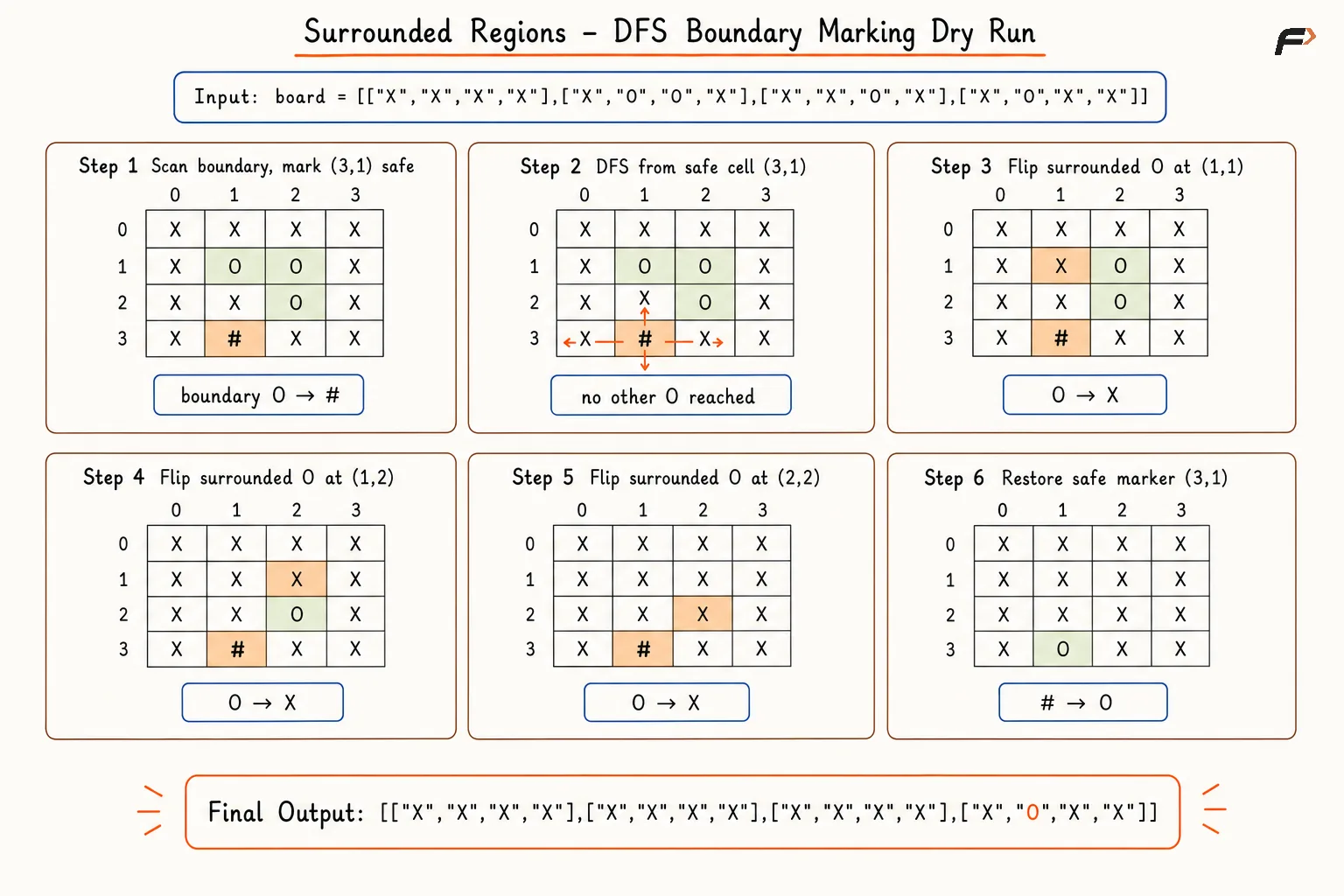
surrounded-regions-dfs-reference-style
Solution
#include <bits/stdc++.h>using namespace std;class Solution {private: // Marks boundary-connected cells using DFS. void markSafe(int row, int col, vector<vector<char>>& board) { int rows = board.size(); int cols = board[0].size(); // Base case: stop for invalid cells and non-'O' cells. if (row < 0 || col < 0 || row >= rows || col >= cols || board[row][col] != 'O') { return; } // Mark the current cell as safe. board[row][col] = '#'; // Move to the upper cell. markSafe(row - 1, col, board); // Move to the lower cell. markSafe(row + 1, col, board); // Move to the left cell. markSafe(row, col - 1, board); // Move to the right cell. markSafe(row, col + 1, board); }public: // Captures surrounded regions using DFS. void solve(vector<vector<char>>& board) { int rows = board.size(); int cols = board[0].size(); // Mark safe cells from the left and right borders. for (int row = 0; row < rows; row++) { markSafe(row, 0, board); markSafe(row, cols - 1, board); } // Mark safe cells from the top and bottom borders. for (int col = 0; col < cols; col++) { markSafe(0, col, board); markSafe(rows - 1, col, board); } // Flip captured cells and restore safe cells. for (int row = 0; row < rows; row++) { for (int col = 0; col < cols; col++) { // Captured cells are still marked as 'O'. if (board[row][col] == 'O') { board[row][col] = 'X'; } // Safe cells were temporarily marked as '#'. else if (board[row][col] == '#') { board[row][col] = 'O'; } } } }};// Prints the board.void printBoard(vector<vector<char>>& board) { for (vector<char>& row : board) { for (char cell : row) { cout << cell << " "; } cout << "\n"; }}// Driver code.int main() { vector<vector<char>> board = { {'X', 'X', 'X', 'X'}, {'X', 'O', 'O', 'X'}, {'X', 'X', 'O', 'X'}, {'X', 'O', 'X', 'X'} }; Solution sol; sol.solve(board); printBoard(board); return 0;}Complexity Analysis
Time Complexity: O(R×C), where R and C are the board dimensions; every cell is processed a constant number of times.
Space Complexity: O(R×C), where the recursive DFS stack can contain up to R×C cells in the worst case.
Approach 2
Breadth First Search uses a queue to identify safe regions without recursive calls. All boundary O cells serve as starting points, creating a multi-source traversal from the four board edges.
Every reachable O is temporarily marked before queue insertion to prevent duplicate entries. A final nested traversal captures unmarked regions and restores marked safe cells.
Algorithm
Store the row count in
Rand the column count inC, and initialize a queue to manage boundary-connected cells awaiting exploration.Traverse all four borders and add every cell containing
Oto the queue, since each boundaryOrepresents a safe starting point.Replace every boundary
Owith#before queue insertion. Early marking prevents duplicate insertion, especially for corner cells.Continue processing while the queue contains cells, ensuring that every safe region connected to any boundary source is explored.
Remove the front cell and examine neighboring cells in the upward, downward, left, and right directions.
For every in-bounds neighbor containing
O, replace the value with#before adding the coordinates to the queue. Early marking ensures that each cell enters the queue only once.Traverse the complete board using an outer loop for rows and an inner loop for columns.
Convert every remaining
OintoX, as no boundary path exists. Restore every#toO, as marked cells belong to safe boundary-connected regions.
Dry Run
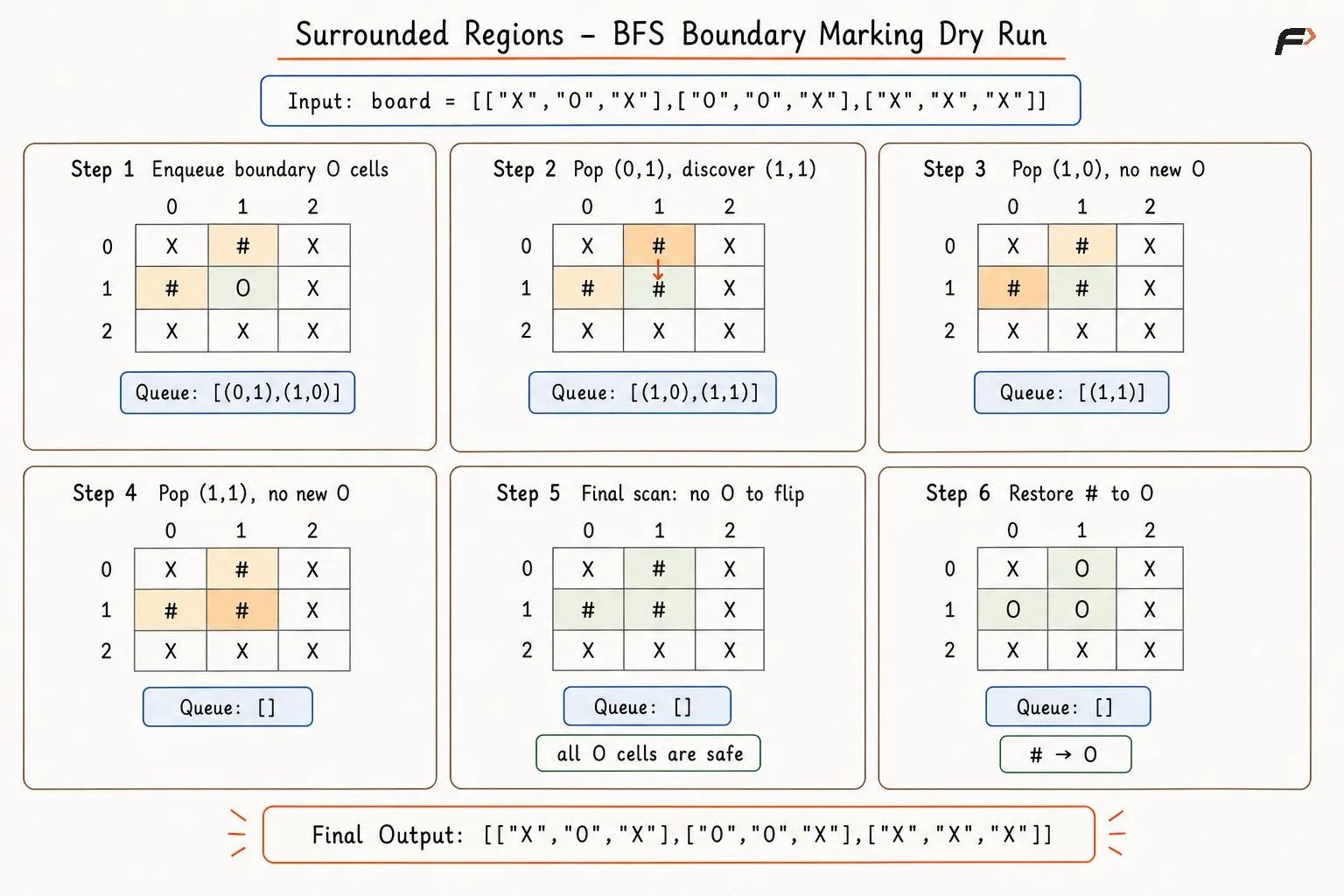
surrounded-regions-bfs-reference-style-corrected
Solution
#include <bits/stdc++.h>using namespace std;class Solution {private: // Marks boundary-connected cells using DFS. void markSafe(int row, int col, vector<vector<char>>& board) { int rows = board.size(); int cols = board[0].size(); // Base case: stop for invalid cells and non-'O' cells. if (row < 0 || col < 0 || row >= rows || col >= cols || board[row][col] != 'O') { return; } // Mark the current cell as safe. board[row][col] = '#'; // Move to the upper cell. markSafe(row - 1, col, board); // Move to the lower cell. markSafe(row + 1, col, board); // Move to the left cell. markSafe(row, col - 1, board); // Move to the right cell. markSafe(row, col + 1, board); }public: // Captures surrounded regions using DFS. void solve(vector<vector<char>>& board) { int rows = board.size(); int cols = board[0].size(); // Mark safe cells from the left and right borders. for (int row = 0; row < rows; row++) { markSafe(row, 0, board); markSafe(row, cols - 1, board); } // Mark safe cells from the top and bottom borders. for (int col = 0; col < cols; col++) { markSafe(0, col, board); markSafe(rows - 1, col, board); } // Flip captured cells and restore safe cells. for (int row = 0; row < rows; row++) { for (int col = 0; col < cols; col++) { // Captured cells are still marked as 'O'. if (board[row][col] == 'O') { board[row][col] = 'X'; } // Safe cells were temporarily marked as '#'. else if (board[row][col] == '#') { board[row][col] = 'O'; } } } }};// Prints the board.void printBoard(vector<vector<char>>& board) { for (vector<char>& row : board) { for (char cell : row) { cout << cell << " "; } cout << "\n"; }}// Driver code.int main() { vector<vector<char>> board = { {'X', 'X', 'X', 'X'}, {'X', 'O', 'O', 'X'}, {'X', 'X', 'O', 'X'}, {'X', 'O', 'X', 'X'} }; Solution sol; sol.solve(board); printBoard(board); return 0;}Complexity Analysis
Time Complexity: O(R×C), where R and C are the board dimensions; every cell enters the queue at most once and the final scan examines all cells.
Space Complexity: O(R×C), where the queue can store up to R×C cell coordinates in the worst case.
Approach 3
Disjoint Set Union represents every board cell using a unique node and introduces one additional virtual boundary node. Every boundary O joins the virtual node, forming a common set for all safe cells.
Adjacent O cells join the same DSU set. After all unions finish, an O cell outside the virtual boundary set has no path to any border and therefore belongs to a surrounded region.
Algorithm
Initialize a DSU structure containing
R×C+1nodes. The firstR×Cnodes represent board cells, while the final node represents the virtual boundary.Map the cell at row
rand columncto node identifierr×C+c, allowing board coordinates to be managed through one-dimensional DSU arrays.Traverse the board using an outer loop for rows and an inner loop for columns, ensuring that every cell is examined.
Process only cells containing
O, sinceXcells do not participate in region connectivity.Merge every boundary
Owith the virtual boundary node, allowing all border-connected safe regions to share a common representative.Merge each
Owith adjacentOcells. Checking only the right and downward neighbors avoids processing the same undirected connection twice.Find the representative of the virtual boundary node after all unions finish.
Traverse the board again and compare every
Ocell’s representative with the virtual boundary representative. Convert the cell toXwhen the representatives differ, as no connection to a border exists.
Dry Run
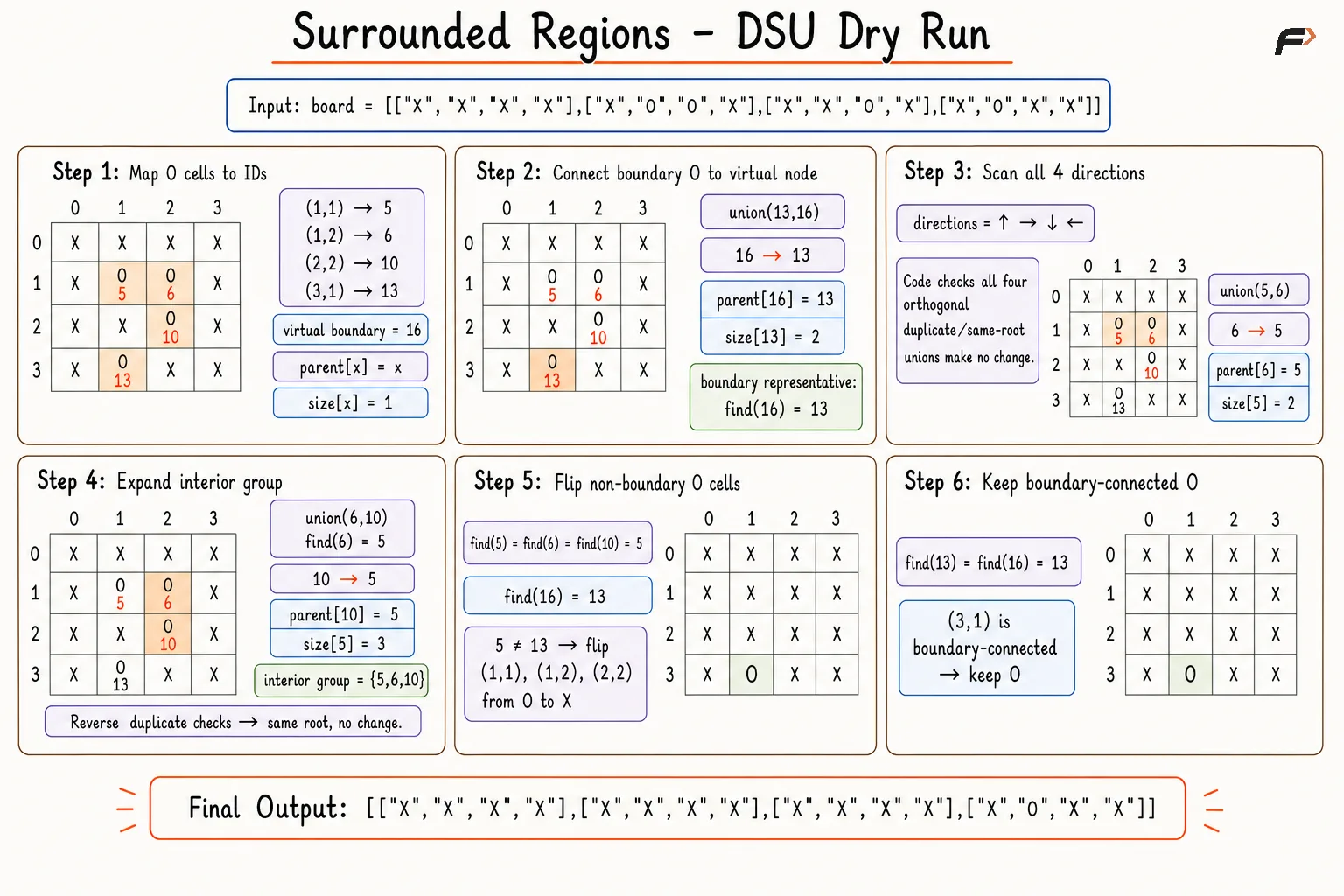
surrounded-regions-dsu-code-faithful-corrected
Solution
#include <bits/stdc++.h>using namespace std;class Solution {private: // Finds the parent representative using path compression. int findParent(int node, vector<int>& parent) { // Base case: the node is its own parent. if (parent[node] == node) { return node; } // Compress the path for faster future lookup. parent[node] = findParent(parent[node], parent); // Return the ultimate parent. return parent[node]; } // Merges two groups using union by size. void unite(int first, int second, vector<int>& parent, vector<int>& size) { // Find the parent of the first node. int parentFirst = findParent(first, parent); // Find the parent of the second node. int parentSecond = findParent(second, parent); // If both nodes are already in one group, stop. if (parentFirst == parentSecond) { return; } // Keep the larger group as the main parent. if (size[parentFirst] < size[parentSecond]) { swap(parentFirst, parentSecond); } // Attach the smaller group to the larger group. parent[parentSecond] = parentFirst; // Update the size of the merged group. size[parentFirst] += size[parentSecond]; }public: // Captures surrounded regions using DSU. void solve(vector<vector<char>>& board) { int rows = board.size(); int cols = board[0].size(); int total = rows * cols; // This extra node represents all boundary-connected 'O' cells. int boundary = total; vector<int> parent(total + 1); vector<int> size(total + 1, 1); vector<int> deltaRow = {-1, 1, 0, 0}; vector<int> deltaCol = {0, 0, -1, 1}; // Initially, every node is its own parent. for (int node = 0; node <= total; node++) { parent[node] = node; } // Merge all connected 'O' cells. for (int row = 0; row < rows; row++) { for (int col = 0; col < cols; col++) { // Skip blocked cells. if (board[row][col] != 'O') { continue; } int current = row * cols + col; // Connect boundary 'O' cells to the virtual boundary node. if (row == 0 || col == 0 || row == rows - 1 || col == cols - 1) { unite(current, boundary, parent, size); } // Check all four adjacent directions. for (int dir = 0; dir < 4; dir++) { int nextRow = row + deltaRow[dir]; int nextCol = col + deltaCol[dir]; // Check if the next cell is inside the board. if (nextRow >= 0 && nextCol >= 0 && nextRow < rows && nextCol < cols) { // Merge only adjacent 'O' cells. if (board[nextRow][nextCol] == 'O') { unite(current, nextRow * cols + nextCol, parent, size); } } } } } // Find the parent of the virtual boundary node. int boundaryParent = findParent(boundary, parent); // Flip 'O' cells outside the boundary group. for (int row = 0; row < rows; row++) { for (int col = 0; col < cols; col++) { // Captured 'O' cells are not connected to the boundary. if (board[row][col] == 'O' && findParent(row * cols + col, parent) != boundaryParent) { board[row][col] = 'X'; } } } }};// Prints the board.void printBoard(vector<vector<char>>& board) { for (vector<char>& row : board) { for (char cell : row) { cout << cell << " "; } cout << "\n"; }Complexity Analysis
Time Complexity: O(R×C×α(R×C)), where R and C are the board dimensions and α is the inverse Ackermann cost of each optimized DSU operation.
Space Complexity: O(R×C), where the DSU parent and size arrays store all R×C board cells and one virtual boundary node.
Interview follow-up Questions
No. A boundary O always remains safe.
Be the first to add a comment.