Given an undirected graph with V vertices numbered from 0 to V - 1, E edges, and a source vertex src, return the shortest distance from source to every vertex.
Every edge has unit weight. If a vertex cannot be reached from source, store -1 for the unreachable vertex.
Example 1
Input: V = 9, E = 10, edges = [[0,1],[0,3],[1,2],[3,4],[4,5],[2,6],[5,6],[6,7],[6,8],[7,8]], src = 0
Output: [0,1,2,1,2,3,3,4,4]
Explanation: BFS from vertex 0 reaches vertices by levels. Distances become 0 for source, 1 for vertices 1 and 3, 2 for vertices 2 and 4, and so on.
Example 2
Input: V = 4, E = 2, edges = [[0,3],[1,3]], src = 3
Output: [1,1,-1,0]
Explanation: Vertices 0 and 1 are one edge away from source 3. Vertex 2 is unreachable, so distance remains -1.
Approach
In a unit-weight graph, every edge contributes exactly one step to the path length. Breadth First Search explores vertices level by level, processing all vertices at distance d before any vertex at distance d+1.
The first visit to a vertex therefore provides the minimum number of edges from the source. A distance array initialized with -1 stores shortest distances while also identifying unvisited and unreachable vertices.
Algorithm
Initialize an adjacency list for
Vvertices, providing efficient access to every neighboring vertex.Traverse all edges and add both directions to the adjacency list, since each undirected edge permits movement between both endpoints.
Create a
distancearray filled with-1, where-1indicates that no path from the source has been discovered.Set the source distance to
0and add the source to a queue, establishing the first BFS level.Continue processing while the queue contains vertices, ensuring level-by-level exploration of all reachable vertices.
For every neighbor having distance
-1, set the distance todistance[current]+1and add the neighbor to the queue, recording the shortest path during the first visit.Return the distance array after BFS finishes, leaving every unreachable vertex marked as
-1.
Dry Run
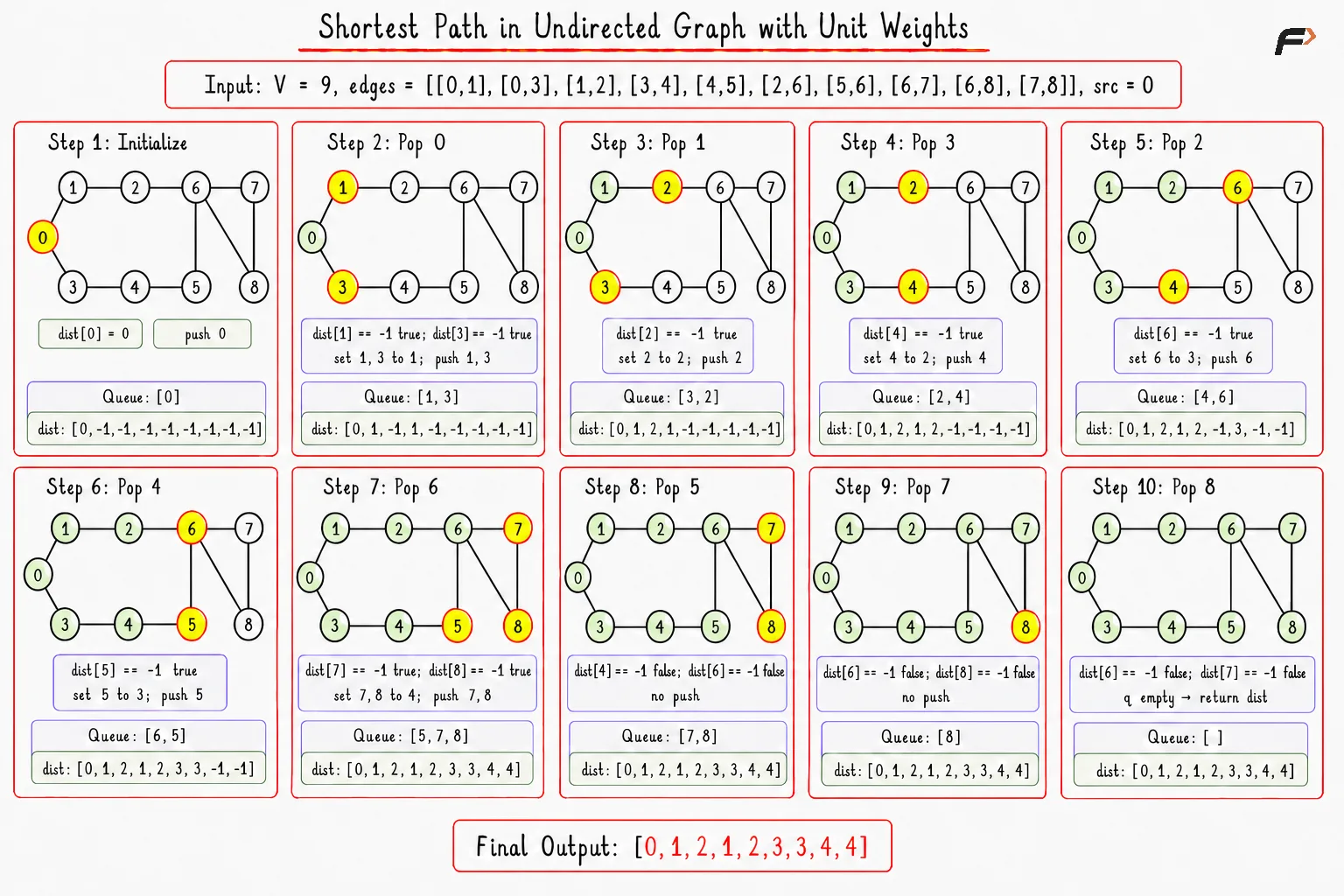
Shortest Path
Solution
#include <bits/stdc++.h>using namespace std;class Solution {public: // Return shortest distance from source to every vertex. vector<int> shortestPath(vector<vector<int>>& edges, int V, int E, int src) { vector<vector<int>> adj(V); // Build undirected adjacency list. for (vector<int>& edge : edges) { int u = edge[0]; int v = edge[1]; adj[u].push_back(v); adj[v].push_back(u); } vector<int> dist(V, -1); queue<int> q; // Source distance is always zero. dist[src] = 0; q.push(src); // BFS visits vertices level by level. while (!q.empty()) { int node = q.front(); q.pop(); // Visit every adjacent vertex. for (int neighbor : adj[node]) { // First visit gives shortest unit-weight distance. if (dist[neighbor] == -1) { dist[neighbor] = dist[node] + 1; q.push(neighbor); } } } return dist; }};// Driver code.int main() { int V = 9; int E = 10; vector<vector<int>> edges = { {0, 1}, {0, 3}, {1, 2}, {3, 4}, {4, 5}, {2, 6}, {5, 6}, {6, 7}, {6, 8}, {7, 8} }; int src = 0; Solution sol; vector<int> ans = sol.shortestPath(edges, V, E, src); // Print computed distances. for (int value : ans) { cout << value << " "; } return 0;}Complexity Analysis
Time Complexity: O(V+E), where V and E are the numbers of vertices and undirected edges; every vertex is processed once and every edge is examined twice.
Space Complexity: O(V+E), where the adjacency list stores V vertices and 2E entries, while the distance array and queue require O(V) space.
Interview follow-up Questions
BFS processes vertices in increasing edge count from source, so first visit always gives minimum unit-weight distance.
Be the first to add a comment.