Given an N×N binary grid, return the size of the largest island possible after changing at most one 0 cell into 1.
An island is a group of 1 cells connected horizontally or vertically. Diagonal cells are not connected. If the grid already contains only land, return N×N.
Example 1
Input: grid = [[1,0],[0,1]]
Output: 3
Explanation: Flipping either zero connects two diagonal land cells through the flipped cell, forming an island of size 3.
Example 2
Input: grid = [[1,1],[1,0]]
Output: 4
Explanation: Flipping the only zero makes the entire grid one island.
Brute Force Approach
Every water cell is temporarily converted into land, followed by a complete island-area calculation using DFS. The largest area obtained across all possible flips becomes the final answer.
A fresh visited matrix keeps every trial independent, while restoring the flipped cell preserves the original grid for the next candidate. Repeated full-grid exploration makes the approach computationally expensive.
Algorithm
Compute the largest existing island using DFS and store the area as the initial answer, covering cases where no beneficial flip exists.
Traverse the grid using an outer loop for rows and an inner loop for columns, ensuring that every water cell is considered as a candidate.
Temporarily change the current water cell to land, simulating the allowed single conversion.
Create a fresh visited matrix and scan the modified grid, using DFS to calculate the area of every island formed during the current trial.
Update the maximum answer with the largest island area obtained from the temporary conversion.
Restore the candidate cell to water, ensuring that the next trial begins with the original grid.
Return
N×Nwhen no water cell exists; otherwise, return the maximum area found across all trials.
Dry Run
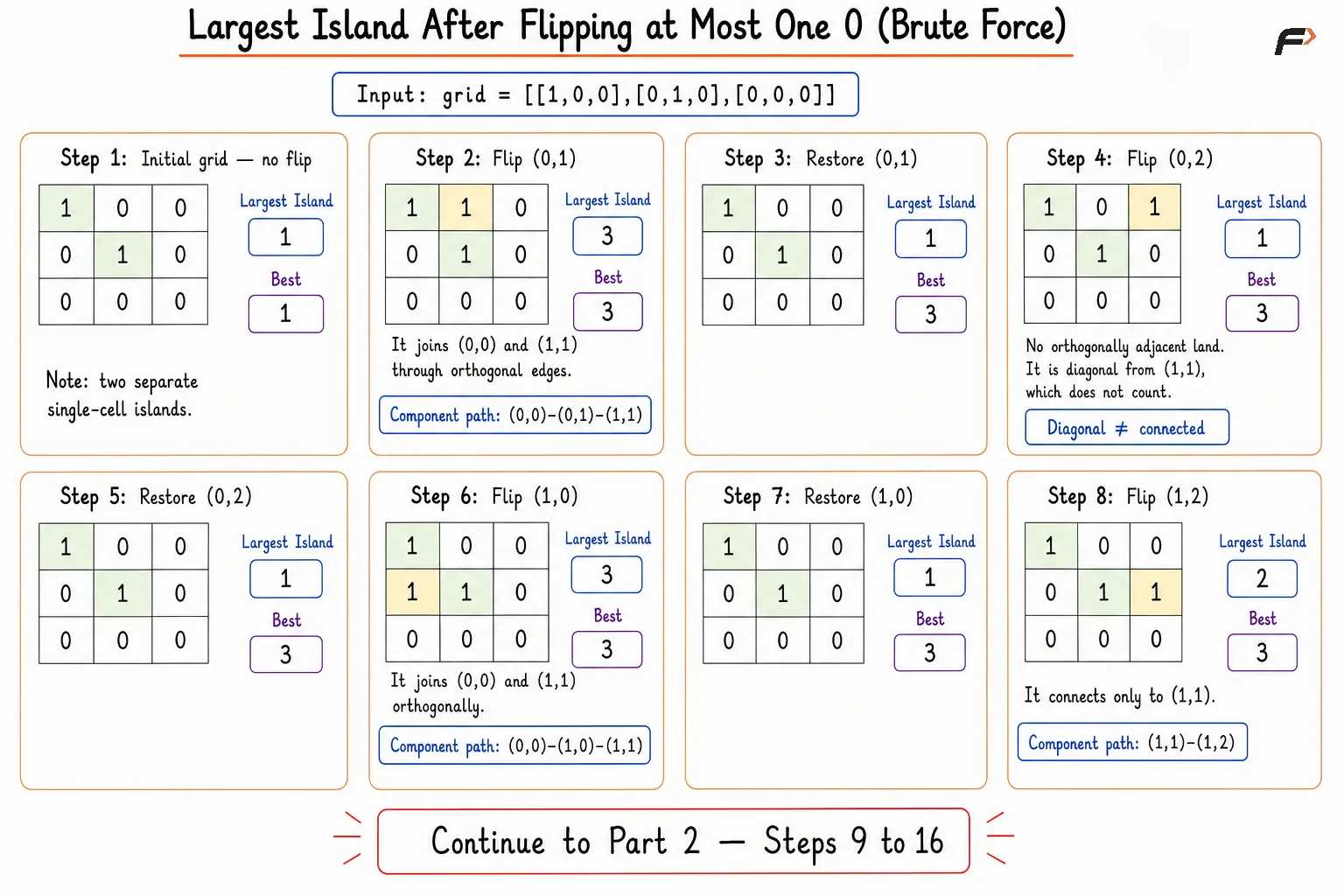
Diagram 1
Solution
#include <bits/stdc++.h>using namespace std;class Solution {private: // Function to count one island after a candidate flip. int dfs(int row, int col, vector<vector<int>>& grid, vector<vector<int>>& visited) { int n = grid.size(); // Stop for invalid cells, water cells, and already counted cells. if (row < 0 || col < 0 || row >= n || col >= n || grid[row][col] == 0 || visited[row][col] == 1) { return 0; } // Mark current land cell as counted. visited[row][col] = 1; // Count current cell and four neighboring directions. int area = 1; area += dfs(row - 1, col, grid, visited); area += dfs(row + 1, col, grid, visited); area += dfs(row, col - 1, grid, visited); area += dfs(row, col + 1, grid, visited); // Return island area for current DFS. return area; } // Function to compute largest island for the current grid. int largestCurrentIsland(vector<vector<int>>& grid) { int n = grid.size(); int best = 0; vector<vector<int>> visited(n, vector<int>(n, 0)); // Traverse every cell and count unvisited islands. for (int row = 0; row < n; row++) { for (int col = 0; col < n; col++) { if (grid[row][col] == 1 && visited[row][col] == 0) { best = max(best, dfs(row, col, grid, visited)); } } } // Return largest island found. return best; }public: // Function to find largest island by trying every zero flip. int largestIsland(vector<vector<int>>& grid) { int n = grid.size(); int answer = largestCurrentIsland(grid); bool hasZero = false; // Try every zero as a flip candidate. for (int row = 0; row < n; row++) { for (int col = 0; col < n; col++) { if (grid[row][col] == 0) { hasZero = true; grid[row][col] = 1; answer = max(answer, largestCurrentIsland(grid)); grid[row][col] = 0; } } } // Return full grid size for all-land grid. if (!hasZero) { return n * n; } // Return best area after at most one flip. return answer; }};// Driver code.int main() { vector<vector<int>> grid = {{1, 0}, {0, 1}}; Solution sol; cout << sol.largestIsland(grid); return 0;}Complexity Analysis
Time Complexity: O((N×N)²), where N×N is the total number of cells; each water candidate can require a complete N×N grid traversal.
Space Complexity: O(N×N), where the visited matrix and recursive DFS stack can each store up to N×N cells.
Optimal Approach 1
Every existing island receives a unique identifier, starting from 2 to avoid conflict with the original water value 0 and land value 1. DFS replaces each island cell with the identifier and records the corresponding area.
For every water cell, a set collects unique neighboring island identifiers. Adding the areas of such islands with one converted cell produces the largest island obtainable from the candidate flip.
Algorithm
Initialize the island identifier to
2, an area map for storing island sizes, and a maximum-area variable for tracking the answer.Traverse the grid and start DFS from every cell containing
1, allowing each unprocessed island to be discovered independently.During DFS, replace every connected land cell with the current island identifier and count the visited cells, permanently labeling the complete component.
Store the calculated area against the island identifier and increment the identifier for the next island.
Traverse every water cell and collect the identifiers of adjacent islands in a set, preventing the same island from being counted through multiple neighboring cells.
Calculate the candidate area as
1for the converted cell plus the stored areas of all unique neighboring islands, then update the maximum area.Return
N×Nwhen the grid contains no water; otherwise, return the maximum candidate area.
Dry Run
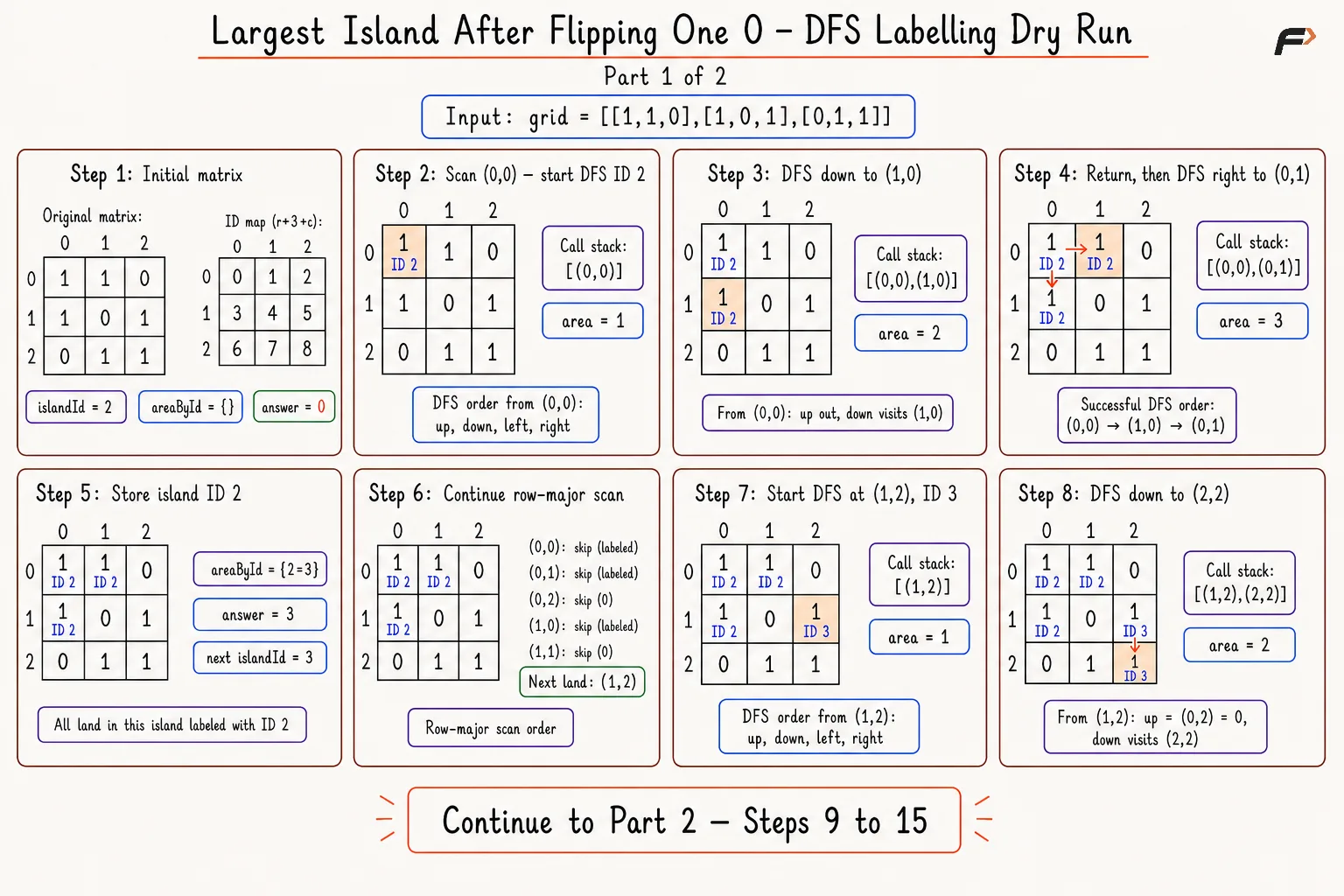
Diagram 1
Solution
#include <bits/stdc++.h>using namespace std;class Solution {private: // Function to label one island and return area. int dfs(int row, int col, vector<vector<int>>& grid, int islandId) { int n = grid.size(); // Stop for invalid cells and non-land cells. if (row < 0 || col < 0 || row >= n || col >= n || grid[row][col] != 1) { return 0; } // Replace land with island id. grid[row][col] = islandId; // Count current cell and all connected land cells. int area = 1; area += dfs(row - 1, col, grid, islandId); area += dfs(row + 1, col, grid, islandId); area += dfs(row, col - 1, grid, islandId); area += dfs(row, col + 1, grid, islandId); return area; }public: // Function to find largest island using component labels. int largestIsland(vector<vector<int>>& grid) { int n = grid.size(); unordered_map<int, int> areaById; int islandId = 2; int answer = 0; bool hasZero = false; vector<int> deltaRow = {-1, 1, 0, 0}; vector<int> deltaCol = {0, 0, -1, 1}; // Label every existing island with a unique id. for (int row = 0; row < n; row++) { for (int col = 0; col < n; col++) { if (grid[row][col] == 1) { int area = dfs(row, col, grid, islandId); areaById[islandId] = area; answer = max(answer, area); islandId++; } } } // Try every zero and merge unique neighboring islands. for (int row = 0; row < n; row++) { for (int col = 0; col < n; col++) { if (grid[row][col] != 0) { continue; } hasZero = true; unordered_set<int> seen; int mergedArea = 1; for (int dir = 0; dir < 4; dir++) { int nextRow = row + deltaRow[dir]; int nextCol = col + deltaCol[dir]; if (nextRow >= 0 && nextCol >= 0 && nextRow < n && nextCol < n && grid[nextRow][nextCol] > 1) { seen.insert(grid[nextRow][nextCol]); } } for (int id : seen) { mergedArea += areaById[id]; } answer = max(answer, mergedArea); } } // Return full grid area when no zero exists. if (!hasZero) { return n * n; } // Return maximum possible island area. return answer; }};// Driver code.int main() { vector<vector<int>> grid = {{1, 1}, {1, 0}}; Solution sol; cout << sol.largestIsland(grid); return 0;}Complexity Analysis
Time Complexity: O(N×N), where N is the grid dimension; island labeling and flip evaluation each process every cell a constant number of times.
Space Complexity: O(N×N), where the recursive DFS stack and island-area map can collectively store information for up to N×N cells.
Optimal Approach 2
Disjoint Set Union groups adjacent land cells into connected components before evaluating any flip. A cell at row r and column c maps to the one-dimensional identifier r×N+c.
For every water cell, a set stores the unique representatives of neighboring land components. The potential island area equals one converted cell plus the sizes of all distinct neighboring components.
Algorithm
Initialize DSU
parentandsizearrays for allN×Ncells, along with four-direction arrays for adjacent-cell traversal.Traverse every grid cell, map
(row, col)torow×N+col, and record the presence of water while skipping union operations for water cells.For every land cell, inspect all four directions and merge every valid neighboring land cell. Duplicate connection checks remain harmless because
unitereturns when both nodes already share a representative.Return
N×Nwhen no water cell exists, as the entire grid already forms the largest possible island.Traverse every water cell and collect the DSU representatives of all four neighboring land cells in a set, preventing duplicate component counting.
Calculate the candidate area as
1plus the sizes of all unique neighboring components, then update the maximum area.Return the largest candidate area after every water cell has been evaluated.
Dry Run
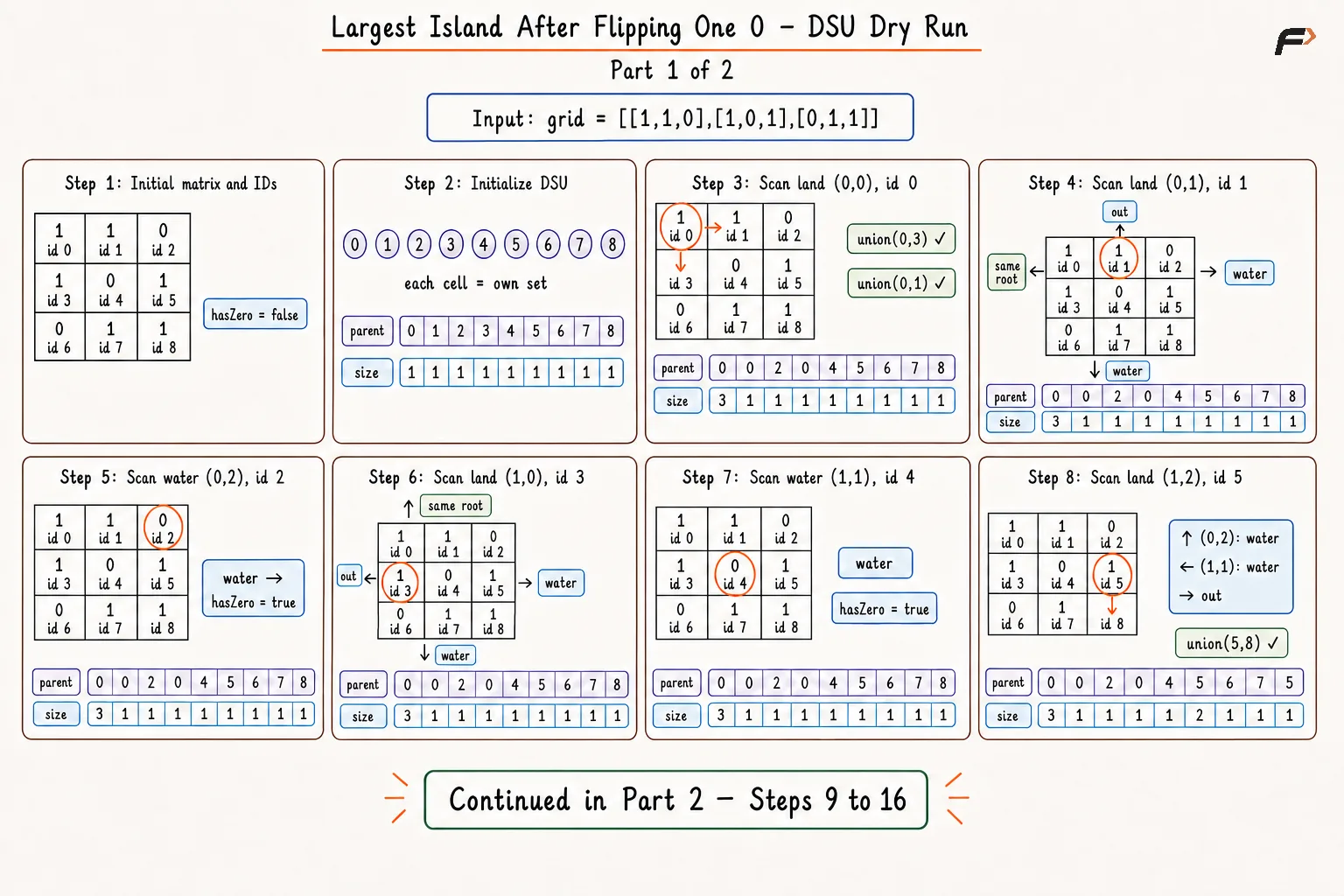
Diagram 1
Solution
#include <bits/stdc++.h>using namespace std;class Solution {private: // Function to find representative with path compression. int findParent(int node, vector<int>& parent) { if (parent[node] == node) { return node; } parent[node] = findParent(parent[node], parent); return parent[node]; } // Function to merge two land components. void unite(int first, int second, vector<int>& parent, vector<int>& size) { int parentFirst = findParent(first, parent); int parentSecond = findParent(second, parent); if (parentFirst == parentSecond) { return; } if (size[parentFirst] < size[parentSecond]) { swap(parentFirst, parentSecond); } parent[parentSecond] = parentFirst; size[parentFirst] += size[parentSecond]; }public: // Function to find largest island using DSU. int largestIsland(vector<vector<int>>& grid) { int n = grid.size(); int total = n * n; vector<int> parent(total); vector<int> size(total, 1); vector<int> deltaRow = {-1, 1, 0, 0}; vector<int> deltaCol = {0, 0, -1, 1}; bool hasZero = false; // Initialize each cell as a separate component. for (int node = 0; node < total; node++) { parent[node] = node; } // Merge adjacent land cells. for (int row = 0; row < n; row++) { for (int col = 0; col < n; col++) { if (grid[row][col] == 0) { hasZero = true; continue; } int current = row * n + col; for (int dir = 0; dir < 4; dir++) { int nextRow = row + deltaRow[dir]; int nextCol = col + deltaCol[dir]; if (nextRow >= 0 && nextCol >= 0 && nextRow < n && nextCol < n && grid[nextRow][nextCol] == 1) { unite(current, nextRow * n + nextCol, parent, size); } } } } if (!hasZero) { return total; } int answer = 1; // Try every zero and combine neighboring DSU components. for (int row = 0; row < n; row++) { for (int col = 0; col < n; col++) { if (grid[row][col] != 0) { continue; } unordered_set<int> seen; int mergedArea = 1; for (int dir = 0; dir < 4; dir++) { int nextRow = row + deltaRow[dir]; int nextCol = col + deltaCol[dir]; if (nextRow >= 0 && nextCol >= 0 && nextRow < n && nextCol < n && grid[nextRow][nextCol] == 1) { seen.insert(findParent(nextRow * n + nextCol, parent)); } } for (int root : seen) { mergedArea += size[root]; } answer = max(answer, mergedArea); } } return answer; }};// Driver code.int main() { vector<vector<int>> grid = {{1, 1}, {1, 1}}; Solution sol; cout << sol.largestIsland(grid); return 0;}Complexity Analysis
Time Complexity: O(N×N×α(N×N)), where N×N is the cell count and α is the inverse Ackermann cost of each optimized DSU operation.
Space Complexity: O(N×N), where the DSU parent and size arrays store one entry for every grid cell.
Interview follow-up Questions
Yes. A set of island ids prevents double-counting the same island.
Be the first to add a comment.