Introduction to DFS Traversals
Depth-First Search, or DFS, is a traversal technique that explores one branch of a tree as deeply as possible before backtracking to explore another branch.
In a binary tree, every node can have a left child and a right child. DFS starts from the root and recursively explores these subtrees.
The three fundamental DFS traversals are:
Preorder: Root → Left → Right
Inorder: Left → Root → Right
Postorder: Left → Right → Root
The difference between them is the moment at which the current node is processed.
Consider a binary tree with the following relationships:
Node
1is the root.Nodes
2and3are the left and right children of1.Nodes
4and5are the children of2.Nodes
6and7are the children of3.
Its DFS traversal orders are:
Traversal | Order |
|---|---|
Preorder |
|
Inorder |
|
Postorder |
|
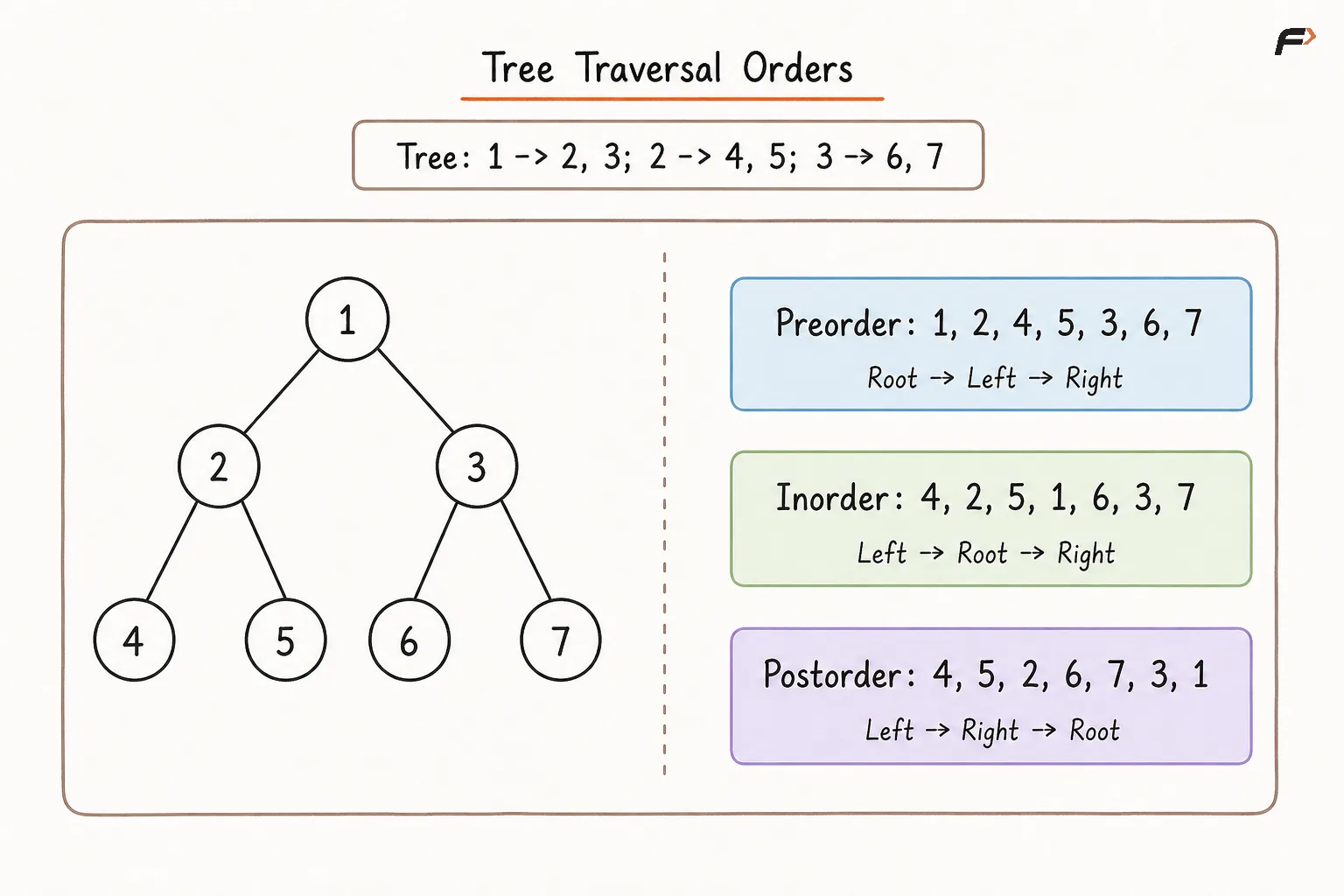
Tree Traversal Orders.png
How Does DFS Work?
DFS follows the recursive structure of a binary tree.
For every node:
Process the current node at the required moment.
Explore its left subtree.
Explore its right subtree.
Return to its parent after both required subtrees are complete.
Whenever a NULL node is reached, that branch has ended, so traversal returns to the previous node.
This return to a previous node is called backtracking.
A recursive DFS uses the program’s call stack to remember:
The current node
Which subtree is being explored
Where execution must continue after a recursive call returns
An iterative DFS stores the same information explicitly inside a stack.
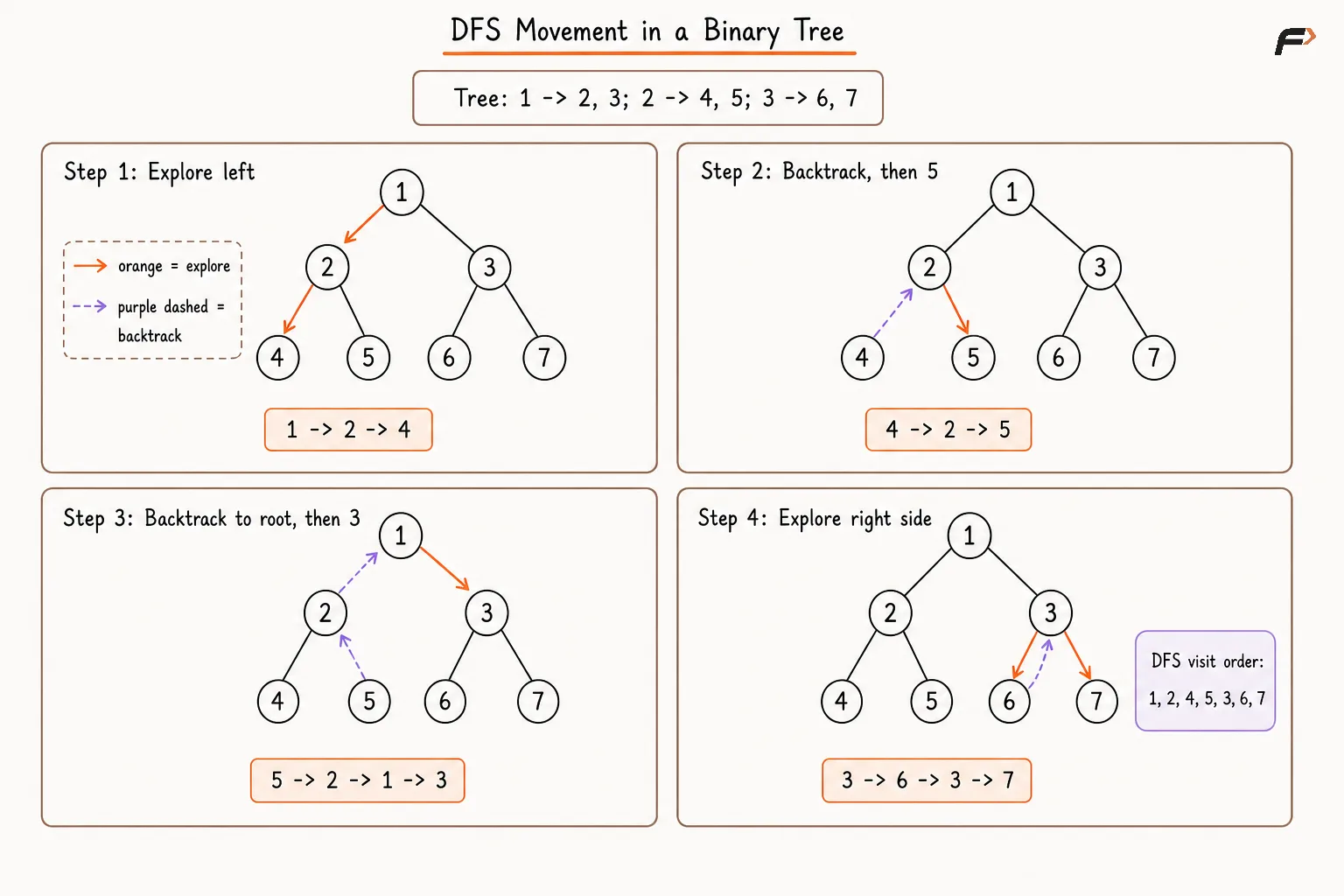
DFS Movement in a Binary Tree.png
The Three-Moment Mental Model
Every node has three important moments during DFS:
Entry: The traversal reaches the node before exploring either subtree.
Between: The left subtree is complete, but the right subtree has not yet been explored.
Exit: Both subtrees are complete, and traversal is about to return to the parent.
These moments directly define the three DFS traversals:
Moment of Processing | Traversal |
|---|---|
Entry into the node | Preorder |
Between the left and right subtrees | Inorder |
Exit from the node | Postorder |
A useful way to remember the orders is to observe where Root appears:
Preorder: Root comes before both subtrees.
Inorder: Root comes in between the subtrees.
Postorder: Root comes after both subtrees.
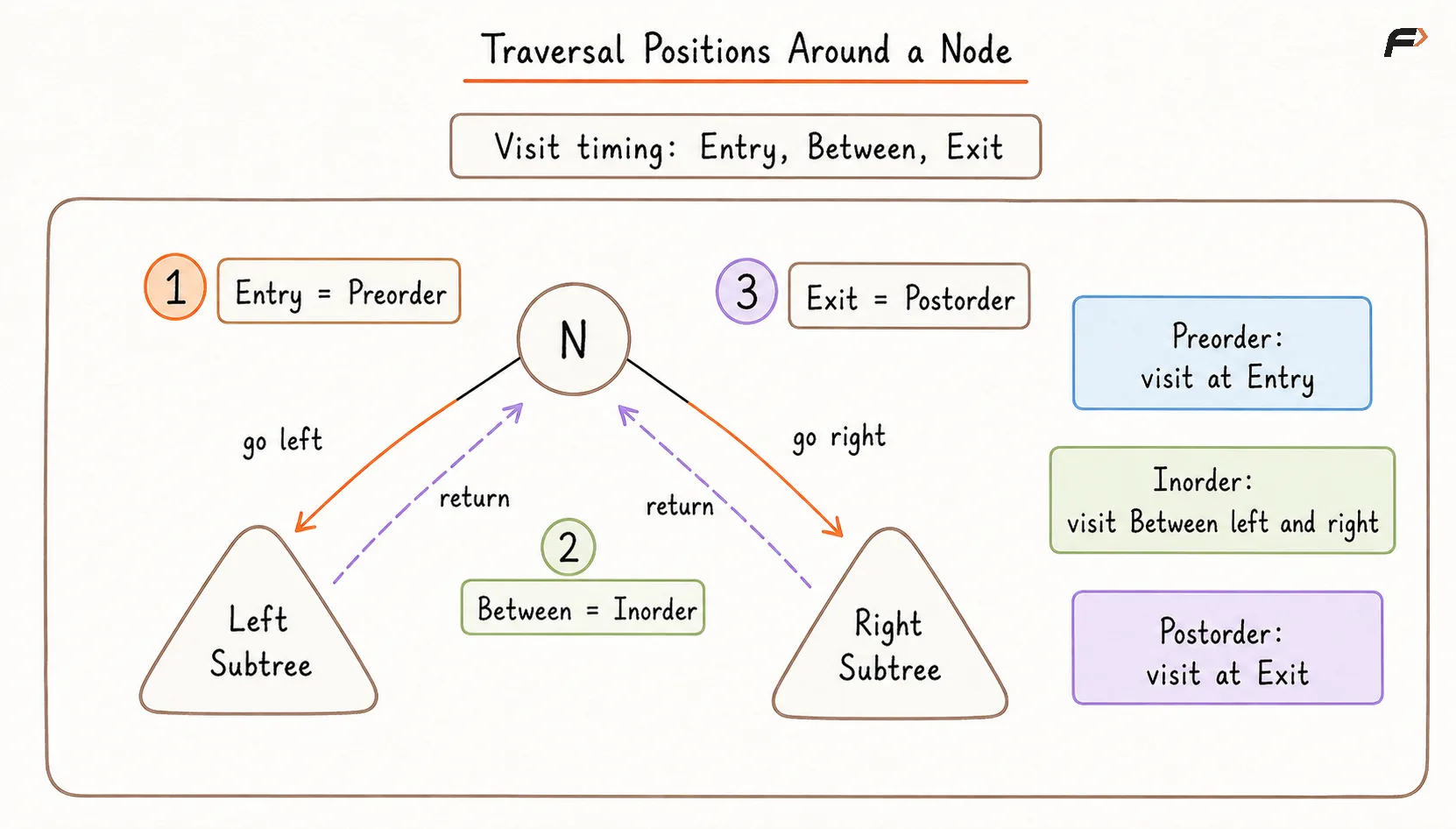
Traversal Positions Around a Node.png
Recursive DFS Structure
Every recursive DFS traversal follows the same basic structure:
Stop when the current node is
NULL.Recursively explore the left subtree.
Recursively explore the right subtree.
Process the root before, between, or after these recursive calls.
Only the processing position changes between preorder, inorder, and postorder.
Because every subtree is itself a binary tree, the same procedure can be applied repeatedly until leaf nodes and then NULL references are reached.
1. Preorder Traversal
Preorder follows:
Root → Left → Right
The current node is processed immediately when it is entered.
Example
Using the example tree:
Visit root
1.Traverse the left subtree rooted at
2.Visit
2, followed by4and5.Traverse the right subtree rooted at
3.Visit
3, followed by6and7.
The preorder traversal is:
1, 2, 4, 5, 3, 6, 7
Algorithm
Check whether the current node is
NULL; if so, return because the branch has ended.Process the current node before visiting either of its children.
Recursively traverse the left subtree.
Recursively traverse the right subtree.
Return after both subtrees have been processed.
Common Uses
Preorder traversal is useful for:
Creating a copy of a tree
Serializing a tree with structural markers
Generating prefix expressions
Processing a parent before its children
Recording root-to-node paths
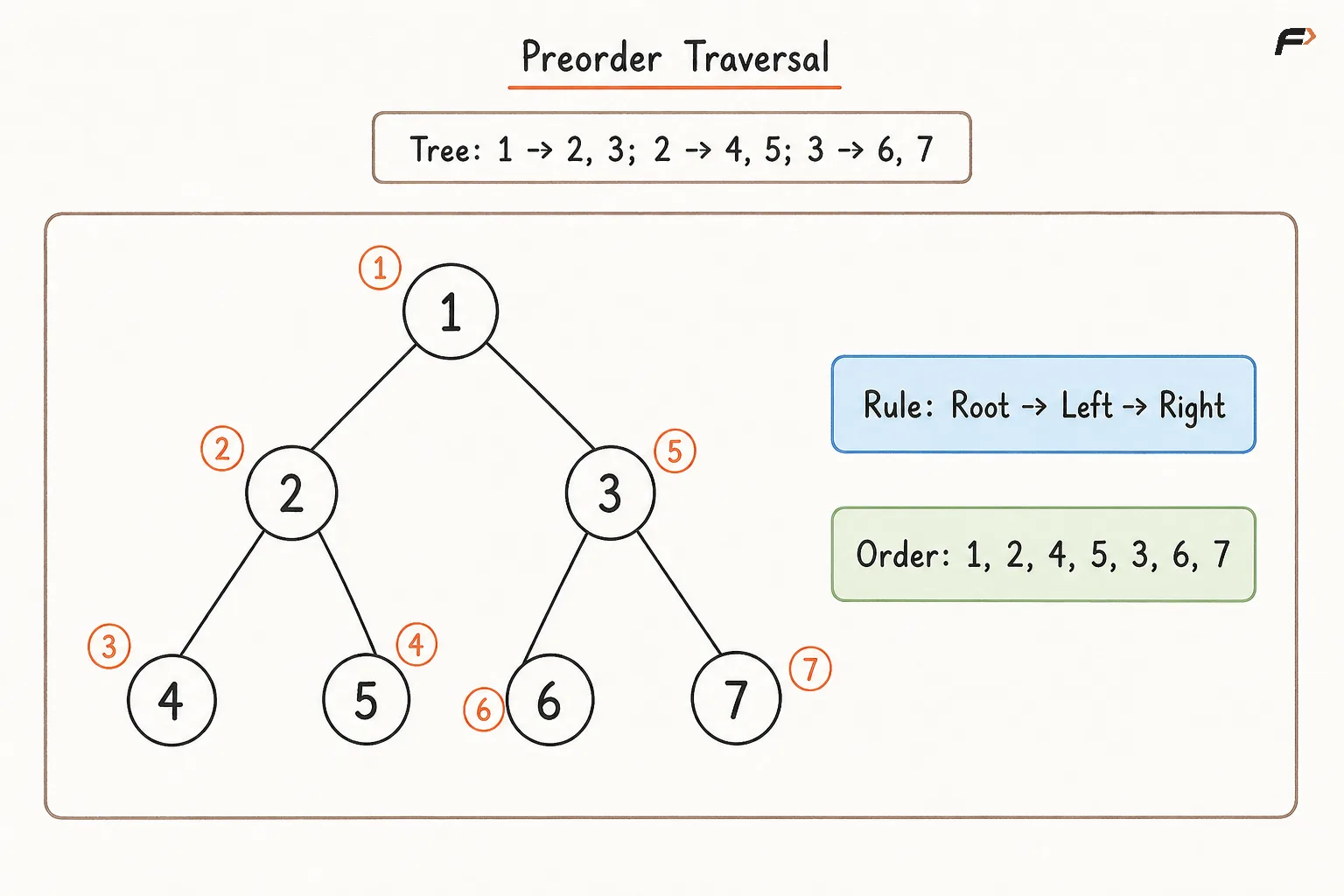
Preorder Traversal.png
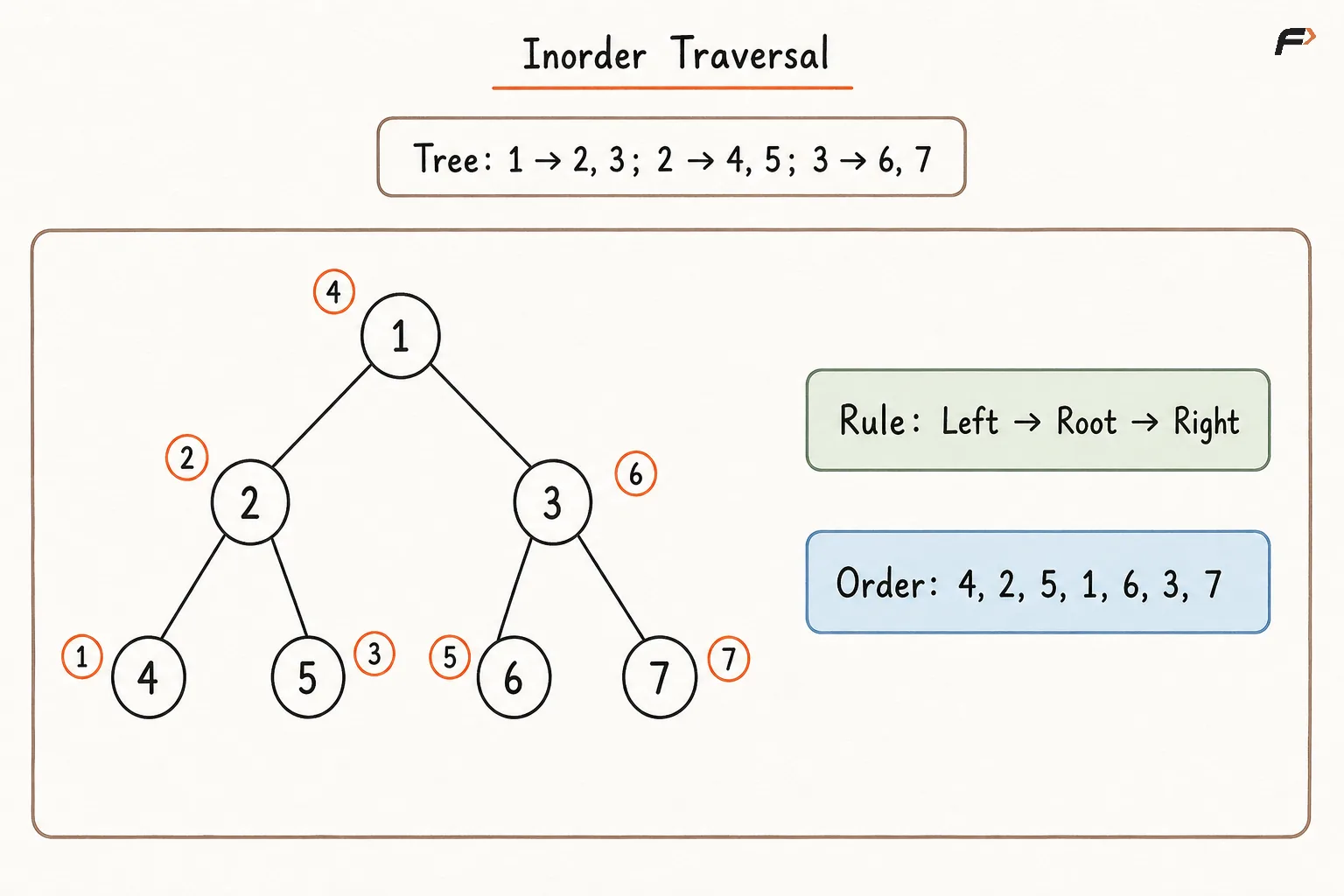
2. Inorder Traversal
Inorder follows:
Left → Root → Right
The current node is processed after its left subtree but before its right subtree.
Example
Using the example tree:
Traverse the left subtree of
1.Visit
4, then2, then5.Process root
1.Traverse the right subtree.
Visit
6, then3, then7.
The inorder traversal is:
4, 2, 5, 1, 6, 3, 7
Algorithm
Check whether the current node is
NULL; if so, return because the branch has ended.Recursively traverse the left subtree.
Process the current node after the left subtree is complete.
Recursively traverse the right subtree.
Return after the right subtree has been processed.
Common Uses
Inorder traversal is useful for:
Retrieving values of a Binary Search Tree in sorted order
Processing values between the left and right subtrees
Generating infix expressions from expression trees
Finding ordered relationships in a Binary Search Tree
Inorder traversal does not produce sorted values for a general binary tree. The sorted result depends on the ordering property of a Binary Search Tree.
Inorder Traversal.png
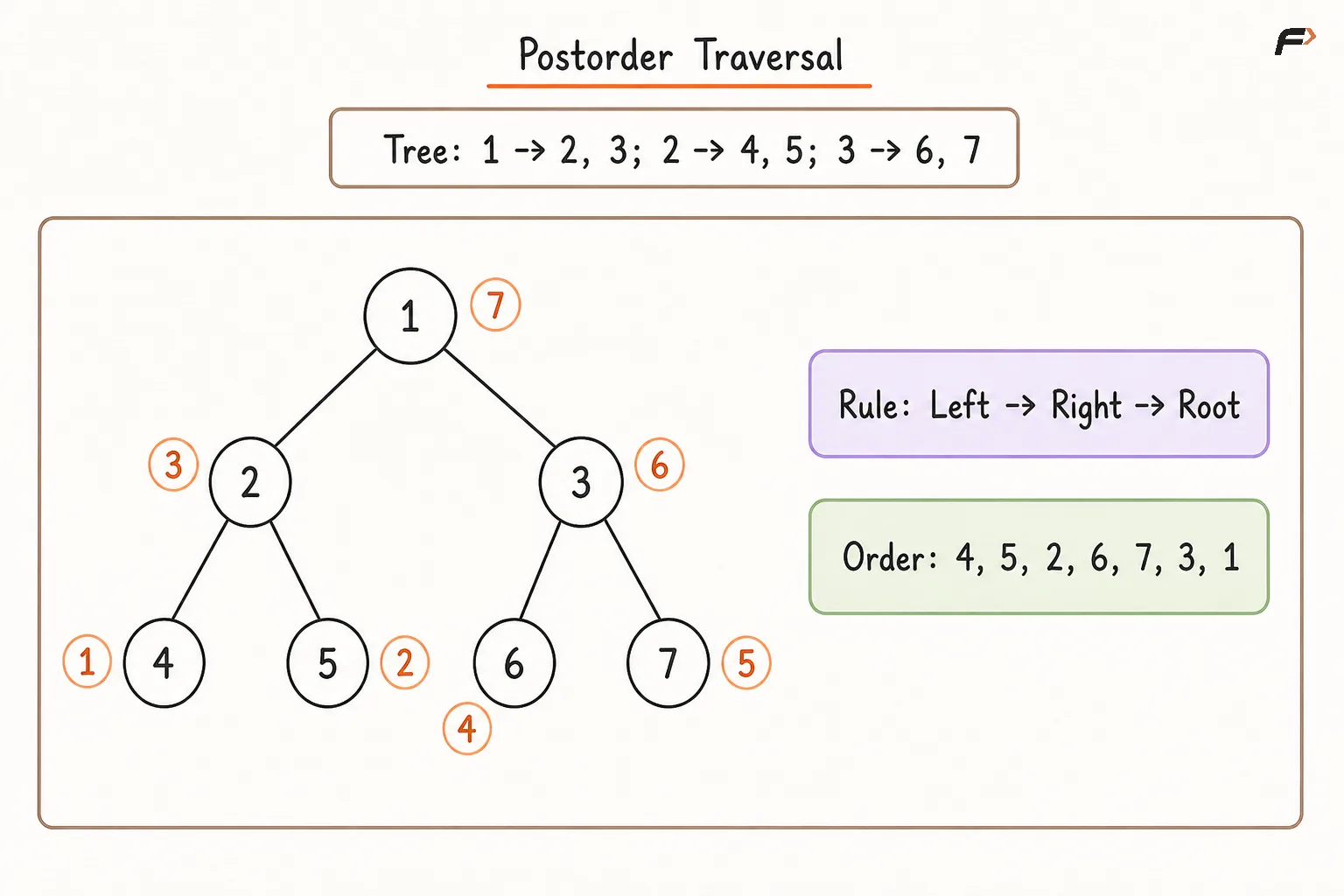
3. Postorder Traversal
Postorder follows:
Left → Right → Root
The current node is processed only after both of its subtrees are complete.
Example
Using the example tree:
Traverse the left subtree of
1.Visit
4and5before processing2.Traverse the right subtree.
Visit
6and7before processing3.Process root
1after both complete subtrees.
The postorder traversal is:
4, 5, 2, 6, 7, 3, 1
Algorithm
Check whether the current node is
NULL; if so, return because the branch has ended.Recursively traverse the left subtree.
Recursively traverse the right subtree.
Process the current node after both subtrees are complete.
Return to the parent node.
Common Uses
Postorder traversal is useful for:
Deleting or freeing a tree
Calculating subtree heights
Checking whether a tree is balanced
Calculating tree diameter
Evaluating expression trees
Generating postfix expressions
Solving problems where a parent depends on results from both children
Postorder Traversal.png
Comparing the Three DFS Traversals
Traversal | Processing Position | Order | Typical Use |
|---|---|---|---|
Preorder | Before both subtrees | Root → Left → Right | Parent-first processing |
Inorder | Between the subtrees | Left → Root → Right | Sorted order in a BST |
Postorder | After both subtrees | Left → Right → Root | Child-first calculations |
The left subtree is explored before the right subtree in all three standard traversals. Only the processing position of the root changes.
Iterative DFS Using a Stack
Recursion automatically stores unfinished function calls in the call stack. An iterative traversal performs the same work using an explicit stack.
Iterative Preorder
To preserve Root → Left → Right order:
Push the root into the stack.
Remove the top node and process it.
Push its right child before its left child.
Continue until the stack becomes empty.
The right child is pushed first because a stack follows Last In, First Out order, causing the left child to be processed first.
Iterative Inorder
To preserve Left → Root → Right order:
Move through left children while storing the visited nodes in a stack.
When no further left child exists, remove the top node and process it.
Move to its right child.
Repeat until both the current node and stack are empty.
Iterative Postorder
Postorder can be implemented using:
Two stacks
One stack with previous-node tracking
One stack with a state value
The state-based method is especially useful because it can also generate preorder, inorder, and postorder together.
Preorder, Inorder, and Postorder in One Traversal
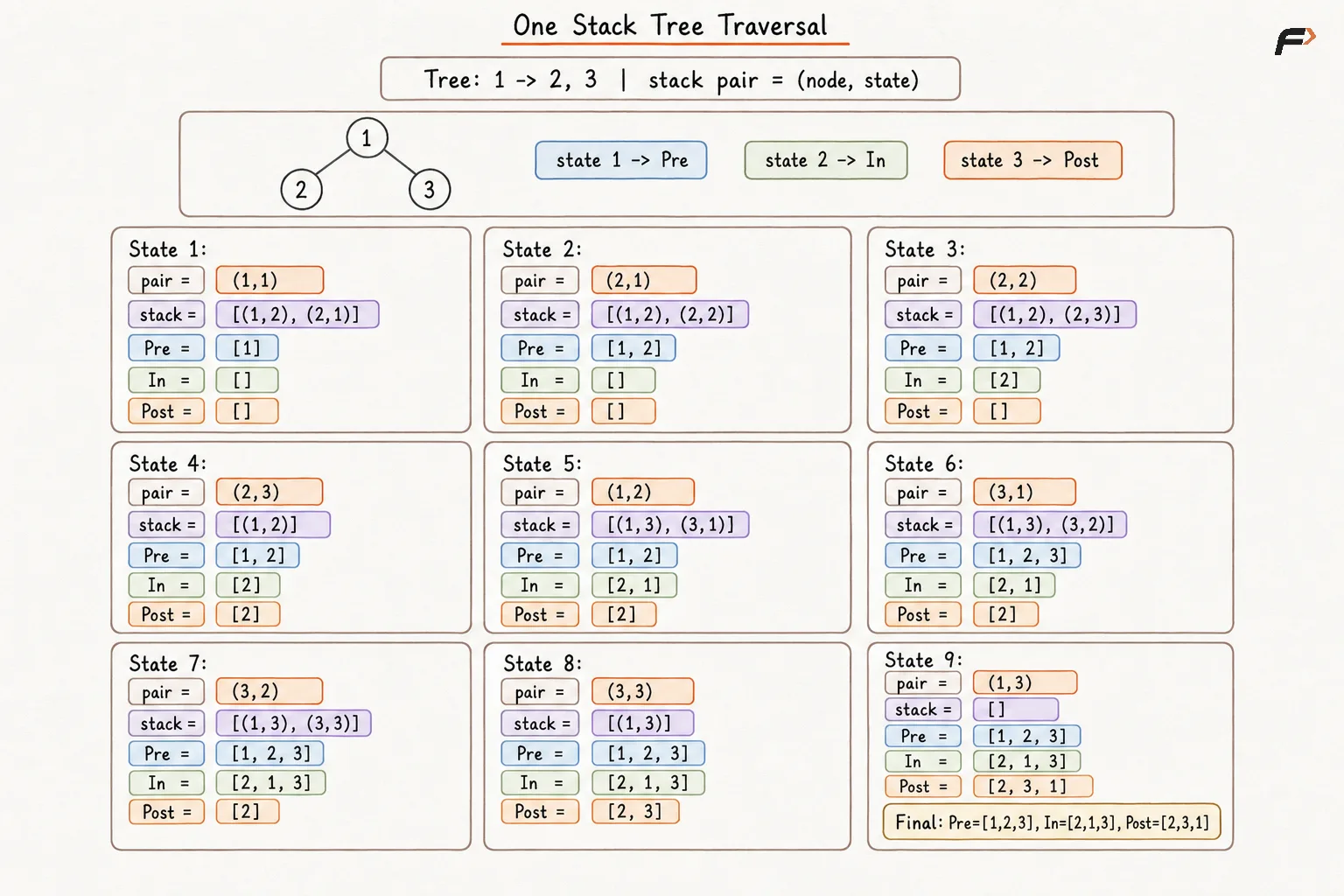
All three traversal orders can be generated during one iterative DFS using a stack of pairs:
(node, state)
The state describes which of the three moments has been reached for that node:
State | Meaning | Traversal Event |
|---|---|---|
| Entering the node | Add to preorder |
| Left subtree completed | Add to inorder |
| Right subtree completed | Add to postorder |
Each node progresses through:
State 1 → State 2 → State 3
State 1: Preorder Event
When a node is removed with state 1:
Add its value to the preorder result.
Change its state to
2and place it back into the stack because it must be revisited after its left subtree.If its left child exists, place the left child into the stack with state
1.
This follows:
Root → Left
State 2: Inorder Event
When a node is removed with state 2:
Add its value to the inorder result.
Change its state to
3and place it back into the stack because it must be revisited after its right subtree.If its right child exists, place the right child into the stack with state
1.
This occurs between:
Left → Root → Right
State 3: Postorder Event
When a node is removed with state 3:
Add its value to the postorder result.
Do not place the node back into the stack because both subtrees are complete.
This completes:
Left → Right → Root
Algorithm
Create empty preorder, inorder, and postorder result lists.
If the root is not
NULL, place(root, 1)into the stack.For state
1, record preorder, return the node with state2, and begin its left subtree.For state
2, record inorder, return the node with state3, and begin its right subtree.For state
3, record postorder because both subtrees are complete.Continue until the stack becomes empty, then return all three traversal orders.
Dry Run of All Three Traversals Together
Consider a smaller tree:
Node
1is the root.Node
2is its left child.Node
3is its right child.
Initial stack:
[(1, 1)]
Initial results:
Preorder = []
Inorder = []
Postorder = []
Step | Removed Pair | Action | Preorder | Inorder | Postorder |
|---|---|---|---|---|---|
1 |
| Record preorder and explore left |
|
|
|
2 |
| Record preorder |
|
|
|
3 |
| Record inorder |
|
|
|
4 |
| Record postorder |
|
|
|
5 |
| Record inorder and explore right |
|
|
|
6 |
| Record preorder |
|
|
|
7 |
| Record inorder |
|
|
|
8 |
| Record postorder |
|
|
|
9 |
| Record postorder |
|
|
|
Final results:
Preorder = [1, 2, 3]
Inorder = [2, 1, 3]
Postorder = [2, 3, 1]
One Stack Tree Traversal.png
Complexity Analysis
Complexity of Individual DFS Traversals
Each node is processed once in an individual traversal.
Time Complexity: O(N)
For recursive DFS, the call stack stores nodes along the current path.
Auxiliary Space Complexity: O(H)
where H is the height of the tree.
Balanced tree:
O(log N)Skewed tree:
O(N)
The output list requires O(N) additional space when the traversal result must be stored.
Complexity of All Three Traversals Together
Each node passes through three constant states.
The total work is:
3 × N
Ignoring the constant factor:
Time Complexity: O(N)
The stack stores nodes along the active traversal path.
Auxiliary Space Complexity: O(H)
The three output lists together contain 3N values, which simplifies to:
Output Space: O(N)
The combined traversal does not improve the asymptotic complexity compared with running three separate traversals. Its advantage is that all three orders are generated through one coordinated stack process.
Recursive and Iterative DFS Comparison
Recursive DFS | Iterative DFS |
|---|---|
Uses the call stack automatically | Uses an explicit stack |
Usually shorter and easier to understand | Provides direct control over stored states |
May cause stack overflow on a deep tree | Can avoid dependence on recursion depth |
Naturally matches the tree structure | Useful when recursion is restricted |
Auxiliary space is | Auxiliary space is generally |
Both methods perform the same logical traversal. The main difference is where the pending work is stored.
How to Choose the Correct DFS Traversal
Use preorder when:
The parent must be processed before its children.
A root-first representation is required.
A path must be built while moving downward.
Use inorder when:
Values of a Binary Search Tree are required in sorted order.
Processing must occur between the two subtrees.
An infix representation is required.
Use postorder when:
A node depends on information returned by its children.
Subtrees must be completed before the parent.
Height, diameter, balance, or subtree properties must be calculated.
Use the combined traversal when:
All three orders are required.
A single explicit-stack process is preferred.
The three node-processing moments need to be demonstrated or recorded.
Common Mistakes
Forgetting the
NULLbase case in recursive traversal.Processing the node at the wrong position.
Confusing preorder with inorder or postorder.
Assuming inorder traversal is sorted for every binary tree.
Pushing the left child before the right child in iterative preorder, causing the right subtree to be processed first.
Forgetting to store nodes while moving left in iterative inorder.
Recording a node in postorder before both subtrees are complete.
Forgetting to update the state before placing a node back into the combined stack.
Adding a node to multiple traversal lists during the same state.
Ignoring the
O(N)recursion depth of a skewed tree.Including output storage inside auxiliary space without stating the convention.
Treating
3Nwork in the combined traversal as a different asymptotic complexity fromO(N).
Interview follow-up Questions
Think of the three moments around a node. Process it on entry for preorder, between the left and right subtrees for inorder, and on exit for postorder.
Be the first to add a comment.