Given head of a singly linked list, return data value present at middle node. For an even number of nodes, return data value from second middle node.
A linked list contains at least one node. Node data can be any valid integer.
Example 1
Input: head = [1, 2, 3, 4, 5]
Output: 3
Explanation: Linked list length equals 5, so middle position equals 3.
Example 2
Input: head = [1, 2, 3, 4, 5, 6]
Output: 4
Explanation: Linked list length equals 6. Two central positions are 3 and 4, so second middle value equals 4.
Approach 1
In this approach, we first count the total number of nodes in the linked list. Once the length is known, the middle node can be found by moving length / 2 steps from the head.
For an odd-length linked list, this reaches the unique middle node. For an even-length linked list, integer division naturally points to the second middle node, which matches the required output.
Algorithm
Traverse the linked list once to count the total number of nodes, as the middle position depends on the list length.
Compute the middle position as
count / 2, since integer division gives the required middle index for both even and odd-sized lists.Reset the traversal pointer to
head, as the second traversal needs to begin from the start of the list.Move the pointer
count / 2steps forward, which places it at the middle node according to the required indexing.Return the data stored in the current node, as the pointer now represents the middle element of the linked list.
Dry Run
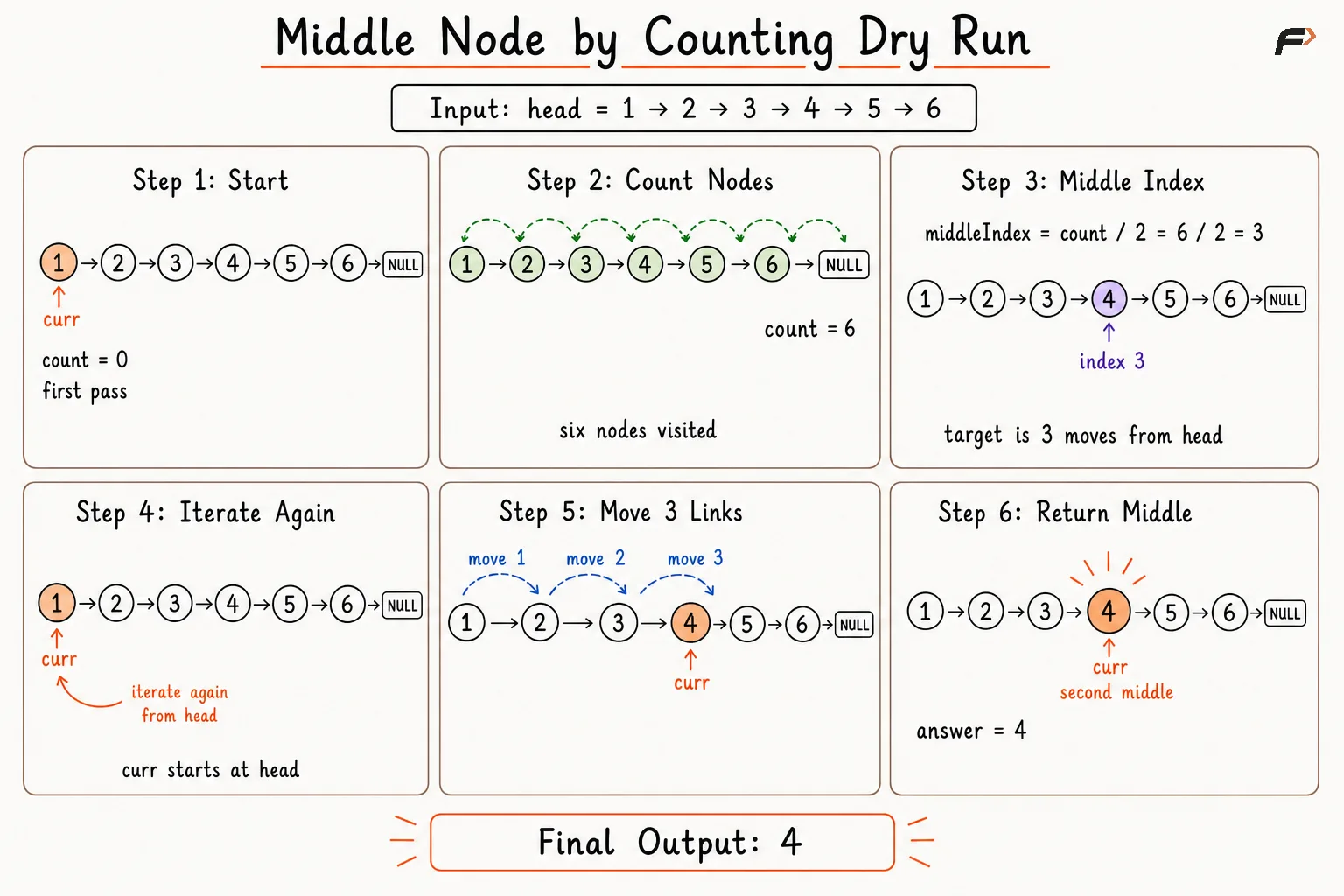
middle of a ll
Solution
#include <bits/stdc++.h>using namespace std;class ListNode {public: int data; ListNode* next; // Constructor for a linked list node ListNode(int value) : data(value), next(nullptr) {}};class Solution {public: // Function to find middle node data using node counting int findMiddle(ListNode* head) { if(!head) return -1; // Count total nodes in linked list int count = 0; ListNode* temp = head; while (temp != nullptr) { count++; temp = temp->next; } // Move to second middle position for even length int middleIndex = count / 2; temp = head; while (middleIndex > 0) { temp = temp->next; middleIndex--; } // Return middle node data return temp->data; }};// Function to build linked list from valuesListNode* buildList(vector<int>& values) { ListNode* head = new ListNode(values[0]); ListNode* tail = head; for (int i = 1; i < (int)values.size(); i++) { tail->next = new ListNode(values[i]); tail = tail->next; } return head;}// Driver codeint main() { vector<int> values = {1, 2, 3, 4, 5, 6}; ListNode* head = buildList(values); Solution sol; cout << sol.findMiddle(head) << endl; return 0;}Complexity Analysis
Time Complexity: O(N), linked list traversal occurs twice across N nodes.
Space Complexity: O(1), only constant extra pointer and counter variables are used.
Approach 2
The slow and fast pointer technique finds the middle of a linked list in a single traversal. The slow pointer moves one node at a time, while the fast pointer moves two nodes at a time. When the fast pointer reaches the end of the list, the slow pointer is positioned at the middle node. For even-length linked lists, this method naturally returns the second middle node.
Algorithm
Initialize two pointers,
slowandfast, athead, whereslowmoves one step at a time andfastmoves twice as fast.Traverse while
fastandfast->nextare notNULL, as this allowsfastto reach the end whileslowmoves toward the middle.Move
slowone step andfasttwo steps in each iteration, so whenfastreaches the end,slowhas reached the middle position.Return the data stored in
slow, as it now represents the middle node of the linked list.
Dry Run
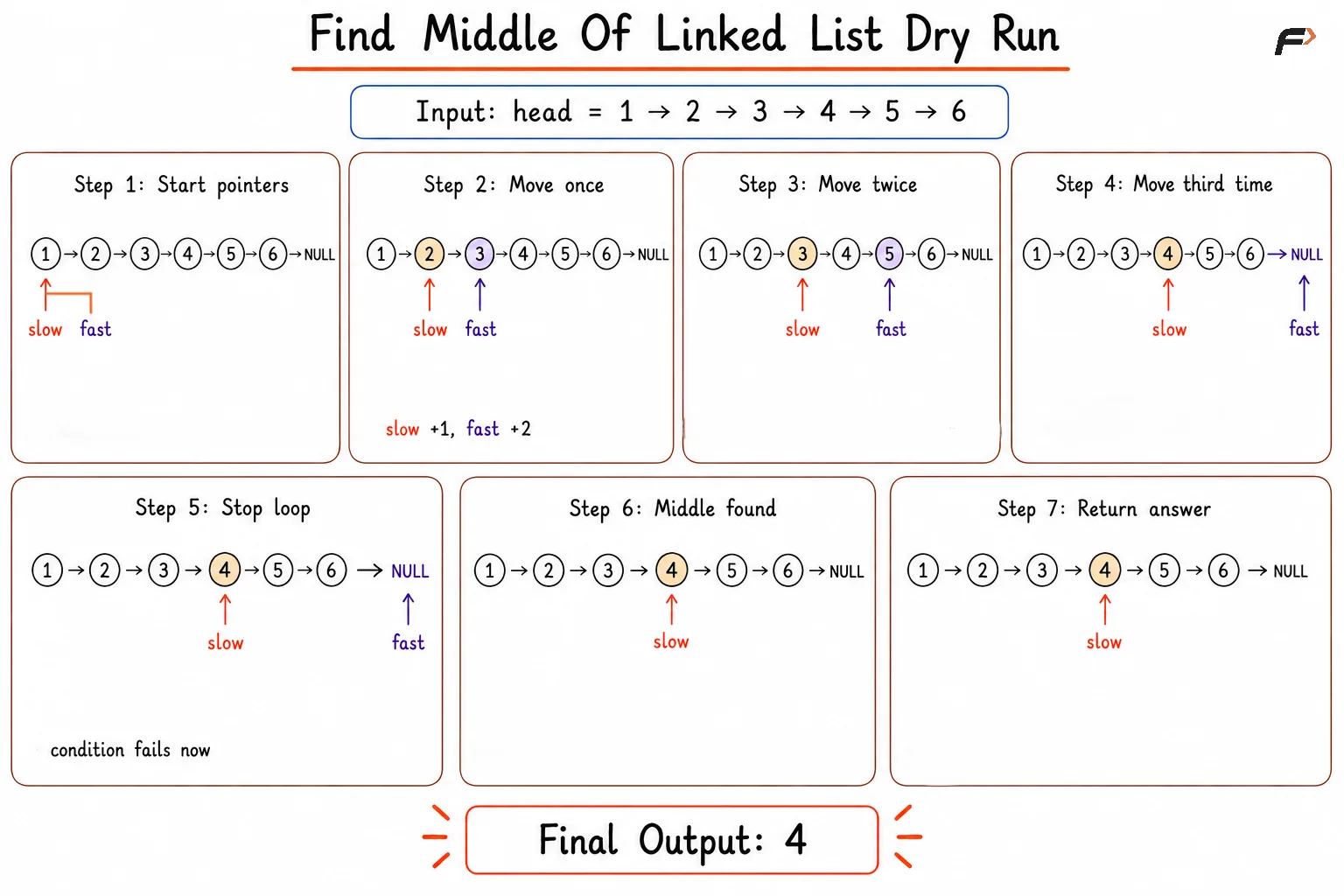
find middle of ll slow fast
Solution
#include <bits/stdc++.h>using namespace std;class ListNode {public: int data; ListNode* next; // Constructor for a linked list node ListNode(int value) : data(value), next(nullptr) {}};class Solution {public: // Function to find middle node data using two pointers int findMiddle(ListNode* head) { // Move fast pointer two steps and slow pointer one step ListNode* slow = head; ListNode* fast = head; while (fast != nullptr && fast->next != nullptr) { slow = slow->next; fast = fast->next->next; } // Return middle node data return slow->data; }};// Function to build linked list from valuesListNode* buildList(vector<int>& values) { ListNode* head = new ListNode(values[0]); ListNode* tail = head; for (int i = 1; i < (int)values.size(); i++) { tail->next = new ListNode(values[i]); tail = tail->next; } return head;}// Driver codeint main() { vector<int> values = {1, 2, 3, 4, 5, 6}; ListNode* head = buildList(values); Solution sol; cout << sol.findMiddle(head) << endl; return 0;}Complexity Analysis
Time Complexity: O(N), linked list traversal visits at most N nodes through pointer movement.
Space Complexity: O(1), only two extra pointers are used.
Interview follow-up Questions
Second middle node is returned for even length. For [1, 2, 3, 4, 5, 6], answer equals 4.
Be the first to add a comment.