Given a sorted doubly linked list containing positive distinct integers and an integer target, find every pair of node values whose sum equals target. Return pairs in increasing order based on the first value of each pair.
A doubly linked list node contains a value, a next pointer, and a previous pointer. Sorted order enables movement from both ends during the optimal solution.
Example 1
Input: DLL = [1, 2, 4, 5, 6, 8], target = 7
Output: [[1, 6], [2, 5]]
Explanation: Values 1 and 6 form sum 7. Values 2 and 5 also form sum 7.
Example 2
Input: DLL = [1, 3, 5, 7, 9], target = 10
Output: [[1, 9], [3, 7]]
Explanation: Values 1 and 9 form sum 10. Values 3 and 7 also form sum 10.
Brute Force Approach
A complement lookup can detect pair values during a single forward traversal. For every node value, target minus current value gives the needed partner. A hash set stores previously visited values, so a matching complement proves a valid pair.
Sorted output order still matters. Since complement matches can be discovered based on traversal order, collected pairs are sorted before returning. Knowledge of hash sets and pair sorting is enough for the hashing approach.
Algorithm
Initialize an empty
answerlist and a hash set, where the hash set stores previously visited values and the answer list stores the valid pairs.Traverse the doubly linked list from
headto tail, as every node value can potentially form a pair with a previously visited value.Calculate
complement = target - current->data, since this is the value required to make the current value sum to the target.If the complement already exists in the hash set, append the pair
{complement, current->data}toanswer, as both values have now been encountered and together satisfy the target sum.Insert
current->datainto the hash set, so it becomes available as a possible complement for subsequent nodes.Continue until the entire list has been traversed, ensuring all possible pairs are considered.
Sort
answerby the first value, as the pairs need to be returned in the required sorted order.Return
answerafter sorting, since it now contains all valid pairs in the expected order.
Dry Run
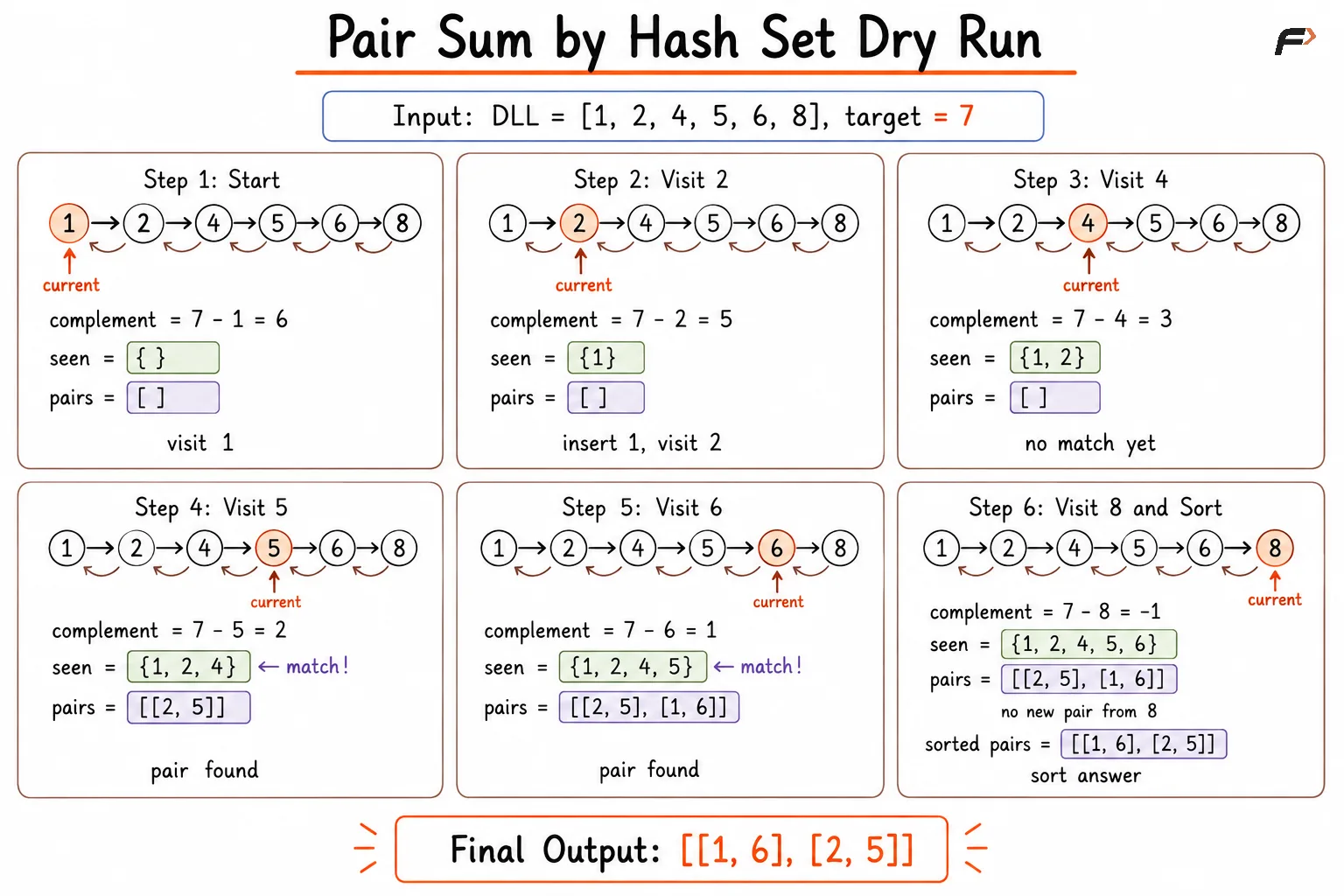
pair sum
Solution
#include <bits/stdc++.h>using namespace std;class Node {public: int data; Node* next; Node* prev; // Constructor for a doubly linked list node. Node(int value) { data = value; next = nullptr; prev = nullptr; }};class Solution {public: // Finds all pairs whose sum equals the target. vector<pair<int, int>> findPairsWithGivenSum(Node* head, int target) { vector<pair<int, int>> answer; unordered_set<int> seen; Node* current = head; // Traverse the list and search for the required complement. while (current != nullptr) { int complement = target - current->data; // Add the pair if its complement was already visited. if (seen.find(complement) != seen.end()) { answer.push_back({complement, current->data}); } seen.insert(current->data); current = current->next; } // Arrange pairs in increasing order. sort(answer.begin(), answer.end()); return answer; }};// Builds a doubly linked list from the given array.Node* buildList(vector<int>& values) { if (values.empty()) { return nullptr; } Node* head = new Node(values[0]); Node* tail = head; for (int index = 1; index < (int)values.size(); index++) { Node* node = new Node(values[index]); tail->next = node; node->prev = tail; tail = node; } return head;}// Driver code.int main() { vector<int> values = {1, 2, 4, 5, 6, 8}; int target = 7; Node* head = buildList(values); Solution solution; vector<pair<int, int>> result = solution.findPairsWithGivenSum(head, target); for (auto pairValue : result) { cout << pairValue.first << " " << pairValue.second << endl; } return 0;}Complexity Analysis
Time Complexity: O(N log N), traversal costs O(N) and sorting collected pairs costs up to O(N log N).
Space Complexity: O(N), hash set storage can contain every list value.
Optimal Approach
The sorted doubly linked list allows pair search from both ends. A left pointer starts at the head and a right pointer starts at the tail. Current sum decides the next movement because increasing the smaller side raises the sum and decreasing the larger side lowers the sum.
The previous pointer gives direct movement from tail toward head, so no extra container is required. The process naturally returns pairs in increasing first-value order because the left pointer only moves forward.
Algorithm
Return an empty list when
headisNULL, as there are no nodes available to form a pair.Initialize
leftatheadand moverightto the tail node, as the sorted list allows the pair search to begin from both extremes.Traverse while
leftandrighthave not met or crossed, since a valid pair requires two distinct nodes.Calculate
sumusing the values ofleftandright, as their combined value determines whether the current pair can satisfy the target.If
sumequals the target, add the pair to the answer and move both pointers inward, since the current pair is valid and neither node needs to be considered again.If
sumis smaller than the target, moveleftforward, as increasing the smaller value is what can raise the sum toward the target.If
sumis greater than the target, moverightbackward, as decreasing the larger value is what can bring the sum down toward the target.Continue until the pointers meet or cross, ensuring all possible valid pairs have been considered.
Return the collected pairs, which naturally appear in increasing order of their first value because
leftmoves only forward.
Dry Run
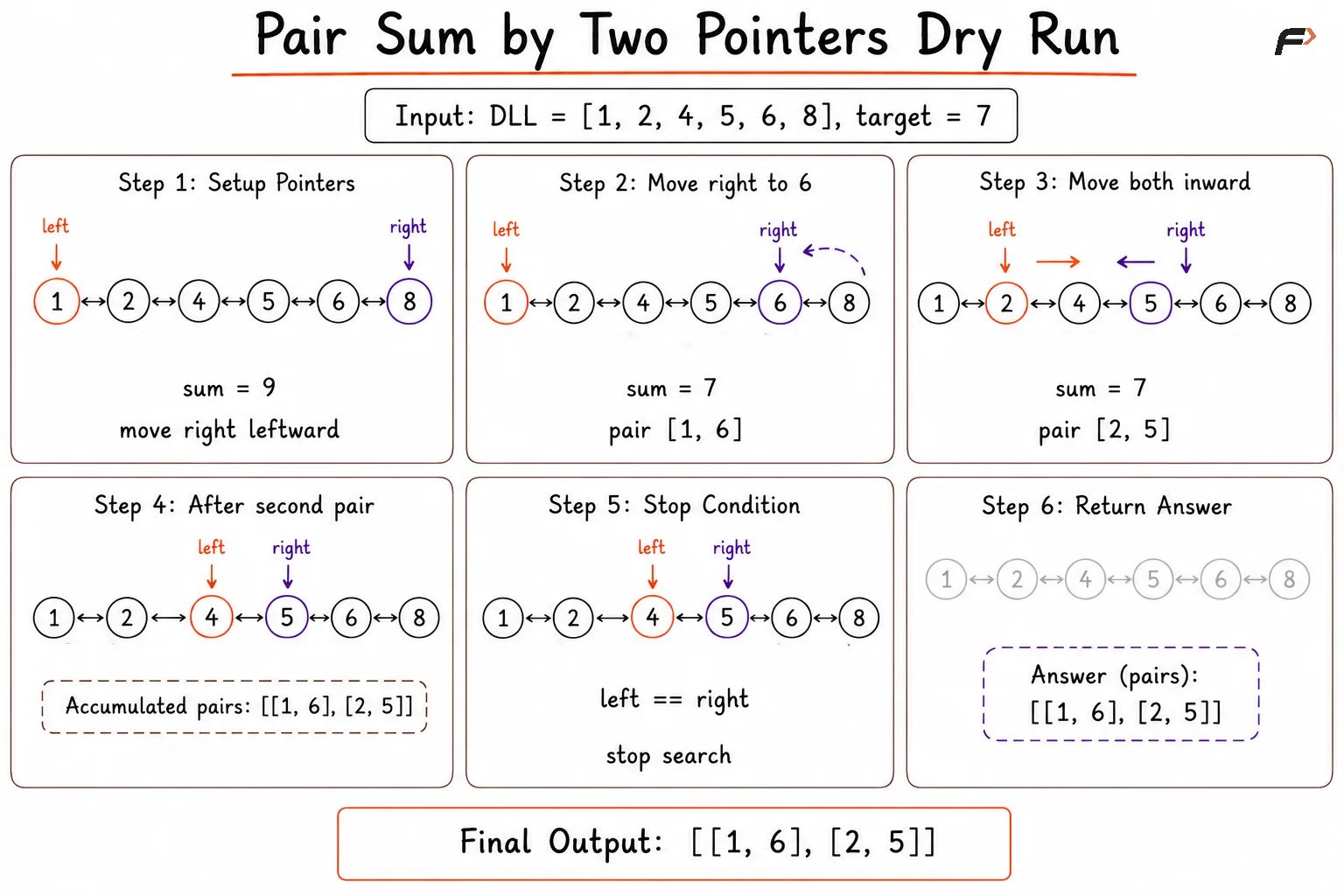
pair sum by two pointers
Solution
#include <bits/stdc++.h>using namespace std;class Node {public: int data; Node* next; Node* prev; Node(int value) { data = value; next = nullptr; prev = nullptr; }};class Solution {public: // Find all pairs with target sum using two pointers. vector<pair<int, int>> findPairsWithGivenSum(Node* head, int target) { vector<pair<int, int>> answer; if (head == nullptr) { return answer; } Node* left = head; Node* right = head; // Move right pointer to final node. while (right->next != nullptr) { right = right->next; } // Move pointers inward until meeting or crossing. while (left != right && right->next != left) { int sum = left->data + right->data; if (sum == target) { answer.push_back({left->data, right->data}); left = left->next; right = right->prev; } else if (sum < target) { left = left->next; } else { right = right->prev; } } return answer; }};// Build a doubly linked list from array values.Node* buildList(vector<int>& values) { if (values.empty()) { return nullptr; } Node* head = new Node(values[0]); Node* tail = head; for (int index = 1; index < (int)values.size(); index++) { Node* node = new Node(values[index]); tail->next = node; node->prev = tail; tail = node; } return head;}// Driver code with a fixed sample.int main() { vector<int> values = {1, 2, 4, 5, 6, 8}; int target = 7; Node* head = buildList(values); Solution solution; vector<pair<int, int>> result = solution.findPairsWithGivenSum(head, target); for (auto pairValue : result) { cout << pairValue.first << " " << pairValue.second << endl; } return 0;}Complexity Analysis
Time Complexity: O(N), tail discovery and inward pointer traversal visit nodes linearly.
Space Complexity: O(1), only pointer variables and answer storage are used.
Interview follow-up Questions
No. The two pointer movement depends on sorted order. An unsorted list needs hashing or sorting before two pointer usage.
Be the first to add a comment.