Given a directed graph represented by an adjacency list, return all eventual safe nodes in ascending order.
A terminal node has no outgoing edges. A safe node is a node from which every possible directed path eventually reaches a terminal node instead of getting trapped in a cycle.
Example 1
Input: graph = [[1,2],[2,3],[5],[0],[5],[],[]]
Output: [2,4,5,6]
Explanation: Nodes 2, 4, 5, and 6 cannot reach a directed cycle.
Example 2
Input: graph = [[1,2,3,4],[1,2],[3,4],[0,4],[]]
Output: [4]
Explanation: Only node 4 is guaranteed to end at a terminal node.
Approach 1
Depth First Search tracks globally visited nodes, nodes in the active recursion path, and nodes proven safe. Reaching an active node confirms a directed cycle, while reaching a previously identified unsafe node confirms a path leading to a cycle.
A node becomes safe only after every outgoing path reaches a safe node or a terminal node. Scanning the final safe array from index 0 to V-1 produces ascending output.
Algorithm
Initialize
visited,pathVisited, andsafearrays of sizeVto track explored nodes, active-path nodes, and proven safe nodes.Traverse every node and start DFS from each unvisited node, ensuring coverage of all disconnected directed components.
Mark the current node as visited and active in
pathVisitedbefore exploring outgoing edges.Return an unsafe result upon reaching an active neighbor, as an edge to the current recursion path confirms a directed cycle.
Continue DFS for every unvisited neighbor; an unsafe recursive result or a previously visited unsafe neighbor also makes the current node unsafe.
Remove the current node from
pathVisitedand mark the node safe only after every outgoing neighbor is proven safe.Scan nodes from
0toV-1, collect all nodes marked safe, and return the resulting ascending list.
Dry Run
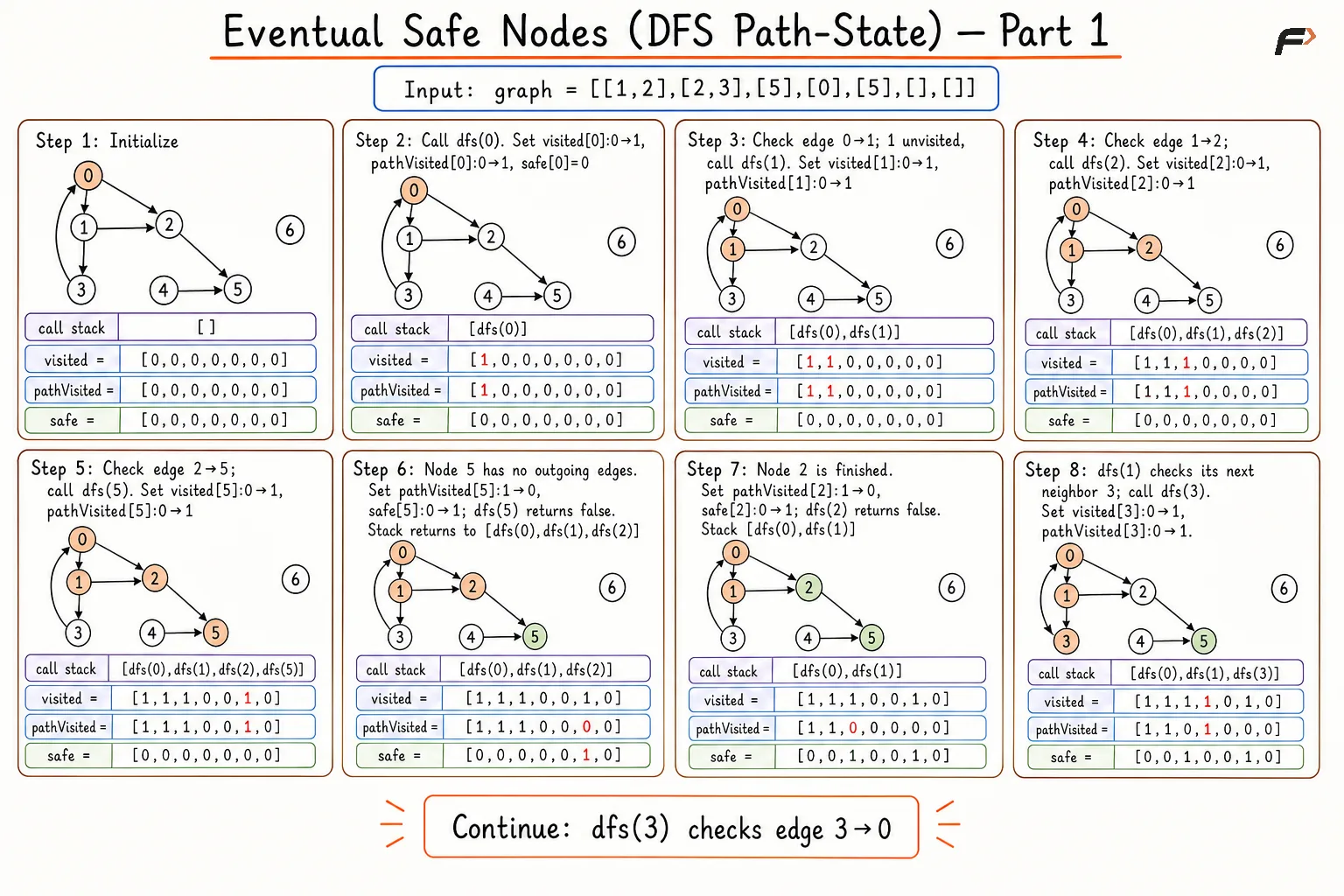
Diagram 1
Solution
#include <bits/stdc++.h>using namespace std;class Solution {private: // Checks whether a node is safe using DFS. bool dfs(int node, vector<int>& visited, vector<int>& pathVisited, vector<int>& safe, vector<vector<int>>& graph) { // Mark node as visited. visited[node] = 1; // Mark node in active DFS path. pathVisited[node] = 1; // Explore all outgoing neighbors. for (int neighbor : graph[node]) { // Visit unvisited neighbor first. if (!visited[neighbor]) { // Unsafe neighbor makes current node unsafe. if (!dfs(neighbor, visited, pathVisited, safe, graph)) { return false; } } // Active-path neighbor confirms a cycle. else if (pathVisited[neighbor]) { return false; } // Previously visited unsafe neighbor makes current node unsafe. else if (!safe[neighbor]) { return false; } } // Remove node from active DFS path. pathVisited[node] = 0; // Mark node as safe after all paths pass. safe[node] = 1; // Return safe status for current node. return true; }public: // Returns all eventual safe nodes in ascending order. vector<int> eventualSafeNodes(vector<vector<int>>& graph) { int vertices = graph.size(); vector<int> visited(vertices, 0); vector<int> pathVisited(vertices, 0); vector<int> safe(vertices, 0); // Start DFS from every unvisited node. for (int node = 0; node < vertices; node++) { if (!visited[node]) { dfs(node, visited, pathVisited, safe, graph); } } vector<int> answer; // Collect safe nodes in ascending order. for (int node = 0; node < vertices; node++) { if (safe[node]) { answer.push_back(node); } } // Return all safe nodes. return answer; }};// Driver code.int main() { vector<vector<int>> graph = { {1, 2}, {2, 3}, {5}, {0}, {5}, {}, {} }; Solution sol; vector<int> answer = sol.eventualSafeNodes(graph); for (int node : answer) { cout << node << " "; } return 0;}Complexity Analysis
Time Complexity: O(V+E), where V and E are the numbers of nodes and directed edges; DFS processes every node and edge once.
Space Complexity: O(V), where the state arrays and recursive DFS stack store a number of entries proportional to V.
Approach 2
Reverse Kahn’s Algorithm begins from terminal nodes, which are safe because no outgoing paths exist. Reversing every directed edge allows safe-state propagation from terminal nodes toward predecessors.
The outdegree of a predecessor decreases whenever one outgoing neighbor is proven safe. An outdegree of 0 confirms that every outgoing path leads to a safe node.
Algorithm
Build a reverse adjacency list and compute the original outdegree of every node, allowing safe states to propagate toward predecessors.
Add all nodes having outdegree
0to a queue, since terminal nodes are safe by definition.Initialize a
safearray to record every node proven to have no path leading to a directed cycle.Continue processing while the queue contains nodes, removing the front node and marking the node safe.
Traverse every predecessor in the reverse graph and decrease the predecessor’s outdegree, representing one outgoing path proven safe.
Add a predecessor to the queue when the outdegree becomes
0, as all outgoing paths now lead to safe nodes.Scan nodes from
0toV-1, collect all marked nodes, and return the resulting ascending list.
Dry Run
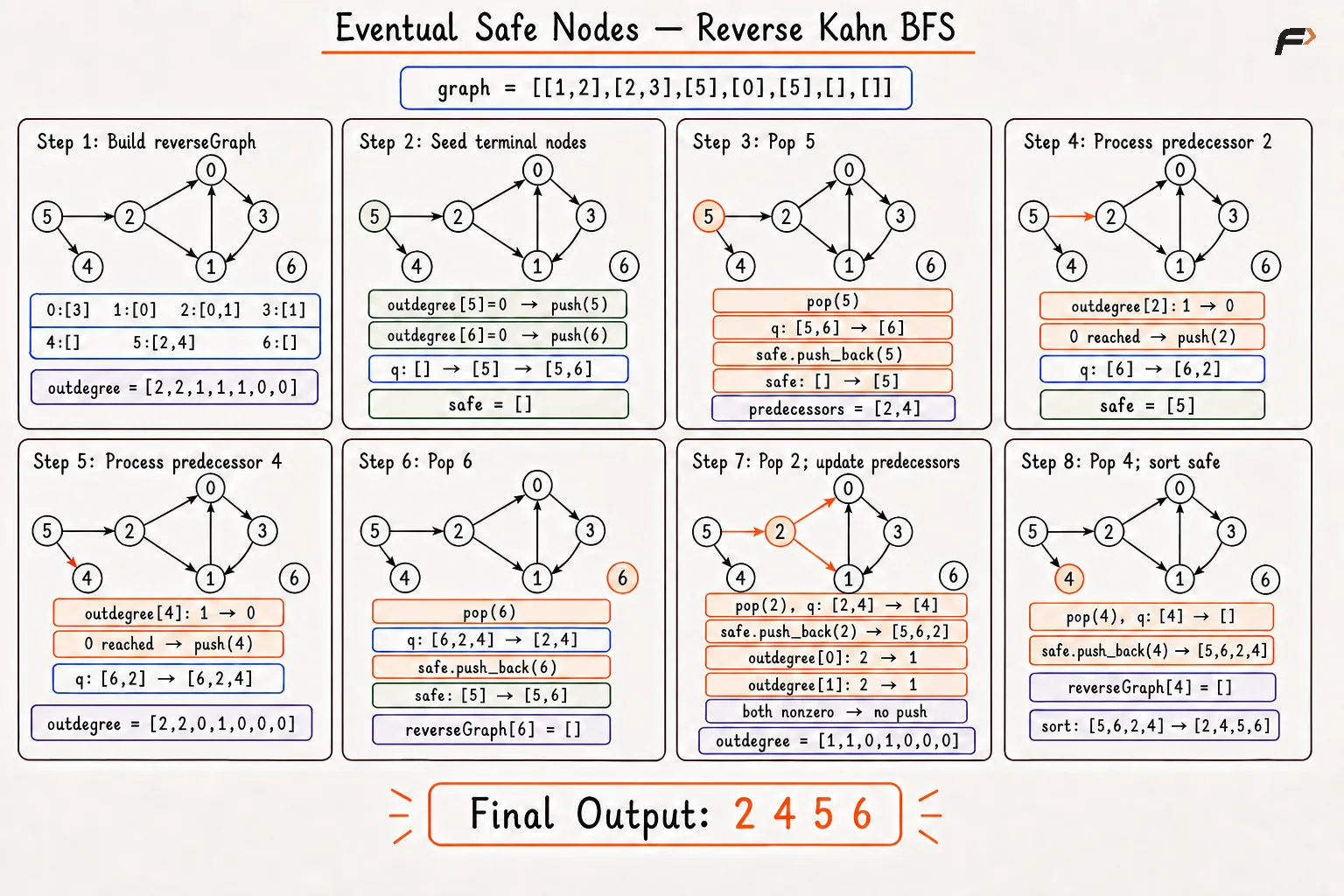
eventual-safe-nodes-reverse-kahn-complete-operations
Solution
#include <bits/stdc++.h>using namespace std;class Solution {public: // Function to find safe nodes using reverse Kahn BFS. vector<int> eventualSafeNodes(vector<vector<int>>& graph) { int vertices = graph.size(); vector<vector<int>> reverseGraph(vertices); vector<int> outdegree(vertices, 0); // Reverse edges and count original outgoing edges. for (int node = 0; node < vertices; node++) { outdegree[node] = graph[node].size(); for (int neighbor : graph[node]) { reverseGraph[neighbor].push_back(node); } } queue<int> q; // Terminal nodes are safe starting points. for (int node = 0; node < vertices; node++) { if (outdegree[node] == 0) { q.push(node); } } vector<int> safe; // Remove safe terminal paths from predecessors. while (!q.empty()) { int node = q.front(); q.pop(); safe.push_back(node); for (int predecessor : reverseGraph[node]) { outdegree[predecessor]--; if (outdegree[predecessor] == 0) { q.push(predecessor); } } } sort(safe.begin(), safe.end()); return safe; }};// Driver code.int main() { vector<vector<int>> graph = {{1,2},{2,3},{5},{0},{5},{},{}}; Solution sol; vector<int> ans = sol.eventualSafeNodes(graph); // Print safe nodes. for (int node : ans) { cout << node << " "; } return 0;}Complexity Analysis
Time Complexity: O(V+E), where V and E are the numbers of nodes and directed edges; every node and reversed edge is processed once.
Space Complexity: O(V+E), where the reverse graph stores V nodes and E edges, while the outdegree array, safe array, and queue require O(V) space.
Interview follow-up Questions
An eventual safe node has every possible path ending at a terminal node.
Be the first to add a comment.