Introduction Dynamic Programming
Dynamic Programming, commonly called DP, is a problem-solving technique for tasks containing repeated smaller problems. A DP solution solves each useful smaller problem once, stores the answer, and reuses the stored answer later.The central idea is simple: avoid solving the same state again. The difficult part is learning to describe a state clearly and connect smaller states to a larger answer.
Many algorithmic problems ask for a minimum cost, maximum value, number of ways, or possible decision. A direct recursive solution may explore every choice, but different choice sequences often reach the same smaller problem.
Dynamic Programming removes repeated work by remembering the answer for each state. A state represents one smaller version of the original task. A transition explains how already solved states build a new state.
Four building blocks appear in almost every DP solution:
State: the exact meaning of one stored answer.
Transition: the rule used to combine smaller answers.
Base case: a smallest state with a direct answer.
Evaluation order: an order that prepares dependencies before use.
Why Dynamic Programming Is Needed
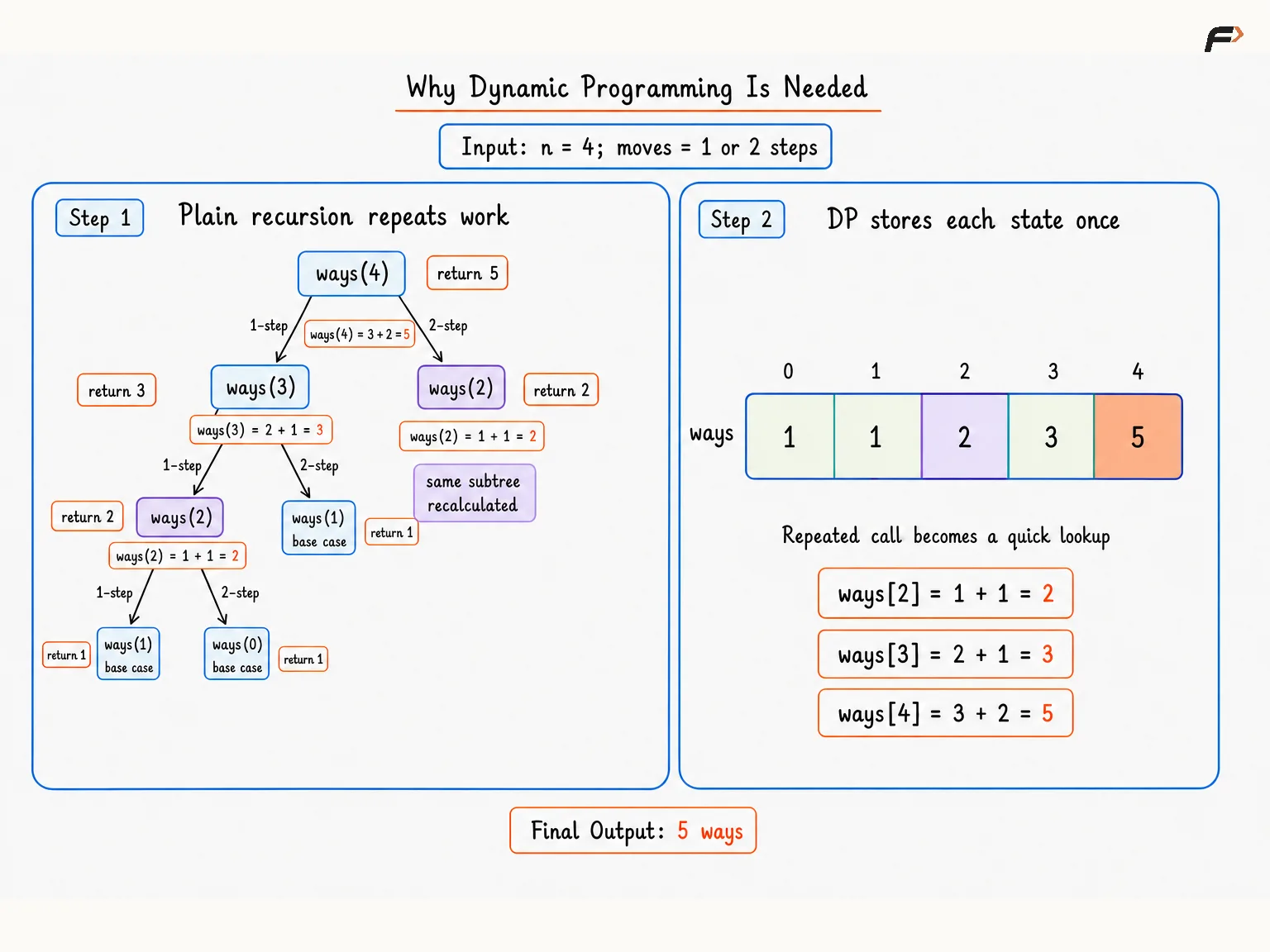
Consider a staircase with n steps. A move may climb either 1 step or 2 steps. The goal is to count the different ways to reach the top.
For n = 4, a recursive solution explores both choices from every step. However, several branches ask for the answer to the same remaining staircase. The answer for step 2, for example, appears through more than one earlier choice.
Plain recursion calculates repeated states again. DP stores each answer and changes repeated calculations into quick lookups.
The staircase also reveals the transition. Every route to step current must end with either a 1-step move from current - 1 or a 2-step move from current - 2. Therefore, the count for the current step comes from the two previous counts.
DP Fundamental
Core Characteristics of DP Problems
Overlapping Subproblems
Overlapping subproblems appear when several recursive paths request the same state. A recursion tree containing repeated labels provides a strong DP signal.
Fibonacci, climbing stairs, frog jump, and house robber all contain repeated index-based states. Storing one answer per index prevents repeated calculation.
Optimal Substructure
Optimal substructure means a larger answer can be built from correct answers to smaller states. A minimum-cost path uses minimum costs to earlier positions. A maximum-value selection uses best values from smaller prefixes.
The word optimal often suggests minimum or maximum problems, but DP also works for counting and Boolean decision problems. The important property is a reliable relationship between the current state and smaller states.
Manageable State Space
DP is useful only if the number of unique states remains manageable. A recurrence with repeated work can still be too expensive when the state definition creates an enormous table.
A quick complexity estimate uses:
number of states × work performed for each state
Ways to Build a DP Solution
Recursion
Recursion expresses the available choices directly. The recursive version is often the easiest place to discover the state, transition, and base cases. Plain recursion may be slow because repeated states are solved many times.
Memoization
Memoization keeps recursion and adds storage. A state is calculated during the first visit and saved in a dp array or map. Later visits return the saved answer immediately.
Memoization is called a top-down approach because calculation begins from the required state and moves toward smaller states.
Tabulation
Tabulation removes recursion and starts from the base cases. Smaller answers are filled first, followed by larger dependent states.
Tabulation is called a bottom-up approach. A correct loop order is essential because every dependency must already contain a valid answer.
Space Optimization
A full DP table is sometimes unnecessary. If a new state needs only a few recent states, older values can be discarded.
For climbing stairs, only the previous two counts are needed. Two variables can replace the full array. Space optimization should be attempted only after the transition and update order are completely clear.
How to Approach a DP Problem
Step 1: Identify the Choice
Begin with the decisions available at one point. Examples include take or skip, move right or down, match or ignore a character, and use or avoid an item.
Step 2: Define the State
Write one precise sentence describing a stored answer. For example, dp[index] may represent the minimum cost required to reach index.
A state must contain enough information to make every future decision correctly. Unnecessary information creates extra dimensions and extra work.
Step 3: Write the Transition
List every smaller state capable of producing the current state. Then choose the correct merge operation:
Add values for independent path counts.
Take a minimum for minimum-cost problems.
Take a maximum for maximum-value problems.
Use logical OR for reachability problems.
Step 4: Set the Base Cases
Base cases are the smallest states with direct answers. Every later answer depends on correct base values, so a wrong base case spreads through the complete table.
Step 5: Choose Memoization or Tabulation
Memoization is a natural first version when recursion is already clear or many states may remain unused. Tabulation is useful when states have a simple order and recursion-stack space should be removed.
Step 6: Verify the Order and Complexity
Confirm that every dependency is ready before use. Count unique states, multiply by the work per state, and include both DP storage and recursion-stack space.
Step 7: Check Space Optimization
Inspect the transition and keep only states needed by the next calculation. Preserve the full table when answer reconstruction or later states need older information.
Common Mistakes and Conclusion
Common beginner mistakes include:
Starting with memoization before understanding the recursive choice.
Writing
dp[index]without defining the stored meaning.Memorizing formulas instead of deriving transitions.
Forgetting a base state or assigning a wrong base value.
Filling a table in an order that reads unfinished states.
Applying DP even though subproblems never repeat.
Optimizing space before checking every dependency.
Counting only the table and forgetting recursion-stack space.
Dynamic Programming is not one fixed algorithm. DP is a reusable way to organize repeated decisions. A strong solution begins with a clear state, follows a correct transition, starts from valid base cases, and processes states in a safe order.
A helpful learning path is: Climbing Stairs → Frog Jump → House Robber . Regular practice gradually makes state definitions and transitions feel natural.
Be the first to add a comment.