Given a directed graph with V vertices represented by an adjacency list, determine whether any directed cycle exists.
A directed cycle exists when traversal follows edge directions and returns to a vertex already present in the same active path. The graph can be disconnected, so every component must be checked.
Example 1
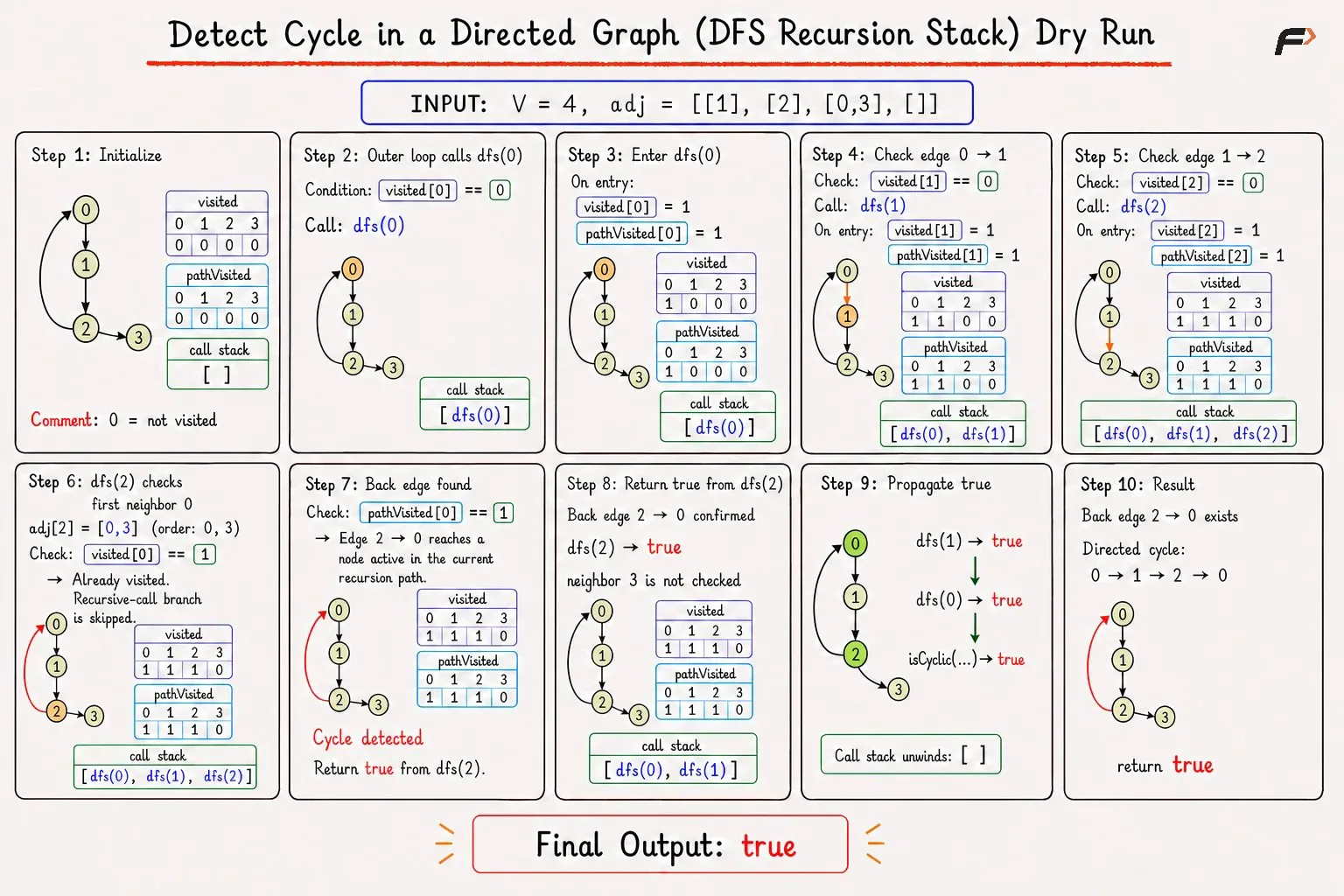
Input: V = 4, adj = [[1],[2],[0,3],[]]
Output: true
Explanation: Directed edges 0 -> 1 -> 2 -> 0 form a cycle.
Example 2
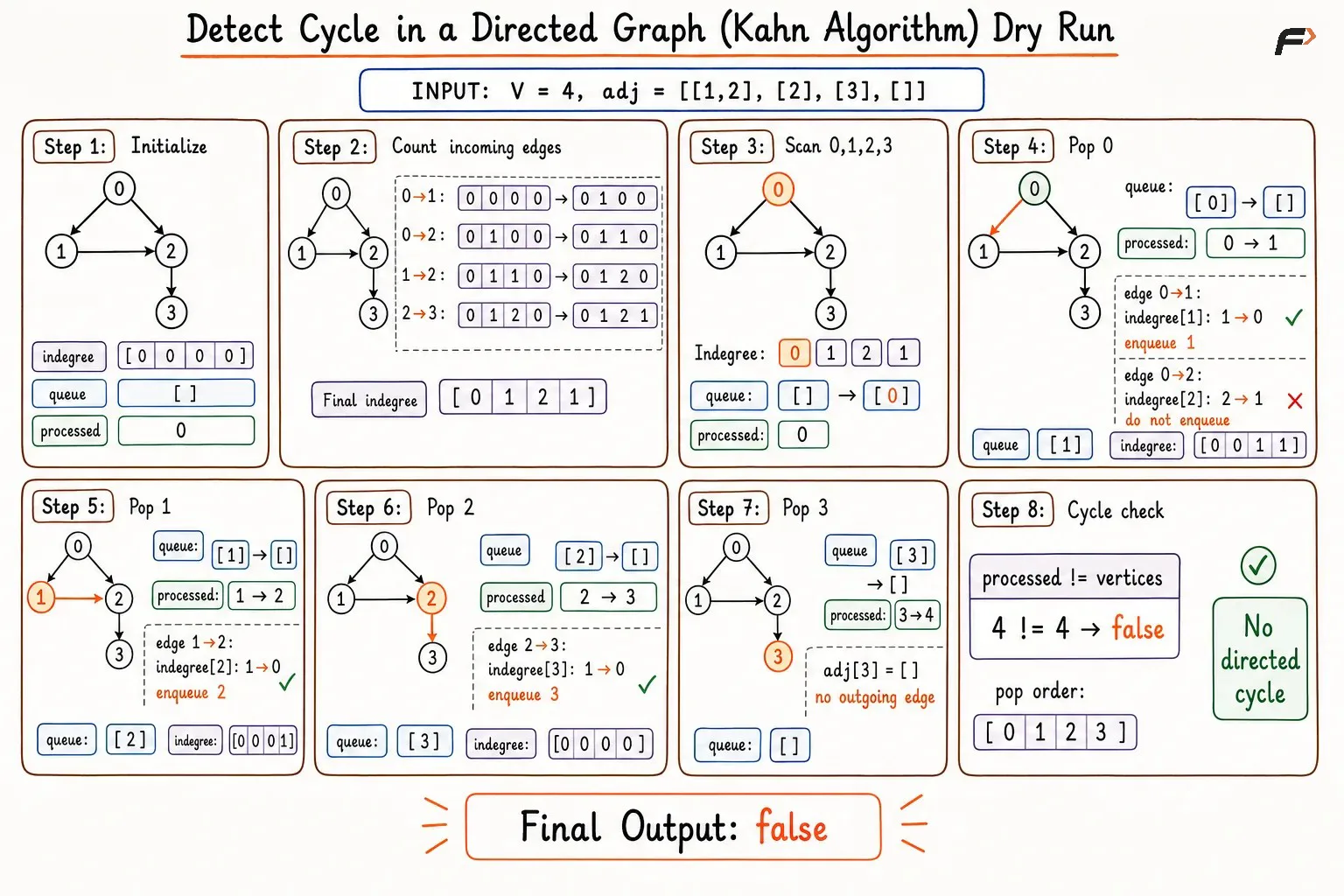
Input: V = 4, adj = [[1,2],[2],[3],[]]
Output: false
Explanation: All directed paths move forward without returning to an active vertex.
Approach 1
Depth First Search maintains two states: vertices visited during the complete traversal and vertices present in the current active recursion path. Reaching a vertex already present in the active path indicates a back edge and confirms a directed cycle.
After all outgoing edges of a vertex are processed, removal from the active path allows later DFS branches to visit the vertex without incorrectly reporting a cycle.
Algorithm
Initialize
visitedandpathVisitedarrays of sizeV, separating globally processed vertices from vertices in the active DFS path.Traverse every vertex and start DFS from each unvisited vertex, ensuring that all disconnected components are examined.
Mark the current vertex in both arrays, recording global visitation and active-path membership.
Examine every outgoing neighbor of the current vertex to inspect all possible directed paths.
For an unvisited neighbor, continue DFS and immediately propagate true when a deeper recursive call detects a cycle.
Return true when a neighbor is already marked in
pathVisited, as an edge to an active-path vertex confirms a directed cycle.Remove the current vertex from
pathVisitedafter processing all neighbors, and return false when every component finishes without detecting a cycle.
Dry Run
detect cycle 1
Solution
#include <bits/stdc++.h>using namespace std;class Solution {private: // Detects a back edge using DFS. bool dfs(int node, vector<int>& visited, vector<int>& pathVisited, vector<vector<int>>& adj) { // Mark the node as visited. visited[node] = 1; // Mark the node in the current DFS path. pathVisited[node] = 1; // Explore all outgoing edges. for (int neighbor : adj[node]) { // Visit the neighbor if it is not visited. if (!visited[neighbor]) { // If a cycle is found deeper, return true. if (dfs(neighbor, visited, pathVisited, adj)) { return true; } } // If neighbor is in the current path, a cycle exists. else if (pathVisited[neighbor]) { return true; } } // Remove current vertex from active DFS path. pathVisited[node] = 0; // No cycle found from this path. return false; }public: // Detects a cycle in a directed graph. bool isCyclic(int vertices, vector<vector<int>>& adj) { vector<int> visited(vertices, 0); vector<int> pathVisited(vertices, 0); // Start DFS from every unvisited vertex. for (int node = 0; node < vertices; node++) { // Only unvisited nodes can start a new DFS. if (!visited[node]) { // If any DFS finds a cycle, return true. if (dfs(node, visited, pathVisited, adj)) { return true; } } } // No back edge exists in any component. return false; }};// Driver code.int main() { int vertices = 4; vector<vector<int>> adj = { {1}, {2}, {0, 3}, {} }; Solution sol; cout << (sol.isCyclic(vertices, adj) ? "true" : "false"); return 0;}Complexity Analysis
Time Complexity: O(V+E), where V and E are the numbers of vertices and directed edges; DFS processes every vertex and edge once.
Space Complexity: O(V), where both visited arrays and the recursive DFS stack store a number of entries proportional to V.
Approach 2
Kahn’s Algorithm applies topological-sorting logic to detect a cycle. In a directed acyclic graph, repeated removal of vertices having indegree 0 eventually processes every vertex.
Vertices belonging to a directed cycle never reach indegree 0 because every cycle vertex retains an incoming edge. A processed count smaller than V therefore confirms a cycle.
Algorithm
Initialize an
indegreearray of sizeV, where each entry stores the number of incoming edges for a vertex.Scan every directed edge and increment the indegree of the destination vertex, preparing the dependency count required by Kahn’s Algorithm.
Add all vertices having indegree
0to a queue, since such vertices have no unresolved incoming dependencies.Initialize
processedCountto0and continue processing while the queue contains vertices.Remove the front vertex and increment
processedCount, recording successful removal from the topological ordering.Decrease the indegree of every outgoing neighbor and add a neighbor to the queue when the indegree becomes
0.Return true when
processedCountdiffers fromV; otherwise, return false because all vertices formed a valid topological order.
Dry Run
detect cycle 2
Solution
#include <bits/stdc++.h>using namespace std;class Solution {public: // Detects a cycle using Kahn's Algorithm. bool isCyclic(int vertices, vector<vector<int>>& adj) { vector<int> indegree(vertices, 0); // Compute indegree for every vertex. for (int node = 0; node < vertices; node++) { for (int neighbor : adj[node]) { indegree[neighbor]++; } } queue<int> q; // Add all vertices with zero indegree. for (int node = 0; node < vertices; node++) { // Zero indegree means this node can be processed first. if (indegree[node] == 0) { q.push(node); } } int processed = 0; // Remove zero-indegree vertices one by one. while (!q.empty()) { int node = q.front(); q.pop(); // Count this node as processed. processed++; // Reduce indegree of outgoing neighbors. for (int neighbor : adj[node]) { indegree[neighbor]--; // If indegree becomes zero, add it to the queue. if (indegree[neighbor] == 0) { q.push(neighbor); } } } // If some vertices remain unprocessed, a cycle exists. return processed != vertices; }};// Driver code.int main() { int vertices = 4; vector<vector<int>> adj = { {1, 2}, {2}, {3}, {} }; Solution sol; cout << (sol.isCyclic(vertices, adj) ? "true" : "false"); return 0;}Complexity Analysis
Time Complexity: O(V+E), where V and E are the numbers of vertices and directed edges; every vertex and edge is processed once.
Space Complexity: O(V), where the indegree array and queue can each store up to V vertices.
Interview follow-up Questions
Reaching a vertex already in the active DFS path means edge directions have formed a closed path.
Be the first to add a comment.