Given the root of a binary tree, determine whether it is height-balanced.
A binary tree is height-balanced if, for every node, the absolute difference between the heights of its left and right subtrees is at most 1.
In other words, for every node:
|leftHeight - rightHeight| <= 1
If even one node violates this condition, the entire tree is considered unbalanced.
Example 1
Input: root = [3, 9, 20, null, null, 15, 7]
Output: true
Explanation: The left subtree has height 1 and the right subtree has height 2. Their difference is 1, and every other node also satisfies the balance condition.
Example 2
Input: root = [1, 2, 2, 3, 3, null, null, 4, 4]
Output: false
Explanation: At one of the nodes, the left subtree becomes more than one level deeper than the right subtree. Since the height difference exceeds 1, the tree is not height-balanced.
Example 3
Input: root = []
Output: true
Explanation: An empty tree contains no node that can violate the balance condition, so it is considered height-balanced.
Approach 1
The balance condition must be verified at every node.
For the current node, first calculate the heights of its left and right subtrees. If their difference is greater than 1, the tree is immediately unbalanced.
Even if the current node satisfies the condition, the same check must still be performed inside both subtrees because an imbalance may exist deeper in the tree.
The drawback is that subtree heights are calculated repeatedly for different ancestors, creating unnecessary work.
Algorithm
If
rootisnull, returntruebecause an empty tree is balanced.Use a helper function
heightthat returns the height of a subtree.Calculate
leftHeightandrightHeightfor the current node.If
abs(leftHeight - rightHeight) > 1, returnfalsebecause the current node violates the balance condition.Recursively verify that both the left and right subtrees are balanced.
Return
trueonly if the current node and both subtrees satisfy the condition.
Dry Run
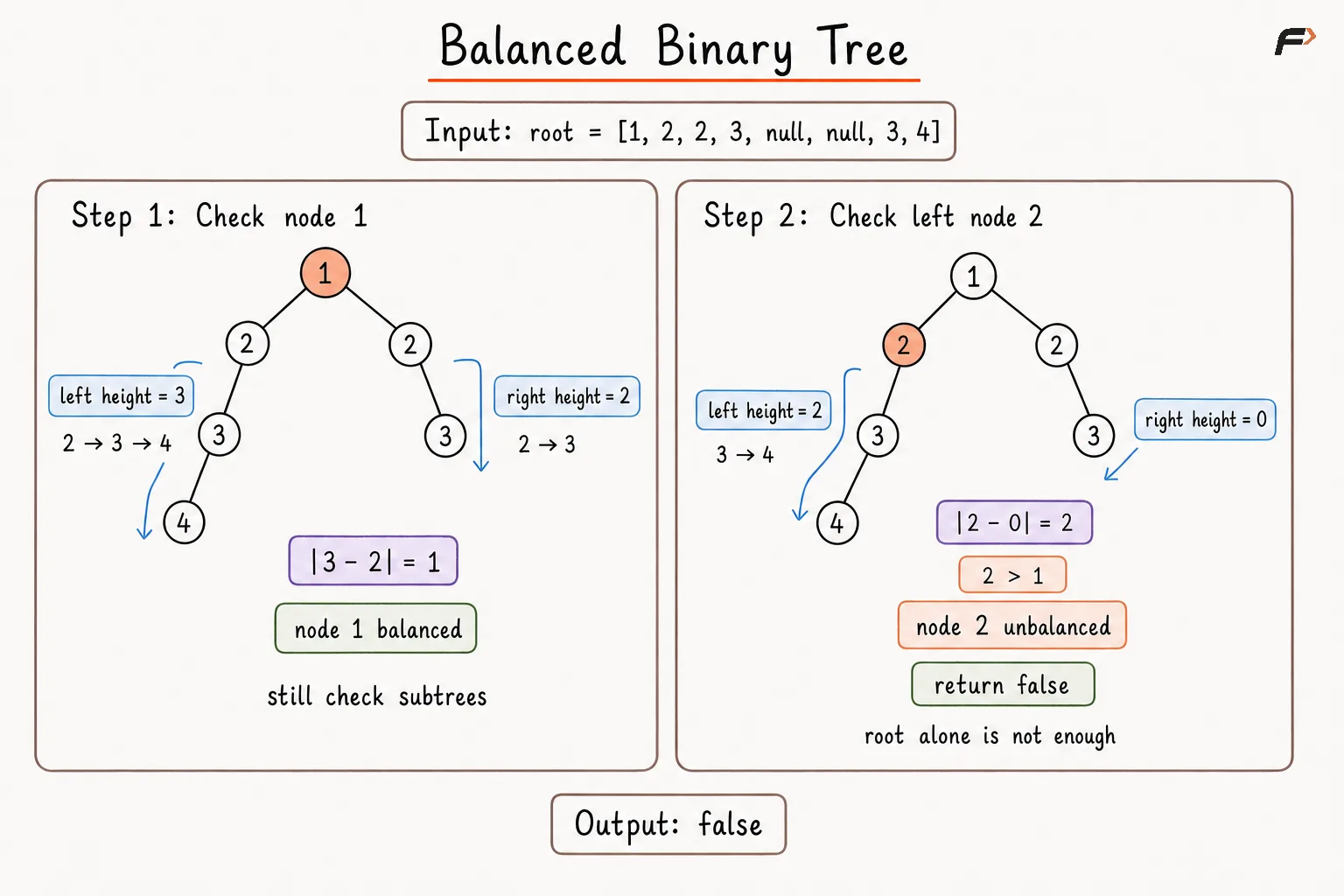
Balanced Binary Tree Approach 1 Dry Run.png
Solution
#include <bits/stdc++.h>using namespace std;struct TreeNode { int val; TreeNode* left; TreeNode* right; TreeNode(int x) : val(x), left(nullptr), right(nullptr) {}};class Solution {private: /* * Return the height of a subtree so the balance * condition can be checked at the current node. */ int height(TreeNode* root) { if (root == nullptr) { return 0; } return 1 + max( height(root->left), height(root->right) ); }public: bool isBalanced(TreeNode* root) { if (root == nullptr) { return true; } int leftHeight = height(root->left); int rightHeight = height(root->right); // A difference greater than one breaks the balance condition. if (abs(leftHeight - rightHeight) > 1) { return false; } /* * The condition must also hold at every node * inside both subtrees. */ return isBalanced(root->left) && isBalanced(root->right); }};int main() { /* 1 / \ 2 2 / \ 3 3 / 4 */ TreeNode* root = new TreeNode(1); root->left = new TreeNode(2); root->right = new TreeNode(2); root->left->left = new TreeNode(3); root->right->right = new TreeNode(3); root->left->left->left = new TreeNode(4); Solution solution; cout << (solution.isBalanced(root) ? "true" : "false") << endl; return 0;}Complexity Analysis
Time Complexity: O(N × H), where N is the number of nodes in the binary tree and H is the height of the tree. Subtree heights may be recalculated for multiple ancestors. This becomes O(N²) for a skewed tree and O(N log N) for a balanced tree.
Space Complexity: O(H), where H is the height of the binary tree, due to the recursion stack. This becomes O(N) for a skewed tree and O(log N) for a balanced tree.
Approach 2
The Approach 1 performs two related tasks separately:
calculate subtree heights,
check whether those subtrees are balanced.
Both can instead be handled during the same post-order traversal.
For every node, first obtain the heights of its left and right subtrees. If either subtree is already unbalanced, return a special value -1 immediately.
Otherwise, check the current height difference. If it exceeds 1, return -1; if not, return the normal subtree height.
This works because valid subtree heights are always 0 or greater, so -1 can safely represent an unbalanced subtree.
Algorithm
Create a helper
checkHeightthat returns the subtree height when balanced and-1when unbalanced.If the current node is
null, return0because an empty subtree has height zero.Compute
leftHeight; if it is-1, return-1immediately because the left subtree is already unbalanced.Compute
rightHeight; if it is-1, return-1for the same reason.If
abs(leftHeight - rightHeight) > 1, return-1; otherwise return1 + max(leftHeight, rightHeight).The complete tree is balanced only if
checkHeight(root) != -1.
Dry Run
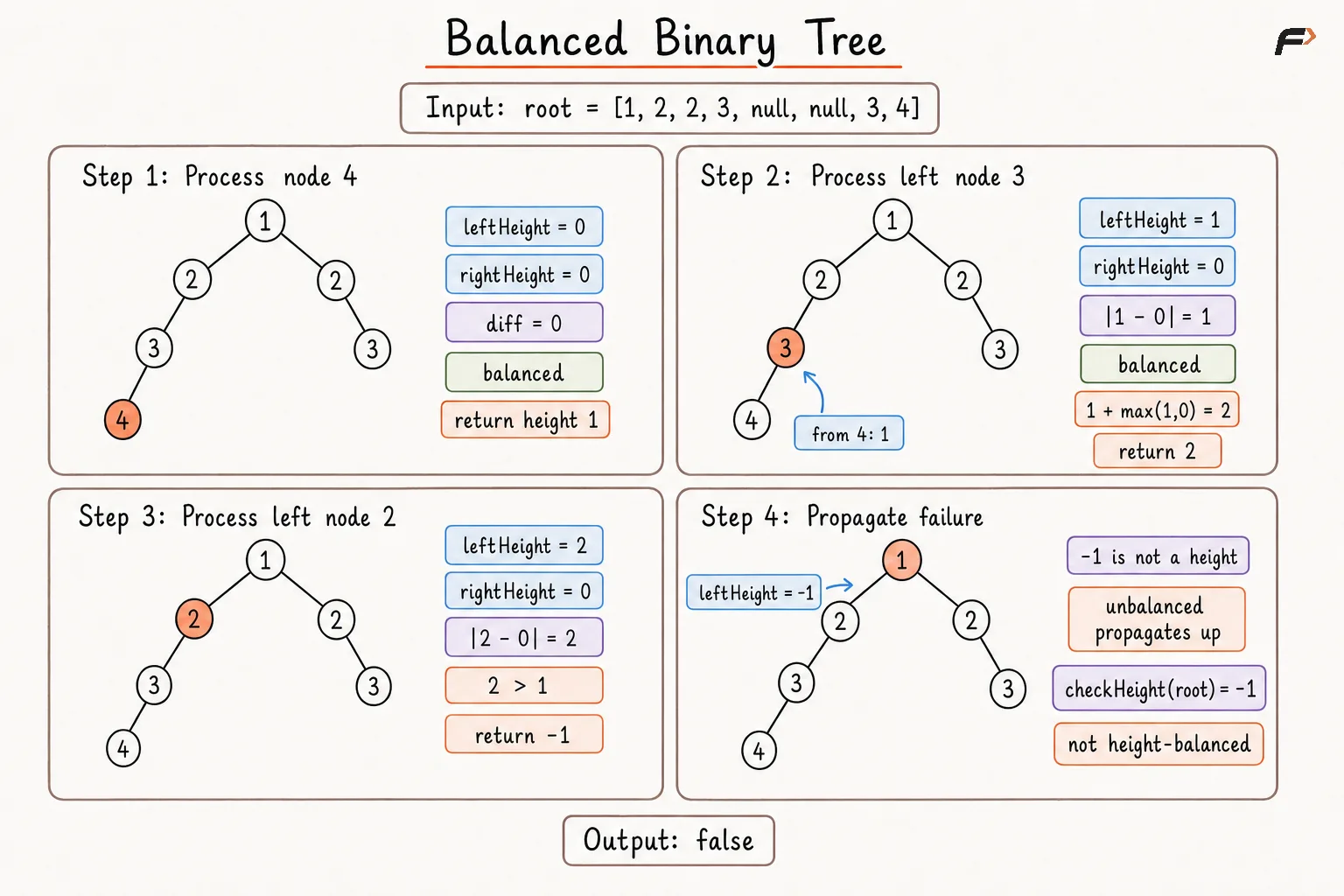
Balanced Binary Tree Approach 2 Dry Run.png
Solution
#include <bits/stdc++.h>using namespace std;struct TreeNode { int val; TreeNode* left; TreeNode* right; TreeNode(int x) : val(x), left(nullptr), right(nullptr) {}};class Solution {private: /* * Return subtree height when balanced. * Return -1 as soon as an imbalance is detected. */ int checkHeight(TreeNode* root) { if (root == nullptr) { return 0; } int leftHeight = checkHeight(root->left); // Propagate an already detected imbalance upward. if (leftHeight == -1) { return -1; } int rightHeight = checkHeight(root->right); if (rightHeight == -1) { return -1; } // The current node fails if its subtree heights differ too much. if (abs(leftHeight - rightHeight) > 1) { return -1; } return 1 + max(leftHeight, rightHeight); }public: bool isBalanced(TreeNode* root) { return checkHeight(root) != -1; }};int main() { /* 1 / \ 2 2 / \ 3 3 / 4 */ TreeNode* root = new TreeNode(1); root->left = new TreeNode(2); root->right = new TreeNode(2); root->left->left = new TreeNode(3); root->right->right = new TreeNode(3); root->left->left->left = new TreeNode(4); Solution solution; cout << (solution.isBalanced(root) ? "true" : "false") << endl; return 0;}Complexity Analysis
Time Complexity: O(N), where N is the number of nodes in the binary tree. Every node is processed at most once, and its height is calculated during the same traversal.
Space Complexity: O(H), where H is the height of the binary tree, due to the recursion stack. This becomes O(N) for a skewed tree and O(log N) for a balanced tree.
Approach 3
The Optimized DFS works in post-order because the height of a node can be determined only after the heights of its children are known.
The same order can be reproduced without recursion by using a stack. Each stack entry stores a node together with a flag indicating whether its children have already been processed.
Once a node is processed after its children, their heights are available in a map. Those heights are used to check the balance condition and calculate the current node's height.
This avoids recursion but requires additional storage for the height of processed nodes.
Algorithm
If
rootisnull, returntrue.Use a stack containing
(node, visited)pairs and a mapheightMapto store computed subtree heights.When a node is first encountered, push it back with
visited = true, then push its children so they are processed first.When the node is popped with
visited = true, obtain its left and right heights fromheightMap, using0for missing children.If their difference exceeds
1, returnfalse; otherwise store1 + max(leftHeight, rightHeight)as the current node's height.If every node is processed without finding a violation, return
true.
Dry Run
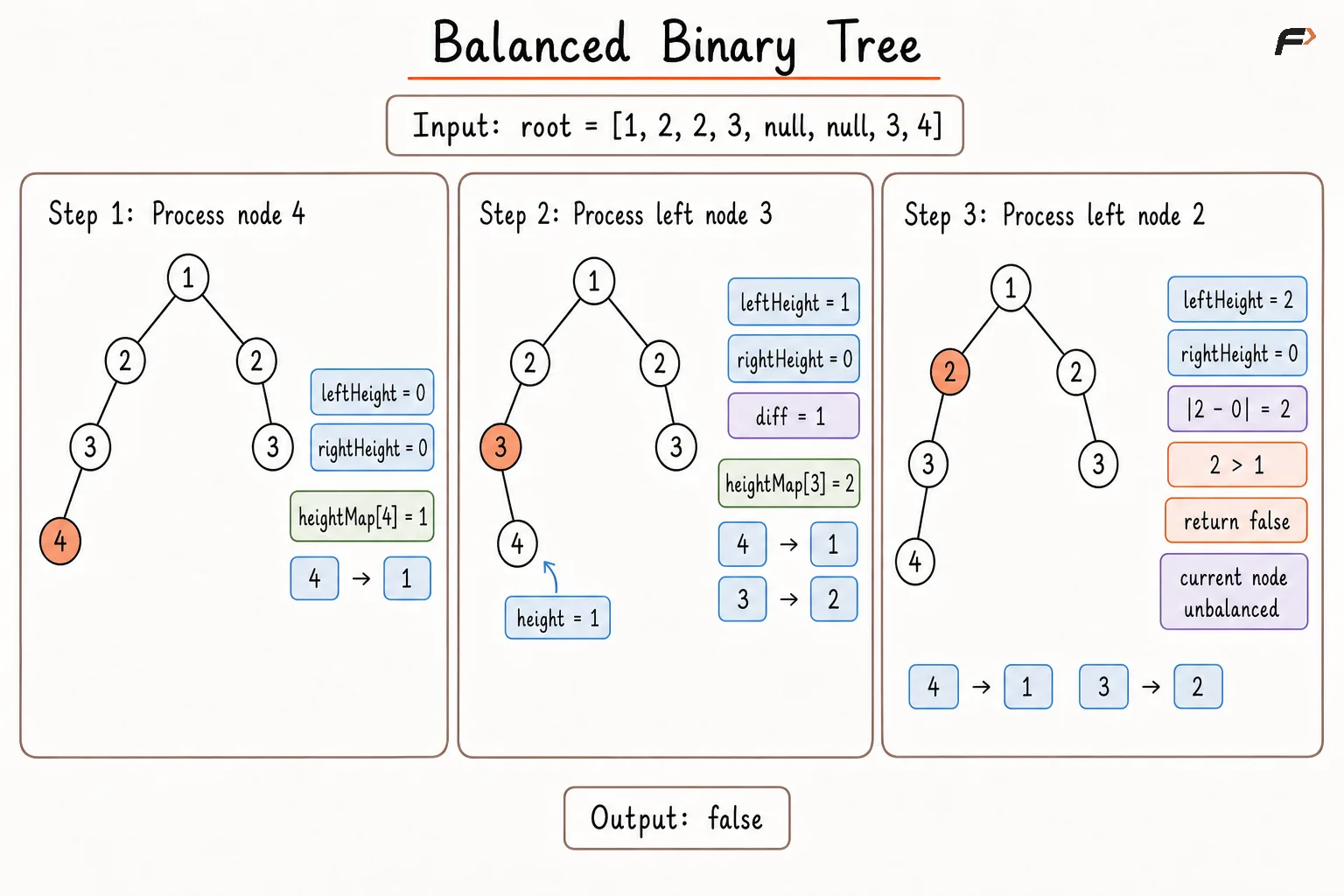
Balanced Binary Tree Approach 3 Dry Run.png
Solution
#include <bits/stdc++.h>using namespace std;struct TreeNode { int val; TreeNode* left; TreeNode* right; TreeNode(int x) : val(x), left(nullptr), right(nullptr) {}};class Solution {public: bool isBalanced(TreeNode* root) { if (root == nullptr) { return true; } /* * The visited flag ensures children are processed * before their parent, reproducing postorder traversal. */ stack<pair<TreeNode*, bool>> nodesStack; nodesStack.push({root, false}); unordered_map<TreeNode*, int> heightMap; while (!nodesStack.empty()) { auto [node, visited] = nodesStack.top(); nodesStack.pop(); if (!visited) { nodesStack.push({node, true}); if (node->right != nullptr) { nodesStack.push({node->right, false}); } if (node->left != nullptr) { nodesStack.push({node->left, false}); } } else { /* * Child heights are already available because * the node is processed only after its children. */ int leftHeight = node->left ? heightMap[node->left] : 0; int rightHeight = node->right ? heightMap[node->right] : 0; if (abs(leftHeight - rightHeight) > 1) { return false; } heightMap[node] = 1 + max(leftHeight, rightHeight); } } return true; }};int main() { /* 1 / \ 2 2 / \ 3 3 / 4 */ TreeNode* root = new TreeNode(1); root->left = new TreeNode(2); root->right = new TreeNode(2); root->left->left = new TreeNode(3); root->right->right = new TreeNode(3); root->left->left->left = new TreeNode(4); Solution solution; cout << (solution.isBalanced(root) ? "true" : "false") << endl; return 0;}Complexity Analysis
Time Complexity: O(N), where N is the number of nodes in the binary tree. Every node is pushed onto and processed from the stack only a constant number of times.
Space Complexity: O(N), where N is the number of nodes in the binary tree. The heightMap may store the height of every node, while the explicit stack also requires additional traversal space.
FAQs
Q1. Is checking the height difference only at the root enough?
No. The root may satisfy the balance condition while a deeper node violates it. Every node in the tree must satisfy the condition.
Q2. Why is the Brute Force Approach slower?
It repeatedly recalculates heights of the same subtrees while checking different ancestors. These repeated traversals can lead to O(N²) time in a skewed tree.
Q3. Why does the Optimized DFS use -1?
All valid subtree heights are non-negative. Therefore, -1 can safely act as a special signal indicating that an unbalanced subtree has already been detected.
Q4. Why is post-order traversal suitable for this problem?
A node cannot determine whether it is balanced until the heights of both its children are known. Post-order processes the children first and the parent afterward.
Q5. What is the advantage of the iterative post-order approach?
It avoids recursive call-stack limits. Its trade-off is additional O(N) storage for explicitly storing computed subtree heights.
Be the first to add a comment.