Bitwise Arithmetic
Computers store integers as binary patterns containing only 0s and 1s. Arithmetic instructions such as addition and subtraction are implemented by processor circuits that operate on these binary values.
At the programming level, using +, -, *, and / is normally the clearest and most efficient choice. The compiler translates these operators into suitable processor instructions.
However, learning bitwise arithmetic helps us understand:
How binary addition produces sum and carry bits
How negative numbers are represented
How multiplication and division by powers of two relate to shifts
How arithmetic can be implemented using bitwise operators
Why certain bitwise identities work
How hardware arithmetic circuits are designed
Bitwise arithmetic is especially relevant in interview problems that restrict the use of standard arithmetic operators.
What Is Bitwise Arithmetic?
Bitwise arithmetic uses operators such as:
XOR (
^)AND (
&)NOT (
~)Left shift (
<<)Right shift (
>>)
to reproduce or support arithmetic operations on binary values.
This does not mean that bitwise replacements are automatically faster than normal arithmetic. Modern processors contain dedicated arithmetic instructions, and compilers already perform many safe optimizations.
The primary purpose of bitwise arithmetic in DSA is to understand binary behaviour and solve problems with specific operator restrictions.
Understanding Binary Addition
Binary addition follows the same carry-based idea as decimal addition, but it uses only 0 and 1.
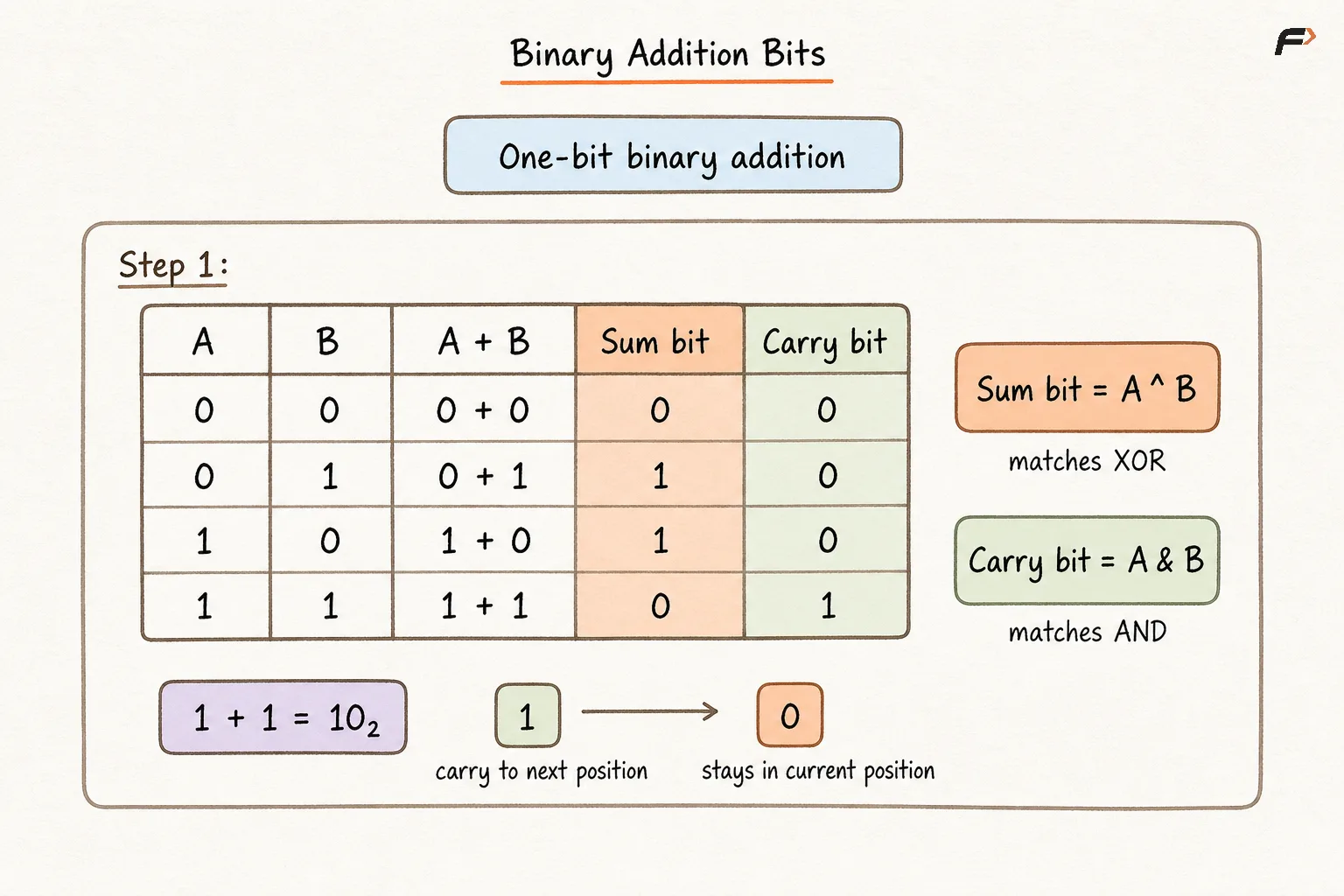
The possible additions of two bits are:
A | B | Sum Bit | Carry Bit |
|---|---|---|---|
0 | 0 | 0 | 0 |
0 | 1 | 1 | 0 |
1 | 0 | 1 | 0 |
1 | 1 | 0 | 1 |
When both bits are 1:
1 + 1 = 10₂
The sum bit is 0, while the carry bit 1 moves to the next position on the left.
The two output columns match familiar bitwise operators:
Sum without carry = A ^ B
Carry = A & B
Because the carry belongs to the next binary position, it must be shifted left:
Shifted Carry = (A & B) << 1
Binary Addition Bits.png
Adding Two Numbers Without the Plus Operator
To add two complete binary numbers:
XOR produces their current sum without carry.
AND identifies the positions that generate a carry.
Left shift moves each carry to the next position.
The process repeats using the partial sum and shifted carry.
Addition finishes when no carry remains.
The two important expressions are:
partialSum = A ^ B
carry = (A & B) << 1
After calculating them:
Replace
AwithpartialSum.Replace
Bwithcarry.Repeat until
Bbecomes0.
At that point, A contains the final sum.
Algorithm
Treat
Aas the current partial sum andBas the carry still waiting to be added.Use XOR to combine them without carrying between bit positions.
Use AND to locate positions where both bits are set and therefore generate a carry.
Shift the carry left by one position because it belongs to the next binary column.
Continue with the new partial sum and carry until no carry remains.
Return the final partial sum as the result.
Dry Run: Add 5 and 3
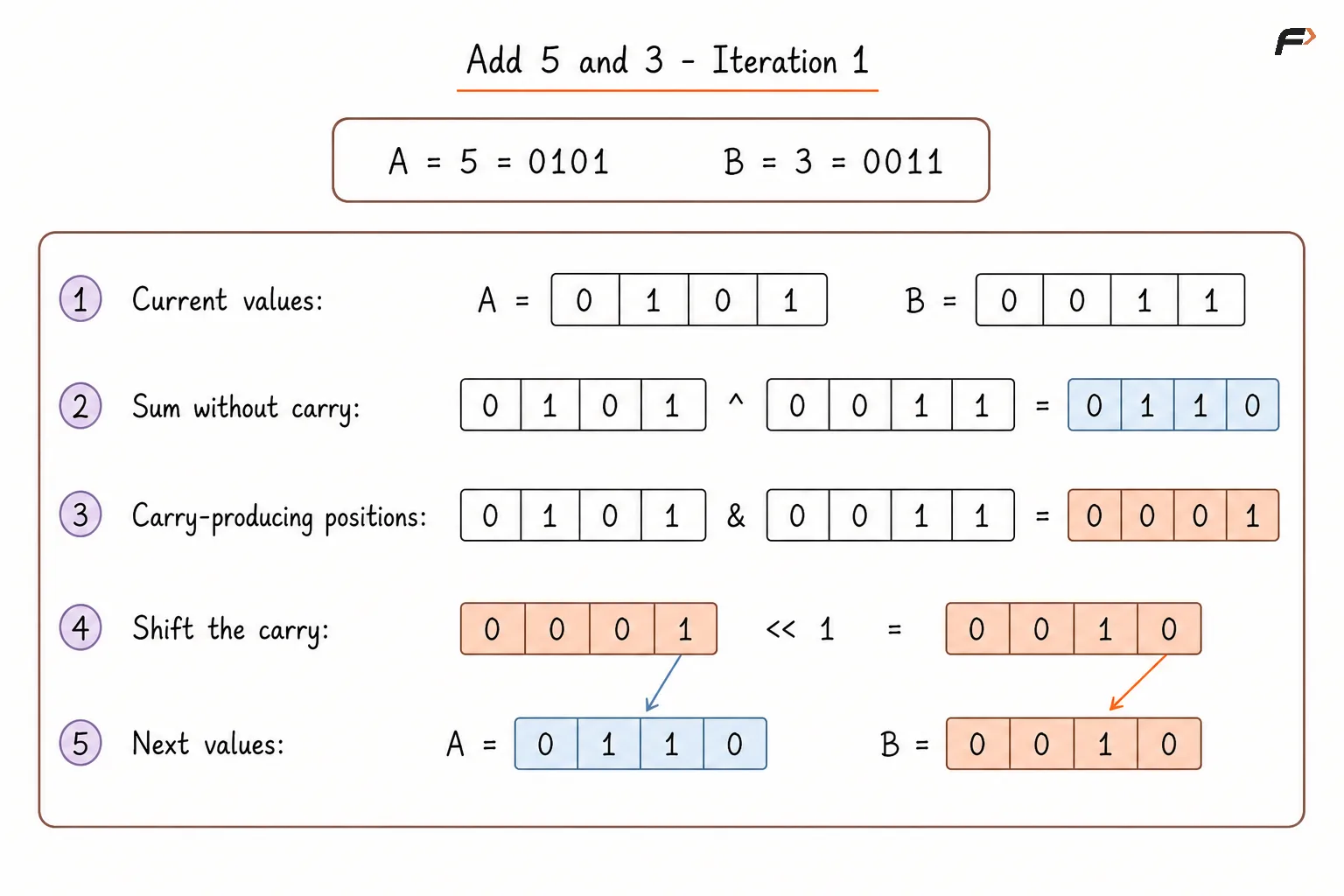
Diagram 1
Why Does the Process Terminate?
Every carry is shifted one position to the left.
For a fixed-width integer, a carry cannot continue moving left indefinitely. It either:
Finds a position where no new carry is generated, or
Moves beyond the available bit width
Therefore, for a W-bit integer, the process requires at most O(W) iterations.
For fixed 32-bit or 64-bit integers, W is constant, so this is commonly treated as:
Time Complexity: O(1)
Space Complexity: O(1)
For arbitrary-precision integers, the cost depends on the number of bits being processed.
A hardware adder does not necessarily execute this exact software loop. Processors use specialized circuits that propagate or predict carries more efficiently.
Subtraction Using Bitwise Arithmetic
In fixed-width two’s-complement arithmetic, subtracting B from A can be rewritten as:
A - B = A + (-B)
The two’s-complement representation of -B is:
-B = ~B + 1
Therefore:
A - B = A + (~B + 1)
The resulting addition can be performed using the XOR-and-carry process.
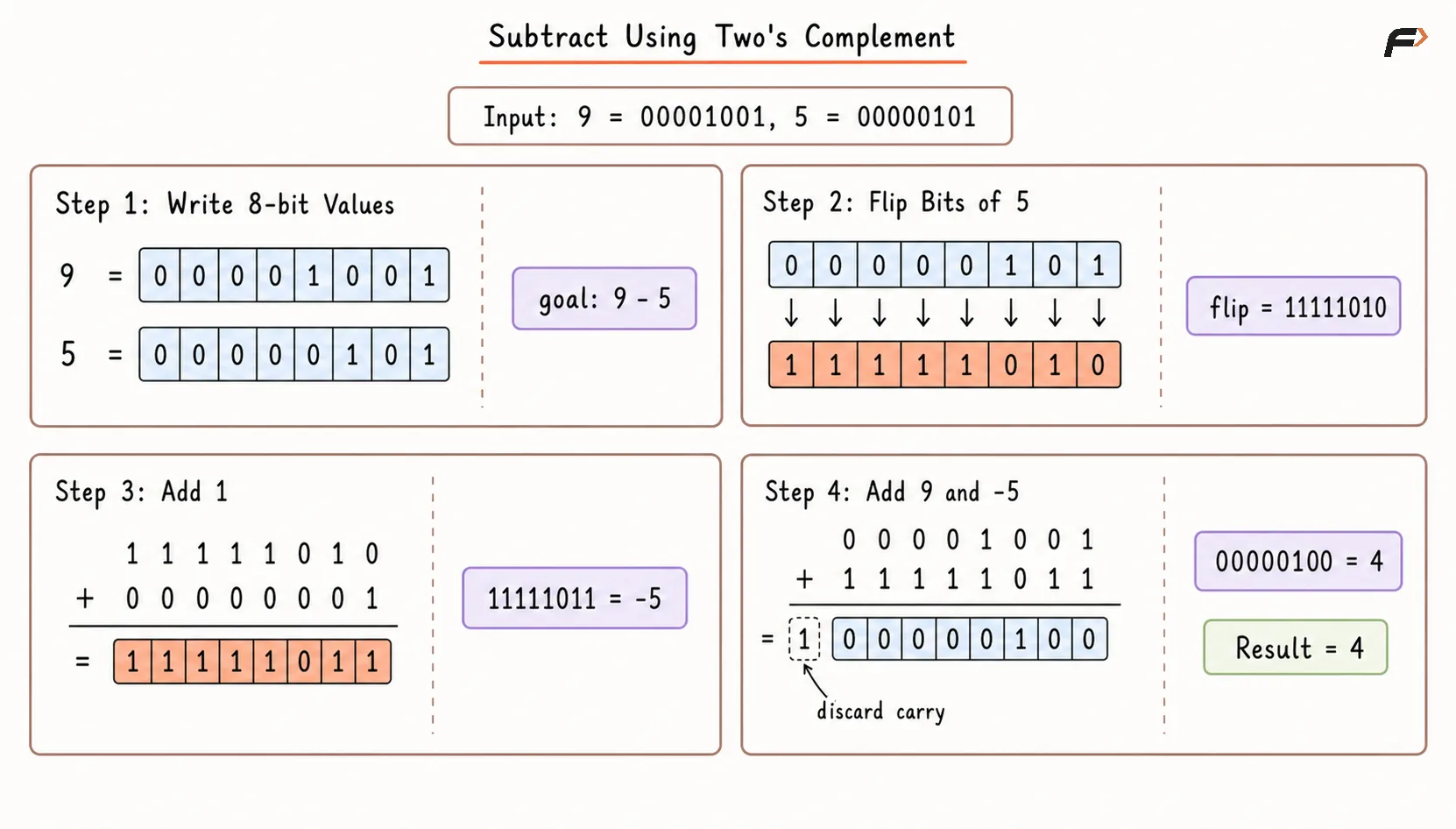
Example: Subtract 5 from 9
Using eight-bit representations:
9 = 00001001
5 = 00000101
Flip every bit of 5:
~5 = 11111010
Add 1:
11111010 + 1 = 11111011
This is the eight-bit two’s-complement representation of -5.
Now add it to 9:
00001001 + 11111011 = 1 00000100
The carry beyond the eight-bit width is discarded.
The remaining value is:
00000100 = 4
Therefore:
9 - 5 = 4
Subtract Using Twos Complement.png
Multiplication Using Shifts
A left shift by K positions corresponds to multiplication by 2ᴷ when:
The value is non-negative
The result remains representable
No important bit is discarded
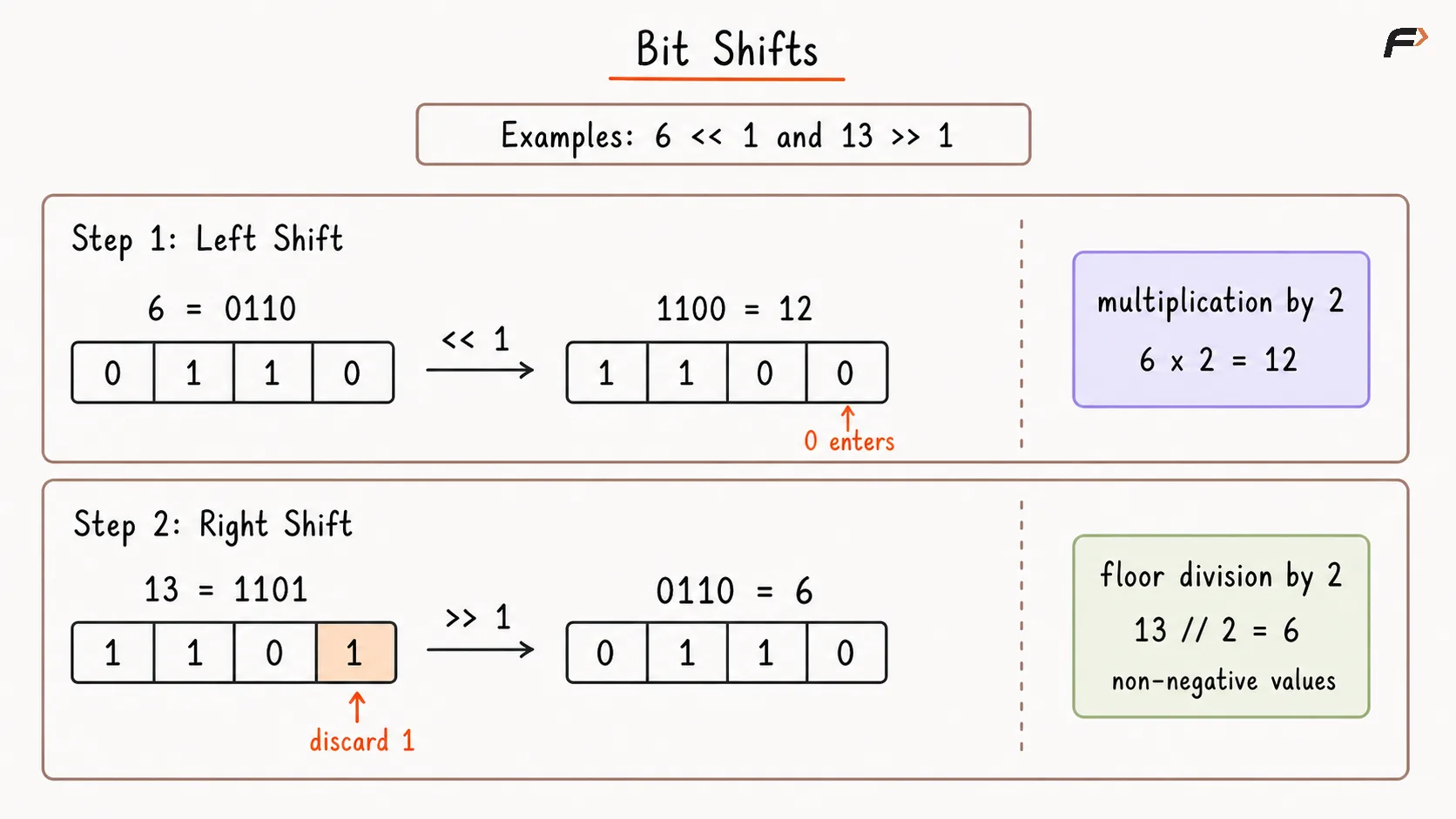
The relation is:
N << K = N × 2ᴷ
For example:
6 << 1 = 12
6 << 2 = 24
Multiplication by a General Number
A multiplier can be decomposed into powers of two using its binary representation.
Consider:
6 × 5
The binary representation of 5 is:
101₂ = 2² + 2⁰
Therefore:
6 × 5 = (6 × 2²) + (6 × 2⁰)
Using shifts:
= (6 << 2) + 6
= 24 + 6
= 30
General binary multiplication examines each set bit of the multiplier. For every set bit, an appropriately shifted copy of the multiplicand contributes to the result.
This is commonly called the shift-and-add method.
Division Using Shifts
For a non-negative integer:
N >> K
corresponds to floor division by 2ᴷ.
For example:
13 >> 1 = 6
because:
13 ÷ 2 = 6 with the fractional part discarded.
Similarly:
20 >> 2 = 5
because:
20 ÷ 4 = 5
This relation requires caution with negative values. Signed right shift and signed integer division may use different rounding behaviour depending on the language.
Division by an arbitrary number cannot generally be replaced with one right shift. More advanced binary division algorithms use repeated comparisons, shifts, and subtraction.
BIt Shifts.png
Essential Bitwise Formulas
Operation | Formula | Important Condition |
|---|---|---|
Sum without carry |
| Produces only the current sum bits |
Shifted carry |
| Must be added repeatedly |
Negate using two’s complement |
| Interpreted within a fixed width |
Subtract |
| Uses fixed-width two’s complement |
Check even |
| Checks the least significant bit |
Check odd |
| Works for standard integer representations |
Multiply by |
| Result must remain representable |
Divide non-negative |
| Uses floor division |
Clear lowest set bit |
| Commonly used for positive values |
Check power of two |
| Excludes zero |
Toggle bit |
| Reverses the selected bit |
Checking Whether a Number Is Even or Odd
The least significant bit determines parity:
Even numbers end in
0.Odd numbers end in
1.
To test the final bit:
N & 1
If the result is 0, the number is even.
If the result is non-zero, the number is odd.
Examples:
10 = 1010
1010 & 0001 = 0000
Therefore, 10 is even.
7 = 0111
0111 & 0001 = 0001
Therefore, 7 is odd.
This expresses parity directly through the binary representation. It should not be used merely under the assumption that it is always faster than modulo; compilers commonly optimize simple parity checks.
Clearing the Lowest Set Bit
The expression:
N & (N - 1)
clears the rightmost set bit of N.
Consider:
N = 12 = 1100
N - 1 = 11 = 1011
Applying AND:
1100 & 1011 = 1000
The lowest set bit has been removed.
This identity is used in Brian Kernighan’s algorithm to count set bits by repeatedly removing one set bit at a time.
Swapping with XOR
Two values can be swapped using XOR:
A = A ^ B
B = A ^ B
A = A ^ B
This works because XOR is reversible. However, it is generally not recommended in normal code because:
It is less readable than a regular swap.
Modern compilers already optimize ordinary swaps.
It can fail when both expressions refer to the same storage location.
It does not provide a dependable performance advantage.
It is better treated as an XOR property demonstration than as an optimization.
Fixed-Width and Signed-Number Behaviour
Bitwise arithmetic is easiest to reason about when the integer width is known.
For a W-bit unsigned integer, results are interpreted modulo:
2ᵂ
Bits that move beyond the available width are discarded.
Signed integers require additional caution:
The highest bit commonly represents the sign under two’s complement.
Left shifting into or beyond the sign bit can produce invalid or language-dependent behaviour.
Right shifting a negative value may copy the sign bit.
Signed arithmetic overflow may not behave consistently across languages.
Arbitrary-precision languages do not have the same fixed-width boundaries.
When the exact bit pattern matters, fixed-width unsigned values usually provide the clearest model.
Language-Specific Considerations
C and C++
Shifting by a negative amount or by an amount greater than or equal to the type width is invalid.
Signed overflow must not be relied upon.
Unsigned types provide predictable modulo arithmetic.
A sufficiently wide mask should be used when accessing high bit positions.
Java
Signed integers use fixed widths and two’s-complement representation.
>>performs a sign-preserving right shift.>>>performs a zero-filling right shift.Shift counts are processed according to the width of the operand type.
Python
Integers have arbitrary precision rather than a fixed 32-bit or 64-bit width.
Negative integers behave as though they have infinitely many leading
1bits.A fixed-width mask is usually required when emulating bounded integer arithmetic.
An addition loop written for unsigned fixed-width values may require special handling for negative inputs.
Operator Precedence
Expressions combining bitwise operators, comparisons, and arithmetic should use explicit parentheses.
In C++ and Java, equality operators have higher precedence than bitwise AND. Therefore:
N & 1 == 0
may not be interpreted as the intended parity check.
Write:
(N & 1) == 0
Similarly, make the grouping clear in expressions such as:
(A ^ B) == 0
or:
((A & B) << 1)
Precedence differs across languages, so explicit grouping improves correctness and readability.
When Is Bitwise Arithmetic Useful?
Bitwise arithmetic is useful when:
A problem forbids
+,-,*, or/.Hardware arithmetic needs to be understood.
Values represent masks, flags, or binary states.
Multiplication or division specifically involves powers of two.
Two’s-complement behaviour is part of the problem.
An embedded or systems-level task requires precise bit control.
A bit-counting or power-of-two identity simplifies the solution.
For ordinary application code, standard arithmetic operators should remain the default because they are clearer and already map to efficient instructions.
Common Mistakes
Assuming a bitwise replacement is automatically faster than normal arithmetic.
Forgetting that XOR gives the sum only when carry is ignored.
Forgetting to shift the carry one position to the left.
Stopping the addition process before the carry becomes zero.
Applying a fixed-width negative-number method directly to Python without masking.
Using signed values when predictable unsigned behaviour is required.
Assuming left shift cannot overflow or discard high bits.
Assuming right shift matches division for every negative number.
Shifting by a negative count or by at least the width of the type.
Mixing bitwise operators with comparisons without parentheses.
Using XOR swap as a production optimization.
Treating
N << Kas general multiplication by any value.Forgetting to exclude zero while checking for a power of two.
FAQs
Q1. Does addition using XOR and AND work for negative numbers?
It works naturally within a defined fixed-width two’s-complement model. In languages with arbitrary-precision integers, such as Python, negative values require an explicit width and mask because their bit representation behaves as though it has infinitely many leading sign bits.
Q2. Can bitwise addition overflow?
Yes. It produces the same fixed-width mathematical result as ordinary binary addition. If the exact result does not fit in the selected width, high bits may be discarded for unsigned arithmetic, while signed overflow behaviour depends on the language.
Q3. Why is right shift not always equivalent to integer division for negative numbers?
Right shift commonly preserves the sign and behaves like rounding toward negative infinity, while integer division in some languages truncates toward zero. For example, shifting -3 right may produce -2, whereas division of -3 by 2 may produce -1.
Q4. Is rewriting arithmetic with bitwise operators faster?
Not necessarily. Processors already provide efficient arithmetic instructions, and compilers optimize common operations. Bitwise arithmetic should be used when it represents the problem naturally or when standard arithmetic operators are restricted, not as an automatic performance optimization.
Q5. How can arbitrary multiplication be performed using bitwise operations?
Examine the binary bits of the multiplier. For every set bit at position i, add the multiplicand shifted left by i. This shift-and-add process constructs the product from powers of two.
Be the first to add a comment.