Introduction and Basics of Binary Trees
A binary tree is a hierarchical data structure in which every node can have at most two children:
A left child
A right child
Each node generally contains:
Data – The value stored in the node
Left reference – Connects the node to its left child
Right reference – Connects the node to its right child
Unlike arrays, linked lists, stacks, and queues, a binary tree is not linear. Its elements form parent-child relationships across multiple levels.
Consider a binary tree containing the following relationships:
Node
1is the root.Nodes
2and3are the children of1.Nodes
4and5are the children of2.Node
6is the right child of3.
The left and right positions are distinct. A node with only a left child represents a different structure from a node with only a right child, even if both children store the same value.
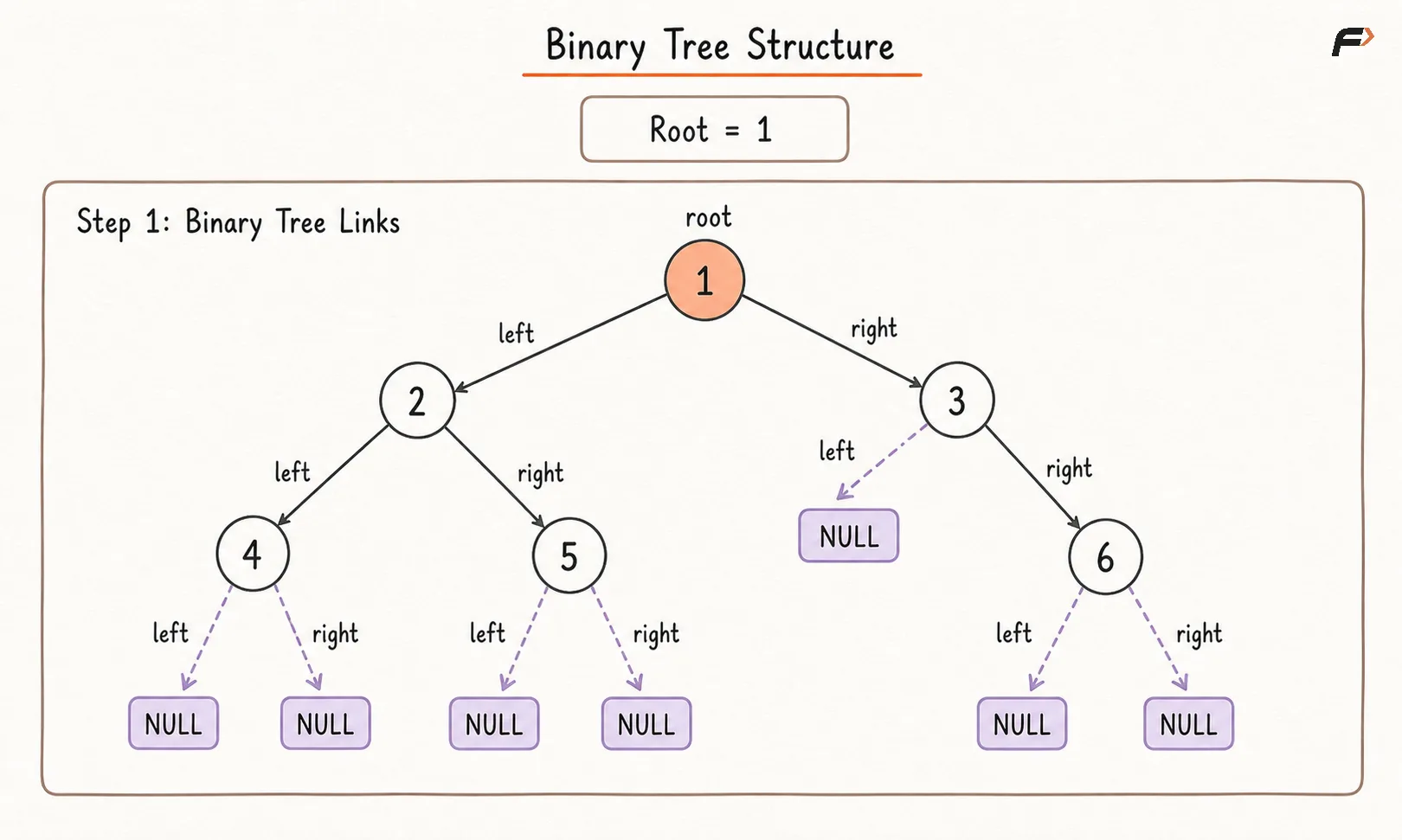
Binary Tree Structure.png
Why Are Binary Trees Used?
Binary trees organize data through hierarchical relationships rather than a single sequential order.
They are useful when a problem requires:
Representing hierarchical information
Dividing a problem into two smaller subproblems
Searching through ordered data
Processing expressions
Maintaining priority
Representing recursive relationships
Performing divide-and-conquer operations
Many important data structures are specialized forms of binary trees, including:
Binary Search Trees
Binary Heaps
AVL Trees
Red-Black Trees
Segment Trees
Syntax Trees
Expression Trees
Huffman Trees
Recursive Structure of a Binary Tree
A binary tree has a naturally recursive structure.
Every binary tree is either:
Empty, represented by
NULL, orA node containing a value, a left binary subtree, and a right binary subtree
The left and right children are themselves roots of smaller binary trees.
This makes recursion a natural way to process trees:
Handle the current node.
Recursively process the left subtree.
Recursively process the right subtree.
Stop when a
NULLreference is reached.
The order of these actions determines the traversal being performed.
Basic Terminology
Consider the example tree described earlier.
Term | Meaning |
|---|---|
Node | An individual element containing data and child references |
Root | The topmost node from which the tree begins |
Edge | A connection between a parent and child |
Parent | A node directly connected above another node |
Child | A node directly connected below another node |
Left Child | The child connected through the left reference |
Right Child | The child connected through the right reference |
Siblings | Nodes that share the same parent |
Leaf Node | A node with no children |
Internal Node | A node with at least one child |
Ancestor | Any node appearing on the path from the root to a node |
Descendant | Any node present below another node |
Subtree | A node together with all of its descendants |
Path | A sequence of connected nodes |
Depth | Number of edges from the root to a node |
Height of a Node | Number of edges on its longest downward path to a leaf |
Height of a Tree | Height of its root |
Degree of a Node | Number of children of the node |
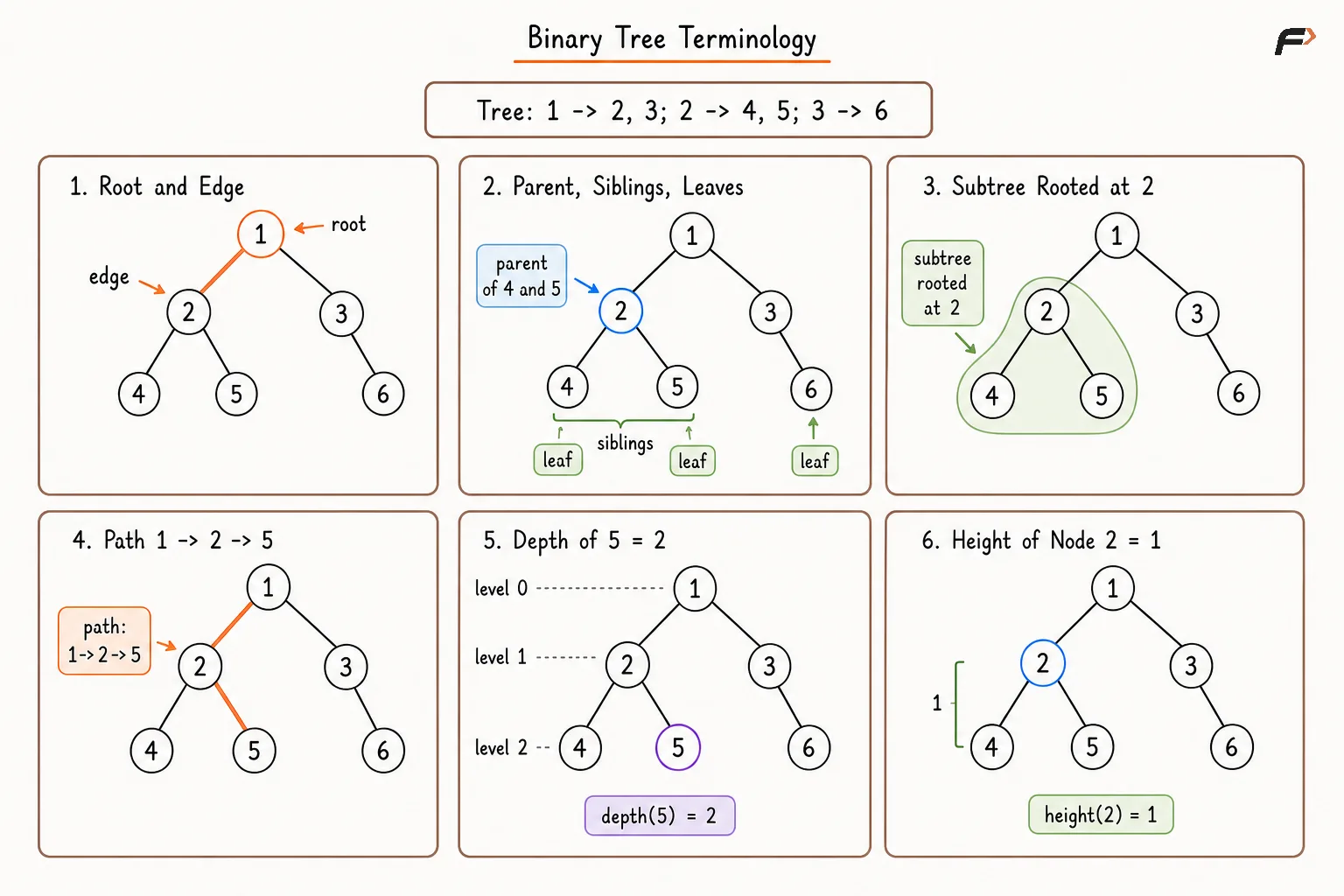
Binary Tree Terminology.png
Root, Parent, and Child
The root is the only node with no parent.
In the example:
1is the root.1is the parent of2and3.2is the left child of1.3is the right child of1.4and5are the children of2.
Every node except the root has exactly one parent in a valid tree.
Leaf and Internal Nodes
A leaf node has no children.
In the example:
4, 5, and 6 are leaf nodes.
An internal node has at least one child.
In the example:
1, 2, and 3 are internal nodes.
A single-node tree contains only its root. Since that node has no children, it is also a leaf.
Ancestors and Descendants
If a node lies on the path from the root to another node, it is an ancestor of that node.
For node 5:
1and2are its ancestors.2is its parent.1is an ancestor but not its direct parent.
A descendant is the reverse relationship.
For node 2:
4and5are its descendants.Both are also its direct children.
A node is generally not considered its own ancestor or descendant unless a problem explicitly defines the relationship differently.
Subtree
Every node can be treated as the root of its own smaller tree.
The subtree rooted at node 2 contains:
2, 4, and 5
The subtree rooted at a leaf node contains only that leaf.
This recursive property is central to most binary-tree algorithms. A problem on the complete tree is frequently solved by first solving it for the left and right subtrees.
Depth and Level
The depth of a node is the number of edges from the root to that node.
Using zero-based depth:
The root has depth
0.Its children have depth
1.Their children have depth
2.
The word level is sometimes used in the same way as depth. Some resources number the root as level 1 instead of level 0, so the convention should always be stated clearly.
In this article:
Level = Depth
and the root is at level 0.
Height of a Node and Tree
The height of a node is the number of edges on the longest path from that node to a leaf.
Using edge-based height:
A leaf node has height
0.A node whose deepest leaf is one edge below has height
1.The height of the tree equals the height of its root.
For the example tree:
Nodes
4,5, and6have height0.Nodes
2and3have height1.Node
1has height2.
Some implementations define height using the number of nodes instead of edges. Under that convention, every height is one greater. The chosen definition must be used consistently.
Degree of a Node
The degree of a node is its number of children.
In a binary tree, a node can have degree:
0for no children1for one child2for two children
The maximum possible degree of a node in a binary tree is 2.
Important Properties of Binary Trees
Assume that the root is at level 0 and the height is measured in edges.
Number of Edges
A non-empty tree with N nodes contains:
N - 1 edges
Every node except the root has exactly one connection from its parent.
Maximum Nodes at a Level
The maximum number of nodes at level L is:
2ᴸ
For example:
Level
0can contain at most1node.Level
1can contain at most2nodes.Level
2can contain at most4nodes.Level
3can contain at most8nodes.
Maximum Nodes for Height H
The maximum number of nodes in a binary tree of height H is:
2ᴴ⁺¹ - 1
This maximum is achieved by a perfect binary tree.
Minimum Nodes for Height H
The minimum number of nodes in a binary tree of height H is:
H + 1
This occurs when every internal node has only one child, forming a chain.
Leaves in a Perfect Binary Tree
A perfect binary tree of height H contains:
2ᴴ leaf nodes
Its total number of nodes is:
2ᴴ⁺¹ - 1
Types of Binary Trees
1. Full Binary Tree
A full binary tree, also called a strict or proper binary tree, is one in which every node has either:
No children, or
Exactly two children
No node has only one child.
2. Complete Binary Tree
A complete binary tree has:
Every level completely filled except possibly the final level.
Nodes in the final level placed as far left as possible.
Complete binary trees are well suited for array representation and are commonly used to implement binary heaps.
3. Perfect Binary Tree
A perfect binary tree has:
Exactly two children for every internal node.
All leaf nodes at the same level.
Every level completely filled.
Every perfect binary tree is both full and complete.
However, a complete tree is not necessarily perfect, and a full tree is not necessarily complete.
4. Balanced Binary Tree
A binary tree is considered balanced when its height remains reasonably small compared with its number of nodes.
A common definition of a height-balanced tree requires that, for every node, the heights of its left and right subtrees differ by at most 1.
A balanced tree containing N nodes generally has height proportional to:
O(log N)
Balanced does not mean that every level must be completely filled.
5. Degenerate Binary Tree
A degenerate binary tree is one in which every internal node has only one child.
Its structure resembles a linked list.
For N nodes, its height becomes:
N - 1
Operations that depend on height may degrade from O(log N) to O(N).
6. Skewed Binary Tree
A skewed tree is a degenerate tree in which all nodes extend in the same direction.
It may be:
Left-skewed
Right-skewed
Every skewed tree is degenerate, but a degenerate tree may alternate between left and right children.
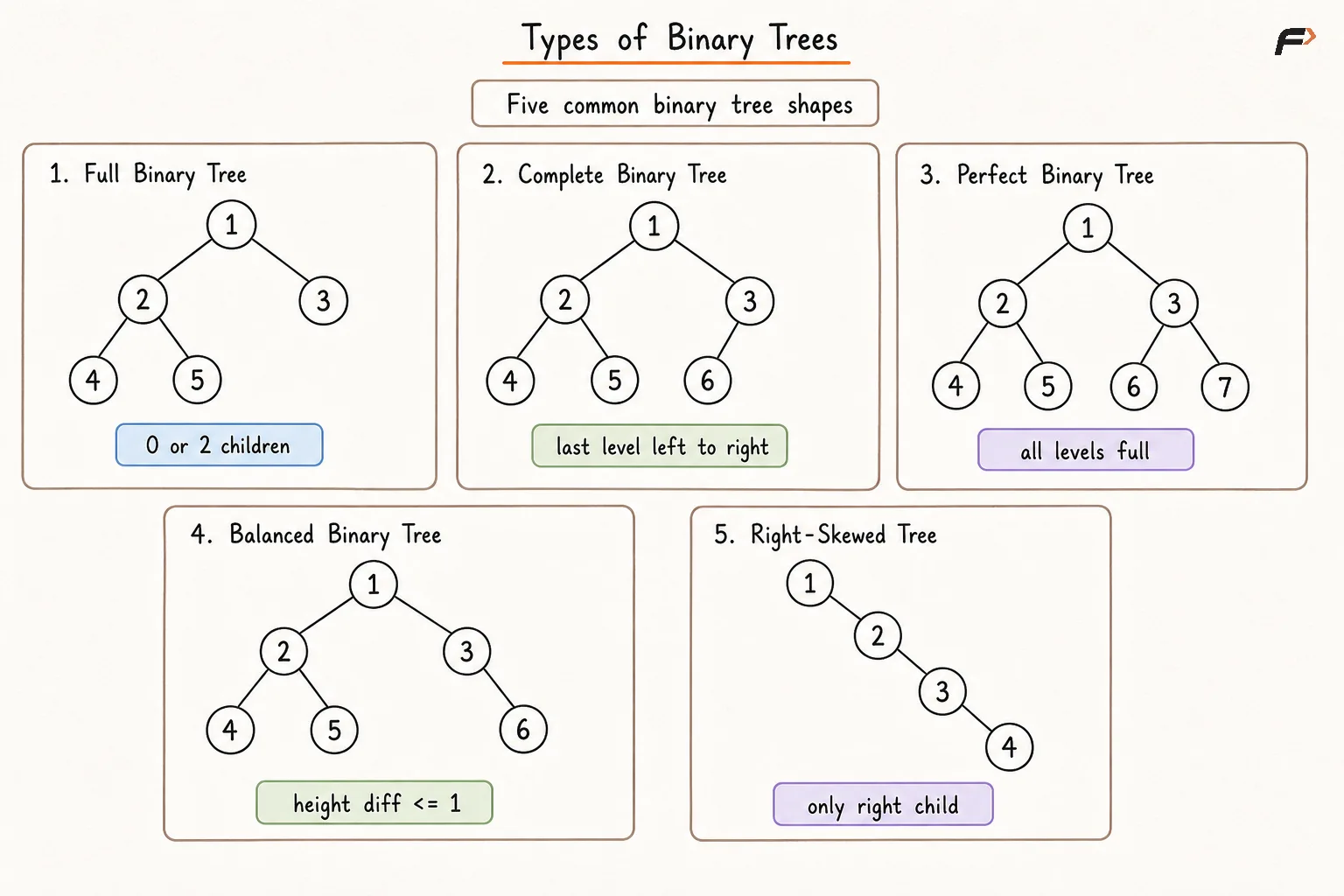
Types of Binary Tree.png
Binary Tree Representation
A binary tree is commonly represented in two ways:
Linked representation
Array representation
1. Linked Representation
In linked representation, every node stores:
Its data
A reference to its left child
A reference to its right child
If a child does not exist, the corresponding reference stores NULL.
The tree is accessed using a reference to its root.
Advantages
Nodes can be created when required.
Sparse and irregular trees do not waste array positions.
Child connections can be changed directly.
It naturally represents most general binary trees.
Limitations
Every node requires storage for two references.
Nodes may not occupy contiguous memory.
There is no direct index-based access to an arbitrary node.
2. Array Representation
In zero-based array representation, the root is stored at index 0.
For a node stored at index i:
Left Child Index = 2i + 1
Right Child Index = 2i + 2
For a non-root node:
Parent Index = floor((i - 1) / 2)
Consider:
[1, 2, 3, 4, 5, 6, 7]
The relationships are:
Node
1at index0has children2and3.Node
2at index1has children4and5.Node
3at index2has children6and7.
Advantages
Parent and child indices can be calculated directly.
No explicit child references are required.
It is efficient for complete or nearly complete trees.
It provides good memory locality.
Limitations
Sparse or skewed trees may leave many unused positions.
Resizing may be required when the allocated capacity is exhausted.
Structural changes can be less convenient than linked representation.
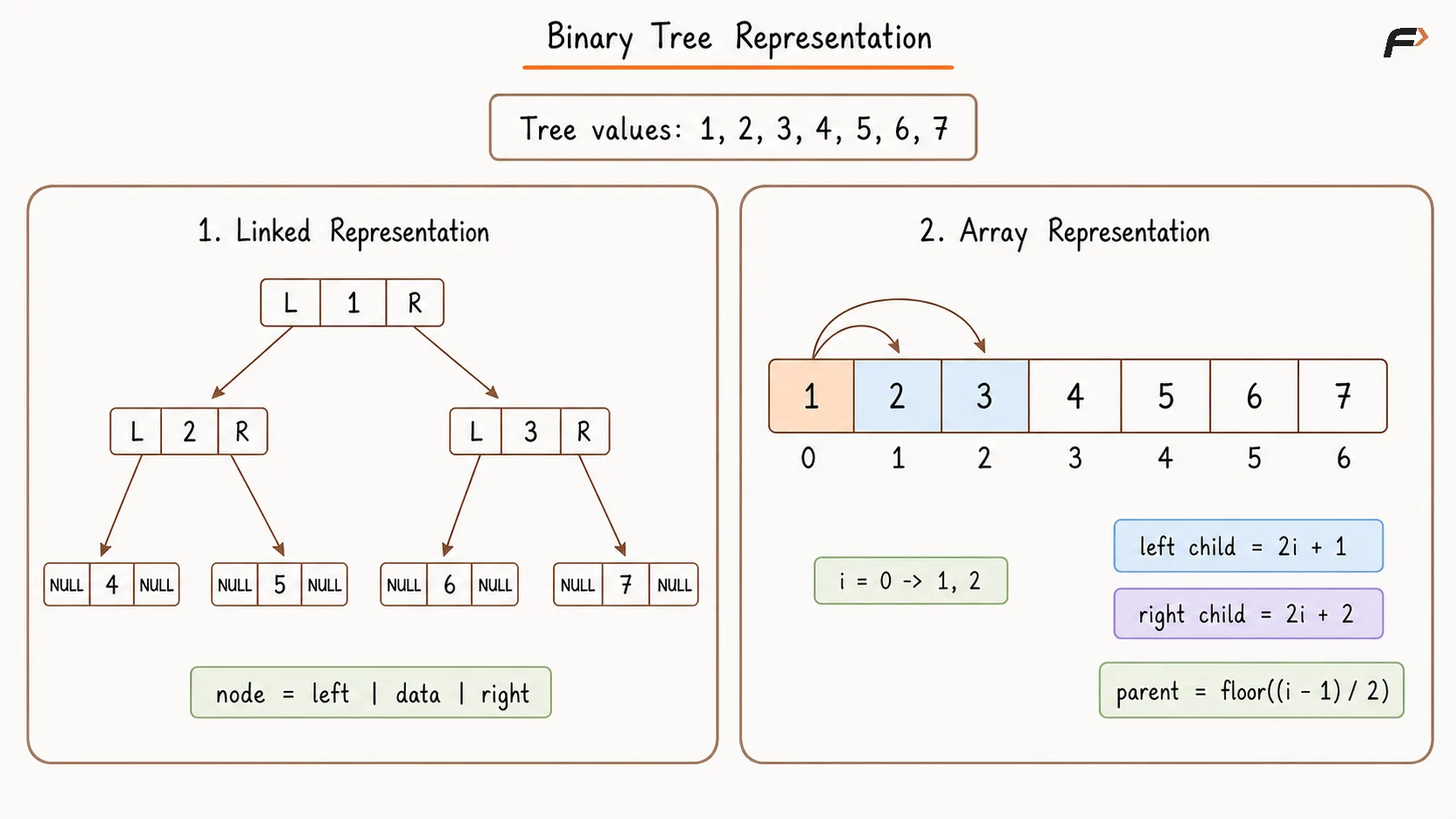
Binary Tree Linked List and Array Representation.png
Binary Tree Traversals
Traversal means visiting every node of the tree exactly once in a defined order.
Binary-tree traversals are divided into:
Depth-First Search
Breadth-First Search
Consider the following relationships:
Root
1Left child
2and right child3Children
4and5under node2Right child
6under node3
Depth-First Search
Depth-First Search explores one subtree deeply before moving to another subtree.
There are three primary DFS traversals.
Preorder Traversal
Order:
Root → Left → Right
For the example:
1, 2, 4, 5, 3, 6
Preorder is useful when the current node must be processed before its subtrees, such as while copying or serializing a tree.
Inorder Traversal
Order:
Left → Root → Right
For the example:
4, 2, 5, 1, 3, 6
Inorder traversal produces sorted values for a Binary Search Tree, but not necessarily for a general binary tree.
Postorder Traversal
Order:
Left → Right → Root
For the example:
4, 5, 2, 6, 3, 1
Postorder is useful when child subtrees must be processed before their parent, such as while deleting a tree or evaluating expression trees.
Breadth-First Search
Breadth-First Search visits nodes one level at a time from left to right. It is also called level-order traversal.
For the example:
1, 2, 3, 4, 5, 6
A queue is commonly used to preserve the order in which nodes must be processed.
Level-order traversal is useful for:
Processing nodes by level
Finding minimum-depth information
Viewing the tree layer by layer
Solving width and level-based problems
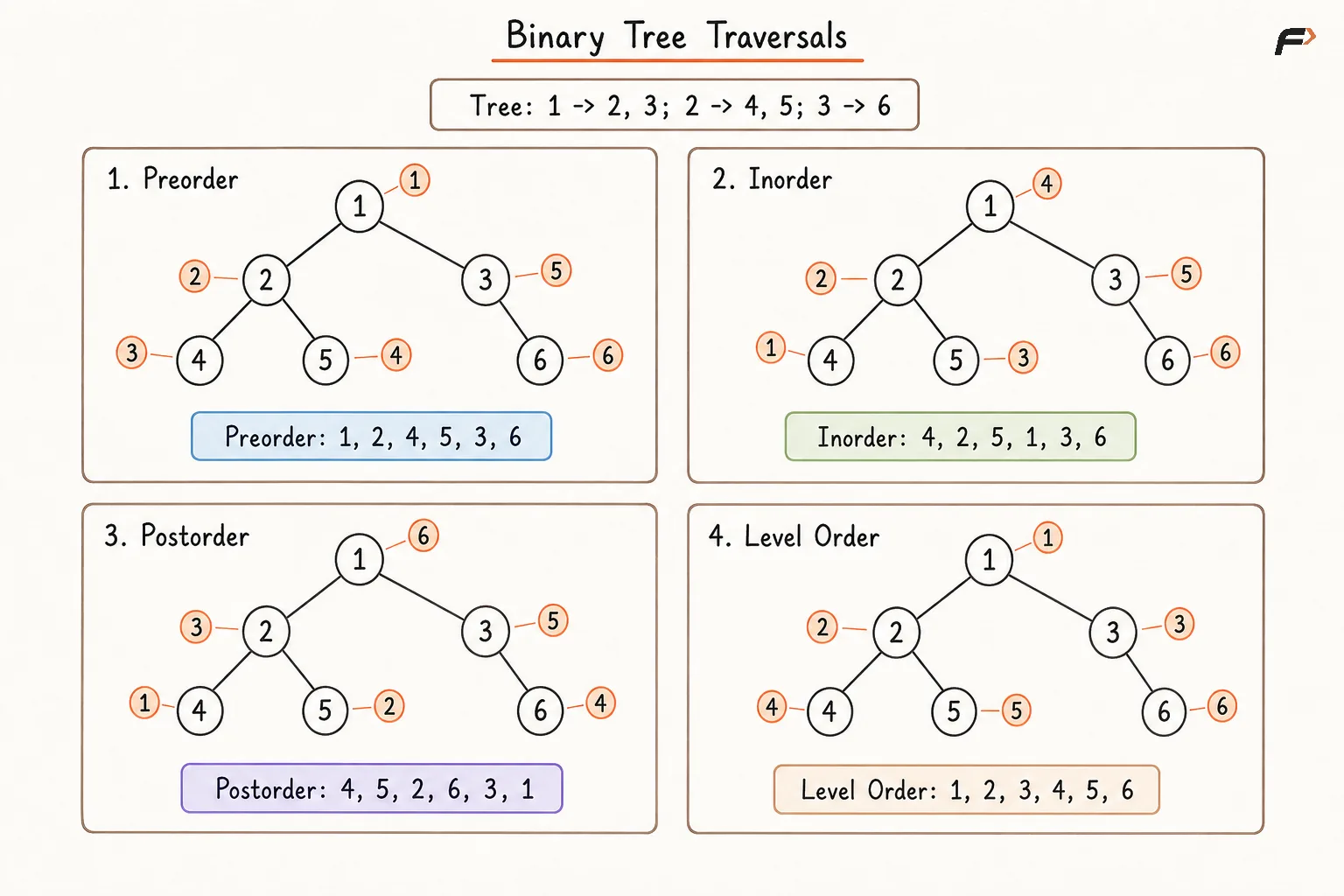
Binary Tree Traversals.png
Traversal Complexity
Every complete traversal visits all N nodes.
Therefore:
Time Complexity: O(N)
The auxiliary space depends on the traversal.
Recursive DFS
Recursive DFS uses the call stack.
Space Complexity: O(H)
where H is the height of the tree.
Balanced tree:
O(log N)Skewed tree:
O(N)
Iterative DFS
Iterative DFS uses an explicit stack.
Its worst-case auxiliary space is:
O(N)
The exact maximum depends on the shape of the tree and traversal method.
Level-Order Traversal
Level-order traversal uses a queue that may hold an entire level.
Space Complexity: O(W)
where W is the maximum width of the tree.
In the worst case:
W = O(N)
Basic Operation Complexities
A general binary tree does not impose any ordering rule on its values. Therefore, operations cannot automatically choose between the left and right subtrees based on the target.
Operation | Time Complexity | Reason |
|---|---|---|
Complete traversal |
| Every node is visited |
Search for a value |
| The target may be anywhere |
Calculate size |
| Every node must be counted |
Calculate height |
| Heights of the subtrees must be examined |
Find maximum or minimum value |
| No ordering is guaranteed |
Access a known child |
| The child reference is directly available |
Insertion and deletion do not have one universal complexity for a general binary tree because the location and structural rule depend on the specific problem.
Binary Tree and Binary Search Tree
A binary tree and a Binary Search Tree are not the same.
Binary Tree | Binary Search Tree |
|---|---|
Every node has at most two children | Every node has at most two children |
No general value-ordering rule | Values follow a defined ordering rule |
Search usually requires | Search takes |
Inorder traversal is not necessarily sorted | Inorder traversal produces sorted order |
Used for general hierarchical structures | Used for ordered searching and updates |
A Binary Search Tree is a special type of binary tree.
A balanced Binary Search Tree can support search, insertion, and deletion in O(log N) time. A skewed Binary Search Tree may require O(N) time.
Applications of Binary Trees
Binary trees are used in:
Binary Search Trees for ordered data
Binary Heaps for priority queues
Expression trees for arithmetic expressions
Syntax trees in compilers
Huffman coding trees for compression
Segment trees for range queries
Decision trees in machine learning
Game trees for decision-making
Hierarchical state representation
Advantages of Binary Trees
They naturally represent hierarchical relationships.
Their recursive structure simplifies many algorithms.
Specialized binary trees can provide efficient searching and updates.
They support several useful traversal orders.
They can grow dynamically in linked representation.
They form the foundation of many advanced data structures.
Limitations of Binary Trees
A general binary tree does not guarantee efficient searching.
Every linked node requires additional child references.
Poor insertion order may create a skewed structure.
Recursive traversal can cause stack overflow for very deep trees.
Sparse trees may waste space in array representation.
More pointer management is required than in contiguous structures.
Common Mistakes
Assuming every binary tree follows the Binary Search Tree ordering rule.
Confusing complete, full, perfect, and balanced binary trees.
Treating left and right children as interchangeable.
Mixing node-based and edge-based height definitions.
Forgetting that a single-node tree has height
0under the edge-based definition.Assuming a balanced tree must be complete.
Forgetting the base case for a
NULLnode during recursion.Calculating DFS space as
O(N)without considering the tree height.Assuming inorder traversal of every binary tree is sorted.
Using array representation for a highly sparse tree without considering wasted positions.
Forgetting that a non-empty tree with
Nnodes hasN - 1edges.
Interview follow-up Questions
A binary tree restricts each node to at most two children but does not impose a value order. A Binary Search Tree additionally arranges values according to an ordering rule, allowing search decisions to follow one subtree.
Be the first to add a comment.