Binary Search Introduction One Shot
What is Binary Search?
Binary Search is an efficient searching technique used to find an element in a sorted collection.
Instead of checking every element one by one, Binary Search checks the middle element and decides which half of the array can still contain the answer.
This makes Binary Search much faster than linear search for large arrays.
Common Binary Search problems include:
Search X in a sorted array
Lower Bound
Upper Bound
Search Insert Position
Floor of X
Ceil of X
Binary Search is an efficient algorithm designed to find the position of a target value within a collection of data. Instead of scanning through the data one item at a time from start to finish, Binary Search works by repeatedly dividing the searchable portion of data in half.
How Binary Search Works
Binary Search works only when the search space follows a sorted or monotonic pattern.
Most Binary Search problems follow the same simple process:
Initialize two pointers, low and high.
Find the middle index of the current search space.
Compare the middle value with the target.
Discard the half where the answer cannot exist.
Repeat until the answer is found or the search space becomes empty.
The main idea is that every step reduces the search space by half.
Search X in a Sorted Array
Given a sorted array of integers and a target value X, determine if X exists in the array. If it does, return its index. If it does not exist, return -1.
For a detailed explanation, see the original TUF blog: Search X in a Sorted Array
Example 1
Input: nums = [1, 3, 5, 7, 9, 11], X = 7
Output: 3
Explanation: The target value 7 is located at index 3 of the array.
Example 2
Input: nums = [1, 3, 5, 7, 9, 11], X = 6
Output: -1
Explanation: The value 6 is not present anywhere in the array.
Algorithm
Edge Case: If the array is empty, immediately return
-1because no search can be conducted.Set two pointers:
low = 0(start of the array) andhigh = n - 1(end of the array).Run a loop while
low <= high:Calculate the middle index:
mid = low + (high - low) / 2.If
nums[mid] == X, the target is found. Immediately returnmid.If
nums[mid] < X, the target must be in the right half. Updatelow = mid + 1to discard the left half.If
nums[mid] > X, the target must be in the left half. Updatehigh = mid - 1to discard the right half.
If the loop finishes and
lowcrosseshigh, the target is not in the array. Return-1.
Dry Run
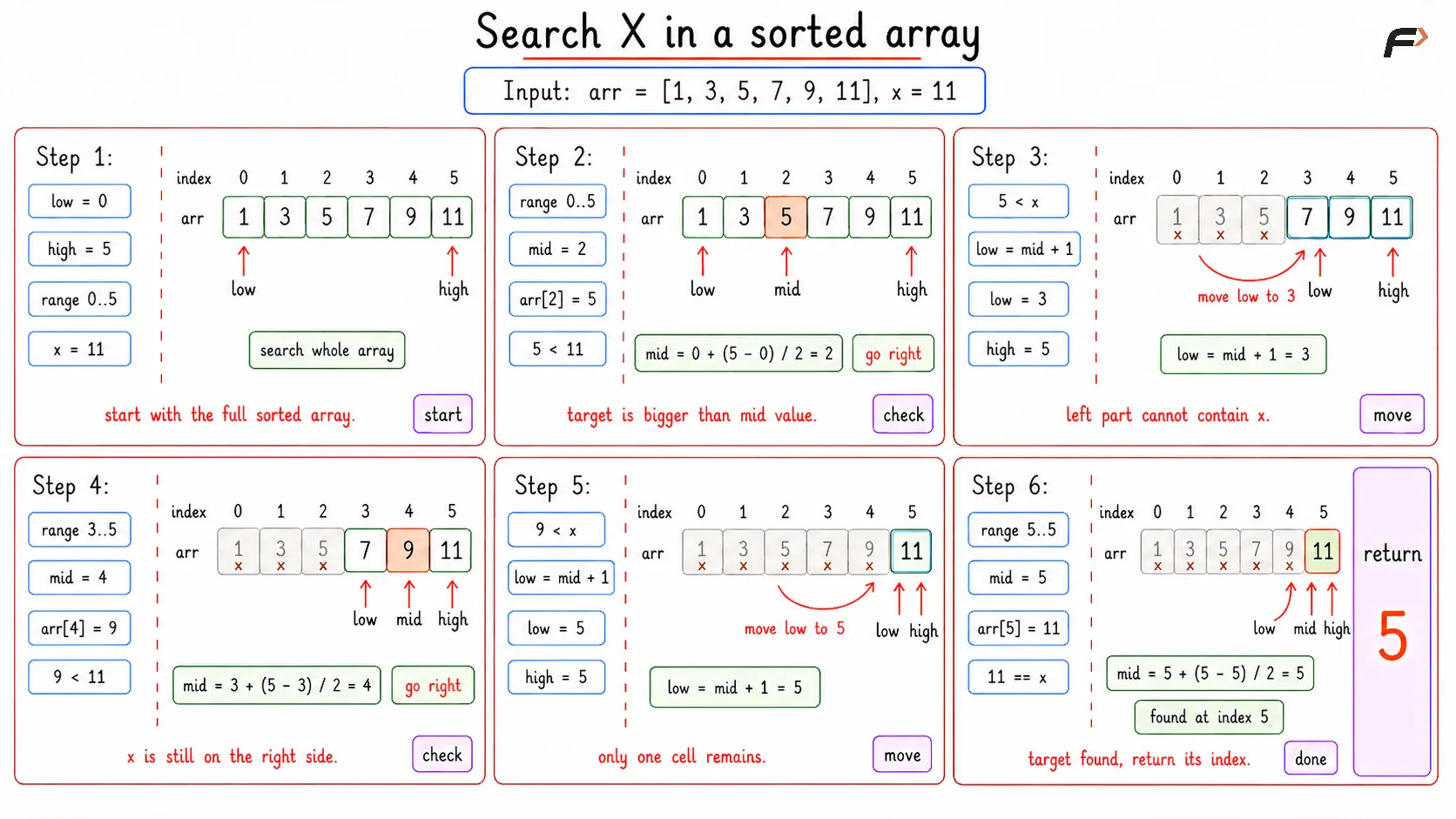
Search X Binary Search Dry Run
Complexity Analysis
Time Complexity: O(log N), N is the size of array, because the search space is cut in half at every step.
Space Complexity: O(1), as the search uses a few pointer variables without extra memory.
Lower Bound
Given a sorted array of integers and a target value X, find the index of the first element in the array that is greater than or equal to X. If no such element exists, return the size of the array (N).
For a detailed explanation, see the original TUF blog: Lower Bound
Example 1
Input: nums = [2, 3, 5, 6, 8, 10], X = 5
Output: 2
Explanation: The first element greater than or equal to 5 is 5 itself, located at index 2.
Example 2
Input: nums = [2, 3, 5, 6, 8, 10], X = 7
Output: 4
Explanation: The value 7 does not exist in the array. The first element strictly greater than or equal to 7 is 8, which is at index 4.
Algorithm
Edge Case: If the array is empty, return
0since that is the index where the boundary begins.Set two pointers:
low = 0(start of the array) andhigh = n - 1(end of the array). Initializeans = nto act as a fallback if no element satisfies the condition.Run a loop while
low <= high:Calculate
mid = low + (high - low) / 2.If
nums[mid] >= X, this is a valid candidate. Save this position by settingans = mid. Since you want the first occurrence, search the left half by settinghigh = mid - 1.If
nums[mid] < X, this element is too small. Move to the right half by settinglow = mid + 1.
Return
ansafter the loop terminates.
Dry Run
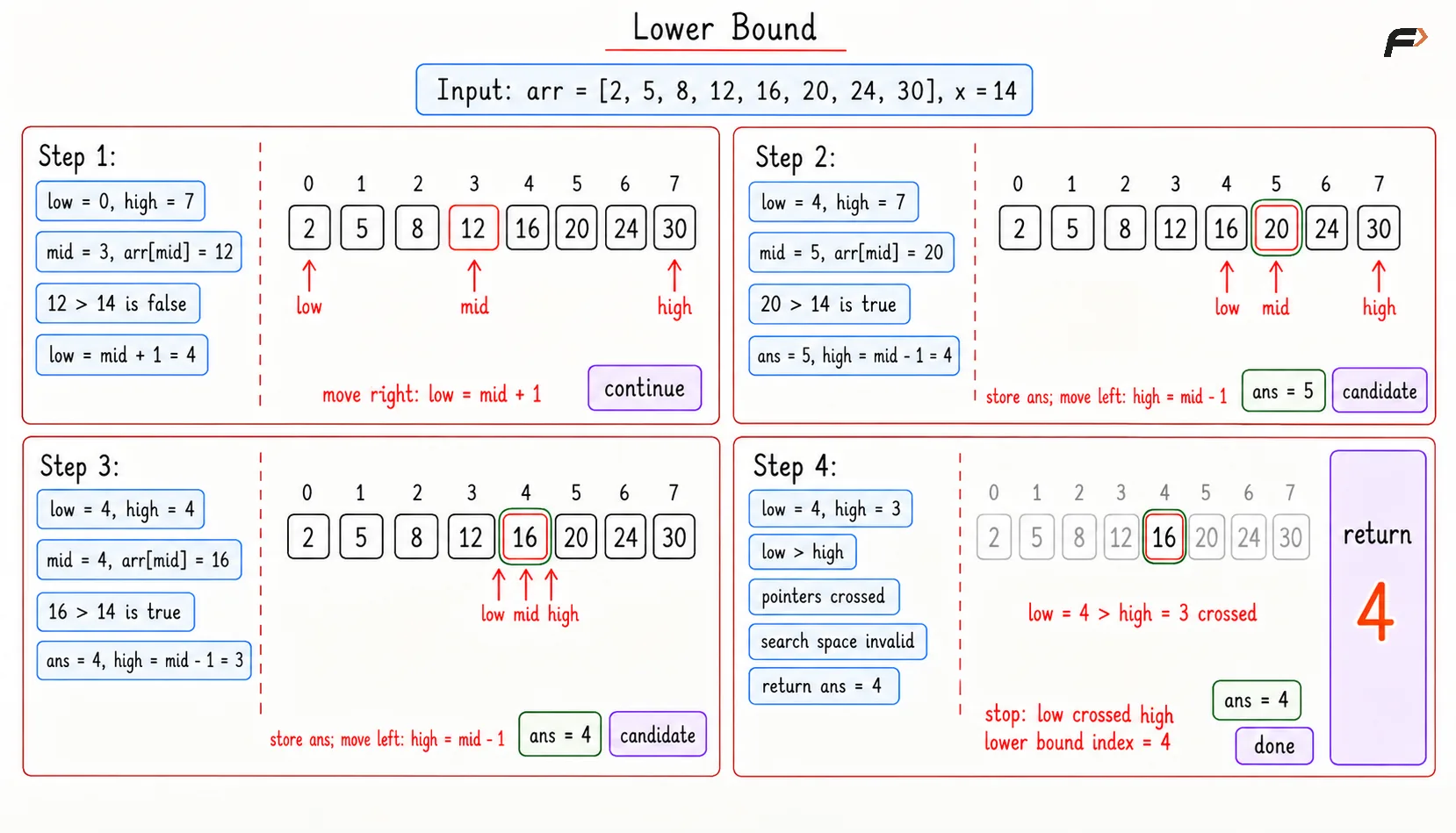
Lower Bound Optimal Dry Run
Complexity Analysis
Time Complexity: O(log N),N is the size of array, because we evaluate one middle element per step and halve the remaining search space.
Space Complexity: O(1), utilizing only fixed boundary pointers and an answer tracker variable.
Upper Bound
Given a sorted array of integers and a target value X, find the index of the first element in the array that is strictly greater than X. If no such element exists, return the size of the array (N).
For a detailed explanation, see the original TUF blog: Upper Bound
Example 1
Input: nums = [2, 3, 5, 6, 8, 10], X = 5
Output: 3
Explanation: The first element strictly greater than 5 is 6, which is located at index 3.
Example 2
Input: nums = [2, 3, 5, 6, 8, 10], X = 4
Output: 2
Explanation: The first element strictly greater than 4 is 5, which is located at index 2.
Algorithm
Edge Case: If the array is empty, return
0.Set two pointers:
low = 0(start of the array) andhigh = n - 1(end of the array). Initializeans = n.Run a loop while
low <= high:Calculate
mid = low + (high - low) / 2.If
nums[mid] > X, this element satisfies the strict condition. Recordans = midand search the left side by settinghigh = mid - 1to check for an earlier valid element.If
nums[mid] <= X, this element is not strictly greater than $X$. Move to the right side by settinglow = mid + 1.
Return
ans.
Dry Run
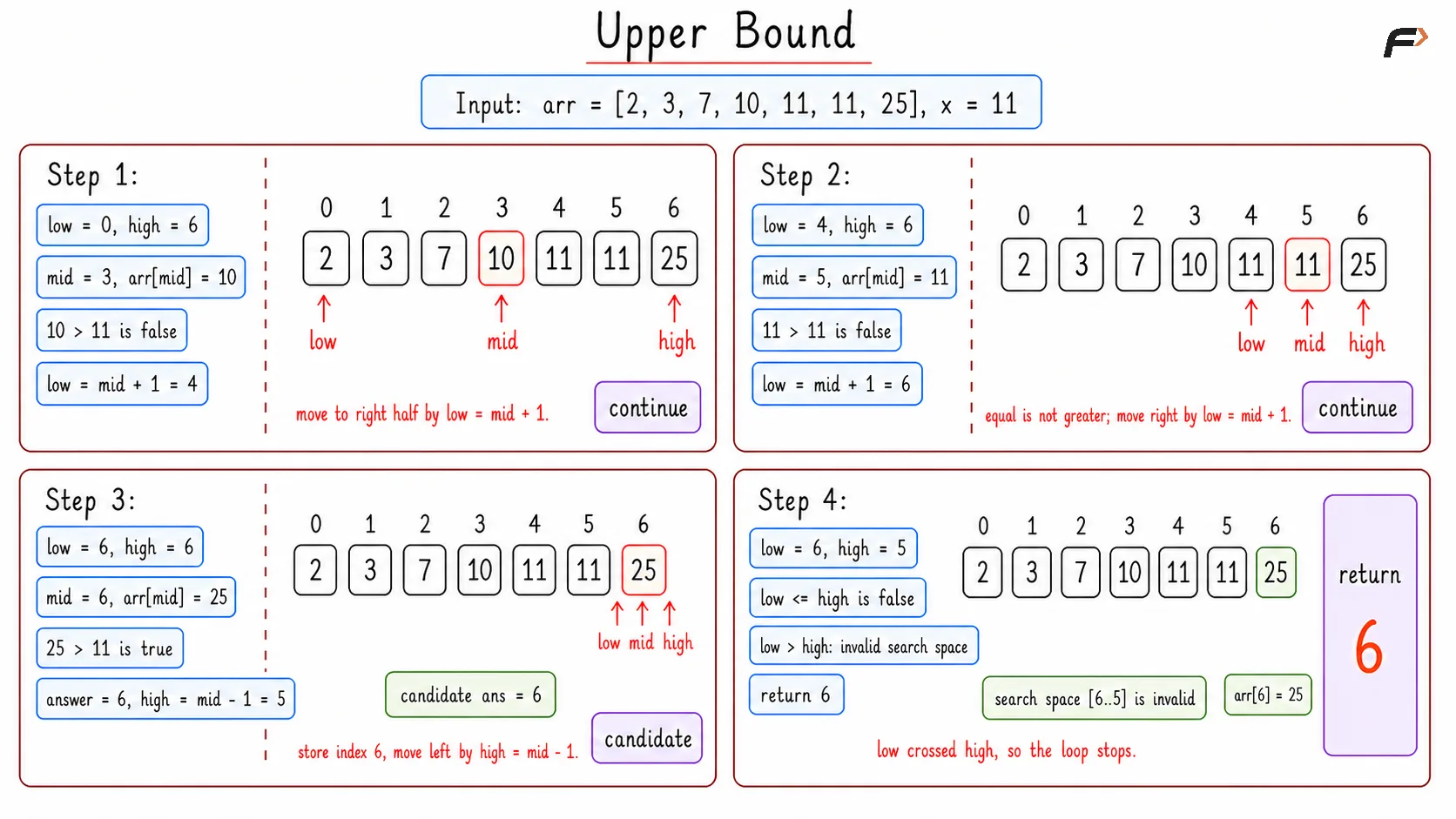
Upper Bound Optimal Dry Run
Complexity Analysis
Time Complexity: O(log N),N is the size of array, because the search space is cut in half at every step.
Space Complexity: O(1), as the search uses a few pointer variables without extra memory.
Search Insert Position
Given a sorted array of distinct integers and a target value X, return the index if the target is found. If not, return the index where it would be if it were inserted in order.
For a detailed explanation, see the original TUF blog: Search Insert Position
Example 1
Input: nums = [1, 3, 5, 6], X = 5
Output: 2
Explanation: The target value 5 exists in the array at index 2.
Example 2
Input: nums = [1, 3, 5, 6], X = 2
Output: 1
Explanation: The value 2 is missing. To keep the array sorted, it should be inserted between 1 and 3, which means it takes over index 1.
Algorithm
Edge Case: If the array is empty, return
0because the element will become the very first item in the list.Set two pointers:
low = 0(start of the array) andhigh = n - 1(end of the array). Initializeans = n.Run a loop while
low <= high:Calculate
mid = low + (high - low) / 2.If
nums[mid] == X, you found the exact value. Returnmidimmediately.If
nums[mid] > X, this position could be where X belongs, or X might belong further to the left. Recordans = midand updatehigh = mid - 1.If
nums[mid] < X, the insertion spot must be further down the line. Updatelow = mid + 1.
Return
ansif an exact match was not found. (Note: The final value oflowat the end of a standard binary search loop also naturally points to this insertion index).
Dry Run
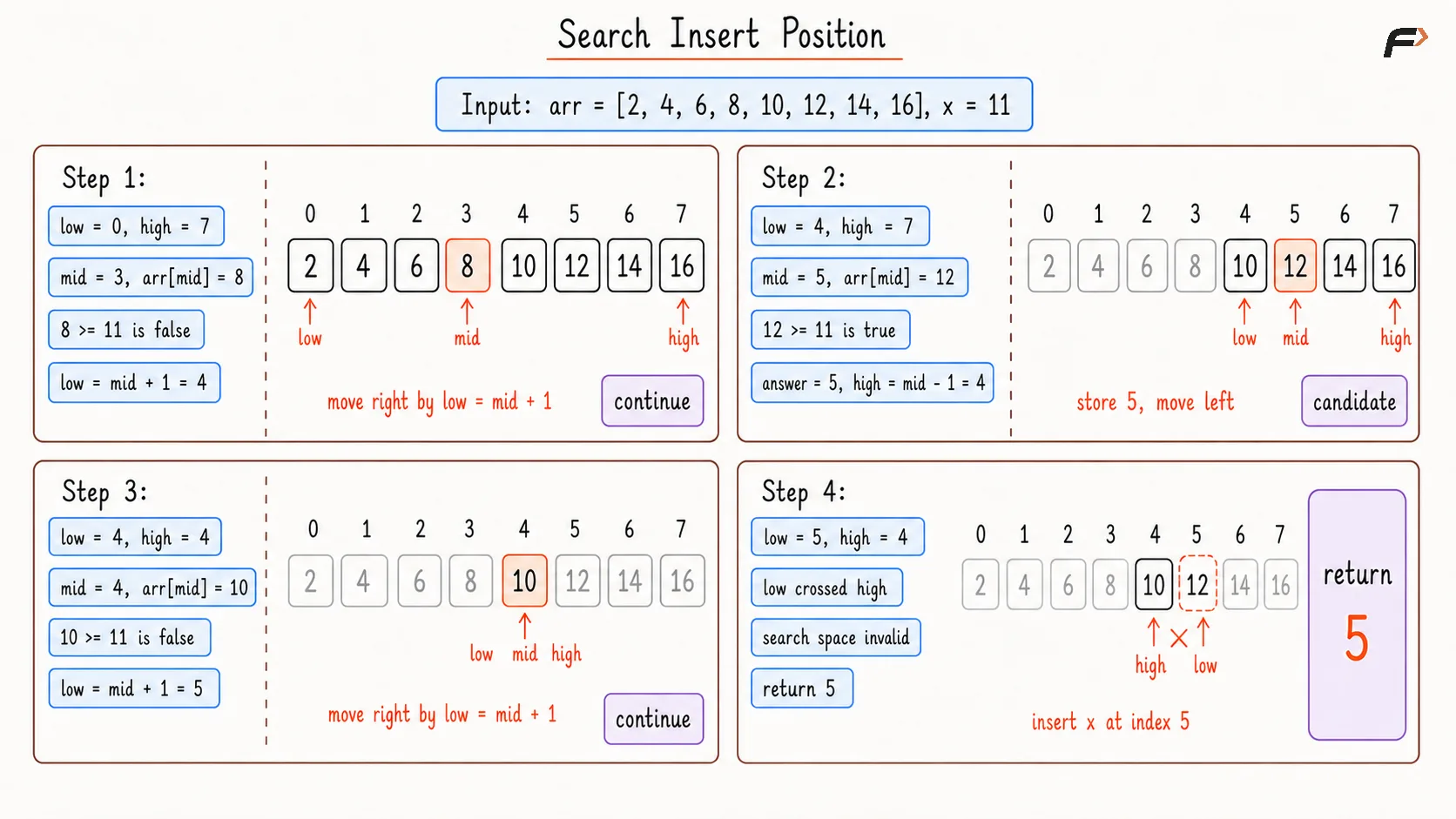
Search Insert Position Optimal Dry Run
Complexity Analysis
Time Complexity: O(log N),N is the size of array, matching the performance of a lower bound binary search.
Space Complexity: O(1), operating completely in place.
Find Floor
Given a sorted array of integers and a target value X, find the largest value in the array that is smaller than or equal to X. Return its index, or -1 if no such element exists.
For a detailed explanation, see the original TUF blog: Find Floor
Example 1
Input: nums = [1, 2, 8, 10, 11, 12], X = 5
Output: 1
Explanation: The elements smaller than or equal to 5 are 1 and 2. The largest among them is 2, which is located at index 1.
Example 2
Input: nums = [1, 2, 8, 10, 11, 12], X = 0
Output: -1
Explanation: There are no elements in the array that are smaller than or equal to 0.
Algorithm
Edge Case: If the array is empty, or if the first element
nums[0]is strictly greater than $X$, return-1because no valid floor element can exist.Set two pointers:
low = 0(start of the array) andhigh = n - 1(end of the array). Initializeans = -1.Run a loop while
low <= high:Calculate
mid = low + (high - low) / 2.If
nums[mid] <= X, this element is a valid candidate for the floor. Storeans = mid. Since you want the largest possible valid value, try to find a larger one by looking in the right half:low = mid + 1.If
nums[mid] > X, the element is too large to be a floor. Discard it and everything to its right by settinghigh = mid - 1.
Return
ans.
Dry Run
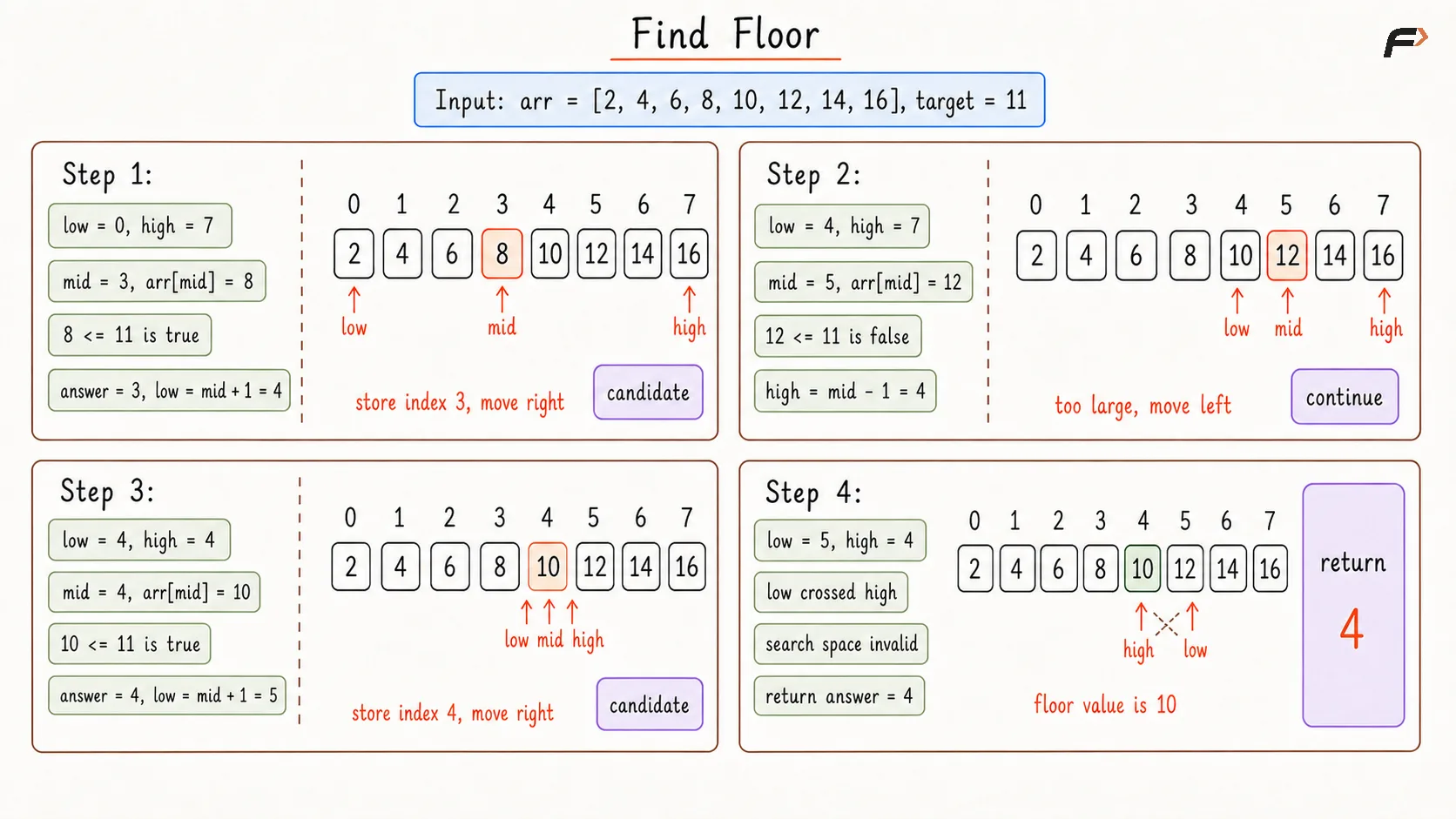
Find Floor Optimal Dry Run
Complexity Analysis
Time Complexity: O(log N),N is the size of array, since we cut the valid catalog items in half with each iteration.
Space Complexity: O(1), requiring no extra auxiliary storage.
Find Ceil
Given a sorted array of integers and a target value X, find the smallest value in the array that is greater than or equal to X. Return its index, or -1 if no such element exists.
For a detailed explanation, see the original TUF blog: Find Ceil
Example 1
Input: nums = [1, 2, 8, 10, 11, 12], X = 5
Output: 2
Explanation: The elements greater than or equal to 5 are 8, 10, 11, 12. The smallest among them is 8, which is located at index 2.
Example 2
Input: nums = [1, 2, 8, 10, 11, 12], X = 15
Output: -1
Explanation: There are no elements in the array greater than or equal to 15.
Algorithm
Edge Case: If the array is empty, or if the last element
nums[n-1]is strictly less than X, return-1because no element can satisfy the ceiling condition.Set two pointers:
low = 0(start of the array) andhigh = n - 1(end of the array). Initializeans = -1.Run a loop while
low <= high:Calculate
mid = low + (high - low) / 2.If
nums[mid] >= X, this element is valid. Recordans = mid. Since you are looking for the smallest value that qualifies, search the left half by settinghigh = mid - 1.If
nums[mid] < X, the value is too small to be a ceiling. Search the right half by settinglow = mid + 1.
Return
ans.
Dry Run
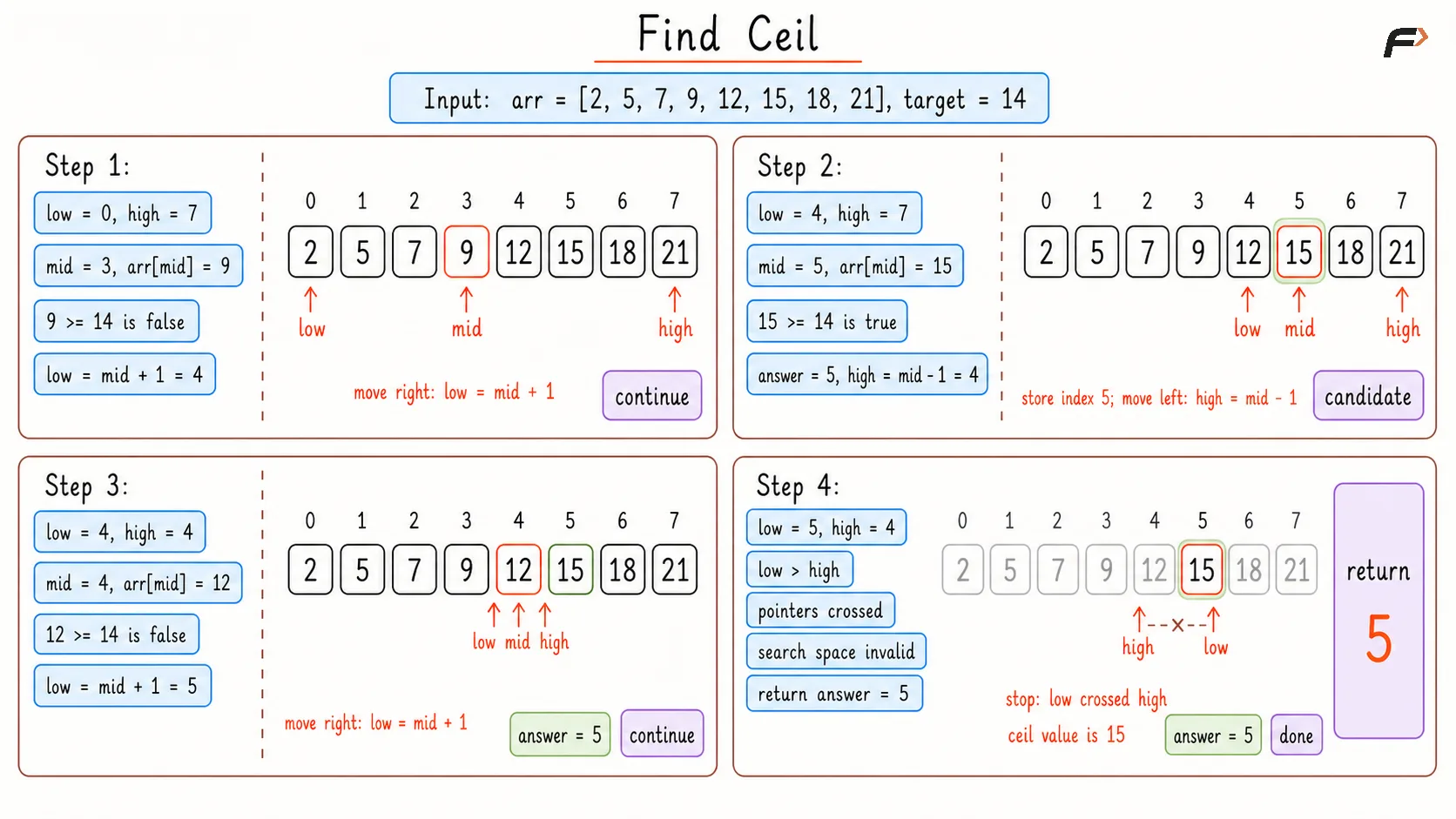
Find Ceil Optimal Dry Run
Complexity Analysis
Time Complexity: O(log N), N is the size of array, because the binary loop boundaries converge logarithmically.
Space Complexity: O(1), utilizing a constant amount of memory tracking variables.
Be the first to add a comment.