Introduction to Binary Search Tree
When managing data in computer science, efficiency is everything. While standard arrays and linked lists are easy to implement, they often fall short when it comes to quick searching, insertion, and deletion. That is where the Binary Search Tree (BST) comes into play.
A Binary Search Tree is a fundamental, non-linear data structure that combines the quick search capabilities of a sorted array with the dynamic insertion benefits of a linked list.
In this article, you will learn the core properties of a BST, how it works, its primary operations, and its real-world applications.
What is a Binary Search Tree (BST)?
A Binary Search Tree is a node-based binary tree data structure that possesses a strict ordering property. Like a standard binary tree, each node in a BST can have a maximum of two children: a left child and a right child. However, a BST imposes a specific rule on how these nodes are arranged.
The Core Properties of a BST
For any given node (let's call it the root node of a subtree), the following rules must always hold true:
Left Subtree Property: The value of all nodes in the left subtree must be less than the value of the root node.
Right Subtree Property: The value of all nodes in the right subtree must be greater than the value of the root node.
Subtree Continuity: Both the left and right subtrees must also recursively be binary search trees.
No Duplicate Values: Typically, a standard BST does not allow duplicate values, though some variations handle duplicates by placing them consistently in either the left or right subtree.
Example of a Valid BST
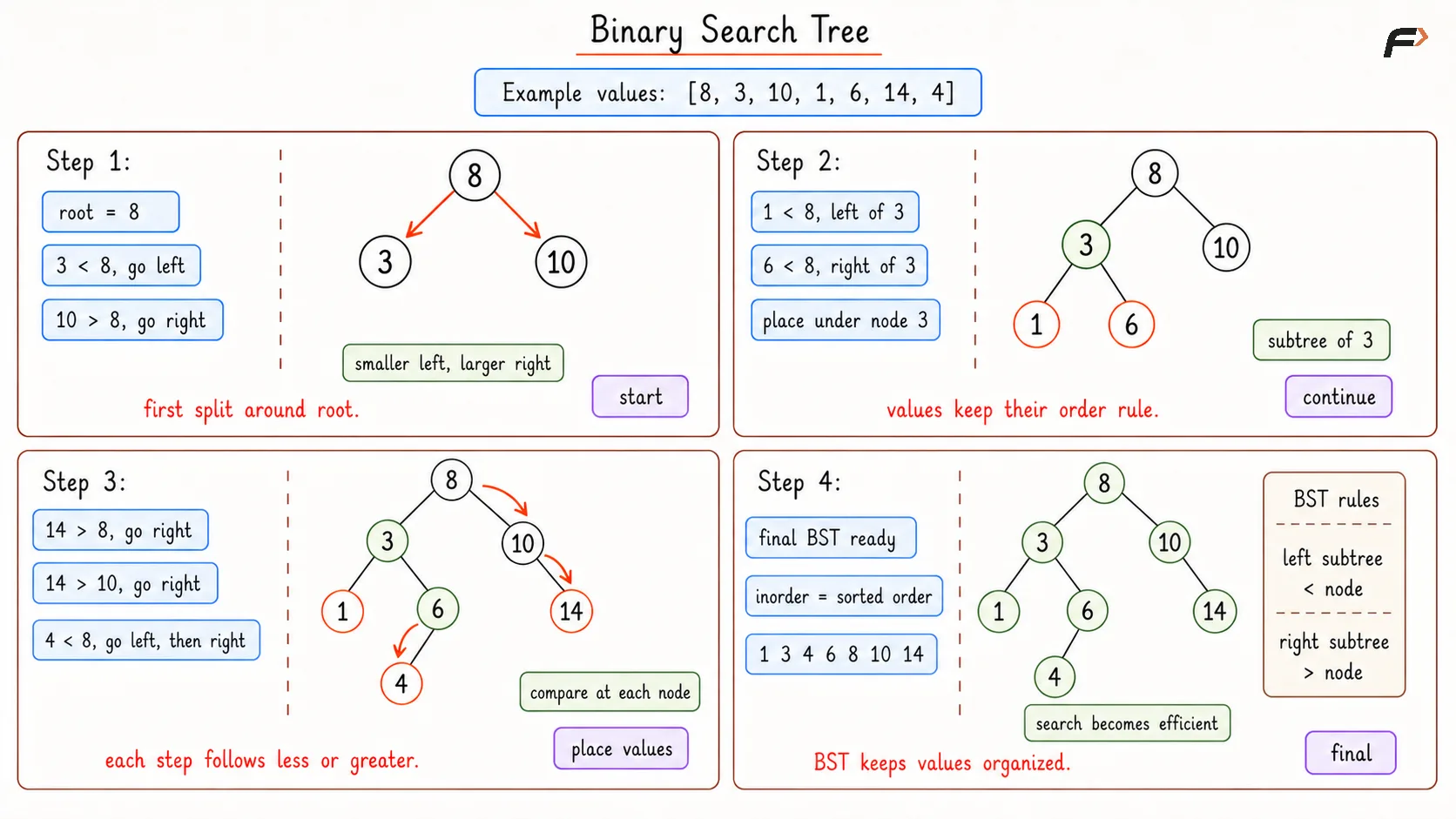
Example of BST
Basic Operations in a Binary Search Tree
Because of its structural design, performing operations on a BST is highly intuitive. The three most common operations are Search, Insertion, and Deletion.
1. Search Operation
Searching for a key in a BST is highly efficient because you can eliminate half of the remaining tree at each step.
Start at the root node.
If the target value matches the root node, return the node.
If the target value is smaller than the root, move to the left child.
If the target value is larger than the root, move to the right child.
Repeat until the value is found or you reach a
nullnode (indicating the value does not exist).
Dry Run
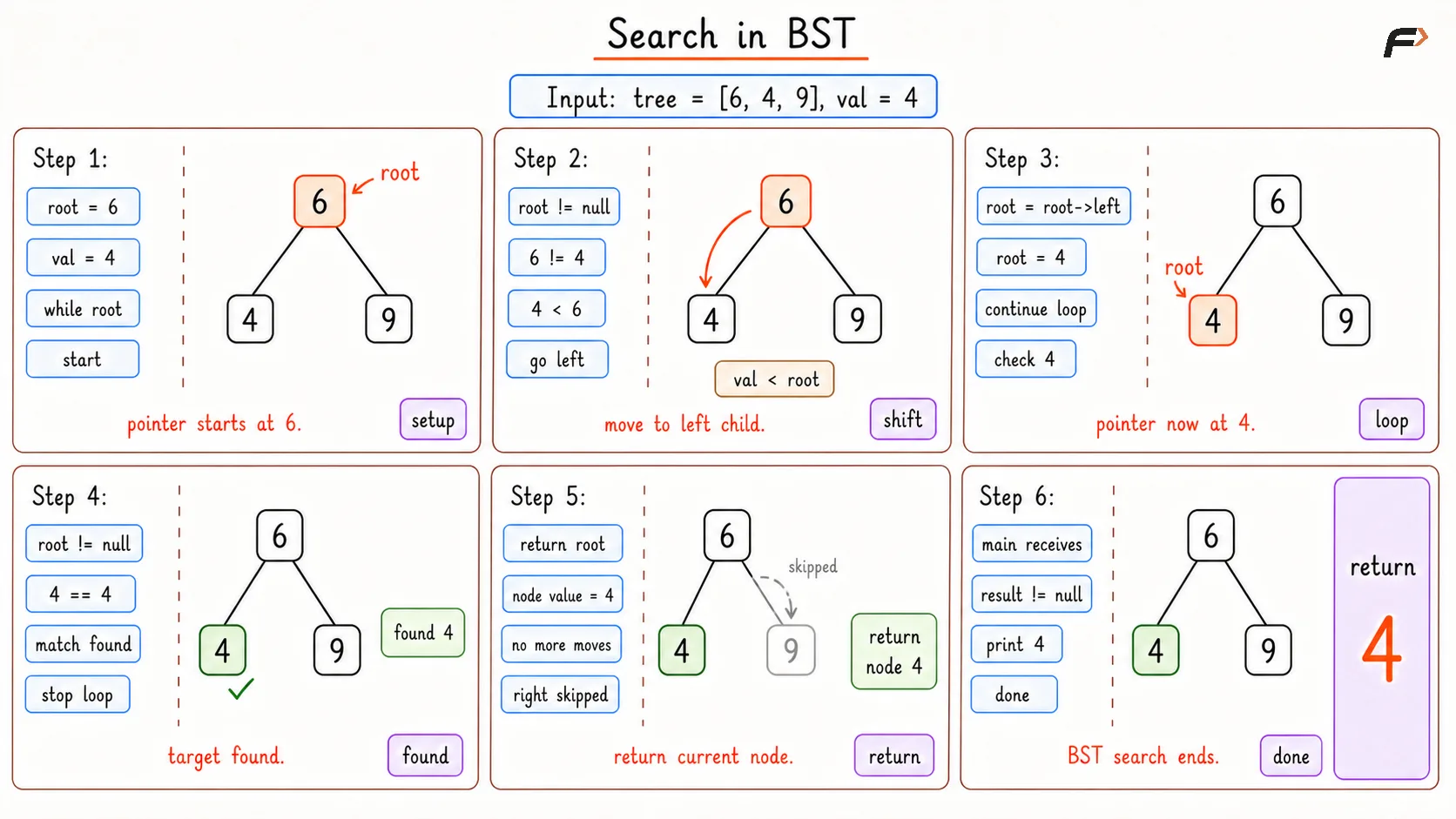
Search in BST Optimal Dry Run
2. Insertion Operation
Insertion follows a similar logic to searching. You must find the correct empty spot where the new value belongs to maintain the BST property.
Compare the new value with the current node.
If the new value is smaller, move left; if larger, move right.
When you hit an empty spot (
null), create a new node and attach it there.
Dry Run
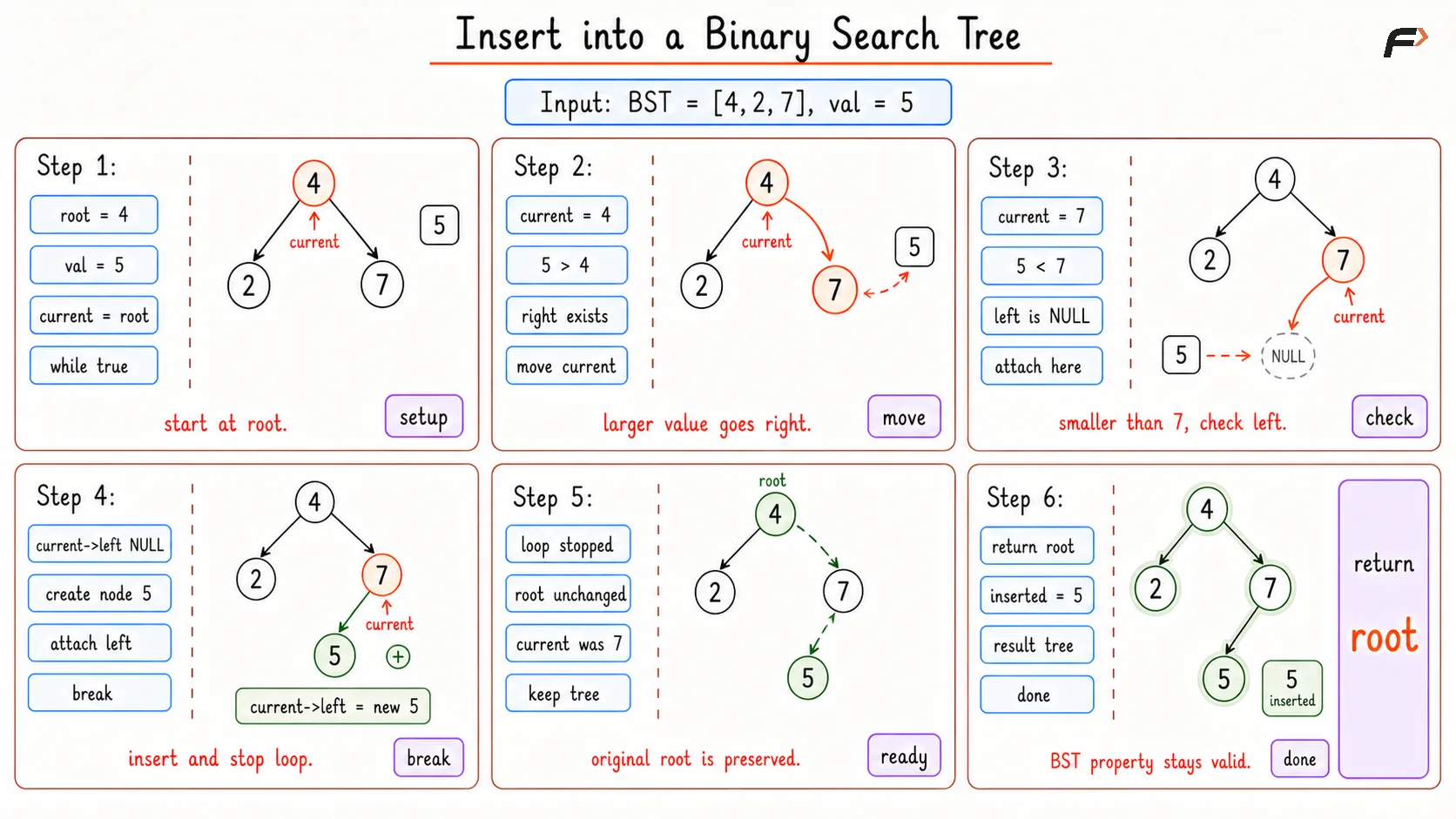
Insert into a BST Optimal Dry Run
3. Deletion Operation
Deleting a node is slightly more complex because you must ensure the tree remains a valid BST after the node is removed. There are three cases to consider:
Case 1: The node is a leaf (no children). Simply remove the node from the tree.
Case 2: The node has one child. Copy the child to the node and delete the child.
Case 3: The node has two children. Find the node's inorder successor (the smallest value in the right subtree) or inorder predecessor (the largest value in the left subtree). Replace the target node's value with this successor's value, and then delete the successor node.
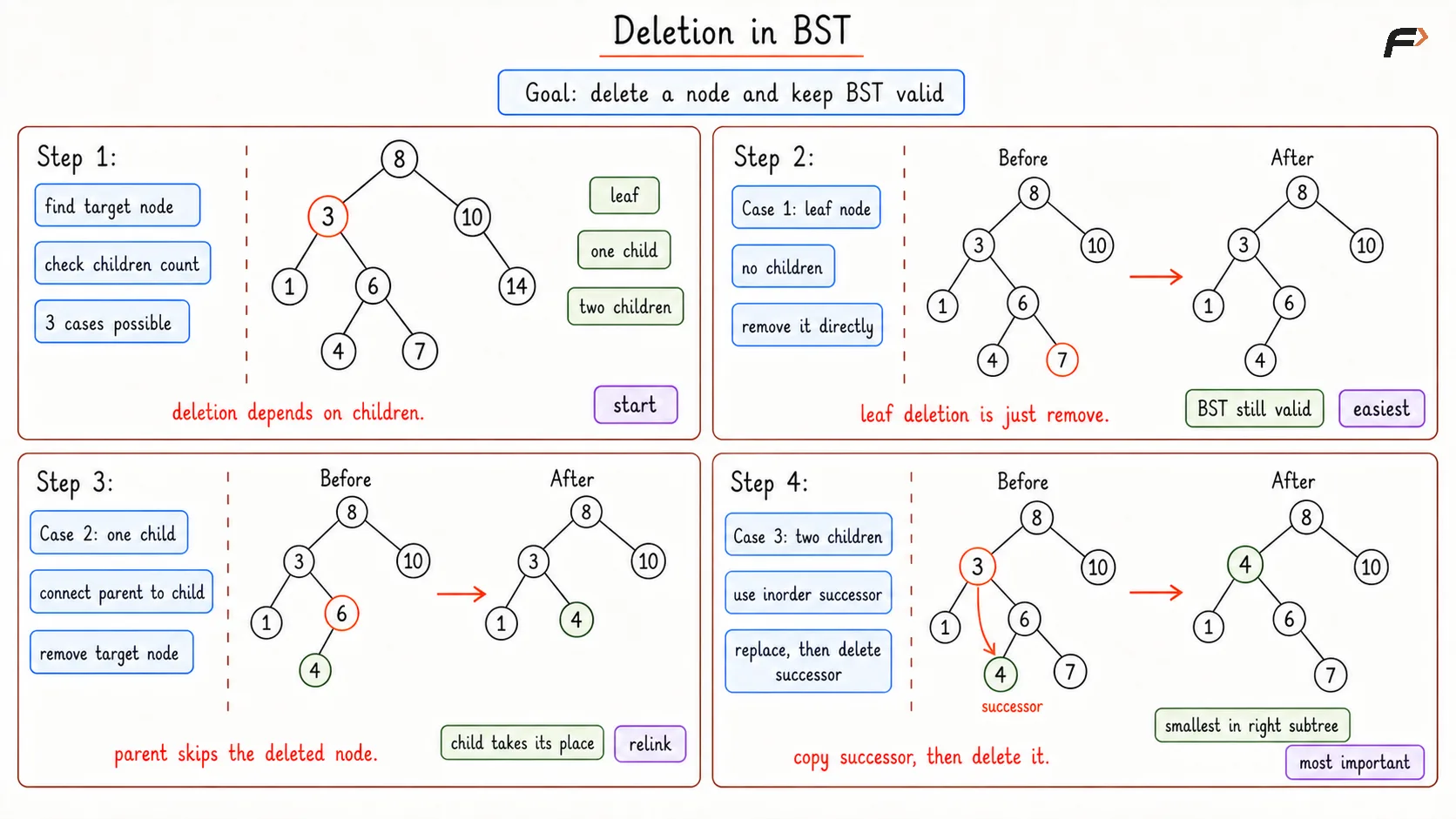
Deletion in BST
Tree Traversals in a BST
Traversing a tree means visiting every node in a specific order. For a Binary Search Tree, traversal techniques yield highly predictable results:
Inorder Traversal (Left, Root, Right): Visiting a BST using inorder traversal visits the nodes in strictly ascending order.
Preorder Traversal (Root, Left, Right): Useful for creating a copy of the tree.
Postorder Traversal (Left, Right, Root): Useful for deleting the tree or evaluating postfix expressions.
Time and Space Complexity Analysis
The efficiency of a BST depends heavily on its shape, which is determined by the order in which elements are inserted.
Operation | Average Case Complexity | Worst Case Complexity |
Search | O(log n) | O(n) |
Insert | O(log n) | O(n) |
Delete | O(log n) | O(n) |
Space | O(n) | O(n) |
Why the Worst Case Occurs: Skewed Trees
If elements are inserted into a BST in sorted order (e.g., 1, 2, 3, 4, 5), the tree turns into a straight line, known as a skewed tree. In this scenario, the BST acts exactly like a linked list, causing operations to degrade to O(n) time complexity.
To prevent this issue, self-balancing binary search trees like AVL Trees and Red-Black Trees are used in production environments to guarantee O(log n) time complexity by balancing themselves automatically during insertions and deletions.
Real-World Applications of BSTs
Binary Search Trees are utilized under the hood in many critical computational systems:
Indexing in Databases: Used to implement multi-level indexing to find records fast.
Memory Management: Used to maintain lists of free memory blocks in operating systems.
Symbol Tables: Implemented in compilers to look up identifiers quickly.
Routing Algorithms: Employed in network routers to manage routing tables.
Summary
The Binary Search Tree is a foundational data structure that offers an optimal balance between fast data access and dynamic modifications. By enforcing the rule that smaller elements go left and larger elements go right, a BST optimizes lookup operations to logarithmic time under average conditions. Understanding the mechanics of a BST is a vital stepping stone toward mastering more advanced data structures like self-balancing trees, heaps, and graphs.
Be the first to add a comment.