181. Traversal Techniques
Given an undirected connected graph with V vertices numbered from 0 to V-1, the task is to implement both Depth First Search (DFS) and Breadth First Search (BFS) traversals starting from the 0th vertex.
The graph is represented using an array/vector of edges, where each element is a pair [u, v] indicating an undirected edge between vertex u and vertex v.
Example 1:
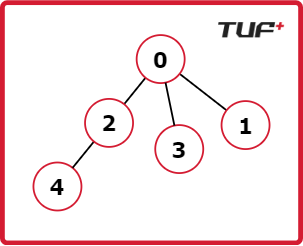
Input: V = 5, edges = [ [0, 1], [0, 2], [0, 3], [2, 4] ]
Output:[0, 2, 4, 3, 1], [0, 2, 3, 1, 4]
Explanation:
DFS: Start from vertex 0. Visit vertex 2, then vertex 4, backtrack to vertex 0, then visit vertex 3, and finally vertex 1. The traversal is 0 → 2 → 4 → 3 → 1.
BFS: Start from vertex 0. Visit vertices 2, 3, and 1 (in the order they appear in the adjacency list). Then, visit vertex 4 from vertex 2. The traversal is 0 → 2 → 3 → 1 → 4.
Example 2:
Input: V = 4, edges = [ [0, 1], [0, 3], [1, 2] ]
Output: [0, 1, 2, 3], [0, 1, 3, 2]
Explanation:
DFS: Start from vertex 0. Visit vertex 1, then vertex 2, backtrack to vertex 0, then visit vertex 3. The traversal is 0 → 1 → 2 → 3.
BFS: Start from vertex 0. Visit vertices 1 and 3, then visit vertex 2 from vertex 1. The traversal is 0 → 1 → 3 → 2.
Now Your Turn!
Pick the correct output for the given inputInput: V = 3, edges = [ [0, 1], [0, 2] ]
Still unsure what the problem is asking ?
Let’s go through a few more examples, step by step, to make it clearer.
Constraints:
- E= Number of Edges
- 1 ≤ V, E ≤ 104