769. Length of loop in LL
Given the head of a singly linked list, find the length of the loop in the linked list if it exists. Return the length of the loop if it exists; otherwise, return 0.
A loop exists in a linked list if some node in the list can be reached again by continuously following the next pointer. Internally, pos is used to denote the index (0-based) of the node from where the loop starts.
Note that pos is not passed as a parameter.
Example 1:
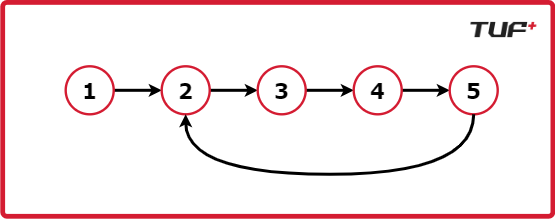
Input: head -> 1 -> 2 -> 3 -> 4 -> 5, pos = 1
Output: 4
Explanation: 2 -> 3 -> 4 -> 5 - >2, length of loop = 4.
Example 2:
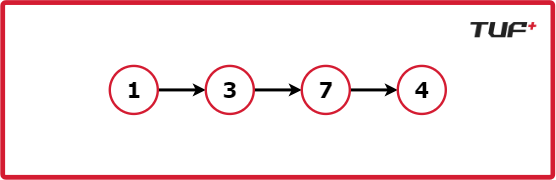
Input: head -> 1 -> 3 -> 7 -> 4, pos = -1
Output: 0
Explanation: No loop is present in the linked list.
Now Your Turn!
Pick the correct output for the given input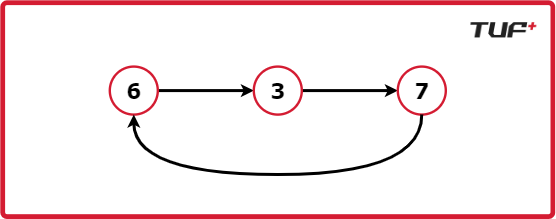
Input: head -> 6 -> 3 -> 7, pos = 0
Still unsure what the problem is asking ?
Let’s go through a few more examples, step by step, to make it clearer.
Constraints:
- 0 <= number of nodes in the cycle <= 105
- 0 <= ListNode.val <= 104
- pos is -1 or a valid index in the linked list