203. Bipartite graph
Given an undirected graph with V vertices labeled from 0 to V-1. The graph is represented using an 2D vector edges ,where edges[i] represent an undirected edge between edges[i][0] and edges[i][1]. Determine if the graph is bipartite or not.
A graph is bipartite if the nodes can be partitioned into two independent sets A and B such that every edge in the graph connects a node in set A and a node in set B.
Example 1:
Input: V=4, edges = [ [0, 1], [0, 3], [1, 2], [2, 3] ]
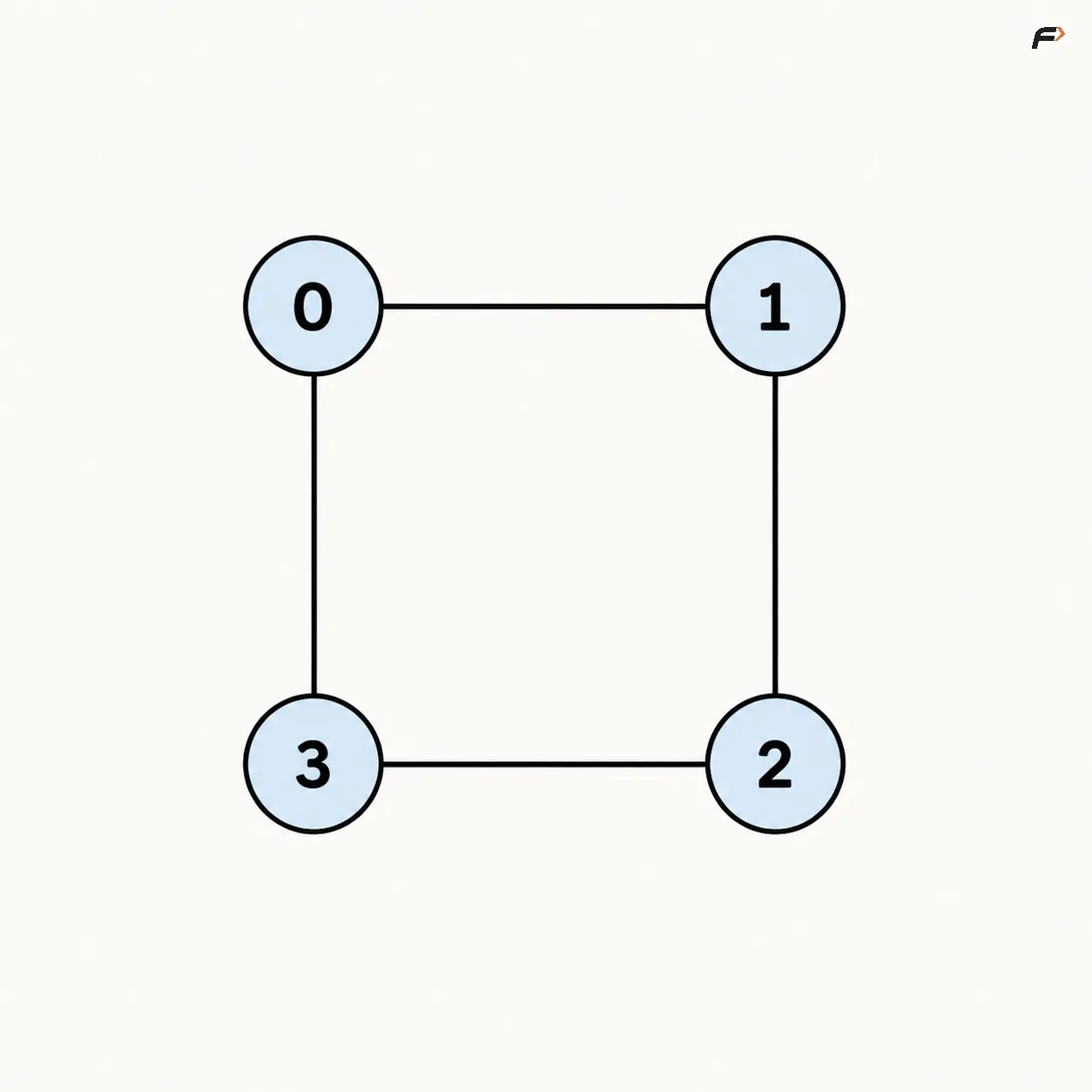 Output: True
Explanation: The given graph is bipartite since, we can partition the nodes into two sets: {0, 2} and {1, 3}.
Example 2:
Input: V=4, edges = [ [0, 1], [0, 2], [0, 3], [2, 1], [3, 2] ]
Output: False
Explanation: The graph is not bipartite. If we attempt to partition the nodes into two sets, we encounter an edge that connects two nodes within the same set, which violates the bipartite property.
Now Your Turn!
Pick the correct output for the given inputInput: V=5, edges = [ [0, 1], [0, 3], [1, 2], [2, 4], [4, 3] ]
Still unsure what the problem is asking ?
Let’s go through a few more examples, step by step, to make it clearer.
Constraints:
- E=number of edges
- 1 ≤ V, E ≤ 104