Trains, Boats and Streams: Concepts, Formulas and Examples
Trains, boats and streams are applications of speed, distance and time. A moving train may have to cover its own length and the length of another object. Flowing water changes a boat's effective speed. In both cases, the main decision is to find the correct distance and the correct effective speed.
Suppose a 100 metre train crosses a pole. The train must move 100 metres because the pole is treated as a point. If the same train crosses a 200 metre platform, it must move 300 metres because its last coach must also leave the platform. The speed formula is the same, but the distance changes.
This guide builds the topic from that basic idea. We will first learn speed, distance, time and unit conversion. We will then use them for train crossings, relative speed, boats moving with or against a stream, and the equation-based patterns used in aptitude exams.
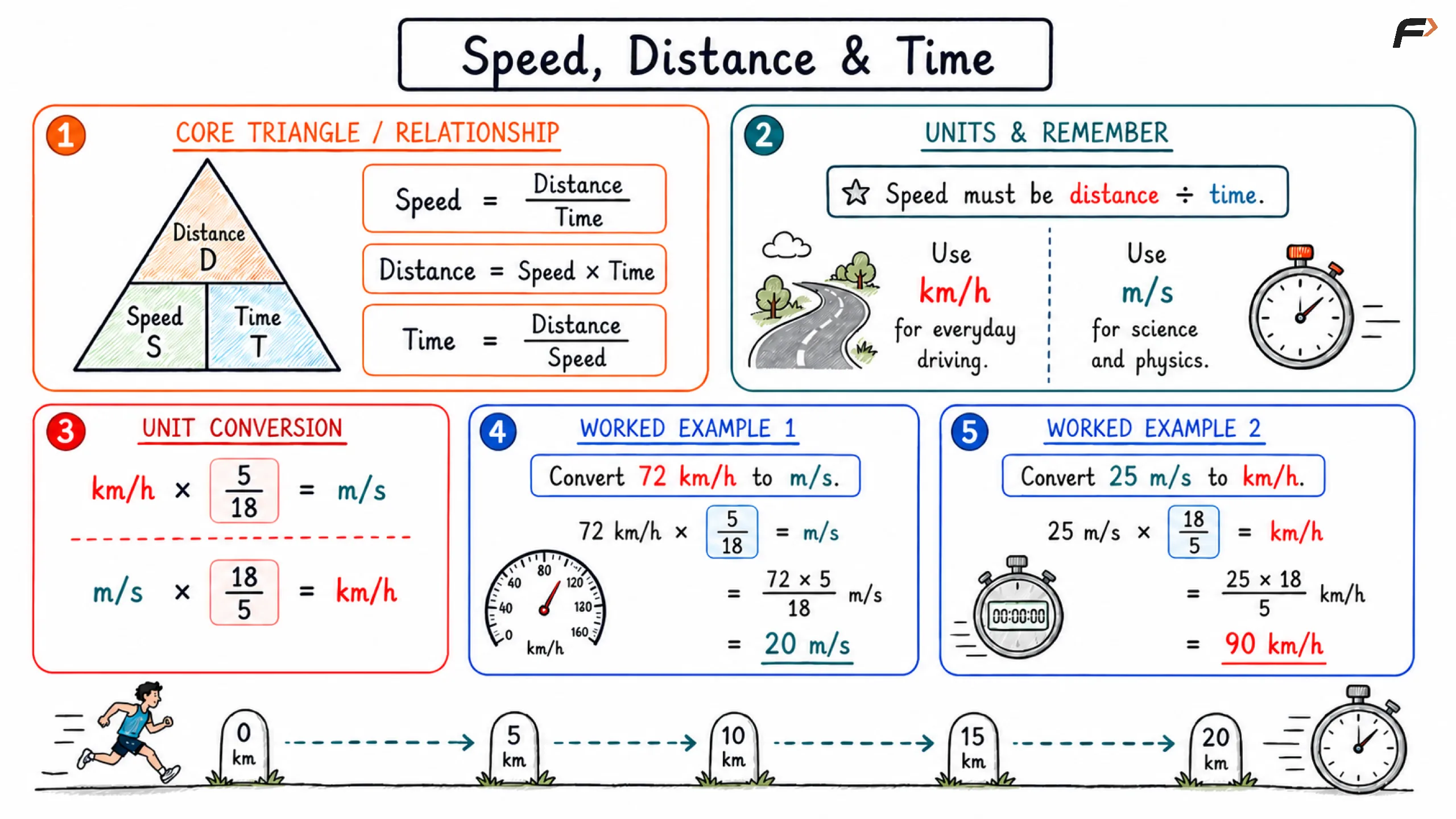
Speed, distance and time foundations and unit conversions
Basics: Speed, Distance and Time
Distance tells us how far an object travels. Time tells us how long the journey takes. Speed tells us how much distance the object covers in one unit of time.
For example, if a bus covers 120 kilometres in 3 hours, it covers kilometres in one hour. Its speed is therefore 40 km/h.
The three basic formulas are:
Do not choose a formula only by looking for numbers. First identify the missing quantity. For journey time, use distance divided by speed. For travelled distance, multiply speed by time.
Keep the units compatible
The units must belong to the same system before we use a formula. Kilometres work with hours. Metres work with seconds.
If distance is in metres and speed is in km/h, convert the speed to m/s. If distance is in kilometres and time is in hours, km/h can be used directly.
Converting km/h and m/s
One kilometre is 1000 metres, and one hour is 3600 seconds. Therefore:
To convert km/h to m/s, multiply by .
Example: Convert 72 km/h to m/s.
To convert m/s to km/h, use the reverse factor, .
Example: Convert 25 m/s to km/h.
Relative Speed: How Fast the Gap Changes
Relative speed tells us how quickly the distance between two moving objects changes.
Imagine two people walking towards each other. One walks 4 metres each second and the other walks 3 metres each second. In one second, the first person closes 4 metres and the second closes 3 metres. Their gap becomes smaller by metres. For opposite directions, we add the speeds.
Now imagine both people walking in the same direction. The faster person walks at 4 m/s and the slower person at 3 m/s. The faster person gains only metre each second. For the same direction, we subtract the speeds.
This single idea explains trains meeting, crossing, passing a person and overtaking another train.
What Distance Does a Train Cover?
The formula for time stays the same:
The important work is finding the distance to be cleared.
Train crossing a pole or a person
A pole has no useful length in this model. A standing person is also treated as a point. The train has completely crossed the point only when its last coach passes it. The train therefore covers its own length.
Example: A 180 metre train moves at 54 km/h. Find the time needed to cross a pole.
First convert the speed:
The train must cover 180 metres.
Train crossing a platform or bridge
When the engine reaches the far end of a platform, the train has not crossed it completely. The last coach is still behind the engine. The train must move one full train length after its engine has covered the platform length.
Example: A 120 metre train crosses a 180 metre platform at 15 m/s.
The same rule applies to a bridge and a tunnel.
Finding a missing train or platform length
If speed and time are known, first find the total distance with:
Then remove the known length.
Example: A 200 metre train crosses a platform in 30 seconds at 54 km/h. Find the platform length.
The speed is m/s. In 30 seconds, the train covers:
This 450 metres contains the train and the platform.
Trains Passing Moving Objects
When the other object moves, use relative speed. The distance rule and the direction rule must both be correct.
Train passing a person or cyclist
A person or cyclist is treated as a point, so the distance is the train's length. If both move in the same direction, subtract their speeds. If they move in opposite directions, add their speeds.
Example: A 210 metre train passes a cyclist moving in the same direction at 6 km/h in 14 seconds. Find the train's speed.
The train covers 210 metres in 14 seconds relative to the cyclist.
Convert this to km/h:
The train is 54 km/h faster than the cyclist.
Two trains crossing in opposite directions
Both trains must clear each other, so add their lengths. Since they move in opposite directions, also add their speeds.
Example: Trains of 160 metres and 140 metres move in opposite directions at 54 km/h and 36 km/h.
Their total length is 300 metres. Their relative speed is km/h, which is 25 m/s.
One train overtaking another
Overtaking means both trains move in the same direction. Add their lengths because the faster train must pass the whole slower train. Subtract their speeds because the faster train gains only the difference each second.
For lengths in metres, convert the relative speed to m/s before dividing.
Example: A 180 metre train moves at 72 km/h. It overtakes a 120 metre train moving at 54 km/h. Find the time needed to overtake it completely.
Step 1: Understand the direction. Both trains move in the same direction. The faster train gains on the slower train only through the difference in their speeds.
Step 2: Convert the relative speed. The train lengths are in metres and the answer is required in seconds.
Step 3: Find the distance to be cleared. The faster train must move past the full length of the slower train. Its own rear end must also cross the slower train's front end. We therefore add both lengths.
Step 4: Find the time.
The faster train takes 60 seconds to overtake the slower train completely.
Train Problems with Two Crossing Conditions
The train length or speed may not be known directly. When the same train crosses two objects, it keeps the same speed, so both situations can be compared.
Example: A train crosses a pole in 12 seconds and a 180 metre platform in 24 seconds. Let the train length be metres.
From the pole condition:
From the platform condition:
Both expressions describe the same speed.
Multiplying both sides by 24 gives , so metres.
If two trains have the same speed and each crosses a pole, length is directly proportional to crossing time. A train that takes 18 seconds is times as long as one that takes 12 seconds.
Same train crossing two different platforms
This pattern gives two platform lengths and two crossing times. The train length is unknown, but it is the same in both journeys. The train speed is also the same.
Example: A train crosses a 150 metre platform in 20 seconds and a 250 metre platform in 25 seconds. Find its speed.
Let the train length be metres and its speed be m/s.
For the first platform, the total distance is :
For the second platform, the total distance is :
Subtract the first equation from the second. This is useful because the unknown train length appears equally in both equations and cancels.
The longer platform adds 100 metres to the journey and 5 seconds to the time. The train must therefore cover metres each second.
Boats and Streams: The Basic Picture
A boat has its own speed, produced by its engine or rowing. The water may also move. Boat and stream calculations combine these two movements.
- Still-water speed: the boat's speed when the water is not flowing.
- Stream speed or current speed: the speed at which the water flows.
- Downstream: the boat moves in the same direction as the current.
- Upstream: the boat moves against the current.
Let be the boat's speed in still water and be the stream speed.
Downstream, the water helps the boat:
Upstream, the water works against the boat:
For the boat to make progress upstream, must be greater than . If both are equal, the boat stays in the same place relative to the riverbank.
Example: A boat moves at 12 km/h in still water, and the stream moves at 3 km/h.
The result also gives us a quick check. Downstream speed must be greater than the still-water speed because the stream helps the boat. Upstream speed must be smaller because the stream slows the boat.
Finding Boat Speed and Stream Speed
If downstream and upstream speeds are known, we can recover the two original speeds.
Add the equations:
Therefore:
Subtract the upstream equation from the downstream equation:
Therefore:
Example: Downstream speed is 18 km/h and upstream speed is 12 km/h.
When distance and time are known, find and first. For example, 30 kilometres downstream in 2 hours gives km/h. The same distance upstream in 3 hours gives km/h. The still-water speed is km/h.
Let us solve that example fully.
Step 1: Find downstream speed.
Step 2: Find upstream speed.
Step 3: Find the boat's own speed. Adding and removes the effect of the stream because the stream adds once and subtracts once.
Step 4: Find the stream speed if required. The difference between downstream and upstream speeds contains the stream effect twice.
So the launch moves at 12.5 km/h in still water, while the water itself moves at 2.5 km/h.
Floating objects
A floating log has no engine and makes no effort of its own. It simply moves with the water. Its speed relative to the riverbank equals the stream speed.
If a log moves at 4 km/h and a boat's still-water speed is 12 km/h, then the boat's upstream speed is km/h.
Time for Upstream and Downstream Journeys
Find the effective speed first, then use time equals distance divided by speed.
Example: A boat's still-water speed is 15 km/h, the stream speed is 3 km/h, and it travels 36 kilometres each way.
Downstream speed is km/h, so downstream time is hours.
Upstream speed is km/h, so upstream time is hours.
The total time is hours. The upstream journey takes one hour more because the stream reduces the boat's speed.
When time is written as hours and minutes, convert the minutes into part of an hour. For example:
Example: A boat covers 40 kilometres downstream in 2 hours and the same distance upstream in 2 hours 40 minutes. Find the stream speed.
The downstream speed is:
The upstream time is hours, so:
Now use half the difference:
The stream speed is 2.5 km/h. Converting the mixed time correctly is the key step in this example.
Same-Distance Boat Problems and Ratios
For the same distance, a higher speed gives a lower time. This is why an upstream return usually takes longer than the downstream trip.
Example: The ratio of boat speed in still water to stream speed is . Let the speeds be and .
If the boat takes 4 hours downstream, the distance is . The upstream time for the same distance is:
The value of is not needed because it appears in both the distance and speed and cancels.
Percentage Relations Between Boat Speeds
A percentage statement must first be changed into an equation.
If downstream speed is 25% more than upstream speed, then:
Now use and :
If km/h, then:
Multiplying by 4 gives . Therefore , so km/h.
Common Mistakes
- Do not mix km/h with metres and seconds.
- Do not use only platform length when a train crosses a platform. Add the train length.
- Do not add speeds for same-direction motion. Use the difference.
- Do not subtract speeds for opposite-direction motion. Use the sum.
- Treat a pole, person, cyclist or passenger as a point unless a length is given.
- Use relative speed when both objects move.
- For downstream movement, add the stream speed. For upstream movement, subtract it.
- For a journey with different speeds, find each part's time separately before adding.
- Convert minutes to a fraction of an hour before using km/h.
Formulas and Cheat Sheet
| Situation | Distance or speed to use |
|---|---|
| Basic speed | |
| Basic distance | |
| Basic time | |
| km/h to m/s | Multiply by |
| m/s to km/h | Multiply by |
| Opposite directions | Relative speed |
| Same direction | Relative speed = |
| Train crosses a point | Distance train length |
| Train crosses a platform or bridge | Distance train length object length |
| Two trains cross or overtake | Distance |
| Downstream speed | |
| Upstream speed | |
| Boat speed in still water | |
| Stream speed |
The safest method is to make two decisions before calculating. First, find the complete distance that must be cleared. Second, find the speed at which that distance closes. Once those are correct, the basic speed, distance and time formulas handle the rest.
Safe Shortcuts
- Convert km/h to m/s by multiplying by , and m/s to km/h by multiplying by . Convert before mixing metre distances with second times.
- For objects moving in opposite directions, add their speeds. For movement in the same direction, subtract the smaller speed from the larger speed.
- A train passing a pole covers only its own length. Passing a platform requires train length plus platform length.
- When the same train has two crossing conditions, write distance relative speed time for both and subtract the equations to remove the repeated train length when useful.
- If downstream and upstream speeds are and , still-water boat speed is and stream speed is .
- For equal upstream and downstream distances, calculate the two times separately. Do not average the speeds because equal distance does not mean equal time.
These shortcuts are safe only after the direction, distance covered and units are identified. They shorten the setup but cannot fix a wrong relative speed.
Frequently Asked Questions
What is the basic formula for train problems?
Use . The distance is the train length when crossing a point. Add the other object's length when crossing a platform, bridge or another train.
Why do we add train and platform lengths?
The engine must cross the platform, and then the rest of the train must follow. The last coach travels one additional train length before the crossing is complete.
When are speeds added or subtracted in relative speed?
Add speeds when objects move in opposite directions. Subtract the slower speed from the faster speed when they move in the same direction.
What are the formulas for upstream and downstream speed?
If boat speed in still water is and stream speed is , downstream speed is and upstream speed is .
How do I find still-water speed from upstream and downstream speeds?
Add upstream and downstream speeds and divide by 2: .
How do I find the speed of the stream?
Subtract upstream speed from downstream speed and divide by 2: .
Is the speed of a floating log equal to stream speed?
Yes. A freely floating log has no driving speed of its own, so it moves with the current.
Why does an upstream journey take more time?
The current reduces the effective speed upstream. For the same distance, a smaller speed gives a larger time.