Time and Work: Complete Beginner Guide with Detailed Examples
Time and Work studies how fast a person, worker, machine or pipe completes a job. The work is the whole job, the time tells us how long it takes, and the rate or efficiency tells us how much of the job is completed in one unit of time.
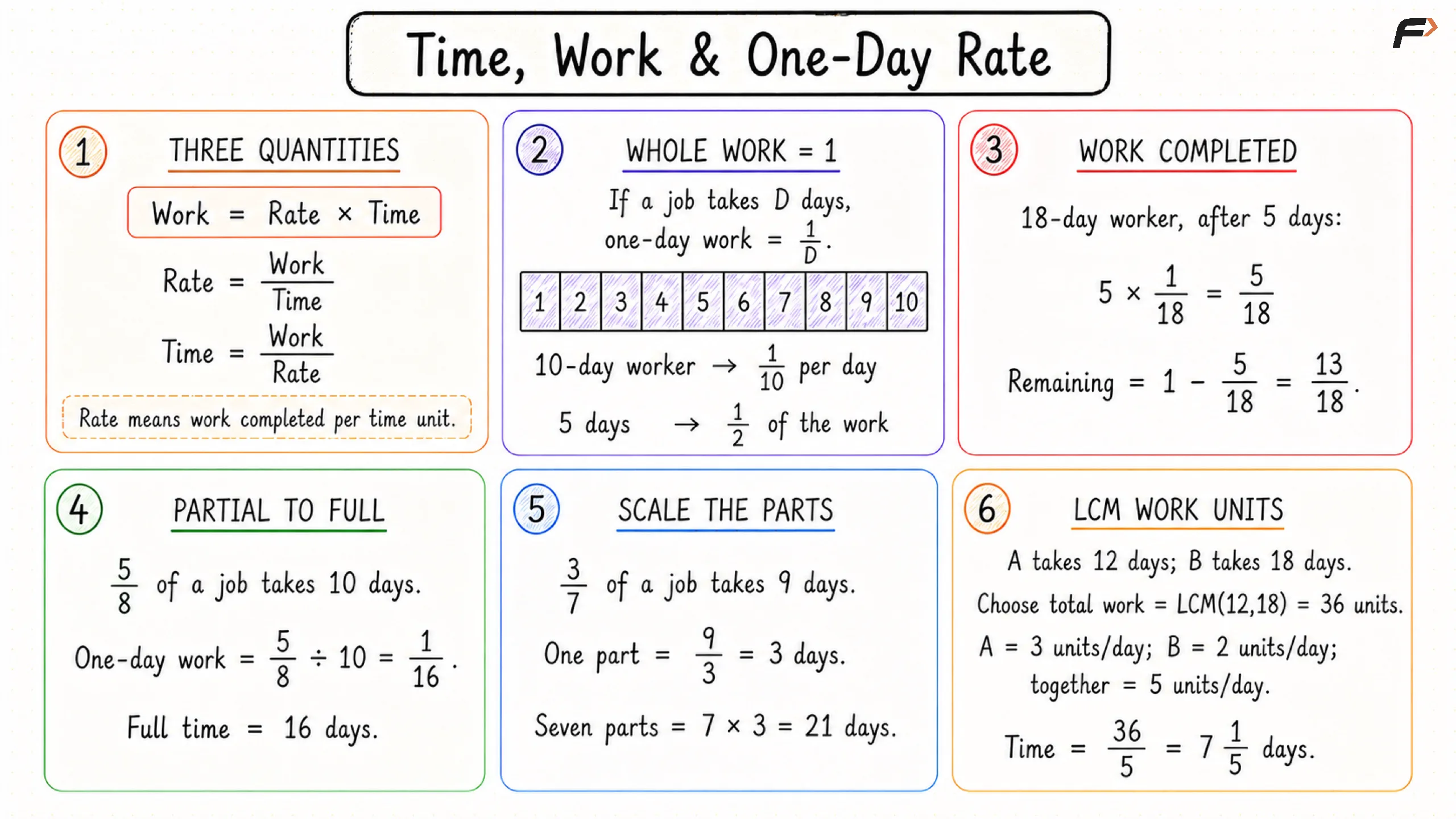
Suppose a worker finishes one wall in 10 days. If the worker does the same amount each day, then one day completes one of the 10 equal parts of the wall. The worker's one-day work is therefore one-tenth of the wall. Five days complete five-tenths, which is half of the wall.
This one-day-work idea connects the entire topic. We will begin with it, then learn how rates combine, why efficiency and time move in opposite directions, how unfinished work is handled, and how the same model solves workers, machines, wages, pipes and changing schedules.
Time, work and one-day rate
The Three Basic Quantities
The topic is built from three connected ideas:
| Quantity | Easy meaning |
|---|---|
| Work | The full task or the part of it being discussed |
| Rate or efficiency | Work completed in one unit of time |
| Time | Number of time units spent working |
Their basic relationship is:
This formula is not special to workers. Distance equals speed multiplied by time for the same reason. Production equals production rate multiplied by time. A tank's filled part equals filling rate multiplied by time.
From the same relationship:
We divide work by rate when finding time because we are asking how many one-time-unit pieces are needed to make the required work.
Why We Usually Treat the Whole Work as 1
A job does not always have to be counted in bricks, pages, units or tasks. When only the complete job matters, we can safely call that whole job 1.
The number 1 does not mean one brick or one hour. It means one complete job, which is 100 percent of whatever task is being discussed.
If a person finishes the whole job in days, the one-day work is:
This works because one full job is shared equally across days. For 18 days, each day contributes one of 18 equal parts.
Case 1: Find the work completed in some days
Example: A worker can complete a job in 18 days. What fraction of the job will be completed in 5 days?
What is given? One full job takes 18 days. The worker keeps the same rate each day.
What are we finding? We need the fraction completed after only 5 days, not the time for the whole work.
First find the work in one day:
Five days contain five equal daily work parts, so multiply by 5:
The worker completes of the job. The remaining part would be .
Case 2: Find the full time from partial work
Example: A completes of a job in 10 days. How long will the whole job take at the same rate?
The 10 days belong to only five-eighths of the work. First find the work completed in one day by sharing that fraction equally across 10 days:
A completes one-sixteenth of the whole job per day. A full job contains 16 such parts, so:
The whole job takes 16 days. We divided by the completed fraction because 10 days represents only part of the full time.
Case 3: Another way to scale partial work
Example: A completes of a job in 9 days. Find the full time.
Think of the job as 7 equal parts. Three parts take 9 days, so one part takes:
The full job has 7 such parts:
The full job takes 21 days. This is the same as .
Adding Rates When People Work Together
When two people help on the same job at the same time, their completed parts are added. If A completes one-fifteenth and B completes one-twentieth in a day, together they complete both parts in that day.
For workers with individual times , and :
Once the combined one-day work is known, time is full work divided by that rate:
Case 1: Two people working together
Example: A finishes a task in 15 days and B finishes it in 20 days. How long will they take together?
A's one-day work is , and B's is . They help each other, so add:
The least common denominator is 60. This lets us describe both rates with equal-sized pieces:
Together:
They complete 7 of 60 equal work parts each day. To complete all 60 parts:
Together they take days. This is less than both 15 and 20 days, which is a useful reason check.
Case 2: Three people working together
Example: A, B and C can complete a job alone in 12, 18 and 36 days. Find their combined time.
Their one-day rates are , and . Use 36 as a common denominator:
Together they complete one-sixth of the job each day. Six equal days complete six-sixths:
The three workers take 6 days.
The LCM Work-Unit Method
Fractions are correct, but some learners find whole work units easier. We may choose the total work as the least common multiple of the individual times. This changes only the measuring unit, not the real job.
For A taking 12 days and B taking 18 days, choose total work as units. Then:
- A completes units per day
- B completes units per day
- together they complete units per day
Their time is:
This is exactly the same as adding . The fraction method calls the work 1. The LCM method calls it 36 units. Both describe the same rate.
Finding a Missing Worker's Rate
Sometimes we know the completion time of a full team and the individual times of only some members. The full team's rate contains everyone's work. To isolate the missing worker, subtract the known rates.
Case 1: Find C's individual time
Example: A takes 12 days, B takes 18 days, and A, B and C together take 5 days. Find C's time alone.
The full team's one-day work is:
A and B together complete:
The full-team rate equals A's rate plus B's rate plus C's rate. Therefore, remove the known A and B part:
C completes eleven of 180 equal parts each day. The time for one complete job is the reciprocal:
C alone takes days.
Case 2: A known individual and a known pair
Example: A alone takes 30 days, while A and B together take 20 days. Find B's individual time.
A's rate is and the pair's rate is . B's contribution is what remains after A's contribution is removed:
B completes one-sixtieth of the job per day, so B alone takes 60 days.
It may feel unusual that B is slower than A even though the pair takes only 20 days. The numbers are consistent: A adds one-thirtieth and B adds one-sixtieth, giving three-sixtieths, which equals one-twentieth.
Work Completed and Work Remaining
When people work for only part of the schedule, first calculate what they finish. Then subtract from the full work:
Case 1: Find the unfinished fraction
Example: A and B can finish a job alone in 18 and 24 days. They work together for 4 days. What fraction remains?
Their combined one-day work is:
Four days complete four copies of that daily work:
The full work is 1, so:
The unfinished part is .
Case 2: One person starts and another finishes
Example: A takes 30 days and works for 12 days. B, who can finish the full job in 40 days, completes the rest. Find the total time.
A completes this fraction in 12 days:
Therefore, the remaining work is:
B's rate is . Time for B to complete only three-fifths is:
A worked for 12 days and B worked for 24 more days:
The job finishes 36 days after A began.
Case 3: One worker leaves after working together
Example: A takes 20 days and B takes 30 days. They work together for 8 days, then A leaves. How many more days does B need?
Together, their rate is:
In 8 days, they complete:
One-third remains. B completes one-thirtieth per day, so:
B needs 10 more days after A leaves. If we need the complete time from the start, it is days.
Efficiency and Time Are Inversely Related
Efficiency means work completed per day. A more efficient worker completes a larger part each day, so fewer days are needed for the same work.
For the same job:
Therefore:
The time ratio is reversed because efficiency and time move in opposite directions.
Case 1: One worker is twice as efficient
Example: A is twice as efficient as B and finishes 30 days earlier. Find their combined time.
If A's efficiency is twice B's, A takes half as much time. Let A take days. Then B takes days.
Their time difference is 30 days:
So A takes 30 days and B takes 60 days. Their combined rate is:
Together they take 20 days.
Case 2: One worker is four times as efficient
Example: A is four times as efficient as B and finishes 60 days earlier. Find their combined time.
The efficiency ratio is , so the time ratio is . Let A take days and B take days. The difference is:
A takes 20 days and B takes 80 days. Their combined rate is:
Together they take 16 days.
Case 3: Percentage increase in efficiency
Example: A takes 24 days. B is 20 percent more efficient than A. Find B's time.
Let A's efficiency be 100 units. Twenty percent more makes B's efficiency 120 units. Their efficiency ratio is:
Reverse it for the time ratio:
If 6 parts of time equal 24 days, one part is 4 days. B takes 5 parts:
B takes 20 days. A common mistake is reducing 24 directly by 20 percent. The correct decrease is not 20 percent because time is the reciprocal of efficiency.
More Workers Mean Less Time
If all workers have equal efficiency and work the same hours, the total effort can be measured in worker-days.
One worker-day means one worker working for one day. For a fixed job:
This rule assumes equal worker efficiency and equal daily working hours.
Case 1: Change the number of workers
Example: Six workers finish a job in 20 days. How long will 10 workers take?
The total effort is:
Ten workers supply 10 worker-days of effort each day. The days needed are:
Ten workers take 12 days. The answer is smaller than 20 because more workers share the same job.
Case 2: Workers needed for remaining work
Example: Five workers can finish a job in 18 days. They work for 12 days. How many workers are needed to finish the rest in 10 days?
The full job needs:
The first 12 days use:
Remaining work is worker-days. If workers must finish it in 10 days:
Three workers are needed for the remaining 10 days.
Case 3: Deadline changes
Example: Twenty workers were assigned a project for 30 days. After 12 days, the remaining work must be finished in 10 days. Find the number of workers required from that point.
Total work is:
Work already completed is:
Remaining work is worker-days. To finish it in 10 days:
The project now requires 36 workers in total. Compared with the original 20 workers, this means extra workers are needed.
Workers, Days, Hours and Quantity of Work
When daily hours change, worker-days alone are not enough. Use worker-hours:
If the amount of output also changes, compare total effort per output unit.
Case 1: Find days when workers, hours and output change
Example: Eighteen workers working 6 hours daily complete 24 units in 8 days. How many days will 12 workers working 9 hours daily need for 36 units?
The first group uses:
Those 864 worker-hours make 24 units. Therefore, one unit needs:
Thirty-six units need:
The second group supplies this many worker-hours per day:
Therefore:
The second group needs 12 days.
Case 2: Find required daily hours
Example: Fifteen workers complete a job in 12 days at 8 hours per day. How many hours daily should 20 workers work to finish the same job in 18 days?
The first schedule needs:
Let the new daily hours be . The second schedule must provide the same total effort:
The 20 workers need to work 4 hours per day. More workers and more days allow fewer hours each day.
Case 3: Machine-hours and production
Example: Five machines produce 300 units in 6 hours. How many units will 8 machines produce in 5 hours at the same rate?
The first case uses machine-hours. These 30 machine-hours produce 300 units, so one machine-hour produces:
The second case has machine-hours. Therefore:
The machines produce 400 units.
Converting Different Worker Types into One Unit
Men, women and children may have different stated efficiencies. We cannot add their headcounts directly unless they are equally efficient. Convert everyone into one common worker unit first.
Example: Three men and five women complete a job in 18 days. One man does as much work as two women. How long will six men and ten women take?
Convert the first team into women. Three men equal six women, so:
For the second team, six men equal twelve women:
The second team has twice the effective workforce. For the same work, twice the rate needs half the time:
The second group takes 9 days.
Dividing Wages According to Work
Fair wages follow the work contributed, not merely the number of people. Work contribution equals efficiency multiplied by the time actually worked.
Case 1: Everyone works for the same time
Example: A, B and C earn ₹6,600 for a job. Alone they take 10, 15 and 30 days. All three work together for the same time. Find C's share.
Because the time worked is equal, their work ratio equals their rate ratio:
Multiply each term by 30 to remove denominators:
There are total parts. C contributed 1 part:
C receives ₹1,100.
Case 2: People work for different times
Example: A can finish a job in 20 days and works for 10 days. B can finish it in 30 days and works for 15 days. Total wages are ₹5,400. Find B's share.
A completes:
B completes:
They contribute equal work even though their individual speeds and working days differ. The wages are therefore divided equally:
B receives ₹2,700.
Opposing Work: Building and Undoing
Not every worker helps. If one person builds while another destroys, their rates move in opposite directions. Add helpful rates and subtract opposing rates.
Example: A builds a wall in 12 days. B can undo the same wall in 36 days. How long will the wall take when both act together?
A adds this part per day:
B removes this part per day:
The actual forward progress is:
Only one-eighteenth of the wall remains completed after both effects in one day. Therefore, the wall takes 18 days.
If the destructive rate were equal to or larger than the building rate, the wall would never be completed while both continued.
Pipes and Tanks Use the Same Work Model
A full tank is treated as one complete work. An inlet adds water, so its rate is positive. An outlet or leak removes water, so its rate is negative.
Case 1: Find a leak's emptying time
Example: A tap fills a tank in 8 hours, but with a leak the tank fills in 12 hours. Find how long the leak alone would take to empty the tank.
The tap tries to add one-eighth of the tank per hour:
With the leak, the actual net filling is only one-twelfth per hour:
The missing part is what the leak removes:
The leak removes one twenty-fourth of the tank each hour, so it empties a full tank in 24 hours.
Case 2: Two inlets and one outlet
Example: Two inlets fill a tank in 6 and 8 hours. An outlet empties it in 24 hours. Find the time when all are open.
Add the inlet rates and subtract the outlet rate:
Using 24 as the common denominator:
One-fourth of the tank fills each hour, so the full tank takes 4 hours.
Case 3: One pipe closes partway
Example: Pipe A fills a tank in 10 hours and pipe B in 15 hours. Both run for 4 hours, then B is closed. Find the total time from the start.
Together, their one-hour filling rate is:
In the first 4 hours, they fill:
One-third remains. After B closes, only A works at one-tenth per hour:
We need the time measured from the start, so we also include the first 4 hours:
The tank fills in hours from the start.
Working Days, Breaks and Calendar Days
A working day is a day on which progress is made. A calendar day counts every day that passes, including breaks. A break changes elapsed time but does not change the amount of work.
Example: A needs 16 working days for a job. A works 4 days, takes a 2-day break and then resumes. Find the total calendar days.
A has already used 4 of the required 16 working days. The work rate does not change, so 12 working days remain:
The calendar includes the first work period, the break and the later work period:
The job finishes after 18 calendar days. The break is counted in time but contributes zero work.
Alternate-Day and Repeating Schedules
When workers follow a repeating schedule, calculate the work done in one full cycle. Repeat complete cycles without changing their order, then handle the last partial cycle carefully.
Example: A can finish a job in 12 days and B in 18 days. They work on alternate days, beginning with A. Find when the job finishes.
A's daily work is and B's is . One two-day cycle completes:
Seven complete cycles use 14 days and complete:
Only one thirty-sixth remains. Day 15 belongs to A, whose full-day rate is one-twelfth, or three thirty-sixths. A needs only one-third of that day to finish one thirty-sixth:
The work finishes in days. We cannot simply use the average two-day rate for the final part without checking whose turn comes next.
Data Sufficiency in Time and Work
Data sufficiency checks whether the given information leads to one definite result. Check each statement alone before combining them.
Example: Can B finish a job in less than 30 days?
- Statement I: A alone takes 30 days.
- Statement II: A and B together take 20 days.
Statement I gives only A's rate. It tells us nothing about B, so it is not sufficient alone.
Statement II gives only the pair's rate. Without A's rate, B cannot be separated, so it is also not sufficient alone.
Together:
B takes 60 days, so the stated time is not below 50 days. Both statements together are sufficient, while neither is sufficient alone.
Common Mistakes and Why They Are Wrong
Adding times instead of rates
People working together add the work they complete each day. Their individual completion times are not added. A 10-day worker and a 15-day worker do not take 25 days together.
Forgetting to take the reciprocal
If a rate is of a job per day, the time is days. The rate itself is not the time.
Using direct proportion for workers and days
For the same job, more equal workers mean fewer days. Workers and days are inversely related, so doubling workers halves time.
Subtracting a percentage directly from time
If efficiency rises by 20 percent, time does not automatically fall by 20 percent. New time is old time divided by 1.2 because time is inversely related to efficiency.
Forgetting completed work before a change
When a person leaves or a pipe closes, do not apply the new rate to the whole job. First find the work already completed, then apply the new rate only to what remains.
Adding an outlet or destructive worker
An outlet removes water and a destructive worker undoes work. Their rates must be subtracted from helpful rates.
Dividing wages by time only
Wages follow actual work, which depends on both efficiency and time worked. A slower worker may work longer and still contribute the same amount.
Formulas and Cheat Sheet
| Situation | Formula or decision | Why it works |
|---|---|---|
| Basic relationship | Work Rate Time | Equal rate is repeated for each time unit |
| One-day work | One whole job is shared across days | |
| Time for required work | Count how many daily-rate pieces make the work | |
| People helping together | Add their rates | Each person adds completed work |
| One person opposes another | Subtract the opposing rate | Opposing work removes progress |
| Remaining work | completed work | The full job is one whole |
| Equal workers, fixed hours | Workers Days constant | Total effort stays fixed |
| Workers and daily hours | Workers Days Hours | Measures total worker-hours |
| Efficiency and time | Same work equals rate times time | |
| Wages | Wage ratio work ratio | Payment follows contribution |
| Inlets and outlets | Add inlets, subtract outlets | Inlets fill while outlets empty |
| Repeating schedule | Find one cycle's work | The same rate pattern repeats |
Safe Shortcuts
- Choose total work as the LCM of the individual times. Dividing that work by each time gives whole-number daily efficiencies and often removes fractions.
- If A and B alone take and days and both help throughout, their combined time is . Do not use this when one person works against the other or leaves partway.
- Reverse an efficiency ratio to get the time ratio for the same job. If efficiencies are , individual times are .
- For equal workers with unchanged daily hours, use workers days constant. Include hours as another factor when daily working hours change.
- To find a missing worker's rate, subtract the known worker rates from the full team's rate, then take the reciprocal to find individual time.
- Divide wages in the ratio rate time worked. Use the rate ratio alone only when everyone works for the same time.
- For pipes and opposing work, add filling or building rates and subtract emptying or undoing rates before taking the reciprocal.
These shortcuts are safe only when the job, work periods and direction of every rate are clear. They should shorten a correct work-rate model, not replace it.
Frequently Asked Questions
What is one-day work?
One-day work is the fraction of the whole job completed in one day. If a person takes 20 days for the full job, the one-day work is .
Why is total work taken as 1?
The exact physical size of the job is often not given or needed. Calling the complete task 1 lets every person's contribution be written as a fraction of the same whole.
Why are rates added when people work together?
Each person completes a part of the same job during the day. The total completed part is the sum of those individual parts.
Why are efficiency and time inversely proportional?
For the same work, a person who completes more work each day needs fewer days. Their product stays equal to the fixed total work.
What is a worker-day?
One worker-day is the effort of one worker working for one day. It is useful only when the workers have equal efficiency and daily hours are unchanged.
When should worker-hours be used?
Use worker-hours when the number of hours worked per day changes. Total effort then depends on workers, days and hours per day.
What happens when someone leaves before the work finishes?
Find the work completed before the person leaves. Subtract it from the whole job. Then use the remaining team's rate only on the remaining work.
How are wages divided when people complete different amounts of work?
Divide wages in the ratio of work done. If everyone works for the same time, this is the efficiency ratio. If their times differ, calculate efficiency multiplied by time for each person.
Are pipes and tanks different from Time and Work?
They use the same mathematics. Filling is positive work and emptying is negative work. A full tank is treated as one complete job.
What is the fastest safe method for combined work?
Use either fraction rates or choose LCM work units. The LCM method often makes arithmetic easier, but both methods must begin with each person's one-time-unit work.
Summary
The whole topic comes from one relationship: work equals rate multiplied by time. When a full job takes days, one day's work is . Helping rates are added, opposing rates are subtracted, and time is found by dividing the required work by the available rate.
For changing schedules, always separate the stages. Find what is completed before someone joins, leaves, rests or closes a pipe. Then calculate the remaining work with the new rate. For groups, machines and changing hours, measure the fixed effort with worker-days, worker-hours or machine-hours.
Most shortcuts are only shorter versions of this reasoning. Once the whole work, each one-day rate, and the reason for adding or subtracting rates are clear, every later situation becomes another use of the same idea.