Syllogism: Rules, Venn Diagrams and Easy Examples
A syllogism is a logical reasoning question that gives statements about groups and asks which conclusions must be true. A group can contain people, objects or imaginary categories. The central decision is not whether a conclusion sounds sensible in real life. It is whether the conclusion is forced by the given statements.
For example, if all coders are analysts and all analysts are engineers, every coder must be an engineer. Nothing in those statements says that every engineer is a coder, so the reverse conclusion is not valid.
This article explains the four basic statement types, how to draw their Venn diagram meaning, how to follow a known object through a chain and how to reject conclusions that add information the statements never gave.
Basics: Groups, Overlap and Certainty
Think of each named class as a circle. A sentence tells you whether one circle is inside another, separate from it, or partly overlaps it. A conclusion follows only when it is true in every diagram allowed by the statements.
Do not use outside knowledge. “All roses are flowers” does not mean all flowers are roses, even though both statements may feel related. Also, an “all” statement does not promise that anything in that group exists. “All dragons are reptiles” can be true even if there are no dragons in the diagram.
The words all, no and some decide the logic. Read them exactly as written.
The Four Basic Statement Types
| Statement | Diagram meaning | What it guarantees |
|---|---|---|
| All A are B | A is inside B | every A is B |
| No A are B | A and B are separate | no A is B, and no B is A |
| Some A are B | A and B overlap | at least one thing is both A and B |
| Some A are not B | part of A lies outside B | at least one A is not B |
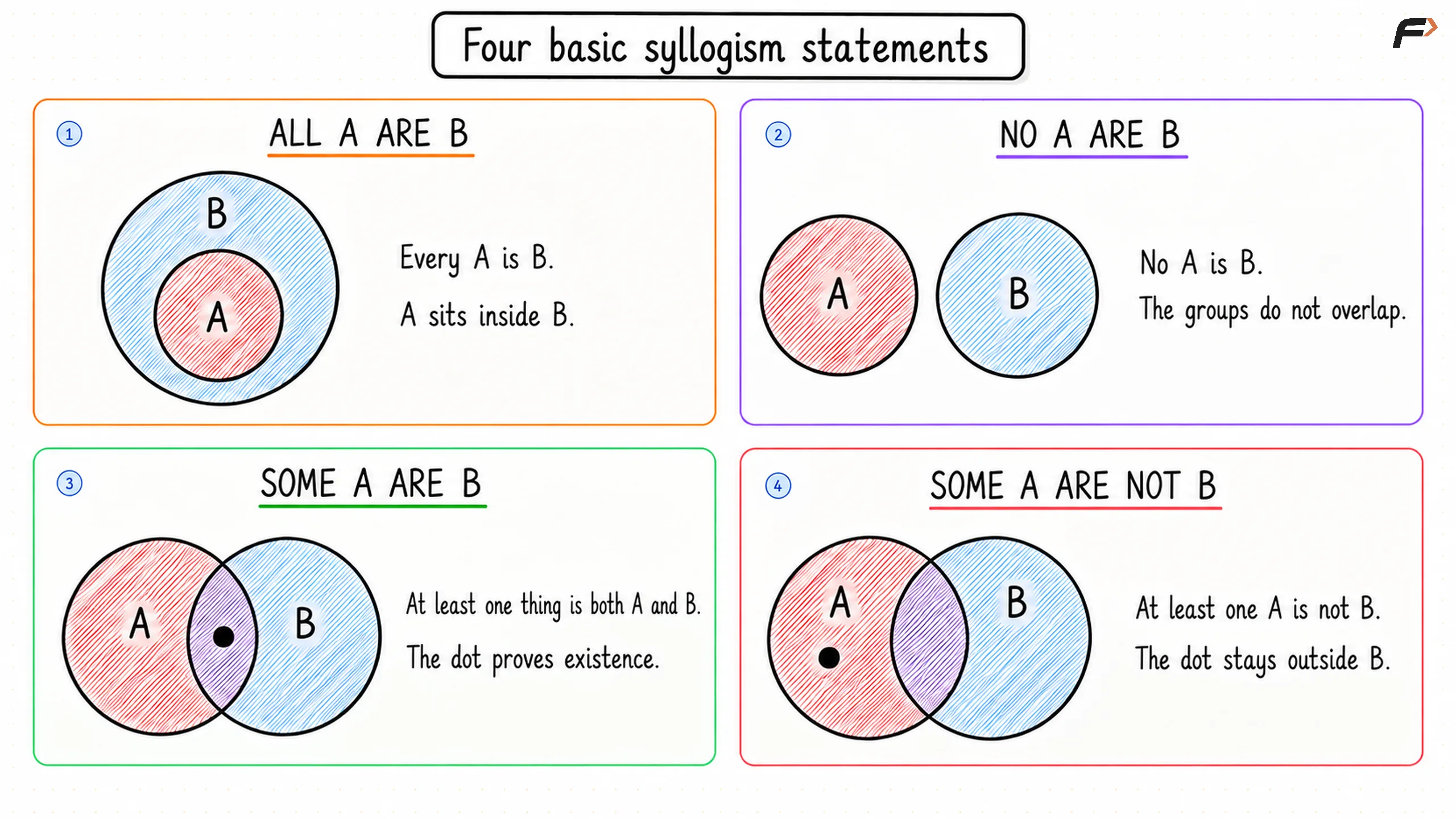
Venn diagrams explaining all, no, some, and some-not syllogism statements
All A are B
“All laptops are devices” means that the entire laptop circle sits inside the device circle. The statement can be read from A to B only. It does not allow the reverse statement, “All devices are laptops.”
Example: All emails are messages. All messages are communications. No communications are letters. Since an email is a message and every message is a communication, every email is a communication. As communications and letters cannot overlap, no email is a letter.
No A are B
“No devices are gadgets” places the two groups apart. This relation is reversible: if no devices are gadgets, no gadgets are devices.
Example: All pencils are stationery. No stationery are tools. A pencil must be stationery, and stationery cannot be a tool. Therefore no pencil is a tool.
Some A are B
“Some roses are flowers” means that at least one object sits in both groups. This is reversible. The same object lets you say “Some flowers are roses.” It does not mean every rose is a flower or every flower is a rose.
Example: Some tickets are passes. All tickets are coupons. The particular ticket that is a pass is also a coupon. Therefore some coupons are passes. We cannot conclude that all passes are coupons, because other passes may not be tickets.
Some A are not B
“Some doctors are not graduates” guarantees at least one doctor outside the graduate group. It says nothing about every doctor and nothing about whether graduates exist.
If all doctors are workers, that known doctor is also a worker. Therefore some workers are not graduates. The conclusion is valid because it follows the same known object, not because it guesses about a new group.
How to Test a Conclusion
Translate each statement into a small diagram or a short chain. Then start from an object whose existence is guaranteed by a “some” statement, or from a whole group named by an “all” statement. Move only in directions allowed by the statements.
Example:
Statements: Some bottles are containers. All containers are vessels. All vessels are cups.
The word “some” gives at least one bottle that is also a container. That same bottle must be a vessel and then a cup. So “Some bottles are cups” follows. “Some cups are bottles” also follows because the same overlap can be named in the opposite order.
For a conclusion beginning with some, look for a guaranteed object. For a conclusion beginning with all or no, check that the full group relationship is forced. A single known object is never enough to prove a statement about all members of a group.
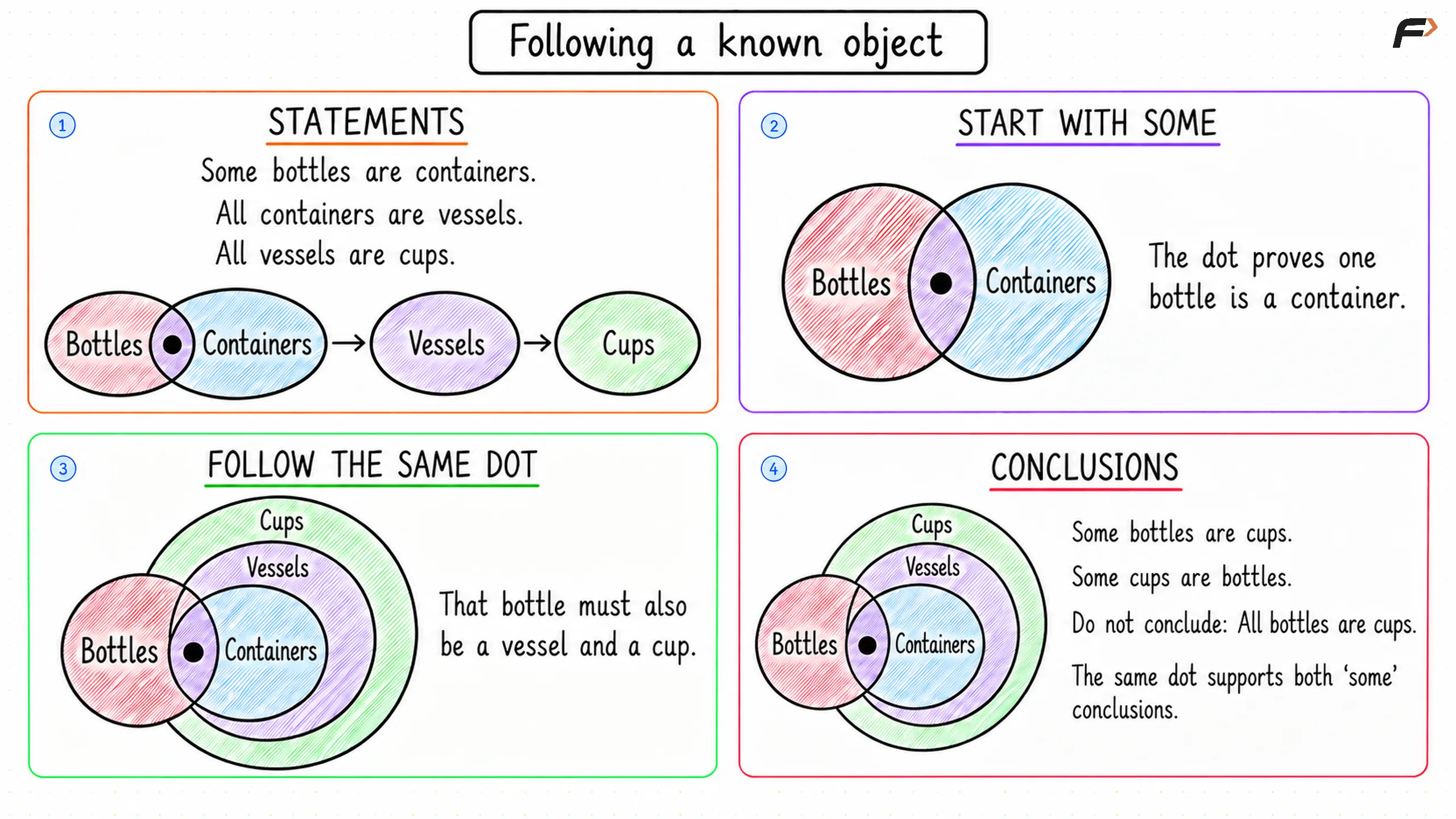
Venn diagram following a known object through a syllogism chain
Rules That Must Not Be Reversed
All statements are one-way
From “All A are B,” you may conclude that no A lies outside B. You may not conclude “All B are A.”
Example: All maps are charts. Some documents are not charts. Anything outside charts cannot be a map, because every map is a chart. Therefore some documents are not maps. But this does not prove that no document is a map. Other documents may still be maps.
A shared larger group does not create an overlap
If all teachers are mentors and all professionals are mentors, teachers and professionals are both inside mentors. They may overlap, but they may also be completely separate. Therefore neither “Some teachers are professionals” nor “All professionals are teachers” follows.
This rule prevents a common error. Being in the same large circle does not tell you how two smaller circles are placed inside it.
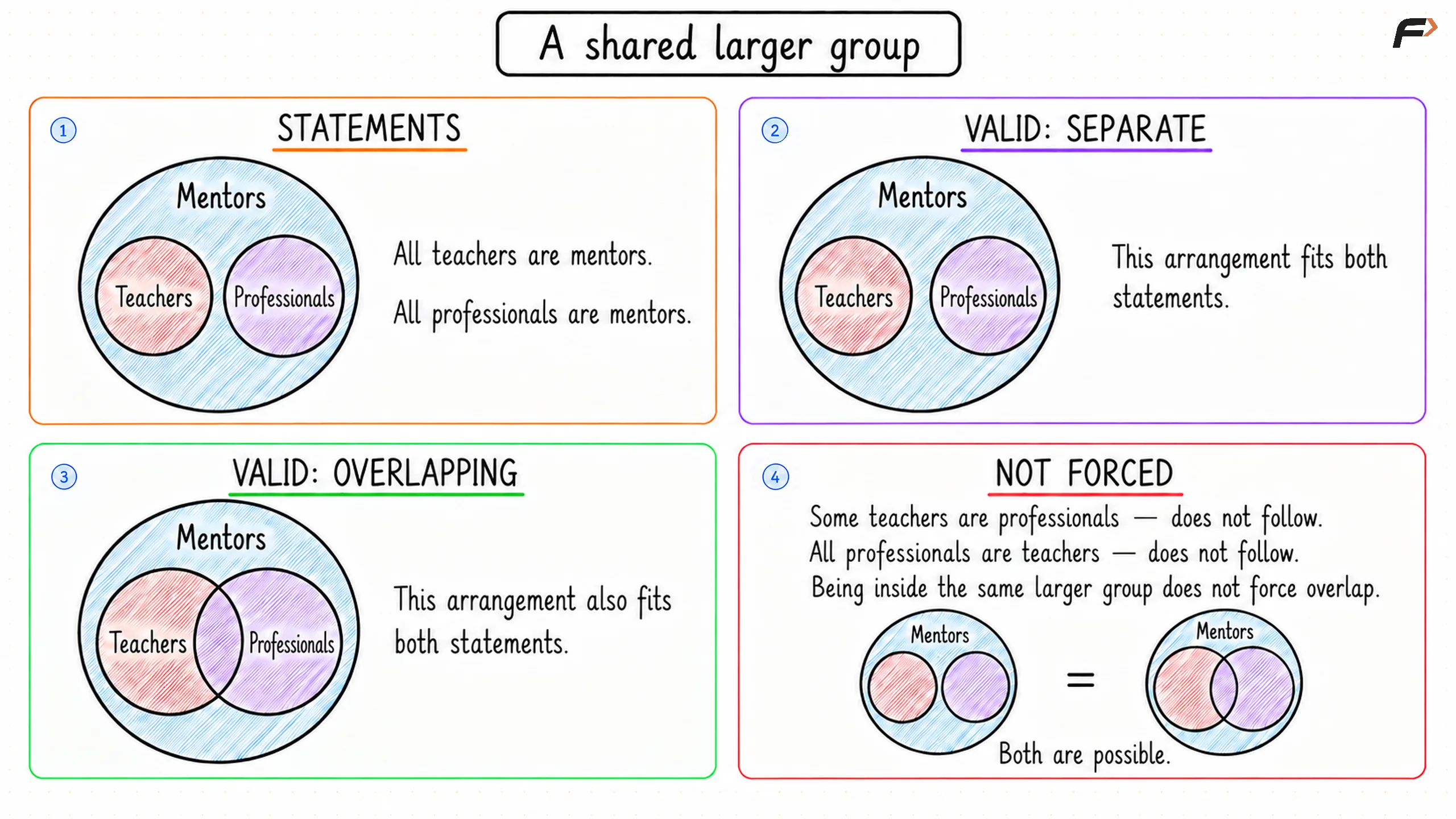
Venn diagrams showing separate and overlapping groups inside one larger group
Two separate “some” statements may name different objects
Some tablets are screens. Some screens are electronics. These sentences do not guarantee that the tablet-screen and the screen-electronic are the same screen. Therefore “Some tablets are electronics” does not follow.
The same issue appears in longer statements. If some pens are markers, all markers are stationery, and some crayons are stationery, we know that some pens are stationery and some crayons are stationery. We still do not know that any pen is a crayon or that any crayon is a marker.
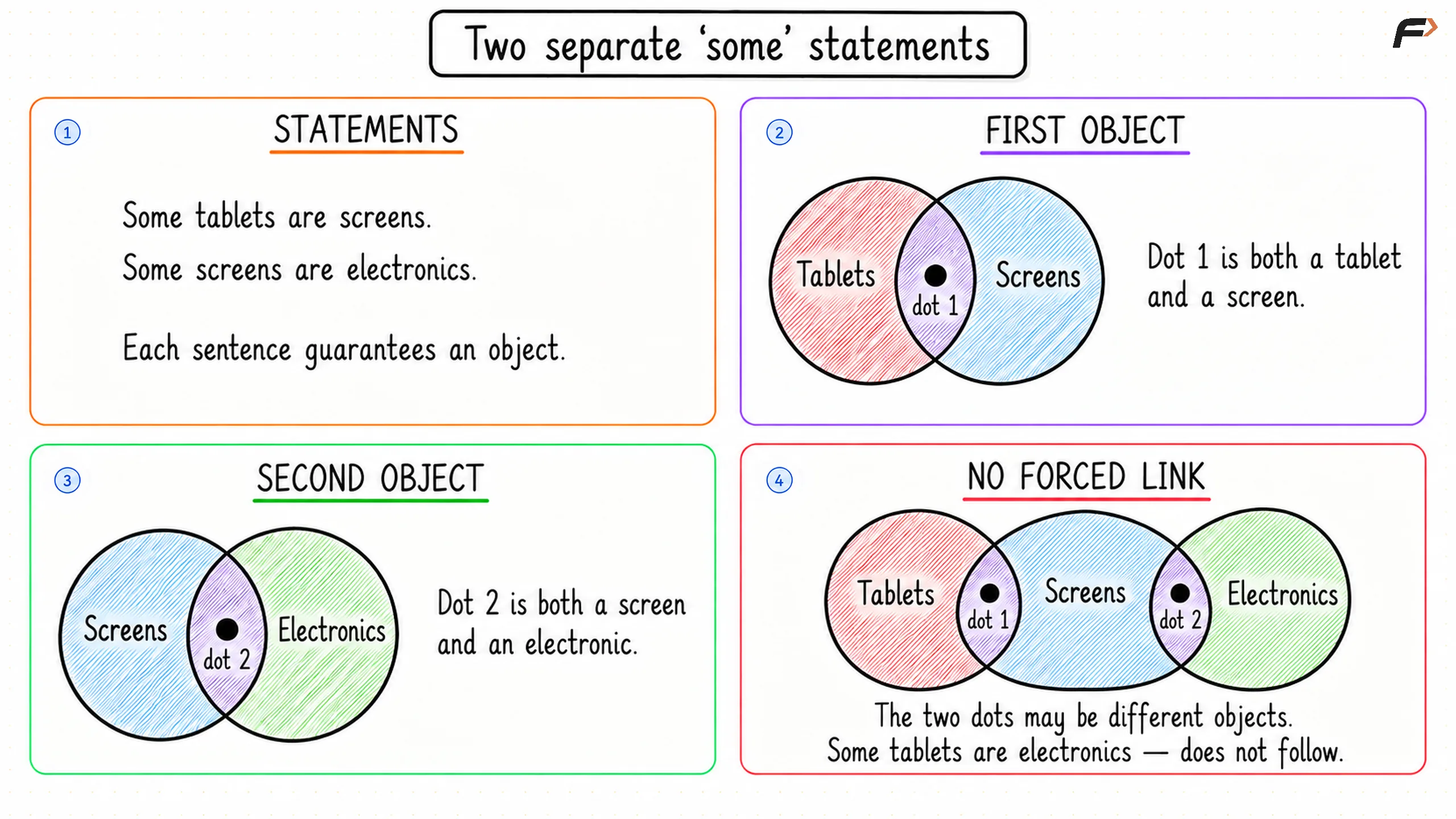
Venn diagrams showing why two some-statements may refer to different objects
Using Exclusion Through a Chain
An exclusion can travel through an inclusion chain. If all A are B and no B are C, then no A are C. The rule is safe because every A is inside B, and B has no overlap with C.
Example: All files are records. No records are documents. Some folders are files.
Every file is a record, so no file can be a document. The particular folders that are files are therefore not documents. Both conclusions, “No files are documents” and “Some folders are not documents,” follow.
Do not reverse a chain casually. From no records are documents, you can say no documents are records. But “all files are records” does not say all records are files.
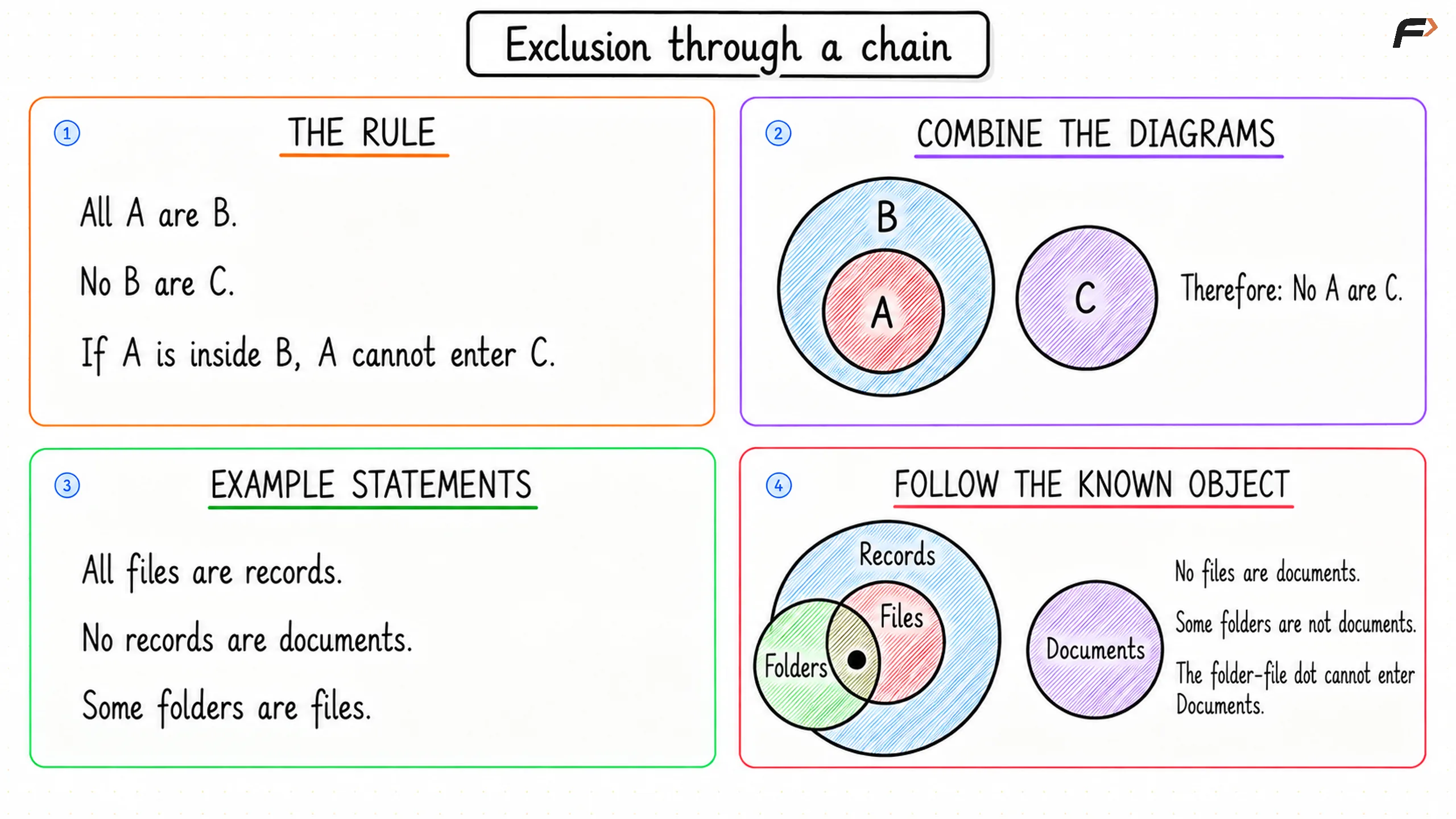
Venn diagram demonstrating exclusion through an inclusion chain
What Does and Does Not Prove Existence
An “all” or “no” statement describes a relationship but may not place an object anywhere. “All clouds are forms” and “No shapes are clouds” do not prove that a cloud exists. Therefore they do not prove “Some forms are not shapes.”
In contrast, “Some learners are readers” creates an object. If no students are learners, that same learner-reader is not a student. So “Some readers are not students” follows.
This is an especially useful check for conclusions starting with some. Ask: which statement gives me an actual member of the required group? If there is no answer, the conclusion is usually not forced.
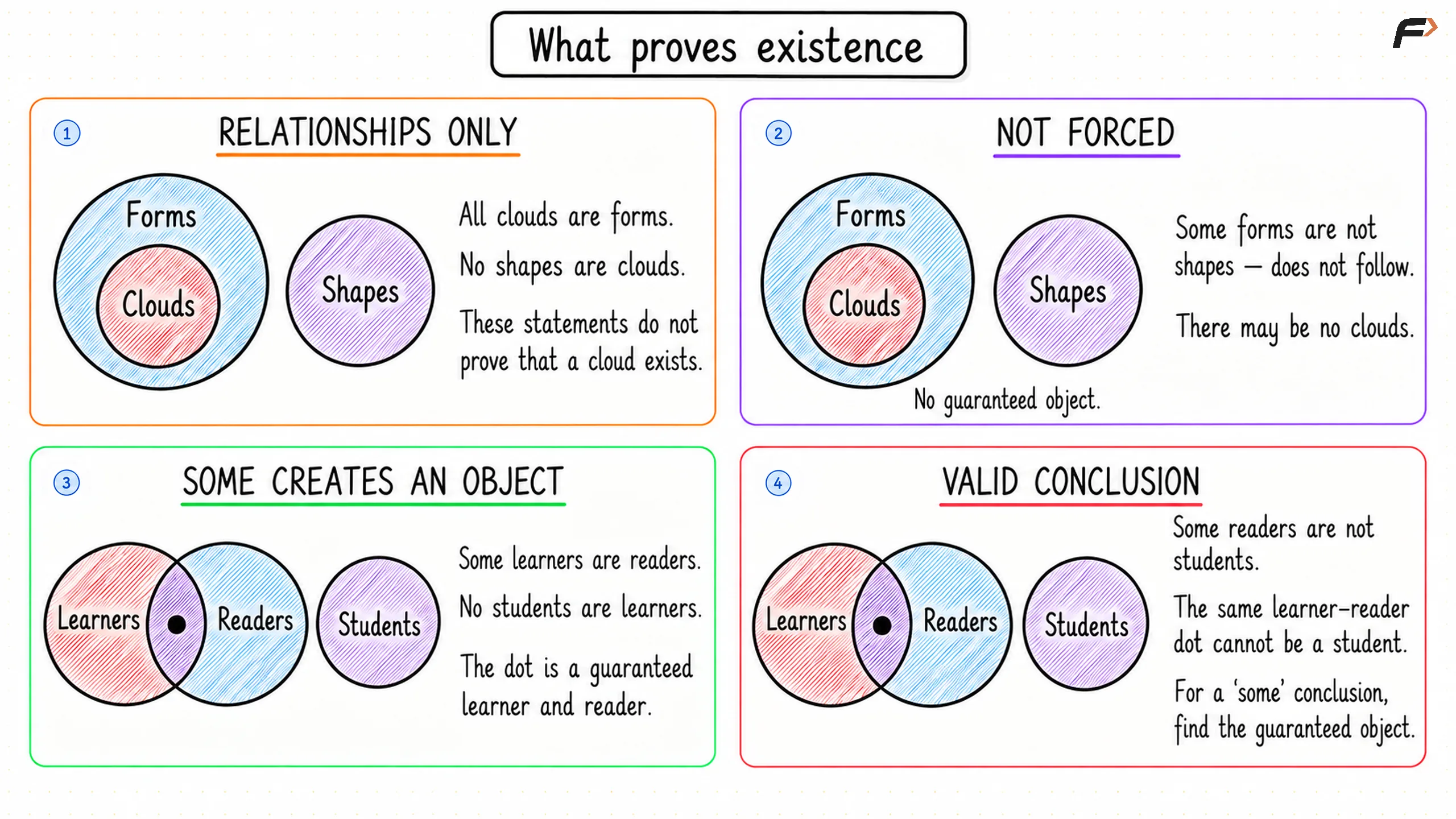
Venn diagrams distinguishing relationships from statements that prove existence
Common Mistakes
- Reversing “All A are B” into “All B are A.”
- Treating two groups inside the same larger group as though they must overlap.
- Joining two separate “some” statements without proof that they describe the same object.
- Turning “some” into “all.” Some roses being plants does not prove all roses are plants.
- Assuming existence from an “all” or “no” statement.
- Using real-world knowledge instead of the diagram allowed by the words.
- Rejecting a reversible conclusion such as “Some foods are fruits” when the statement says “Some fruits are foods.”
Formulas and Cheat Sheet
| Given statement or chain | Safe conclusion | Condition |
|---|---|---|
| All A are B | no A is outside B | Always |
| No A are B | no B are A | Exclusion is reversible |
| Some A are B | some B are A | It is the same overlap |
| Some A are not B | at least one A lies outside B | Do not change “some” to “all” |
| All A are B, all B are C | all A are C | Follow the inclusion chain forward |
| All A are B, no B are C | no A are C | A is fully inside the group excluded from C |
| Some A are B, all B are C | some A are C | Follow the known object through the chain |
| Some A are B, no B are C | some A are not C | The known overlap cannot enter C |
| Some A are B; some B are C | no certain A-C conclusion | The two “some” objects may differ |
Safe Shortcuts
- Draw “all” as a smaller circle inside a larger circle. This is safe when the statement has the form “All A are B.”
- Mark a dot for every “some” statement. Carry that same dot through any later “all” statement. This is safe because the dot represents the guaranteed object.
- Treat “no” as a barrier between two circles. This is safe in either reading direction, because the two groups cannot share a member.
- For a conclusion beginning with “some,” find its dot before accepting it. This is safe because a conclusion about existence needs an object guaranteed by the statements.
- Reject a conclusion that combines two separate dots unless a statement connects them. This prevents the most common false overlap.
Shortcuts should make the diagram faster to read, not replace the exact meaning of all, no and some.
FAQs
Is a Venn diagram necessary for syllogism?
No. A short chain often works for simple statements. A Venn diagram is more reliable when there are several groups, exclusions or two “some” statements that could be confused.
Can “some A are B” be reversed?
Yes. If at least one object is both A and B, it is also both B and A. The conclusion “Some B are A” follows.
Why does “All A are B” not mean “All B are A”?
The first statement places A inside B. B can contain other members outside A, so the reverse would add information that was never given.
How do I solve a conclusion with “some not”?
Find an existing object from a “some” statement, then show that it cannot belong to the excluded group. For example, some drivers are pilots and no pilots are officers gives some drivers who are not officers.
Summary
Syllogism is about certainty, not probability or real-world facts. Read each statement as a relationship between groups, follow known objects through valid chains and refuse any conclusion that reverses, enlarges or invents an overlap. The words all, no and some are the complete rulebook.