Speed, Time and Distance: Concepts, Formulas, and Clear Examples
Speed, Time and Distance describes how far an object travels, how long the journey takes, and how quickly the distance is covered. Speed is the distance travelled per unit of time. Distance is the length of the journey. Time is the duration of that journey.
For example, if a car covers 168 km in 3 hours, it covers km in one hour. Its speed is therefore 56 km/h.
The same relationship connects average speed, stoppages, two moving objects, trains, boats and circular tracks. The main idea is to decide which distance and which time belong in the calculation. We will develop that understanding one situation at a time.
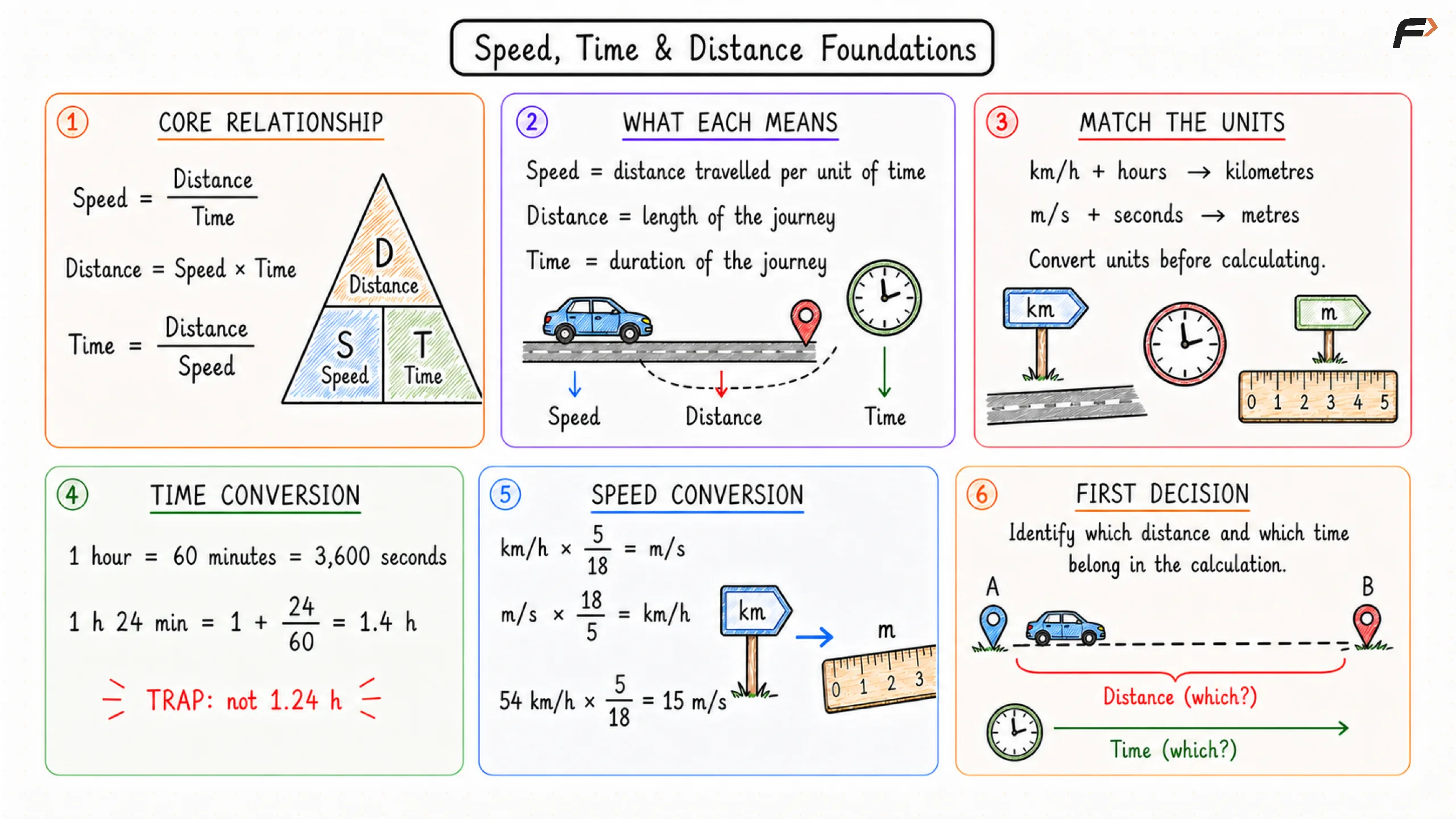
Speed and unit conversions
The Relationship Between Speed, Time, and Distance
The central formula is:
Rearranging it gives the other two formulas:
The units must match. If speed is in kilometres per hour, time must be in hours to obtain distance in kilometres. If speed is in metres per second, time must be in seconds to obtain distance in metres.
Finding Speed, Distance, or Time
When two of the three values are known, the third can be found directly.
Case 1: Find speed
Example: A person covers 2.4 km in 18 minutes. Since the distance is in kilometres and the required speed is in kilometres per hour, convert the time to hours:
Now:
Case 2: Find distance
Example: An object moves at 6 m/s for 12 minutes. First convert 12 minutes to seconds:
Then:
Case 3: Find time
Example: A car travels 168 km at 56 km/h.
In each case, the formula is simple once the units are made compatible.
Converting Time Units
Many errors in this topic come from treating minutes as a decimal part of an hour.
Use:
For example:
If a vehicle covers 35 km in that time, its speed is:
Do not write 1 hour 24 minutes as 1.24 hours. The digits after a decimal represent tenths and hundredths of an hour, not minutes.
Converting km/h and m/s
Since 1 km is 1,000 m and 1 hour is 3,600 seconds:
Therefore:
Case 1: km/h to m/s
Example:
At this speed, the distance covered in 50 seconds is:
Case 2: m/s to km/h
Example:
The conversion factors are reciprocals because one conversion reverses the other.
What Average Speed Really Means
Average speed is not automatically the average of the given speeds. Its definition is:
This definition works for every journey. Shorter formulas for equal distances or equal times come from it.
Case 1: Unequal stages of a journey
Example: A vehicle covers 120 km at 60 km/h and then 180 km at 90 km/h.
The times are:
Thus:
Although the distances are unequal, the times happen to be equal in this example.
Average Speed for Equal Distances
Suppose equal distances are covered at speeds and . The slower part takes more time, so the ordinary mean is not valid. The average speed is the harmonic mean:
Why does this formula work?
Let each part be km. Then:
and:
Therefore:
Example: A person travels half a route at 40 km/h and the other half at 60 km/h.
The answer is not 50 km/h. More time is spent travelling at 40 km/h, so the average is pulled towards the lower speed.
Case 1: A round trip
Example: A vehicle goes from one town to another at 54 km/h and returns over the same distance at 36 km/h.
A return journey over the same route is an equal-distance case.
Average Speed for Equal Time Intervals
If speeds and are maintained for equal amounts of time, the average speed is the arithmetic mean:
This works because equal time gives equal weight to each speed.
If the time intervals are not equal, use a time-weighted average:
Case 1: Unequal time intervals
Example: A vehicle travels for 2 hours at 45 km/h and then 3 hours at 60 km/h.
The plain average, 52.5 km/h, would give equal importance to periods of different length and would be incorrect.
Average Speed Across Several Legs
For three or more stages, the safest method is always to calculate the distance and time of each stage, add them, and use the definition.
Example: A train covers:
- 90 km at 60 km/h,
- 120 km at 80 km/h,
- 150 km at 100 km/h.
The time for each stage is 1.5 hours. Therefore:
The same table-based method works with any set of journey values:
| Stage | Distance | Speed | Time |
|---|---|---|---|
| 1 | |||
| 2 | |||
| 3 |
Add the final column instead of averaging the speeds by sight.
Stoppages and Average Speed
A vehicle's running speed ignores stoppages. Its average speed over the whole trip includes the time spent stopped.
Case 1: A fixed stop every hour
Example: A bus runs at 54 km/h but stops for 8 minutes in every clock hour. During one hour, it moves for only 52 minutes:
The distance covered in that clock hour is:
Therefore its average speed, including stops, is 46.8 km/h.
Finding stoppage time per hour
If a vehicle runs at speed but its average speed including stops is , then the fraction of each clock hour spent moving is .
So stoppage time per hour is:
For a running speed of 60 km/h and an average speed of 45 km/h:
For a running speed of 72 km/h and an average of 60 km/h:
Finding total stoppage time
A vehicle covers 300 km in 5 hours, including stops. Its running speed is 75 km/h.
The actual running time is:
Therefore:
A Journey with a Separate Halt
If a halt is stated separately between journey legs, add it directly to total time.
Example: A vehicle travels 150 km at 75 km/h, stops for 30 minutes, and then travels another 150 km at 50 km/h.
The halt is 0.5 hour, so:
The vehicle covers no distance during the halt, but the halt still belongs in the denominator.
Relative Speed: Two Objects Moving Towards Each Other
Relative speed tells us how quickly the distance between two objects changes.
When two objects move towards each other, their speeds add:
Example: Two people are 500 m apart and walk towards each other at 6 m/s and 4 m/s.
Their closing speed is:
Therefore:
Both people contribute to closing the gap, which is why their speeds are added.
Moving in Opposite Directions from the Same Point
When two objects start together and move in opposite directions, their separation also increases at the sum of their speeds.
Example: Two cyclists leave the same point in opposite directions at 28 km/h and 32 km/h. Their separation after 2 hours is:
If the final separation is given, time can be found by dividing it by the sum of the speeds. For example, two vehicles moving at 38 km/h and 47 km/h become 255 km apart after:
Relative Speed in the Same Direction
When objects move in the same direction, only the excess speed of the faster object closes the gap:
Case 1: Overtaking
Example: A faster vehicle is 24 km behind a slower vehicle. Their speeds are 54 km/h and 42 km/h.
Case 2: A chase
Example: A vehicle travelling at 75 km/h chases another travelling at 60 km/h with a 45 km lead.
Case 3: Find the unknown faster speed
Example: A slower object travels at 18 km/h. After 3 hours, the faster object is 27 km ahead, and both started together in the same direction.
The relative speed is:
Therefore the faster speed is:
For two moving objects, first decide whether the distance between them changes by the sum or the difference of their speeds.
Speed Ratios and Time Ratios
For the same distance:
Therefore speed and time are inversely proportional:
Case 1: Same distance
Example: The speeds of A and B are in the ratio . If A takes 72 minutes, then:
The faster traveller takes less time, which is a useful check on the answer.
Case 2: Find a speed from a ratio
Example: Two speeds are in the ratio . If the faster object covers 180 km in 2 hours, its speed is 90 km/h. Nine ratio parts therefore represent 90:
So the slower speed is:
Case 3: Time ratio to speed ratio
Example: Two people cover the same route in times with ratio . Their speed ratio is the inverse:
Never invert a ratio unless the same distance condition is present.
Boats and Streams
Let:
- be the speed of the boat in still water;
- be the speed of the current.
When the boat moves downstream, the current helps it:
When it moves upstream, the current opposes it:
If downstream speed and upstream speed are known:
Case 1: Find the current
Example: The downstream speed is 24 km/h and the upstream speed is 16 km/h.
The still-water speed is:
Case 2: Find downstream time
Example: A boat moves at 18 km/h in still water, and the current is 3 km/h. Its downstream speed is:
To cover 84 km downstream:
Case 3: Find upstream speed
Example: A boat's downstream speed is 30 km/h and the current is 5 km/h.
First find the still-water speed:
Then:
Notice that going from downstream speed to upstream speed removes the current twice:
Case 4: Find upstream journey time
Example: A boat moves at 20 km/h in still water against a current of 4 km/h. For an upstream distance of 64 km:
Always find the effective upstream or downstream speed before using .
A Train Passing a Pole or a Person
When a train passes a stationary point such as a pole, signal, or standing person, the train must cover its own length.
Case 1: Find train length
Example: A train moves at 72 km/h and passes a pole in 18 seconds.
Convert the speed:
Then:
Case 2: Find train speed
Example: A 210 m train passes a pole in 14 seconds.
In kilometres per hour:
A Train Passing a Platform or Bridge
To clear a platform or bridge completely, the front of the train must travel the length of the train plus the length of the object.
Case 1: Find platform length
Example: A 180 m train moving at 54 km/h crosses a platform in 30 seconds.
Convert the speed:
The total distance covered is:
Therefore:
Case 2: Find train speed while crossing a bridge
Example: A 160 m train crosses a 200 m bridge in 18 seconds.
The phrase “crosses completely” is a signal that both lengths must be included.
Movement on a Circular Track
On a circular track, two runners meet whenever their relative motion gains one full lap.
For a track of length :
Same direction
Opposite directions
Case 1: Same direction
Example: Two runners move on a 720 m track at 8 m/s and 6 m/s in the same direction.
The faster runner must gain one complete lap on the slower runner.
Case 2: Opposite directions
Example: Two runners move on a 600 m track at 7 m/s and 5 m/s in opposite directions.
Their combined movement closes one lap between them.
Data Sufficiency in Speed, Time and Distance
Data sufficiency checks whether the given statements provide enough information, not necessarily whether the final number must be produced immediately.
Use four steps:
- Write the target quantity or comparison.
- Identify the variables required.
- Test each statement independently.
- Combine the statements only when required.
Case 1: Is average speed greater than 60 km/h?
Example: Average speed requires total distance and total time:
Suppose one statement gives km and another states hours. Neither is sufficient alone. Together:
Therefore the two statements together are sufficient to answer yes.
Case 2: Find the speed of a river current
Example: If one statement gives only downstream speed, the current cannot be separated from the boat's speed. If another statement gives only upstream speed, the same uncertainty remains. Together, downstream 26 km/h and upstream 18 km/h give:
So both statements together are sufficient.
A Reliable Speed, Time and Distance Method
Use this sequence when several movements or time periods are connected:
- Draw or describe the direction of motion.
- Convert all quantities to compatible units.
- Decide whether ordinary speed, average speed or relative speed is needed.
- For average speed, find total distance and total time.
- For relative motion, decide whether speeds add or subtract.
- For boats, replace ordinary speed with downstream or upstream speed.
- For trains, identify the complete length that must pass a point or object.
- For stoppages, include stopped time in total time but not in distance.
This method is more dependable than choosing a memorised shortcut from keywords alone.
Useful Reasoning Checks
Faster calculation comes from recognising the movement structure before doing the arithmetic. The following checks come directly from the basic formulas.
Match the units before you calculate
Convert units at the beginning instead of carrying mismatched units through several steps. If a train's length is in metres and time is in seconds, change its speed to m/s first. If distance is in kilometres and speed is in km/h, change minutes to hours.
Some common conversions can be recalled immediately:
These values appear often with train speeds and can save a full conversion step.
For average speed, identify what is equal
Do not average two speeds until you know whether the distances or the times are equal.
- For equal distances, use .
- For equal times, use .
- If neither is equal, use total distance divided by total time.
For example, equal distances at 40 km/h and 60 km/h give 48 km/h, not 50 km/h. A useful check is that an equal-distance average lies closer to the lower speed because more time is spent there.
Decide whether the gap changes by a sum or a difference
Think about the gap between the two objects:
- if they move towards each other, the gap closes at ;
- if they move apart in opposite directions, the gap grows at ;
- if they move in the same direction, the gap changes at .
This one decision handles meeting, separation, chasing, overtaking and circular-track movement.
Use inverse ratios when the distance is the same
For a fixed distance, speed and time are inversely proportional. If the speed ratio is , the time ratio is . You can reverse the ratio immediately instead of introducing an unknown distance.
Check the direction of the result: the faster object must take less time. If your ratio says otherwise, it has not been inverted correctly.
Use the percentage shortcut only for the same distance
When distance remains fixed, speed and time change in opposite directions. If speed rises by , the percentage fall in time is:
If speed falls by , the percentage rise in time is:
For example, a rise in speed reduces the time by . Use this shortcut only when the distance is unchanged.
For a boat, write the two effective speeds first
Before using , write:
If both effective speeds are given, their average gives the boat's still-water speed, and half their difference gives the current. For downstream and upstream speeds of 24 km/h and 16 km/h, you can directly obtain:
For a train, find the crossing distance first
The speed formula is usually simple. First decide how much distance the train's front must cover:
- passing a pole: train length;
- crossing a platform or bridge: train length plus object length.
Once that distance is written in metres and the speed is in m/s, use . This short setup prevents missing one of the lengths.
When two trains cross each other, the distance is the sum of their lengths. Use the difference of their speeds when they move in the same direction and the sum when they move in opposite directions:
Use a one-hour assumption for regular stoppages
If a vehicle stops for a fixed number of minutes every hour, work with one clock hour. A bus that runs at 54 km/h but moves for only 52 minutes covers:
So its average speed is 46.8 km/h. There is no need to assume a longer journey.
Keep fractions until the last step
Values such as hours, of an hour, or km/h are often easier to use as fractions. Cancel common factors before multiplying, and round only when an approximate value is required.
For example:
Check the answer before moving on
A quick range check can catch errors without repeating the full calculation:
- an average speed must lie between the lowest and highest speeds;
- upstream speed must be lower than still-water speed;
- downstream speed must be higher than still-water speed;
- a chase time must be positive;
- including a stoppage must reduce the average speed.
These checks take only a few seconds and help catch a wrong operation or an incorrect unit conversion.
Formulas and Cheat Sheet
| Situation | Formula | Condition |
|---|---|---|
| Basic relationship | , , | Distance and time units must match the speed unit |
| Convert km/h to m/s | Multiply by | Use when distance is in metres and time is in seconds |
| Convert m/s to km/h | Multiply by | Use when distance is in kilometres and time is in hours |
| General average speed | Include travelling time and any stated halt time | |
| Equal distances at speeds | The two travelled distances must be equal | |
| Equal times at speeds | The two time intervals must be equal | |
| Opposite directions | Relative speed | The gap changes because of both speeds |
| Same direction | Relative speed | Use for chasing or overtaking |
| Same distance | Distance must be fixed | |
| Boat downstream | is still-water speed and is stream speed | |
| Boat upstream | The boat must be faster than the stream | |
| Boat and stream from | , | Both speeds belong to the same boat and stream |
| Train passing a pole | Use train length and speed in matching units | |
| Train passing a platform | Add train length and platform length | |
| Two trains crossing | Choose sum or difference of speeds from their directions | |
| Circular track meeting | Use sum for opposite directions and difference for the same direction |
Safe Shortcuts
- Use the distance-speed-time triangle: Remember . Cover the value you need: and .
- Convert speed quickly: Multiply km/h by to get m/s. Multiply m/s by to get km/h.
- Check whether distance or time is equal: For equal distances at speeds and , average speed is . For equal times, it is .
- Use relative speed: Add speeds when objects move towards each other. Subtract the slower speed from the faster speed when they move in the same direction.
- Reverse speed and time ratios: For the same distance, if speeds are in the ratio , times are in the ratio .
- Use the complete train distance: A train passing a pole covers its own length. A train passing a platform covers train length plus platform length.
- Find boat and stream speeds from two observations: If downstream speed is and upstream speed is , still-water speed is and stream speed is .
Frequently Asked Questions
Is average speed always the average of two speeds?
No. Average speed is total distance divided by total time. The arithmetic mean works when the speeds are maintained for equal times. For equal distances, use the harmonic mean .
When do relative speeds add?
They add when two objects move towards each other or move away from the same point in opposite directions. In both cases, the distance between them changes because of both speeds.
When do relative speeds subtract?
They subtract when two objects move in the same direction and one catches the other. The faster object closes the gap only by its excess speed.
Why is the current subtracted twice when finding upstream speed from downstream speed?
Downstream speed is , while upstream speed is . Moving from the first to the second removes , so .
What distance does a train cover while crossing a platform?
It covers its own length plus the platform's length. The rear of the train must move beyond the far end before the crossing is complete.
Should stoppage time be included in average speed?
Yes, if the question asks for average speed over the complete journey. A halt adds time but no distance, so it lowers the average speed.