Simple Interest: Complete Beginner Guide with Detailed Examples
Simple Interest is the extra money paid for borrowing money, or earned for investing money, when the interest is always calculated on the original sum. That original sum is called the principal. The rate tells us how much interest is charged on every 100 rupees in one time period. The time tells us how long the money is borrowed or invested.
Suppose you invest ₹1,000 at per year. Ten percent means ₹10 for every ₹100. Since ₹1,000 contains ten groups of ₹100, the interest for one year is . Under Simple Interest, the second year also gives ₹100 because the calculation still uses the original ₹1,000. The interest does not begin earning more interest.
This fixed-interest idea is the base of the whole topic. We will first understand each word and build the formula. We will then use the same idea for months, reverse calculations, changing rates, equal interests and split investments.
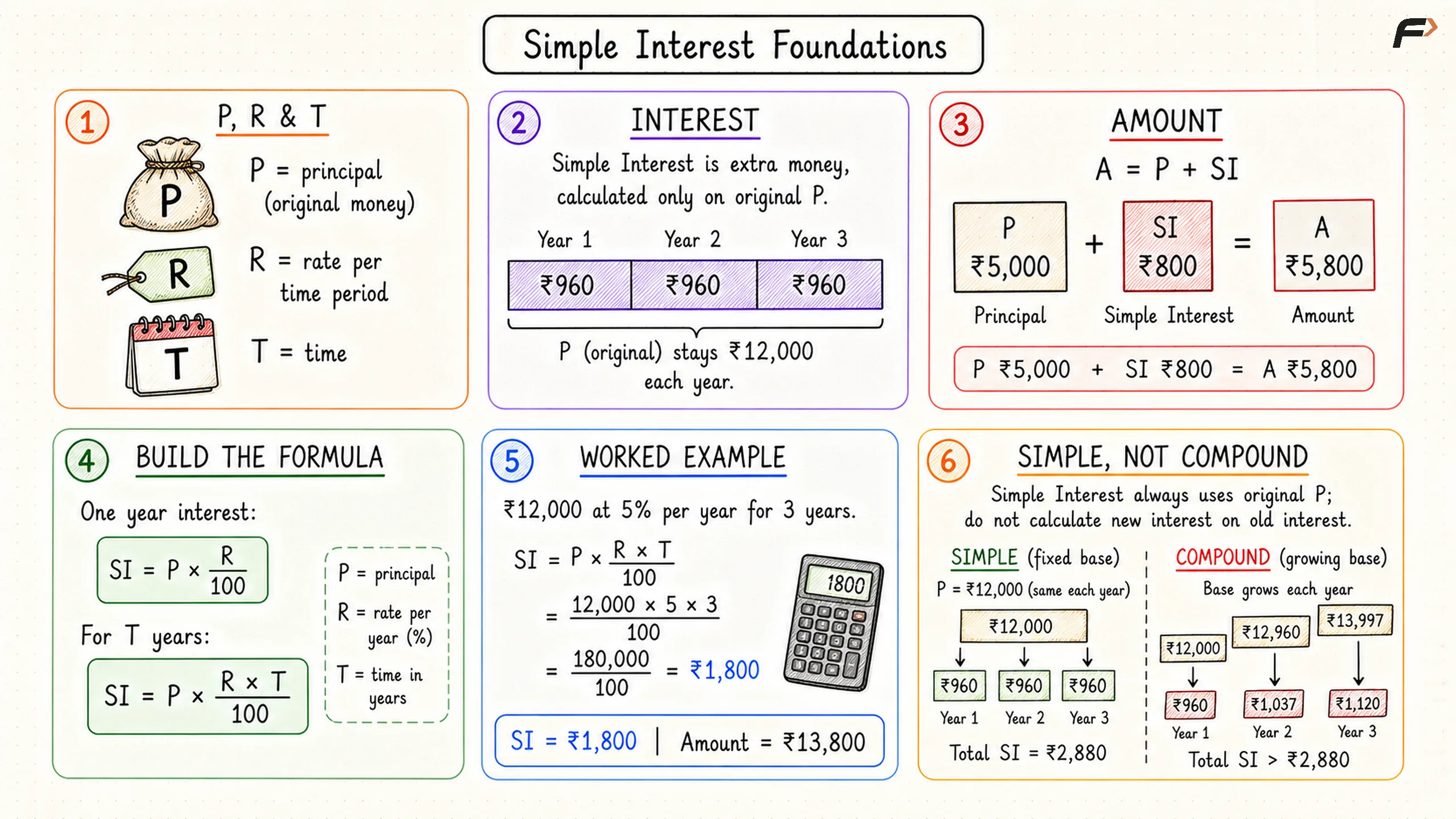
Simple Interest foundations
The Five Basic Words
Before using a formula, we need to know what each number means. Mixing up the principal, interest and amount is one of the most common mistakes.
| Term | Symbol | Easy meaning |
|---|---|---|
| Principal | The original money borrowed or invested | |
| Rate | Interest on every 100 units of principal for one time period | |
| Time | How long the money is used | |
| Simple Interest | The extra money paid or earned | |
| Amount | The original principal plus the total interest |
Principal
The principal is the starting money. If you borrow ₹8,000, then ₹8,000 is the principal. If you place ₹8,000 in a bank deposit, it is still the principal. The direction of money changes, but the meaning of principal does not.
Rate
A rate of means ₹6 of interest for every ₹100 of principal during the stated time unit. A rate of per annum means per year. A rate of per month means for each month.
The words after the rate matter. A number without its time unit is incomplete because per year and per month are very different charges.
Time
Time tells us how many rate periods are used. A yearly rate needs time in years. A monthly rate needs time in months. We will learn how to match these units before placing them in the formula.
Interest and amount
Interest is only the extra money. Amount is everything paid or received at the end. Therefore:
Example: A principal of ₹5,000 earns ₹800 as Simple Interest. Find the amount.
The extra money is already known as ₹800. We need the full amount, so we must put the original ₹5,000 and the extra ₹800 together.
The final amount is ₹5,800, while the interest alone is ₹800. This is why we should first mark whether we need or .
Why Simple Interest Stays the Same Every Year
Simple Interest always uses the original principal. Interest already earned is not added to the principal for the next year. Because the base stays unchanged, the interest added in each equal time period also stays unchanged.
Take ₹12,000 at per year. Eight percent means 8 out of every 100. To find one year's interest, we take of ₹12,000:
The calculation uses ₹12,000 in every year:
| End of year | Principal used to calculate interest | Interest added that year | Total amount |
|---|---|---|---|
| 1 | ₹12,000 | ₹960 | ₹12,960 |
| 2 | ₹12,000 | ₹960 | ₹13,920 |
| 3 | ₹12,000 | ₹960 | ₹14,880 |
Notice what does not happen. At the start of year 3, the amount is ₹13,920, but we do not calculate of ₹13,920. We still calculate of ₹12,000. Using ₹13,920 as the new base would mean that old interest also earns interest. That is Compound Interest, not Simple Interest.
This gives us a useful mental picture. Simple Interest is like adding the same-sized block every year. If one block is ₹960, then two years add two blocks, three years add three blocks and so on.
Building the Simple Interest Formula
It is easier to remember the formula when we know where it comes from.
First, find the interest for one year. A rate of means out of 100. Therefore, the interest on principal for one year is:
Under Simple Interest, the same interest is added every year. For years, we take that one-year interest times:
Writing the same expression in a shorter form gives the standard formula:
The division by 100 appears because the rate is a percentage. The multiplication by time appears because the same periodic interest is added once for every time period.
Case 1: Find Simple Interest and amount
Example: Find the amount on ₹12,000 at per annum for 3 years.
What is given? The principal is ₹12,000, the yearly rate is , and the time is 3 years. The word “per annum” means per year, so the rate and time already use the same unit.
What are we finding? We need the amount, not only the interest. We therefore need two stages. First find the Simple Interest. Then add it to the principal.
Five percent of ₹12,000 is the interest for one year:
The money stays invested for 3 years, and each year adds the same ₹600. Therefore:
This is the same as using the full formula:
The ₹1,800 is only the extra money. To find the final amount, add back the original ₹12,000:
The answer is ₹13,800. It contains ₹12,000 of original money and ₹1,800 of interest.
Matching the Units of Rate and Time
The rate tells us the size of the interest for one particular time unit. The time tells us how many of those units pass. That is why their units must match.
If the rate is per year but we place 30 months directly as , the formula would read 30 as 30 years. That would make the answer twelve times too large. We avoid this by converting months into years before calculating.
Useful facts are:
Case 1: Time is given in months
Example: A loan of ₹5,000 carries per annum Simple Interest for 30 months. Find the interest.
What is given? We have , per year and a time of 30 months.
Why can we not calculate immediately? The rate counts years, but the time counts months. They do not yet speak the same unit. Because 12 months make 1 year, we divide the number of months by 12:
This means 30 months contains two complete years and half of another year. Now is yearly and is in years, so the formula can be used safely:
We can understand the arithmetic in small pieces. Eight percent of ₹5,000 is ₹400 for one year. For 2.5 years, the interest is two and a half copies of ₹400:
The borrower must pay ₹1,000 as interest for the 30 months. The total repayment would be .
Case 2: Time is given in quarters
Example: Find the Simple Interest on ₹12,000 at per annum for 3 quarters.
A quarter is one-fourth of a year because a year has four equal quarters. Three quarters therefore means three out of those four parts:
The yearly interest on ₹12,000 at is:
We need only three-fourths of a year's interest, so we take three-fourths of ₹960:
The interest for 3 quarters is ₹720. The fraction is used because only three of the year's four quarters have passed.
Case 3: Rate and time are both monthly
Example: A short-term advance of ₹4,800 is charged at per month for 10 months. Find the interest.
Here, the rate is already per month and the time is already in months. The units match, so converting 10 months into years would create unnecessary work and could lead to a wrong answer.
The monthly interest is of ₹4,800:
Each of the 10 months adds ₹36:
The total interest is ₹360. The main rule is not “always convert months to years.” The correct rule is “make the time unit match the rate unit.”
Finding Principal, Rate or Time
The standard formula connects four values: , , and . If three are known, the fourth can be found. We do not need four separate formulas, but rearranged forms can save time.
These forms come from undoing multiplication. For example, was multiplied by and and divided by 100. To leave alone, we multiply by 100 and divide by and .
Case 1: Find the principal
Example: A deposit earns ₹1,260 at per annum in 3 years. Find the principal.
The interest, rate and time are known, while the starting money is missing. Therefore, the unknown is :
The product means the total interest over 3 years is of the principal. In other words, of the unknown principal equals ₹1,260. Dividing reverses that percentage:
The original deposit was ₹6,000. A quick check shows that of ₹6,000 is ₹420 per year, and .
Case 2: Find the rate
Example: ₹8,000 earns ₹1,440 in 3 years. Find the annual rate.
The principal, interest and time are known. The rate is missing, so:
First divide the total interest by 3 to see the interest for one year:
Now ask what percent ₹480 is of ₹8,000:
The annual rate is . This makes sense because of ₹8,000 is ₹480, and three years give ₹1,440.
Case 3: Find the time
Example: A principal earns ₹600 per year as Simple Interest. How long will it take to earn ₹1,500?
The phrase “₹600 per year” tells us the size of one equal yearly interest block. We need enough ₹600 blocks to make ₹1,500. Therefore, divide the total required interest by the interest earned in one year:
The time is 2.5 years, which is 2 years and 6 months. We divided to find how many ₹600 yearly parts fit inside ₹1,500.
Interest Given as a Fraction or Percentage of Principal
Interest may be given as a fraction or percentage of the principal instead of as a rupee value. This still gives enough information because both descriptions can be placed in the same equation.
Case 1: Interest is a fraction of principal
Example: The Simple Interest for 5 years is three-tenths of the principal. Find the annual rate.
“Three-tenths of the principal” means:
The standard formula for the same interest is:
Since both expressions describe the same , we set them equal:
The same positive principal appears as a factor on both sides. Cancelling it does not mean that the principal is zero. It means the answer depends on the relationship between interest and principal, not on the actual size of the principal.
Three-tenths is . Thus, the investment earns a total of over 5 years. Simple Interest adds the same rate each year, so:
The annual rate is .
Case 2: Total interest is a percentage of principal
Example: The interest for 4 years is of the principal. Find the annual rate.
The is the interest for all 4 years together. It is not the one-year rate. Because Simple Interest adds an equal percentage each year, four years at give a total of .
Divide the four-year percentage equally across the four years:
The annual rate is . The important step is to notice whether a percentage describes one year or the whole time.
When the Amount Is a Multiple of the Principal
An amount such as contains both the original principal and the interest. We must remove the original before treating the rest as interest.
In general, if , then:
Example: A sum becomes times itself after 5 years at Simple Interest. Find the rate.
The final amount is . Out of this, is only the original principal. The part above is the interest:
The decimal means . Therefore, the total interest over 5 years is of the principal. The same percentage is added each year, so divide by 5:
The annual rate is . A common mistake is to use as the interest. That counts the original principal as if it were extra money.
Amounts Given After Two Different Times
Amounts at different times become easy to compare when we remember that Simple Interest adds the same amount every year. If the later amount is larger, the difference comes only from the extra years between the two dates.
If is the amount after years and is the amount after years, then:
We subtract the amounts to remove the common principal and the interest already present at the earlier date. We divide by the time gap because the remaining difference was earned equally during those extra years.
Case 1: Find the principal
Example: A sum becomes ₹11,800 after 3 years and ₹13,000 after 5 years. Find the principal.
The time gap is years. The amount rises by:
This ₹1,200 is not the full five-year interest. It is only the interest added during years 4 and 5. Since those 2 years add equal interest, one year's interest is:
The amount ₹11,800 was reached after 3 years. Three years of interest equal:
Amount equals principal plus interest. To move backwards from amount to principal, subtract the interest already added:
The original principal was ₹10,000. Checking with the fifth year gives , so the result fits both amounts.
Case 2: Find the rate as well
Example: A sum becomes ₹16,800 after 4 years and ₹18,900 after 7 years. Find the annual rate.
The later amount includes 3 more years of interest because . The increase during those years is:
Therefore, one year's interest is:
Four years of interest equal . Remove this from the amount after 4 years:
Now ₹700 is the yearly interest on ₹14,000. The yearly rate is the yearly interest as a percentage of the principal:
The annual rate is .
Equal Simple Interests
When two investments earn the same Simple Interest, their interest expressions are equal:
The 100 is common to both sides, so it cancels:
This is not a new interest formula. It is simply the normal formula written for two equal results.
Case 1: Find an unknown time
Example: ₹8,000 at for 2 years earns the same interest as ₹12,000 at for years. Find .
The phrase “same interest” tells us to equate the two products:
The left side describes the earning power of the first investment. The right side describes the earning power of the second. Divide both sides by to leave alone:
The second investment needs 2 years. Although its principal is larger, its rate is smaller in exactly the matching proportion.
Case 2: Find an unknown rate
Example: ₹9,000 at for 4 years earns the same interest as ₹6,000 at for 3 years. Find .
Again, “same interest” allows us to equate the products:
The second investment has less principal and less time. To catch up with the first investment's interest, it needs a higher rate. Solving gives:
The required rate is .
Direct Proportion in Simple Interest
The formula shows that interest changes directly with , and . “Directly” means that if one factor doubles while the other two stay fixed, the interest also doubles.
- If and stay fixed, changes in the same ratio as .
- If and stay fixed, changes in the same ratio as .
- If and stay fixed, changes in the same ratio as .
The fixed conditions are important. We cannot say interest follows time alone if the rate also changes.
Case 1: Ratio of interests
Example: Two equal principals are invested for the same time at and . Find the ratio of their interests.
The principals are equal, so the factors cancel in a ratio. The times are also equal, so the factors cancel. Only the rates remain:
The interests are in the ratio . We do not need the actual principal or time because they affect both investments equally.
Case 2: Interest changes with time
Example: A deposit earns ₹1,500 in 30 months. At the same principal and rate, how much will it earn in 42 months?
Only time changes. Therefore, interest changes in the same ratio as time:
The fraction tells us that the new time is times the old time. The interest must also become times as large:
The interest for 42 months is ₹2,100.
Case 3: Percentage change in rate
Example: With principal and time fixed, interest rises from ₹1,200 to ₹1,500 because the rate changes. Find the percentage increase in rate.
When and stay fixed, and change by the same percentage. First find the increase in interest:
Percentage increase is measured against the original value, which is ₹1,200:
The interest increased by , so the rate also increased by . We use the original interest in the denominator because percentage change always compares the change with the starting value.
Difference Between Two Simple Interests
If two cases have the same principal and time but different rates, only the rate part changes. Instead of calculating two full interests and subtracting them, we can use the rate difference directly:
The symbol means “difference in.” This shortcut works because subtracting the two formulas leaves the common and factors multiplied by the rate difference.
Case 1: Find the interest difference
Example: Find the difference between the interests on ₹8,000 for 3 years at and .
The principal and time are unchanged. The rate difference is:
So the difference between the two interests equals the interest produced by a rate on the same ₹8,000 for 3 years:
The higher-rate plan earns ₹720 more.
Case 2: Find principal from an interest difference
Example: Two rates differ by . Over 2.5 years, the interest difference is ₹1,000. Find the principal.
The ₹1,000 difference was created only by the extra rate over the same 2.5 years. Place those values in the difference formula:
Since , the difference equals of the principal. If is ₹1,000, then is ten times as much:
The principal is ₹10,000.
Case 3: Only the principal changes
Example: Two principals differ by ₹4,000. They use the same rate for 3 years. Find the difference in interest.
The common rate and time affect both sums equally. Therefore, the interest difference is simply the interest on the ₹4,000 difference:
The larger principal earns ₹840 more interest.
Keeping Interest Fixed When Rate Changes
Suppose the principal and required interest stay fixed. In , the product must then stay fixed:
If the rate rises, the same interest is reached in less time. If the rate falls, more time is needed. This opposite movement is called inverse proportion.
Example: The rate increases by , but the Simple Interest must remain the same. By what percentage must time decrease?
Let the old rate be and the old time be . A increase makes the new rate of the old rate:
For the interest to stay unchanged:
Cancel the common positive rate and divide by 1.25:
The new time is of the old time. Therefore, the part removed is:
Time must decrease by . It does not decrease by because the increase and decrease are measured from different starting values.
Changing Rates During One Investment
Sometimes the same principal uses one rate for a while and another rate later. We cannot use either rate for the full time. Each time block must use the rate that belongs to it.
The principal remains the original principal in every block because the calculation still uses Simple Interest:
Case 1: Rates change after a few years
Example: ₹10,000 earns for the first 2 years and for the next 3 years. Find the total interest.
For the first block, use and 2 years:
For the second block, the rate becomes and lasts 3 years. The principal is still ₹10,000, not ₹11,200:
Both blocks belong to the same investment, so add their interests:
The total interest is ₹3,600.
Case 2: Rates change during months
Example: ₹15,000 earns per annum for 18 months and per annum for the next 6 months. Find the total interest.
Both rates are yearly, so both month values must be changed into years:
Now calculate the first block:
Calculate the second block with its own rate and time:
Add the two parts because they cover different pieces of the full time:
The total interest is ₹2,250.
Finding One Equivalent Rate
An equivalent rate is one constant rate that gives the same total Simple Interest as several rates. It is not always the ordinary average because a rate used for more money or more time should have more effect on the answer.
Case 1: Same principal, different time periods
When the same principal uses different rates for different lengths of time, use a time-weighted average:
Example: A principal earns for 2 years and for 3 years. Find one rate for all 5 years that gives the same interest.
The rate affects 2 years, so its contribution is . The rate affects 3 years, so its contribution is . The total contribution is across 5 years.
The equivalent rate is per year. A plain average of 6 and 9 would be wrong because the rate lasts longer.
Case 2: Different principals, same time
When different sums use different rates for the same time, use a principal-weighted rate:
Example: ₹12,000 is invested at and ₹8,000 at for one year. Find the equivalent rate on the total ₹20,000.
First find what each part earns in one year:
Together, the investments earn on a total principal of ₹20,000. The equivalent rate is therefore:
The answer is , not . More money was placed at the lower rate, so the final rate is pulled closer to 5.
Dividing a Sum Between Two Rates
When a total sum is split into two parts, choosing one part automatically tells us the other. If the total is and one part is , the other is .
Example: ₹20,000 is divided between and for one year. The total interest is ₹1,560. Find the amount invested at .
Let ₹ be placed at . The full ₹20,000 must be used, so the part at is ₹.
The interest from the part is:
The interest from the part is:
Their sum is the given total interest:
Multiply by 100 to remove the denominators:
Open the bracket and combine the terms:
So ₹12,000 was invested at , and the remaining ₹8,000 was invested at .
A quick check explains the result. If all ₹20,000 were at , the interest would be ₹1,200. Moving ₹12,000 to a rate that is 3 percentage points higher adds . The total becomes ₹1,560.
Several Deposits or Loans
If separate sums have different principals, rates or times, each sum has its own interest calculation. We calculate them separately because one set of values cannot correctly describe all of them.
Case 1: Three deposits
Example: Find the total interest from these deposits:
- ₹8,000 at for 2 years
- ₹12,000 at for 18 months
- ₹10,000 at for 1 year
The second time must first become 1.5 years because its rate is per annum. Now calculate each deposit:
We need the combined interest, so add the three separate results:
The three deposits earn ₹3,210 in total.
Case 2: Loans taken on different dates
Example: A borrower takes ₹12,000 at . One year later, another ₹8,000 is borrowed at the same rate. Both loans are repaid two years after the second loan. Find the total interest.
The loans do not run for the same time. The first loan begins one year earlier. It runs for that first year plus the two years after the second loan begins, so its time is 3 years. The second loan runs for only 2 years.
For the first loan:
For the second loan:
Both interest charges must be paid, so:
The total interest is ₹3,640. A small timeline helps prevent the mistake of giving both loans the same time.
Comparing Loan or Investment Plans
If two plans use the same principal, the common part does not affect which interest is larger. We can compare only .
Case 1: Which loan is cheaper?
Example: On the same ₹10,000 loan, Plan A charges for 2.5 years and Plan B charges for 3 years.
For Plan A, the total interest percentage is:
For Plan B, it is:
Plan A charges of the principal, while Plan B charges . On ₹10,000, these are ₹2,000 and ₹2,100. Therefore, Plan A is cheaper by ₹100.
Case 2: Which investment earns more?
Example: Compare for 4 years with for 3 years on the same ₹15,000.
The first option earns a total of:
The second earns:
The first option earns 3 percentage points more. Three percent of ₹15,000 is:
The plan for 4 years earns ₹450 more.
Discount Followed by Simple Interest
Some financial situations contain two operations, and their order matters. If an item is discounted before finance begins, the discounted price becomes the principal because that is the amount actually borrowed.
Example: An item has a marked price of ₹18,000 and gets a cash-price discount. The discounted price is financed for 2 years at Simple Interest. Find the total repayment.
First find the discount:
Subtract it from the marked price to find the money actually financed:
Now use ₹16,200 as the principal. Using ₹18,000 would wrongly charge interest on money that was removed by the discount.
The final repayment contains the financed principal and its interest:
The total repayment is ₹18,792.
Simple Interest and Compound Interest for Two Years
In the first year, Simple Interest and Compound Interest are the same because both begin with the same original principal. The difference starts in the second year. Compound Interest adds the first year's interest to the base, so that interest itself earns interest.
For two years:
Example: Compare Simple Interest and Compound Interest on ₹10,000 at per year for 2 years.
Under Simple Interest, each year earns of ₹10,000, which is ₹1,000. Two years therefore earn:
Under Compound Interest, the first year also earns ₹1,000, so the amount becomes ₹11,000. In the second year, is calculated on ₹11,000:
Therefore, the total Compound Interest is . The difference is:
The extra ₹100 is interest on the first year's ₹1,000 interest.
Data Sufficiency
Data sufficiency checks whether the known facts are enough to produce one unique result. It does not require every possible calculation. The safest method is to write the values that are needed and then check each statement separately.
Example: Find the principal.
- Statement I: The Simple Interest for 3 years is ₹1,800.
- Statement II: The annual rate is .
To find principal, we need:
Statement I gives and , but it does not give . Different rates could produce different principals, so Statement I alone is not enough.
Statement II gives only . It does not give interest or time, so it is also not enough alone.
Together, the statements give all three required values:
Both statements together are sufficient, but neither statement alone is sufficient.
Common Mistakes and Why They Are Wrong
Using amount as the new principal
Under Simple Interest, the original principal stays fixed. If ₹12,000 becomes ₹13,920 after two years, the next year's interest is still calculated on ₹12,000. Using ₹13,920 would add interest on old interest and turn the calculation into Compound Interest.
Confusing interest with amount
The formula gives interest, not amount. To find the amount, add the principal after finding .
Mixing yearly and monthly units
Do not place months directly beside a per-annum rate. Convert the months to years. However, if the rate and time are both monthly, keep both in months.
Treating a total percentage as an annual rate
If interest for 4 years is of principal, the annual rate is . The describes all four years together.
Using the ordinary average for unequal weights
A rate used for 3 years should affect an equivalent rate more than a rate used for 1 year. A rate applied to ₹20,000 should affect the answer more than one applied to ₹5,000. Use time or principal weights according to what changes.
Applying a shortcut without checking fixed values
Interest follows the rate directly only when principal and time stay fixed. Interest follows time directly only when principal and rate stay fixed. Always check what remains unchanged before using a ratio.
Formulas and Cheat Sheet
| Situation | Formula or decision | Why it works |
|---|---|---|
| Find interest | Find one period's percentage interest, then repeat it for time | |
| Find amount | Amount contains original money and extra interest | |
| Find principal | Undo multiplication by rate and time | |
| Find rate | Express the interest as a yearly percentage of principal | |
| Find time | Find how many equal interest periods are needed | |
| Months with yearly rate | years | The time unit must match “per annum” |
| Quarters with yearly rate | years | Four quarters make one year |
| Equal interests | The two expressions are equal | |
| Amounts at two times | Yearly interest | The amount difference comes from the extra years |
| Same principal and time, different rates | Only the rate part changes | |
| Same rate and time, different principals | Only the principal part changes | |
| Same interest and principal | Rate and time must balance each other | |
| Changing rates | Each time block uses its own rate | |
| Time-weighted rate | A rate used longer has more effect | |
| Principal-weighted rate | A rate used on more money has more effect |
Safe Shortcuts
- First find one period's interest as . Multiply that value by time when the rate and time units already match.
- Under Simple Interest, the total interest percentage over years is . Use this only when the same annual rate applies throughout.
- For equal interests, equate . The common division by 100 cancels.
- When amounts are given after two different years, yearly interest is amount difference divided by time difference. This works because Simple Interest adds the same amount each year.
- For plans with the same principal, compare instead of calculating both interests. Include as well if the principals differ.
- When rates change during one investment, add the blocks and multiply once by . Keep the original principal in every block.
These shortcuts are safe only after rate and time units are matched and the calculation is confirmed to use Simple Interest. They shorten arithmetic but do not change the fixed-principal rule.
Frequently Asked Questions
What is Simple Interest in easy words?
Simple Interest is extra money calculated only on the original principal. The base does not grow when earlier interest is added. Therefore, equal time periods add equal amounts of interest.
What is the formula for Simple Interest?
The formula is , where is principal, is the percentage rate per matching time period and is the number of those periods.
What is the difference between interest and amount?
Interest is only the extra money earned or paid. Amount is the original principal plus that interest, so .
Why do we divide by 100 in the formula?
A percentage means “out of 100.” A rate of means 8 out of every 100 units of principal. Dividing by 100 changes the percentage into the part of the principal used for the calculation.
Should months always be divided by 12?
No. Divide months by 12 only when the rate is per year. If the rate is per month and time is also in months, the units already match and no conversion is needed.
How can I identify principal in a word problem?
Look for the original money borrowed, deposited, lent or invested. If a discount happens before finance begins, the discounted price is the principal because that is the money actually financed.
How do I solve questions with amounts after two different years?
Subtract the two amounts and divide by the difference in years. This gives one year's constant interest. Use it to find the interest up to either stated year, then subtract that interest from the amount to find principal.
Why can principal cancel from some equations?
When both sides contain the same positive principal as a multiplication factor, dividing both sides by that principal removes it. This means the required rate or time depends on a ratio, not on the actual size of the principal.
When can I compare only rate multiplied by time?
You can compare when the principal is the same in both plans. If the principals differ, include principal and compare .
Can two rates simply be averaged?
Only when their weights are equal. If rates last for different times, use a time-weighted average. If they apply to different principals for the same time, use a principal-weighted average.