Series Completion: Patterns, Rules and Easy Examples
Series completion is the task of finding a missing term in an ordered list. A term is one item in the list, and a pattern is the rule that connects one term to the next. The central decision is to identify the rule that fits every given step, rather than choosing a rule that explains only the first pair.
For example, rises by 2 each time, so its next term is 10. The same idea can appear as letters, groups of letters, numbers with letters, or two alternating smaller series.
This article starts with the safest way to inspect a series. It then covers equal changes, changing changes, special number patterns, alphabet patterns, mixed terms and the more advanced rules that combine earlier ideas.
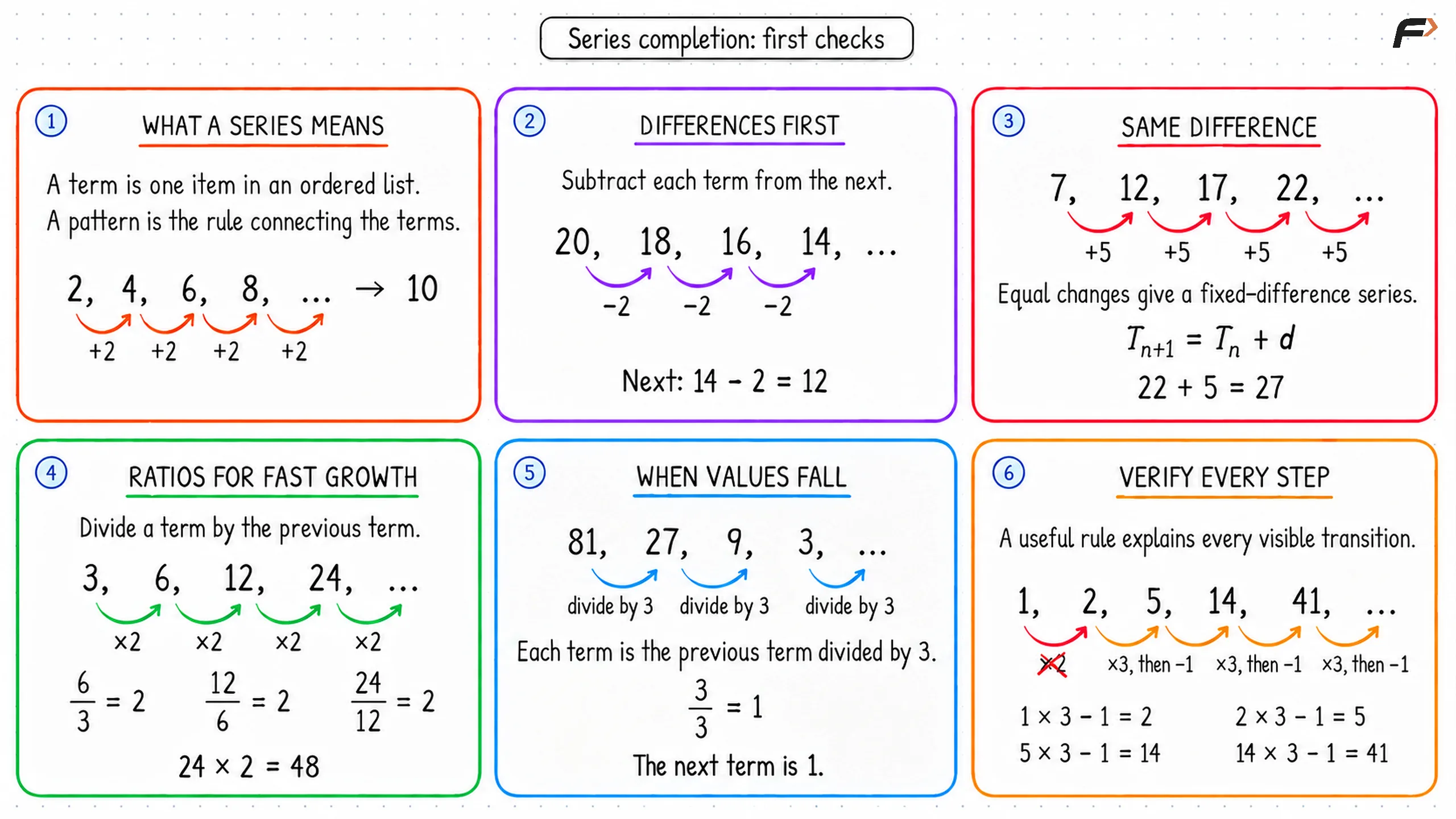
Series completion first checks for differences and ratios
Basics: Read the Terms Before Guessing
Write the terms clearly and compare neighbouring terms. For a number series, first calculate the differences by subtracting the earlier term from the next term. If the series changes quickly, also test the ratio by dividing a term by the previous term.
For , the differences are . The negative sign matters. It says that 2 is being subtracted each time, so the next term is .
Do not accept a rule after one successful step. A rule is useful only when it explains all the visible transitions. For example, begins with , but multiplying by 2 fails at the next step. The rule is actually “multiply by 3, then subtract 1.”
Equal Addition, Subtraction, Multiplication and Division
The simplest series uses the same operation and the same value every time. Equal addition or subtraction produces equal differences. Equal multiplication or division produces equal ratios.
| What you see | Rule to test | Example |
|---|---|---|
| Same difference | add or subtract a fixed value | |
| Same ratio | multiply or divide by a fixed value | |
| Values shrink quickly | test division |
Equal differences
Example: Find the missing term in .
The increases are , and . Because every change is the same, this is a fixed-difference series. Continue the same change from the last term: . The missing term is 27.
Equal ratios
Example: Find the next term in .
Each term is twice the preceding term: , and . Continue the same multiplication: . The next term is 48.
When the terms fall, division may be clearer. In , each term is the previous term divided by 3. Therefore the next term is .
When the Differences Change
A changing first difference does not mean there is no pattern. Write the differences as a new sequence and inspect them. This is often called looking at the second level of the series.
Example: Find the next term in .
The differences are . The terms do not add one fixed value, but the amounts being added rise by 1 each time. After adding 3, 4 and 5, add 6 next. Therefore , so the missing term is 20.
The same idea can use odd differences. The series has differences . Those are consecutive odd numbers, but the more useful recognition is that the terms are squares: . The next term is .
Special Number Patterns
Some series are built from familiar number families. If equal differences and ratios do not work, rewrite each term in a useful form.
Squares, cubes and factorials
Perfect squares are numbers of the form : . Perfect cubes are numbers of the form : .
Example: In , write the terms as . The next base is 5, so the next term is .
A factorial is the product of all positive integers from a number down to 1. For example, . The series is , so its next term is .
Fibonacci-type rules
In a Fibonacci sequence, each term is the sum of the preceding two terms. The standard opening is because , and .
Some series modify this idea. In , each new term is the previous two terms plus 1. Check it before continuing: and . The next term is .
Repeating Operations and Alternating Positions
Not every series uses one operation throughout. Read the operations in order.
Example: Find the next term in .
The operations are . The pattern is a two-step cycle. Since the last step was multiplication, the next step is , giving .
Another common structure alternates between two separate series. In , the odd-position terms are , while the even-position terms are . The missing seventh term belongs to the first group, so it is 8.
Alphabet Series
Convert every letter to its position in the alphabet: , , through . Then use the same checks as for number series.
Example: Find the missing letter in .
The positions are . Their jumps are , so the next jump is . The next position is , and the 21st letter is U.
Alphabet series can move backward. In , the positions are . Subtract 2 again to get position 18, which is R.
Wrapping after Z
If a move passes 26, continue from the beginning. In , the jumps are . The next prime-number jump is , giving . Since , the answer is E.
Treat the alphabet as a loop only when the earlier terms clearly establish a forward pattern. Do not wrap merely to make a preferred option fit.
Mixed and Grouped Series
When a term has two or more parts, separate them before looking for a rule. A letter-number term may contain one pattern for the letters and another for the numbers.
Example: Find the next term in .
The letters move , which is positions each time. The numbers are , which double each time. These are separate patterns, so solve them separately. After G comes I when we move forward 2 positions, and after 16 comes . Combining the results gives I32.
The same method works for groups. In , compare letters in the same place. The first letters are A, B, C; the second letters are C, D, E; and the third letters are E, F, G. The next group is DFH.
Common Mistakes
- Stopping after one match. Check every available transition before trusting a rule.
- Treating a changing difference as failure. Inspect the differences themselves.
- Mixing the parts of a mixed term. Separate letters, numbers and positions first.
- Forgetting that an alphabet series can move backward or wrap after Z.
- Calling a pattern random before testing squares, cubes, factorials, Fibonacci rules, alternating positions and operation cycles.
- Choosing the most complicated possible rule. Prefer the simplest rule that explains every term without exceptions.
Formulas and Cheat Sheet
| Situation | Rule | Condition |
|---|---|---|
| Equal difference | The same appears between every pair | |
| Equal ratio | The same non-zero ratio applies | |
| Increasing differences | Find first | The differences form their own pattern |
| Square sequence | Terms are consecutive perfect squares | |
| Cube sequence | Terms are consecutive perfect cubes | |
| Factorials | The terms match | |
| Fibonacci | Each term equals the previous two-term sum | |
| Alphabet position | Convert letters before comparing changes | |
| Alphabet wrap | use when | The established pattern moves past Z |
Safe Shortcuts
- Check differences before anything else when the terms are close together. It is the fastest valid first test for addition and subtraction patterns.
- Check ratios when values double, halve, grow rapidly or shrink rapidly. This is safe only when the same multiplier or divisor works for every pair.
- Recognise as squares and as cubes only after confirming consecutive bases.
- Split alternate positions when the changes repeat in an up-down rhythm, such as . This is safe when both position groups have clear independent rules.
- Split a mixed term into parts before combining an answer. This is safe when each part has enough terms to verify its own pattern.
Shortcuts should shorten correct reasoning, not replace checking the condition that makes them valid.
FAQs
What should I check first in a series completion question?
Start with differences between neighbouring terms. If they are not fixed, test the differences as a new series, then test ratios, special number families and alternating positions.
How do I solve alphabet series questions?
Write the alphabet positions of the letters and solve the resulting number pattern. Convert the final position back to a letter, taking care to wrap after 26 only when the pattern requires it.
How can I identify a mixed series quickly?
Separate the letter, number or group positions. Solve each small sequence independently, then join the answers in the original order.
Can a series have more than one valid pattern?
With too few terms, many artificial rules can be invented. In aptitude tests, use the simplest rule that explains every visible term and matches the answer choices without adding an unexplained exception.
Summary
Series completion begins with careful comparison, not guessing. Test equal differences and ratios, inspect changing differences, recognise special families and separate mixed or alternating patterns. A final check of every transition is what turns a possible pattern into a reliable answer.