Partnership: Complete Beginner Guide with Examples
A partnership is a business run by two or more people called partners. The money a partner puts into the business is called capital or investment. After some time, the business may make a profit or face a loss. We need to know how to share that profit or loss fairly.
Suppose A puts in ₹3,000 and B puts in ₹2,000 for the same length of time. A has put in more money, so A gets a larger share. Their sharing ratio is .
Money alone is enough only when the time is equal. When partners invest for different lengths of time, both money and time matter. We will begin with simple ratios. Then we will learn what happens when a partner joins late, leaves early, changes the money, gets extra pay for working, or shares a loss.
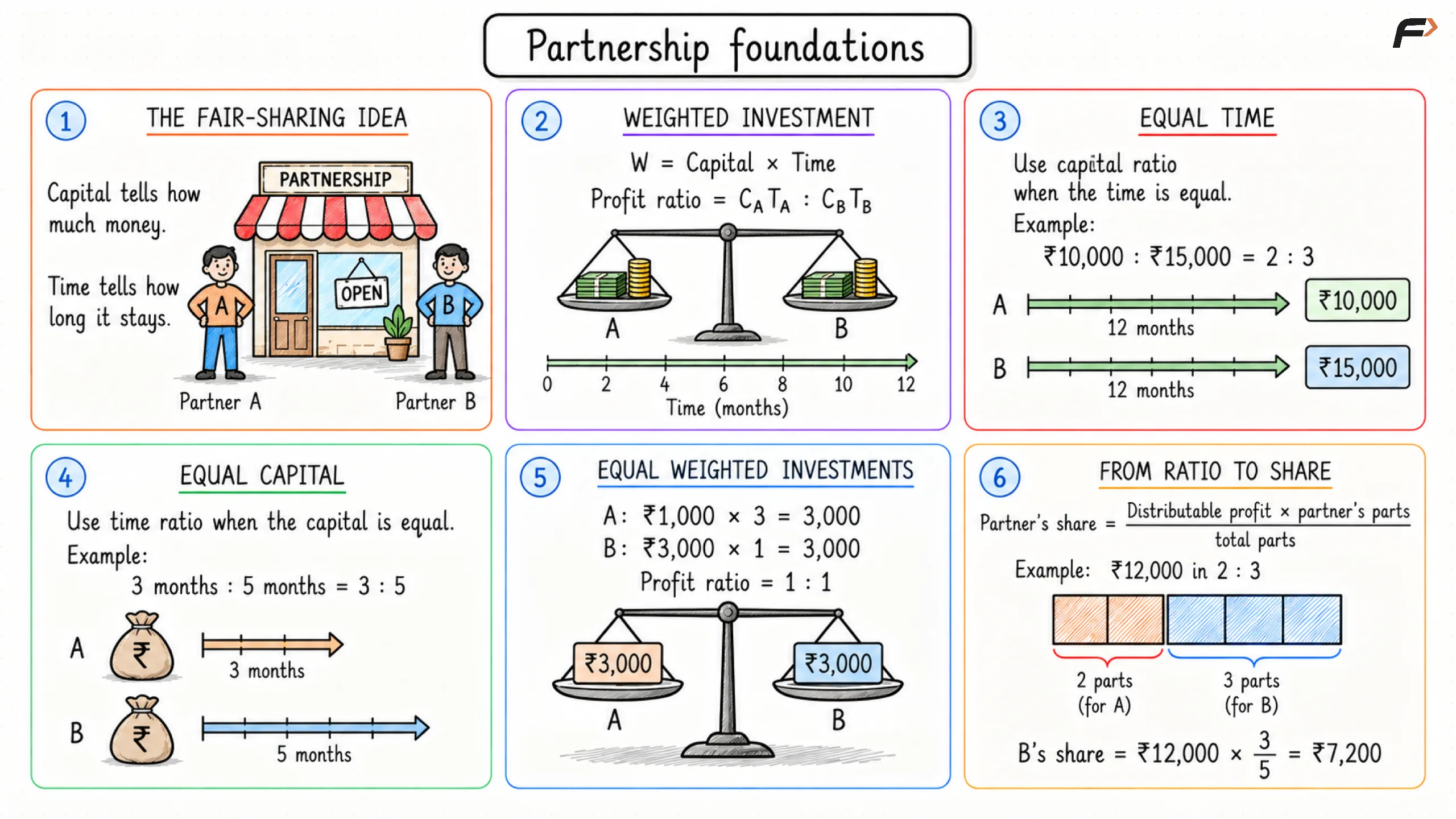
Partnership foundations: capital, time, weighted investment and profit sharing
Basics: The Words Used in Partnership
Before using a formula, it helps to know what each amount means.
- Capital or investment is the money placed in the business.
- Profit is the extra money the business makes after paying its costs.
- Loss is the money the business loses.
- Profit-sharing ratio tells us how many equal parts each partner gets.
- Investment time is the time for which a partner's money stays in the business.
- Working partner is a partner who puts in money and also helps run the business.
- Sleeping partner is a partner who puts in money but does not help run the business every day.
- Salary is a set payment for work done.
- Commission is an extra payment, often given as a percentage of the profit.
- Reserve is money kept in the business for later use.
- Donation is money given away, such as money given to charity.
- Distributable profit is the money left after taking out a salary, commission, reserve, donation or any other given amount.
The words annual profit mean profit for one year. One year has 12 months. If all the times are given in months, keep them in months. There is no need to change them into years.
Ratio Parts: The Small Idea Behind Every Share
A ratio such as means that the first partner gets 2 equal parts and the second partner gets 3 equal parts. Together they have:
The ratio does not mean the first person gets ₹2 and the second gets ₹3. It only compares the sizes of their shares. The money value of one part depends on the total money being shared.
If a total amount is divided in the ratio , then:
Example: A and B share a profit of ₹12,000 in the ratio . Find B's share.
What we know: A has 2 ratio parts, B has 3 ratio parts, and the total profit is ₹12,000.
What we are finding: We need the money value of B's 3 parts.
Why we use this idea: The sharing ratio is already known. We only need to divide the total into the given number of equal parts.
Slow solution: First count all the parts:
B gets 3 of these 5 parts. So:
Divide before multiplying because it keeps the numbers small:
Now take 3 such parts:
Meaning of the answer: B gets ₹7,200. The ₹4,800 left goes to A.
Weighted Investment: Why Capital and Time Both Matter
Capital tells us how much money a partner puts into the business. Time tells us how many months that money stays there. We use both because money that stays for more months helps the business for more months.
Suppose A puts ₹1,000 into a business for 3 months. In the first month, the business can use A's ₹1,000. The same ₹1,000 is still there in the second month and the third month. So we can add A's money once for every month:
Adding ₹1,000 three times is the same as multiplying ₹1,000 by 3:
This answer, 3,000 rupee-months, is called A's weighted investment. It is not a new amount of money that A paid. It is only a number used to compare A's money and time with another partner's money and time.
Now suppose B puts ₹3,000 into the same business for only 1 month. B's weighted investment is:
A and B both have a weighted investment of 3,000 rupee-months. A used less money for more time. B used more money for less time. These two differences balance each other, so A and B get equal profit shares.
This is why weighted investment is found by multiplying capital and time:
After finding the weighted investment of each partner, put those values in a ratio. For partners A and B:
Here, and show the capital put in by A and B. The letters and show the number of months for which their capital stays in the business.
The unit of weighted investment is rupee-months when capital is in rupees and time is in months. We do not usually write this unit in the final ratio because the same unit appears for every partner. The important rule is that all partners' time values must use the same unit.
Same Time: Profit Ratio Equals Capital Ratio
When all partners invest for the same time, the same time number appears on both sides of the ratio. We can remove that common number:
This is why equal time lets us use the investment ratio directly.
Example: A invests ₹10,000 and B invests ₹15,000 for the same time. Find their profit-sharing ratio.
What we know: The money amounts are ₹10,000 and ₹15,000. The time is the same for both.
What we are finding: We need the ratio in which the profit should be divided.
Why we use this idea: The same time multiplies both capitals, so it does not change their ratio.
Slow solution: Begin with the capital ratio:
We can divide both numbers by 5,000:
So:
Meaning of the answer: Out of every 5 equal profit parts, A gets 2 and B gets 3.
Equal Capital: Profit Ratio Equals Time Ratio
When the money amounts are equal, the same money number appears on both sides. We can remove that common number:
Example: A and B invest equal amounts. A's money stays for 3 months and B's money stays for 5 months. Find their profit ratio.
What we know: The money amounts are equal, but the times are 3 months and 5 months.
What we are finding: We need to compare their shares.
Why we use this idea: The same money helps the business equally in one month. The person whose money stays longer helps for more months.
Slow solution: Since the money is the same, use only the time ratio:
This ratio is already in simplest form.
Meaning of the answer: A gets 3 parts and B gets 5 parts because B's money stayed in the business for two more months.
Different Capital and Different Time
When both money and time are different, we cannot leave out either one. Multiply the money by the time for each partner. Then put those answers in a ratio and make the ratio smaller.
Example: A invests ₹4,000 for 6 months. B invests ₹3,000 for 8 months. Find their profit ratio.
What we know: A has more money but less time. B has less money but more time.
What we are finding: We need to compare the weighted investments of A and B.
Why we use this idea: The money ratio alone is not enough, and the time ratio alone is not enough. Multiplying money by time uses both pieces of information.
Slow solution: A's weighted investment is:
B's weighted investment is:
Their values are equal, so:
Meaning of the answer: B's extra time makes up for A's extra money. So both get equal profit shares.
Three or more partners
The same rule works for three or more partners. Multiply money by time for each person, and then put all the answers in one ratio.
Example: A invests ₹6,000 for 9 months, B invests ₹9,000 for 6 months, and C invests ₹3,000 for 12 months. Find their profit ratio.
What we know: We know how much money each person puts in and how long it stays.
What we are finding: We need one small and simple ratio for all three partners.
Why we use this idea: Each person's share depends on both the money and the time.
Slow solution: Find the weighted investment for each partner:
The first ratio is:
Divide every term by 18,000:
Meaning of the answer: A and B get equal shares. C gets 2 parts for every 3 parts that A or B gets.
Turning a Profit Ratio into Actual Money
After finding the ratio, add all its parts. To find one partner's money, multiply the distributable profit by that partner's parts, and divide by the total parts.
For partners with ratio and profit left to share:
Example: A, B and C share ₹18,000 in the ratio . Find C's share.
What we know: C has 4 parts. The total amount being shared is ₹18,000.
What we are finding: We need the value of C's 4 parts.
Why we use this idea: The sharing ratio is already known, so we do not need to multiply money by time again.
Slow solution: Add the parts:
One part is:
C has 4 parts:
Meaning of the answer: C gets ₹8,000 from the total profit.
Finding a Missing Share from One Known Share
Sometimes the total profit is not needed. If one partner's actual share and ratio part are known, find the value of one part first.
Example: A and B share profit in the ratio . B receives ₹9,000. Find A's share.
What we know: B's 3 parts are worth ₹9,000. A owns 2 parts.
What we are finding: We need the money value of A's 2 parts.
Why we use this idea: Every ratio part has the same value. A known share tells us that common value.
Slow solution: Find one part from B's share:
Now find A's 2 parts:
Meaning of the answer: A gets ₹6,000. Together, A and B get ₹15,000.
Finding the Total Profit from a Known Share
If a partner's share is known, first find one ratio part and then multiply by the total number of parts.
Example: A and B share profit in the ratio . A receives ₹3,500. Find the total profit.
What we know: A's 5 parts equal ₹3,500. Together A and B have 9 parts.
What we are finding: We need the value of all 9 parts.
Why we use this idea: The known share fixes the value of one part.
Slow solution: Divide A's money by A's parts:
Count all parts:
Now find the total:
Meaning of the answer: The total profit is ₹6,300. A gets ₹3,500 and B gets ₹2,800.
Using the Difference Between Two Shares
A given difference between two shares matches the difference between their ratio parts. This lets us find one part without finding both shares first.
Example: A and B invest for equal time in the ratio . B's profit is ₹3,000 more than A's. Find the total profit.
What we know: A has 5 parts, B has 7 parts, and B's extra 2 parts are worth ₹3,000.
What we are finding: We need the value of all 12 parts.
Why we use this idea: The money difference matches the ratio-part difference.
Slow solution: Find the difference in parts:
These 2 parts equal ₹3,000, so one part equals:
The total number of parts is:
So:
Meaning of the answer: The total profit is ₹18,000. A gets ₹7,500 and B gets ₹10,500. Their difference is the given ₹3,000.
A Partner Who Joins After the Business Starts
A one-year business has 12 months. A person who joins late keeps the money in the business only for the months that are left:
The phrase “joins after 3 months” means the first 3 months have already passed, so the investment remains for 9 months.
Example: A starts with ₹9,000. B joins after 3 months with ₹18,000. The profit for the year is ₹20,000. Find B's share.
What we know: A invests for all 12 months. B enters after 3 months, so B invests for months.
What we are finding: We need B's part of the profit for the year.
Why we use this idea: The money and time are different, so we must multiply money by time.
Slow solution: Find the weighted investment for both partners:
Make the ratio smaller:
B has 3 of the total 5 parts:
Meaning of the answer: B gets ₹12,000. B joined later, but B put in much more money, so B still gets the larger share.
A Partner Who Withdraws or Leaves Early
When a partner takes all the money out before the end, count only the months when the money was in the business. “Withdraws after 8 months” means the money stayed for 8 months.
Example: A invests ₹8,000 for a full year. B invests ₹12,000 but withdraws after 8 months. The profit is ₹14,000. Find B's share.
What we know: A's time is 12 months and B's time is 8 months.
What we are finding: We need B's share after using both money and time.
Why we use this idea: B's larger capital did not stay for the full year.
Slow solution: Find both weighted investments:
The values are equal, so the ratio is . B gets half:
Meaning of the answer: B gets ₹7,000 because both weighted investments are the same.
When a Partner Changes the Capital
If the money changes during the year, one multiplication cannot cover the whole year. Break the year into smaller time blocks. In each block, the money must stay the same. Multiply money by time for every block, and then add the answers.
For one partner:
Money added increases the capital from that point onward. Money withdrawn decreases it from that point onward.
Example: A starts with ₹6,000 and adds ₹2,000 after 6 months. B keeps ₹8,000 invested for the full year. Find the profit ratio.
What we know: A has ₹6,000 for the first 6 months and ₹8,000 for the next 6 months. B has ₹8,000 for all 12 months.
What we are finding: We need the total weighted investment for each partner.
Why we use this idea: A's capital changes halfway through the year, so the two time blocks must be counted separately.
Slow solution: For A's first 6 months:
After adding ₹2,000, A's capital becomes ₹8,000. For the next 6 months:
Add A's two weighted investments:
B's weighted investment is:
Make the ratio and reduce it:
Meaning of the answer: A gets 7 parts and B gets 8 parts because B kept the larger money amount in the business for more months.
Finding an Unknown Capital
When the profit ratio and time are known, call the missing capital . Make a capital × time ratio and solve the ratio equation.
Example: A invests ₹15,000 for 12 months. B invests rupees for 8 months. Their profit ratio is . Find B's capital.
What we know: A's money and time are known. B's time is known. The profit ratio is also known.
What we are finding: We need the capital that makes the given ratio.
Why we use this idea: The profit ratio is the same as the capital × time ratio.
Slow solution: Write both weighted investments:
Match this with :
Cross multiplication gives:
Both sides contain 8, so cancel it:
Divide by 9:
Meaning of the answer: B must invest ₹20,000 for 8 months to have 8 profit parts against A's 9 parts.
Finding an Unknown Time
Equal profit shares mean equal weighted investments, even when the money amounts are different. We can use the same idea to find a missing time.
Example: A invests ₹14,000 for 12 months. B invests ₹21,000 for months. They receive equal profit shares. Find .
What we know: Equal shares give a ratio. A has less money but keeps it for the full year.
What we are finding: We need the time that makes B's weighted investment equal to A's.
Why we use this idea: Equal shares need equal weighted investments when there is no extra salary or commission.
Slow solution: Set the two weighted investments equal:
Multiply the numbers on the left:
Divide both sides by 21,000:
Meaning of the answer: B's larger capital needs only 8 months to equal A's smaller capital kept for 12 months.
Distributable Profit After Money Is Set Aside
Distributable profit means the profit that is left for the partners to share. Some money may first be kept as a reserve, paid as an office expense, or given as a donation. The order is important:
- Find the amount being set aside.
- Subtract it from the total profit.
- Divide only the profit that is left.
If is taken out of profit , the distributable profit is:
Example: A business earns ₹45,000. It donates 10% before A and B share the rest in the ratio . Find A's share.
What we know: The donation comes before ratio sharing. A has 3 of the 5 ratio parts.
What we are finding: We need A's part of the profit that remains after donation.
Why we use this idea: Money given away cannot be shared by the partners.
Slow solution: Find 10% of ₹45,000:
Subtract the donation:
Now divide ₹40,500 in the ratio . A receives:
Meaning of the answer: A gets ₹24,300. We use the ratio on ₹40,500, not on the first amount of ₹45,000.
Reserve and office expenses
A reserve is money kept in the business for use later. Office expenses are costs such as rent, bills or supplies. If either amount is taken out before sharing, subtract it first.
For example, if 15% of ₹14,000 is used for office expenses, 85% remains:
The ₹11,900 is the distributable profit. It is not yet the share of any one partner.
Loss Sharing and Insurance Recovery
Unless another rule is given, partners share a loss in the same ratio as profit. The same ratio tells us how much loss each person must pay.
Example: A and B share a loss of ₹9,000 in the ratio . Find B's loss.
What we know: B carries 5 parts out of a total of 12 parts.
What we are finding: We need B's part of the total loss.
Why we use this idea: The given ratio is the loss-sharing ratio.
Slow solution: Add the parts:
Take B's 5 parts:
Meaning of the answer: B pays ₹3,750 of the loss, while A pays ₹5,250.
Insurance recovery means money received from the insurance company after a loss. This money lowers the loss before the partners share it. If the loss is ₹18,000 and the insurance recovery is ₹6,000, the loss left is:
Only this ₹12,000 is shared in the loss ratio.
Working Partner Salary
A working partner may get a set salary for managing the business. “Salary before sharing” means we take the salary out of the total profit first. Then we divide the money left in the normal ratio.
A monthly salary must first be found for the full given time:
Example: A gets a salary of ₹3,000 from a total profit of ₹18,000. The profit left is shared by A and B in the ratio . Find the total money A gets.
What we know: A gets two amounts: the salary and A's ratio share from the profit left.
What we are finding: We need to add both amounts that A gets.
Why we use this idea: The salary is paid before sharing, so it must be removed before the ratio is used.
Slow solution: Subtract the salary from total profit:
A has 2 of the total 5 ratio parts:
Now add A's salary:
Meaning of the answer: A gets ₹9,000 in total. The ₹6,000 ratio share is only one part of A's money.
Monthly salary before sharing the yearly profit
If a working partner gets ₹2,000 per month for a full year, the salary is:
Take this full ₹24,000 out of the year's profit before sharing the money left. If we forget to multiply the monthly salary by 12, every step after it becomes wrong.
Working Partner Commission
Commission is often given as a percentage instead of a set amount. First find which money amount the percentage uses. If A gets “20% of the total profit as commission before sharing,” find 20% of the full profit first.
Example: A helps run a business and gets 20% of the total profit as commission. A and B invest ₹10,000 and ₹15,000 for equal time. The total profit is ₹30,000, and the money left is shared in their investment ratio. Find A's total income.
What we know: A gets commission first. The profit left is shared in the money ratio .
What we are finding: We need A's commission plus A's share from the money left.
Why we use this idea: Commission and ratio share are two separate parts of A's income.
Slow solution: Find 20% of the total profit:
Remove this commission:
A has 2 of the 5 investment-ratio parts:
Add both amounts:
Meaning of the answer: A gets ₹15,600 in total. This is ₹6,000 commission plus ₹9,600 from the distributable profit.
The words may instead say “commission on the profit left after commission.” That needs a different equation. Always check which amount is used to find the percentage.
One Example with Three Partners
Several ideas can come together. First find each person's time. Then multiply money by time, make the ratio smaller, and divide the distributable profit.
Example: A invests ₹8,000 from the beginning. B joins after 2 months with ₹12,000. C joins after 4 months with ₹16,000. The profit for the year is ₹43,000. Find C's share.
What we know: A invests for 12 months, B for months, and C for months.
What we are finding: We need C's share after forming the correct three-person ratio.
Why we use this idea: The partners join at different times. So using only their money would not be fair. We must multiply each person's money by that person's time.
Slow solution: Find each weighted investment:
Form the ratio and divide every term by 8,000:
The total number of parts is:
C has 16 parts:
Meaning of the answer: C gets ₹16,000. Here, each ratio part is worth ₹1,000.
Common Mistakes
Comparing only the capitals when time is different
Use only the money ratio when the times are equal. If someone joins late, leaves early or changes the money, multiply money by time.
Using “joins after” as the time invested
In a 12-month business, joining after 4 months gives months of investment. The number 4 is the waiting time, not the investment time.
Forgetting to split a changing capital
If ₹6,000 becomes ₹8,000 after 6 months, neither amount applies to the full year. Use .
Dividing the full profit before deductions
Salary, commission, reserve, charity and expenses may come before sharing. Take out the given amount first. Divide only the money left.
Forgetting to add a working partner's special payment back
After finding the partner's ratio share, add the salary or commission if we need the person's total money.
Applying commission to the wrong amount
“Percentage of total profit” and “percentage of profit left after commission” do not mean the same thing. Check which amount the percentage uses before doing any maths.
Adding time when capital should be multiplied by time
Capital × time means multiplication. Do not add ₹8,000 and 12 months. Money and time are different things, so that addition has no meaning.
Mixing months and years
Convert all periods to the same unit before making the ratio. For example, 1 year and 6 months should be written as 12 months and 6 months.
Using ratio parts as rupees
A ratio of means 5 equal parts, not ₹3 and ₹2. Find the value of one part from the total or a known share.
Forgetting to subtract insurance recovery
Recovered money reduces the loss. Subtract it first and share only the loss that remains.
Formulas and Cheat Sheet
| Situation | Formula or method | Condition |
|---|---|---|
| Weighted investment | Money stays the same for time | |
| Basic profit ratio | No special sharing rule changes the ratio | |
| Equal time | All partners invest for the same period | |
| Equal capital | All partners invest equal money | |
| Partner's share | is the distributable profit and is that partner's part | |
| Value of one part | One actual share is known | |
| Total from one share | The sharing ratio is known | |
| Using a share difference | The given money difference is between those two shares | |
| Joining after months | months | The total partnership period is one year |
| Money changes | Make a new time block whenever the money changes | |
| Percentage taken out | is taken from total profit | |
| Distributable profit after taking out | The percentage is taken out before sharing | |
| Loss after insurance recovery | Insurance recovery comes before loss sharing | |
| Total working salary | Salary rate and period unit must match | |
| Working partner's total | Extra pay comes before sharing the distributable profit | |
| Missing capital or time | Match to the given profit ratio | Use the same time unit on both sides |
Safe Shortcuts
Cancel equal time immediately: If every partner invests for the same period, use the capital ratio directly. This is safe only when no capital changes during that period.
Cancel equal capital immediately: If every partner invests the same amount, use the time ratio directly. The money amounts must truly be equal.
Use small capital numbers: If A's capital is twice B's, write their capitals as 2 and 1. There is no need to make up large rupee amounts. Then multiply these small numbers by their times.
Remove common zeros before multiplying: In , divide both ratio sides by 1,000 first. This is safe because dividing both sides of a ratio by the same nonzero number does not change the ratio.
Equal shares mean equal weighted investments: Set when two partners get equal shares. This is safe only when salary, commission or another extra payment is not part of those shares.
Use the part difference directly: For ratio and a share difference of ₹3,000, the 2-part difference is ₹3,000. This is safe only when the money difference is between those same two shares.
Use the percentage left: If 15% is taken out, 85% is left. Multiply by when only the money left is needed.
Make a time line for every capital change: Mark month 0, every joining, withdrawal or capital-change month, and month 12. This prevents a short period from being counted as a full year.
Shortcuts should make correct maths shorter. We must still check the time, the order in which money is taken out, and what the final amount means.
Frequently Asked Questions
What is the basic formula for partnership aptitude?
Profit or loss is usually shared in the ratio of capital multiplied by time. For A and B, the ratio is .
Why is time multiplied by capital?
Capital tells us how much money is in the business. Time tells us how long it stays there. Multiplying them uses both facts.
When can profit be divided only in the investment ratio?
Use only the investment ratio when every partner's capital stays in the business for the same length of time.
What does weighted investment mean?
Weighted investment means capital multiplied by time. Multiply a partner's money by the number of months for which that money stays in the business.
How is the time found when a partner joins late?
Subtract the months already passed from the full partnership period. In a one-year business, joining after 3 months gives 9 months of investment.
How is profit shared when capital changes during the year?
Break the year into time blocks where the money stays the same. Multiply money by time for each block. Add those answers for the partner, and then compare the totals.
Do partners share a loss in the same ratio as profit?
Usually yes, unless another loss-sharing rule is given. First subtract any insurance recovery. Then divide the loss that is left.
What is a working partner?
A working partner puts money into the business and also helps run it. This partner may get a salary or commission before the distributable profit is shared.
Is a working partner's salary included in the profit share?
Yes, when it is paid before sharing. Subtract the salary first and share the money left. Then add the working partner's ratio share to the salary.
How do I find total profit from one partner's share?
Divide the known share by that partner's ratio parts to find one part. Multiply one part by the sum of all ratio parts.
How do I find profit from the difference between two shares?
Subtract their ratio parts. Divide the money difference by that part difference, then multiply by the total number of parts.
Should partnership time be in months or years?
Either unit works if every period uses the same unit. Months are usually easier when partners join, leave or change capital during a year.
Summary
Partnership sharing begins with one simple idea: use both the money and the time. If the time is equal, compare only the money. If the money is equal, compare only the time. If either one is different, multiply money by time.
After finding the ratio, share only the money that is left. Take out salary, commission, reserve, charity, expenses or insurance recovery in the given order. Remember that a working partner's ratio share may be only one part of the total money that person gets.