Number System: Complete Beginner Guide with Easy Examples
The number system is the language we use to write, compare and work with numbers. It begins with very small ideas, such as digits and place value. Those small ideas then help us understand bigger ideas, such as factors, remainders, powers, HCF, LCM and trailing zeros.
Think about the number 347. The digit 3 means 300 because it is in the hundreds place. The same number is also 5 more than 342, which is a multiple of 9. Both facts come from the number system, but they describe the number in different ways.
We will begin with the meaning of a number. Then we will build each new idea from the ideas that came before it.
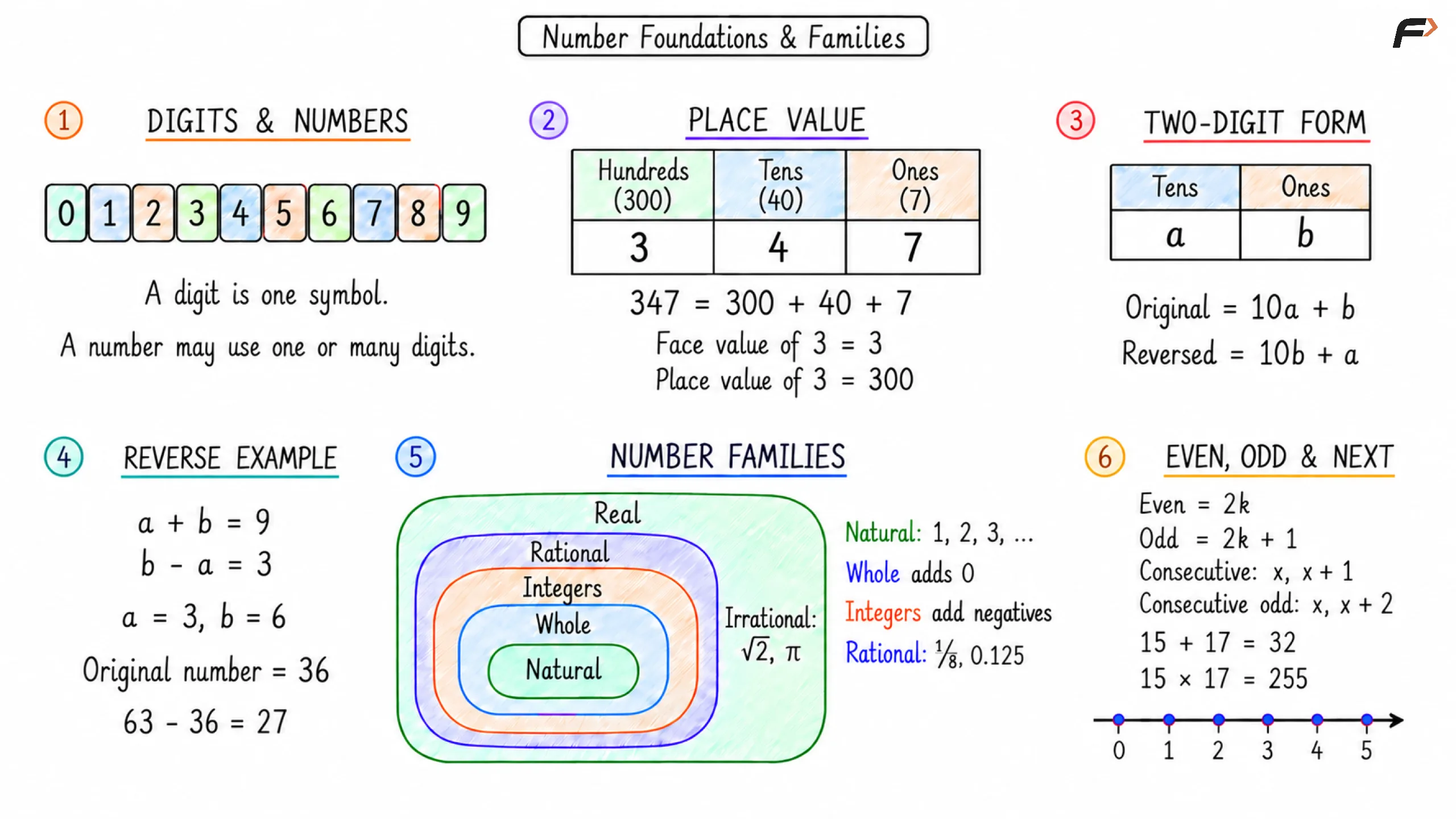
Number foundations, place value and number families
Basics: Digits, Numbers and Place Value
A digit is one symbol used to write numbers. The ten digits are:
A number may contain one digit or many digits. For example, 7 is a one-digit number, 36 is a two-digit number, and 2025 is a four-digit number.
The position of a digit gives it a place value. In 347:
- 3 is in the hundreds place, so its value is .
- 4 is in the tens place, so its value is .
- 7 is in the ones place, so its value is .
Therefore:
The digit itself is called its face value. The face value of 3 in 347 is 3, but its place value is 300.
Forming a two-digit number
If the tens digit is and the ones digit is , the number is:
This happens because tens means , and ones means . If the digits are reversed, the new number is .
Example: A two-digit number has digit sum 9. Reversing its digits makes it 27 greater. Find the original number.
What we know: Let the tens digit be and the ones digit be . Their sum is 9. The reversed number is 27 greater.
What we are finding: We need both digits and then the original number.
Why we use this idea: Place value lets us write the original number as and the reversed number as .
Slow solution: The digit sum gives:
The difference between the reversed number and the original number is 27:
Remove the brackets and collect like terms:
Divide every term by 9:
Now we have and . Add them:
So . Put this into :
So . The original number is:
Meaning of the answer: The number is 36. Its digits add to 9, and its reverse, 63, is 27 greater than 36.
Types of Numbers
Different names help us describe different groups of numbers.
Natural numbers are the counting numbers:
Whole numbers are the natural numbers together with zero:
Integers include negative whole numbers, zero and positive whole numbers:
A rational number can be written as , where and are integers and . Fractions, whole numbers and terminating decimals are rational numbers.
An irrational number cannot be written as an exact fraction of two integers. Its decimal digits continue without ending and without a repeating block. Examples include and .
A real number is any rational or irrational number that can be placed on the number line.
Even, odd and consecutive numbers
An even number is divisible by 2. It can be written as , where is an integer.
An odd number leaves remainder 1 when divided by 2. It can be written as .
Consecutive integers come one after another, such as 8, 9 and 10. If the first is , the next is .
Consecutive odd numbers have a gap of 2, such as 15 and 17. If the first is , the next is .
Example: Two consecutive odd numbers have sum 32. Find their product.
What we know: The numbers are odd and next to each other in the list of odd numbers.
What we are finding: We need the two numbers and then their product.
Why we use this idea: Consecutive odd numbers differ by 2, so they can be written as and .
Slow solution: Write their sum:
Combine the two terms:
Subtract 2 from both sides:
Divide by 2:
The next odd number is . Their product is:
Meaning of the answer: The numbers are 15 and 17, and multiplying them gives 255.
Fractions and Decimals
A fraction shows a part of a whole. In , the top number 3 is the numerator, and the bottom number 8 is the denominator. The denominator tells us that the whole is split into 8 equal parts. The numerator tells us that 3 parts are being used.
A decimal is another way to write parts of a whole. The first place after the decimal point shows tenths, the second shows hundredths, and the third shows thousandths.
To change a terminating decimal into a fraction, count the digits after the decimal point. Use 10, 100, 1000 and so on as the denominator, then simplify.
Example: Write 0.125 as a fraction in lowest terms.
What we know: There are three digits after the decimal point.
What we are finding: We need an equal fraction that cannot be reduced further.
Why we use this idea: Three decimal places mean thousandths, so 0.125 means 125 thousandths.
Slow solution: Write the decimal over 1000:
Both 125 and 1000 are divisible by 125:
Meaning of the answer: The decimal 0.125 and the fraction name the same amount.
Factors, Multiples, Prime Numbers and Composite Numbers
A factor or divisor of a number divides it exactly and leaves remainder 0. For example, 8 is a factor of 72 because .
A multiple is made by multiplying a number by a whole number. The positive multiples of 6 are:
These ideas are connected. If 6 is a factor of 24, then 24 is a multiple of 6.
A prime number is a whole number greater than 1 with exactly two positive factors: 1 and itself. Examples are 2, 3, 5, 7 and 11.
A composite number is a whole number greater than 1 with more than two positive factors. For example, 12 is composite because 1, 2, 3, 4, 6 and 12 all divide it.
The number 1 is neither prime nor composite. It has only one positive factor.
Checking whether a number is prime
To check whether is prime, we only need to test prime divisors up to . Factors come in pairs. If both factors were greater than , their product would be greater than . Therefore, a composite number must have at least one factor at or below its square root.
Example: Find the largest two-digit prime number.
What we know: The largest two-digit number is 99.
What we are finding: We need the first prime number found while moving down from 99.
Why we use this idea: Starting from the top prevents us from checking many smaller values.
Slow solution: The number 99 is divisible by 3 because . The number 98 is even, so it is divisible by 2. Now check 97.
The square root of 97 is a little less than 10. We only need to test the primes 2, 3, 5 and 7.
- 97 is not even, so 2 does not divide it.
- Its digit sum is 16, so 3 does not divide it.
- It does not end in 0 or 5, so 5 does not divide it.
- , so 7 does not divide 97.
No prime up to divides it. Therefore, 97 is prime.
Meaning of the answer: There is no larger two-digit prime because 98 and 99 are composite. The answer is 97.
Prime Factorisation
Prime factorisation means writing a number as a product of prime numbers. For example:
The small raised numbers are called exponents or powers. The exponent 3 in tells us that 2 appears three times as a factor.
Prime factorisation is useful because it shows the basic building blocks of a number. We will use it for the number of divisors, HCF, LCM, perfect squares, perfect cubes and trailing zeros.
Division Algorithm and Remainders
When one whole number is divided by another, we can write:
The remainder is always at least 0 and smaller than the divisor.
For example:
This tells us three things at once. The quotient is 38, the nearest lower multiple of 9 is 342, and 347 is 5 more than that multiple.
Example: By how much does 347 exceed the nearest lower multiple of 9?
What we know: We divide 347 by 9.
What we are finding: We need the extra part after the nearest lower multiple.
Why we use this idea: That extra part is exactly the remainder.
Slow solution: Divide 347 by 9:
The multiple is . The distance from 342 to 347 is:
Meaning of the answer: The number 347 is 5 above the nearest lower multiple of 9.
Least number to subtract
If leaves remainder when divided by , subtracting removes the extra part and reaches the lower multiple.
Example: Find the least number that must be subtracted from 458 to make it divisible by 13.
Slow solution: Divide 458 by 13:
The remainder 3 is the extra part. Subtract it:
Meaning of the answer: Subtracting 3 reaches the nearest lower multiple of 13.
Least number to add
If the remainder is not zero, the distance to the next multiple is .
Example: Find the least number that must be added to 123 to make it divisible by 8.
What we know: .
What we are finding: We need the remaining distance to the next multiple of 8.
Why we use this idea: Multiples of 8 are 8 steps apart. The remainder says 3 steps have already been covered after 120.
Slow solution: The full gap is 8 and the covered part is 3:
Check:
Meaning of the answer: Adding 5 reaches the next multiple, 128.
If the original remainder is 0, the number is already divisible. The least number to add is 0, not the divisor.
Divisibility Rules
A divisibility rule is a quick check that tells us whether one number divides another exactly.
- Divisible by 2: the last digit is 0, 2, 4, 6 or 8.
- Divisible by 3: the sum of the digits is divisible by 3.
- Divisible by 4: the number formed by the last two digits is divisible by 4.
- Divisible by 5: the last digit is 0 or 5.
- Divisible by 6: the number is divisible by both 2 and 3.
- Divisible by 8: the number formed by the last three digits is divisible by 8.
- Divisible by 9: the sum of the digits is divisible by 9.
- Divisible by 10: the last digit is 0.
- Divisible by 11: the difference between the sums of alternate digits is 0 or a multiple of 11.
Missing digit using the rule of 3
Example: Find the smallest digit that makes divisible by 3.
What we know: A number is divisible by 3 when its digit sum is divisible by 3.
What we are finding: We need a digit from 0 to 9.
Why we use this idea: The full number is not needed. Its digit sum gives the same divisibility result for 3.
Slow solution: Add the known digits:
The full digit sum is . Since 15 is already divisible by 3, can be 0, 3, 6 or 9. The smallest digit is 0.
Check the number 2508:
Meaning of the answer: The smallest possible digit is 0, and 2508 is divisible by 3.
Missing digit using the rule of 9
Example: Find the digit that makes divisible by 9.
Slow solution: The known digits add to . We need to be a multiple of 9. The next multiple of 9 is 9, so:
Check: , so 522 is divisible by 9.
Why the rule of 9 works
Every place value is a power of 10. When divided by 9, the number 10 leaves remainder 1. Therefore, , and all higher powers also behave like 1 for remainders after division by 9. Each digit then contributes only its own value.
Example: A 50-digit number is made by repeating the block 12. Find its remainder when divided by 9.
What we know: Each block has 2 digits, and the full number has 50 digits.
What we are finding: We need the remainder after division by 9.
Why we use this idea: A number and its digit sum leave the same remainder after division by 9.
Slow solution: The number of blocks is:
The digit sum of one block is . Therefore, the full digit sum is:
Now divide 75 by 9:
Meaning of the answer: The large 50-digit number leaves remainder 3 when divided by 9.
Counting Multiples in a Range
The number of positive multiples of from 1 to is the whole-number part of . The whole-number part is called the floor value and is written .
Example: How many positive multiples of 6 are there from 1 to 100?
What we know: Multiples are and so on.
What we are finding: We need the largest multiplier that keeps the result at or below 100.
Slow solution: Divide 100 by 6:
The last multiple inside the range is . Therefore, there are 16 positive multiples.
Meaning of the answer: The list begins at 6 and ends at 96, giving 16 numbers.
Multiples common to two numbers
A number divisible by both and must be a multiple of .
Example: How many integers from 100 to 200 are divisible by both 4 and 6?
What we know: The number must meet both divisibility conditions.
What we are finding: We need the count of common multiples in the range.
Why we use this idea: All common multiples of 4 and 6 are multiples of their LCM. Since , we only count multiples of 12.
Slow solution: The first multiple of 12 above 100 is 108. The last multiple of 12 below 200 is 192.
Write them as through . The number of integer multipliers is:
The extra counts both ends.
Meaning of the answer: There are 8 multiples of 12 from 108 to 192.
Smallest or Greatest Number with a Divisibility Condition
To find the smallest number of a given size that is divisible by , begin at the smallest number of that size and move to the next multiple of .
Example: Find the smallest three-digit number divisible by 7.
What we know: The smallest three-digit number is 100. Also, .
Why we use this idea: Consecutive multiples of 7 differ by exactly 7.
Slow solution: The multiple 98 is too small because it has only two digits. Add 7 to reach the next multiple:
Check: .
Meaning of the answer: The answer is 105. No multiple of 7 lies between 98 and 105.
Example: Find the least four-digit number divisible by 11.
Slow solution: The smallest four-digit number is 1000:
The distance to the next multiple is . Therefore:
Meaning of the answer: The least four-digit multiple of 11 is 1001.
Greatest number below a limit with a fixed remainder
A number that leaves remainder after division by has the form .
Example: Find the greatest number below 500 that leaves remainder 3 when divided by 7.
What we know: Such a number must look like .
Slow solution: The nearest multiple of 7 below 500 is 497, but would be 500, which is not below 500. Move to the previous multiple:
Add the required remainder:
Check: .
Meaning of the answer: The greatest valid number below 500 is 493.
HCF, LCM and Co-prime Numbers
The Highest Common Factor, or HCF, is the greatest positive number that divides all the given numbers exactly.
The Least Common Multiple, or LCM, is the smallest positive number that is a multiple of all the given numbers.
For 12 and 18, the common factors are 1, 2, 3 and 6, so the HCF is 6. Their common multiples begin 36, 72 and 108, so the LCM is 36.
Two numbers are co-prime numbers when their HCF is 1. They do not need to be prime themselves. For example, 8 and 9 are both composite, but they are co-prime because they share no prime factor.
For two positive integers and :
Ratio and HCF
If two numbers are in the ratio and are co-prime, the numbers can be written as and , where is their HCF.
Example: Two numbers are in the ratio , and their HCF is 6. Find their LCM.
What we know: The ratio parts 4 and 5 are co-prime, and the common HCF is 6.
What we are finding: We need the actual numbers and their LCM.
Why we use this idea: Because 4 and 5 share no factor, the full common part of the actual numbers is exactly 6.
Slow solution: Form the numbers:
Use the product relation:
Divide by 6:
Meaning of the answer: The two numbers are 24 and 30, and their smallest common multiple is 120.
Powers and Exponents
In , the number is the base and is the exponent. The exponent tells us how many copies of the base are multiplied:
For example, .
Some basic rules are:
Also, for every nonzero .
Example: Find .
Slow solution: Expand each power separately:
Now add:
Meaning of the answer: The value of the full expression is 59.
Unit Digit and Cyclicity
The unit digit is the last digit of a whole number. For a large power, we often do not need the full value. We only need the repeating pattern of last digits. This repeating behaviour is called cyclicity.
For powers of 7, the unit digits are:
The cycle length is 4. Divide the exponent by 4. A remainder of 1 means the first cycle value, 2 means the second, and so on. A remainder of 0 means the last value of the cycle.
Example: Find the unit digit of .
What we know: Only the unit digit of the base matters, so we use 3 instead of 13.
What we are finding: We need the last digit, not the full power.
Why we use this idea: Multiplication of the earlier digits cannot change the last-digit pattern created by the unit digit.
Slow solution: Powers of 3 have unit digits:
The cycle length is 4. Divide the exponent:
Remainder 3 points to the third value in the cycle, which is 7.
Meaning of the answer: The very large number ends in 7.
Example: Find the unit digit of .
Slow solution: Powers of 9 end in . The cycle length is 2. Since leaves remainder 0, use the last cycle value, 1.
Meaning of the answer: The unit digit is 1. A zero cycle remainder never means a made-up zero position. It means the final position in the cycle.
Modular Arithmetic and Residue
Modulo describes remainders. The statement:
means 17 and 2 leave the same remainder when divided by 5. The word residue simply means the remainder being discussed.
We can replace a number by its remainder before adding or multiplying. This keeps values small.
Example: Find the residue of modulo 7.
What we know: We need the remainder after division by 7.
Why we use this idea: The remainders of powers can repeat even when the powers themselves become large.
Slow solution: Find the first few remainders:
Multiplying by 2 begins the same pattern again, so the cycle is with length 3. Divide 10 by 3:
Remainder 1 points to the first cycle value, 2.
Meaning of the answer: The residue is 2, so leaves remainder 2 when divided by 7.
Using the form
If leaves remainder when divided by , then:
for some integer .
Example: A number leaves remainder 2 when divided by 5. Find the remainder of when divided by 5.
What we know: .
Why we use this idea: This form represents every number that leaves remainder 2, such as 2, 7, 12 and 17.
Slow solution: Substitute into the expression:
Now is divisible by 5, and . The remainder is 2.
Meaning of the answer: Every possible value of that meets the condition makes leave remainder 2.
Perfect Squares and Square Roots
A perfect square is made by multiplying an integer by itself. Examples are:
In the prime factorisation of a perfect square, every exponent is even. For example, .
A square root reverses squaring. Since , we have .
Example: Find the next perfect square greater than 150.
Slow solution: The square just below 150 is:
Move to the next integer and square it:
Since , the next perfect square is 169.
Meaning of the answer: No perfect square lies between 150 and 169.
Square root by the long division method
The long division method finds a square root one digit at a time.
Example: Find by long division.
What we know: We want the positive number whose square is 2025.
Why we use this idea: Pairing digits matches the way one new root digit affects two place values in the square.
Slow solution: Starting from the right, group the digits as .
Find the largest square not greater than 20. Since and , write 4 as the first root digit. Subtract:
Bring down the next pair 25, giving 425. Double the current root 4 to get 8. Now find a digit such that the two-digit number multiplied by is at most 425.
Try 5:
It fits exactly. Put 5 beside 4 in the root. The root is 45, and the new remainder is 0.
Meaning of the answer: because .
Perfect Cubes and the Smallest Multiplier
A perfect cube is made by multiplying an integer by itself three times. In its prime factorisation, every exponent is a multiple of 3.
For example:
To make a number a perfect cube, add only the prime factors needed to raise every exponent to the next multiple of 3.
Example: Find the smallest positive integer that must multiply 3675 to make a perfect cube.
What we know: Prime factorise 3675:
What we are finding: We need the smallest set of missing prime factors.
Why we use this idea: Every exponent in a perfect cube must be 0, 3, 6 and so on.
Slow solution: The exponent of 3 is 1, so it needs 2 more. The exponent of 5 is 2, so it needs 1 more. The exponent of 7 is 2, so it also needs 1 more.
The multiplier is:
After multiplication, the prime powers become , which is a perfect cube.
Meaning of the answer: The smallest multiplier is 315. Using fewer factors would leave at least one exponent outside a group of three.
Sum of the First Odd Natural Numbers
The sum of the first odd natural numbers is:
This works because each new odd number builds the next square. One dot makes . Adding 3 dots around it makes . Adding 5 more makes .
Example: Find the sum of the first 25 odd natural numbers.
Slow solution: Here , so:
Meaning of the answer: Adding the first 25 odd numbers gives the perfect square 625.
The Expression
The expression has a common factor of . Taking that common factor outside gives:
This says we are multiplying two consecutive integers: and the integer just before it. One of two consecutive integers is always even, so is always even when is an integer.
Example: Find when .
What we know: The value of is 18.
What we are finding: We need the value left after subtracting 18 from its square.
Why we use this idea: Factoring first changes the expression into the easier product of two nearby numbers.
Slow solution: Factor the expression:
Now put :
We can check by the longer route:
Meaning of the answer: Both methods give 306. The factored form also shows that the result is the product of 18 and 17.
Counting Positive Divisors
Suppose a number has prime factorisation:
Every positive divisor is made by choosing an exponent for each prime. For , we may choose , giving choices. Multiply the choices for all primes:
The symbol means the number of positive divisors of .
Example: Find the number of positive divisors of 72.
What we know: .
What we are finding: We need the number of different factors, not their sum.
Why we use this idea: A divisor can use 0, 1, 2 or 3 copies of 2, and 0, 1 or 2 copies of 3.
Slow solution: The power of 2 gives choices. The power of 3 gives choices. Combine every choice of 2 with every choice of 3:
Meaning of the answer: The number 72 has 12 positive divisors.
Finding an exponent from the divisor count
Example: The number has exactly 25 positive divisors. Find .
Slow solution: Apply the divisor-count rule:
Divide by 5:
Therefore, .
Meaning of the answer: The number is , and its divisor count is .
Smallest number with a fixed divisor count
Example: Let , where . If has exactly 15 divisors, find its smallest possible value.
What we know: .
Why we use this idea: The factor pairs of 15 give all possible exponent choices.
Slow solution: The factor pairs of 15 are and .
From , we get and .
From , we get and:
Both meet , but 144 is smaller.
Meaning of the answer: The smallest possible number is 144.
HCF, Product and Number of Possible Pairs
If two numbers have HCF , write them as and . After the full HCF is removed, and must be co-prime. If they shared another factor, the original HCF would be larger than .
Example: Two positive integers have HCF 6 and product 5040. How many unordered pairs are possible?
What we know: Write the numbers as and , with .
What we are finding: We need the number of pairs, where changing the order does not create a new pair.
Why we use this idea: Removing the HCF separates the shared part from the parts that must not share any prime factor.
Slow solution: Use the product:
Because and are co-prime, a complete prime-power block must stay together. The block cannot be split between them, or both would contain 2.
There are three blocks: , 5 and 7. Each block can go to or , giving ordered assignments. Swapping and gives the same unordered pair, so divide by 2:
The four co-prime factor pairs are , , and .
Meaning of the answer: There are 4 unordered pairs of original numbers after multiplying each value in a pair by 6.
Trailing Zeros
A trailing zero is a zero at the right end of a whole number, such as the two zeros in 4300.
One trailing zero comes from one factor of 10:
Therefore, the number of trailing zeros is the number of complete pairs of 2 and 5.
Example: Find the number of trailing zeros in .
What we know: There are 50 factors of 2 and 30 factors of 5.
Why we use this idea: Every zero needs one of each factor. Pairing stops when the smaller group is finished.
Slow solution: We can make only 30 complete pairs because there are only 30 factors of 5:
Meaning of the answer: The product ends with 30 zeros. The extra 20 factors of 2 do not make more zeros without matching factors of 5.
Trailing zeros in a factorial
The symbol , read as n factorial, means:
In a factorial there are more factors of 2 than factors of 5, so we count only the factors of 5:
The symbol means “how many factors of 5 are present.” Multiples of 5 give at least one factor of 5. Multiples of 25 give one extra factor, and multiples of 125 give another extra factor.
Example: Find the trailing zeros in .
What we know: Division removes prime factors, so subtract the counts in the denominator from the count in the numerator.
Slow solution: Count factors of 5 in :
Count factors of 5 in one :
There are two copies of in the denominator, so the remaining count is:
Meaning of the answer: No factor of 5 remains to pair with a factor of 2, so the value has 0 trailing zeros.
Successive Division
In successive division, the first quotient is divided again. The original number is not divided separately by both divisors.
Suppose is first divided by with remainder . If the quotient is , then:
If is then divided by with remainder , write:
Substitute the second line into the first:
Example: A number is successively divided by 5 and then 3. The remainders are 3 and 1. Find the remainder when the original number is divided by 15.
What we know: The first remainder belongs to the original number divided by 5. The second belongs to the first quotient divided by 3.
Why we use this idea: Writing both divisions prevents the two remainders from being mixed incorrectly.
Slow solution: Let the first quotient be :
Let the next quotient be :
Substitute:
Meaning of the answer: The original number is 8 more than a multiple of 15, so its remainder after division by 15 is 8.
Common Mistakes
Treating 1 as a prime number
Prime numbers have exactly two positive factors. The number 1 has only one factor, so it is neither prime nor composite.
Forgetting that zero is a digit
When a missing digit may be any digit, 0 is allowed unless putting it first would remove the required number of digits.
Using divisor minus remainder when the remainder is zero
If a number is already divisible, the least value to add or subtract is 0.
Taking position zero in a cycle
When an exponent leaves remainder 0 after division by the cycle length, use the last value in the cycle.
Splitting a prime-power block between co-prime parts
If and must be co-prime, a full block such as must go completely to one side.
Counting only one factor of 5 from multiples of 25
The number 25 contains two factors of 5. That is why the factorial formula also divides by 25, 125 and higher powers.
Mixing the two remainders in successive division
The second remainder belongs to the first quotient. Write both division equations before combining them.
Formulas and Cheat Sheet
| Concept | Formula or rule | Simple meaning |
|---|---|---|
| Two-digit number | is the tens digit and is the ones digit | |
| Reversed two-digit number | The digits exchange places | |
| Division Algorithm | , where | Number equals a multiple of the divisor plus the leftover |
| Least value to subtract | Remove the leftover | |
| Least value to add | when | Complete the gap to the next multiple |
| Multiples from 1 to | Count full groups of | |
| Multiples in | Count up to , then remove those below | |
| HCF and LCM | Product of two numbers equals product of HCF and LCM | |
| Ratio with co-prime parts | Numbers | is the HCF when are co-prime |
| Number of divisors | Add 1 to every prime exponent, then multiply | |
| Sum of first odd numbers | Odd numbers build a square | |
| Consecutive product form | Multiply by the integer just before it | |
| Same-base multiplication | Add exponents | |
| Same-base division | Subtract exponents | |
| Power of a power | Multiply exponents | |
| Fixed remainder form | is more than a multiple of | |
| Perfect square | All prime exponents are even | Prime factors can be grouped in pairs |
| Perfect cube | All prime exponents are multiples of 3 | Prime factors can be grouped in threes |
| Trailing zeros of | Count complete pairs of 2 and 5 | |
| Factors of 5 in | Count 5s, including extra 5s inside 25, 125 and so on | |
| Successive division | The second remainder belongs to the first quotient | |
| Co-prime pair count | unordered pairs | Use when a product has distinct prime-power blocks |
Safe Shortcuts
- To reach the next multiple of , divide once. If the remainder is , add .
- To reach the previous multiple, subtract the remainder.
- To count common multiples of two numbers, count multiples of their LCM.
- To test whether is prime, check only prime divisors up to .
- For divisibility by 3 or 9, use the digit sum instead of the full number.
- For a unit digit, keep only the last digit of the base and find its cycle.
- When the cycle remainder is 0, choose the last cycle value.
- For , the smaller exponent is the number of trailing zeros.
- For a perfect square, complete prime exponents to even numbers. For a perfect cube, complete them to multiples of 3.
- After removing the HCF from two numbers, check that the remaining parts are co-prime.
A shortcut is safe only when its condition is clear. It should make correct reasoning shorter, not replace the meaning of the concept.
Frequently Asked Questions
What is the number system in aptitude?
The number system is the study of digits, types of numbers, factors, multiples, divisibility, remainders, HCF, LCM, powers and other properties of numbers. These ideas help us understand how numbers are built and how they behave.
What is the difference between a factor and a multiple?
A factor divides a number exactly. A multiple is made by multiplying a number. For example, 4 is a factor of 20, while 20 is a multiple of 4.
Is 1 a prime number?
No. A prime number must have exactly two positive factors, 1 and itself. The number 1 has only one positive factor.
What is the easiest way to find a remainder?
Use the Division Algorithm . Find the largest multiple of the divisor that does not pass the number. The difference is the remainder.
How do I find the least number to add for divisibility?
Divide the number by the divisor. If the remainder is , add . If the remainder is already 0, add 0.
What is the difference between HCF and LCM?
HCF is the largest number that divides the given numbers. LCM is the smallest positive number that all the given numbers divide exactly.
Can two composite numbers be co-prime?
Yes. The numbers 8 and 9 are composite, but their HCF is 1, so they are co-prime.
Why do we add 1 to each exponent when counting divisors?
An exponent allows the choices . That list contains choices because choosing exponent 0 is also allowed.
What does residue mean in modular arithmetic?
Residue means remainder. Saying the residue of 17 modulo 5 is 2 means 17 leaves remainder 2 when divided by 5.
Why do unit digits repeat in a cycle?
There are only ten possible unit digits. Repeated multiplication must eventually return to an earlier unit digit. From that point, the same pattern repeats.
How are trailing zeros formed?
Each trailing zero needs a factor of 10, and . Count how many complete pairs of 2 and 5 are present.
What is the main difference between successive division and separate division?
In successive division, the quotient from the first division is divided again. In separate division, the original number is divided independently each time.
Summary
The number system begins with digits and place value. Place value explains why a two-digit number is . Factors divide exactly, while multiples are made by multiplication. Prime factorisation breaks a number into prime building blocks and supports many later ideas.
The Division Algorithm connects a number, its divisor, quotient and remainder. Divisibility rules make exact division easier to recognise. HCF shows the largest shared factor, while LCM shows the first shared multiple. Co-prime numbers have HCF 1.
Powers can create repeating unit-digit and remainder cycles. Perfect squares have even prime exponents, and perfect cubes have exponents in groups of three. Divisor counts come from the number of exponent choices. Trailing zeros come from pairs of 2 and 5. In successive division, always remember that the second division is performed on the first quotient.
The final cheat sheet gathers every main formula in one table. Use it for revision after the meaning of each idea is clear.