Mixture and Alligation: Complete Beginner Guide with Easy Examples
A mixture is made when two or more things are put together. Milk mixed with water, salt dissolved in water, two kinds of rice, and copper mixed with zinc are all mixtures.
Alligation is a quick method for finding the ratio in which two materials must be mixed to get a chosen average price or concentration.
The whole topic becomes easy when we keep track of two things:
- The total amount of the mixture
- The amount of the important part inside it
For a salt solution, the important part may be salt. For an alcohol solution, it may be alcohol. For a rice mixture, we track total money spent instead of a pure liquid.
We will begin with parts, percentages and pure content. Then we will build through weighted average, alligation, adding one material, removal and replacement, repeated replacement, vessel transfers, profit and loss.
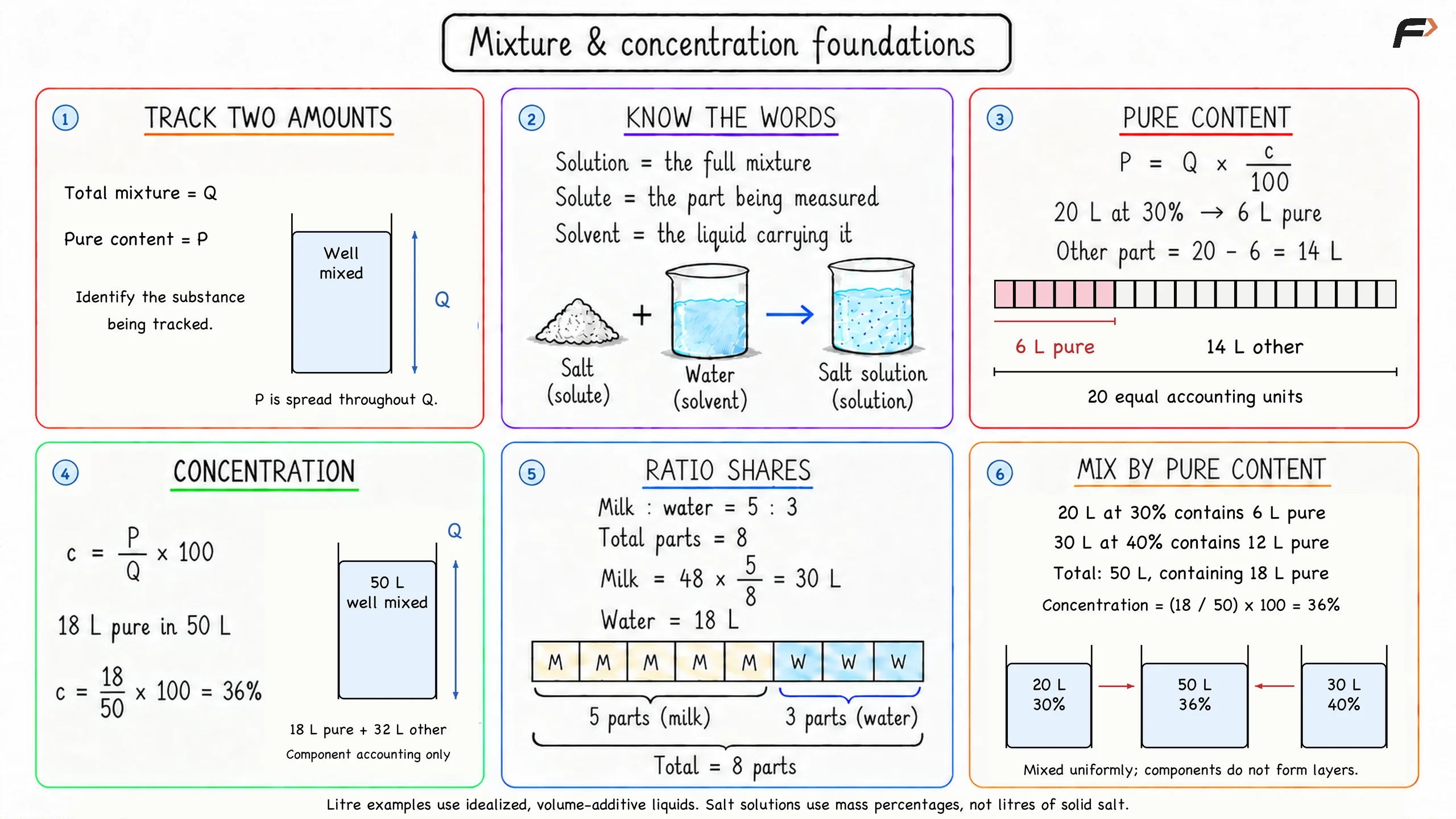
Mixture and concentration foundations
Basics: What Is Inside a Mixture?
Consider litres of a salt solution.
The full litres is the solution. Salt is the solute, which is the substance mixed into another substance. Water is the solvent, which is the liquid in which the salt is mixed.
In simple words:
- Solution means the full mixture.
- Solute means the part being measured, such as salt or acid.
- Solvent means the other liquid, often water.
The pure salt is:
The remaining part is water:
The word pure content means the actual amount of the substance we are tracking. In this example, the pure content is litres of salt.
Meaning of Concentration
Concentration tells us how much of the full mixture is the pure substance.
If litres of pure salt is present in litres of solution, then:
This does not mean there are litres of salt. It means that out of every equal parts of the mixture, parts are salt.
Turning a percentage into a fraction
It is often easier to think of a percentage as a fraction of the whole:
So a solution contains parts pure substance in every equal parts of solution.
Ratios Inside a Mixture
Suppose milk and water are in the ratio .
This does not mean there are exactly litres of milk and litres of water. It means that for every equal parts:
- parts are milk.
- parts are water.
The total number of parts is:
Therefore:
and:
Example: A -litre mixture contains milk and water in the ratio . Find the milk quantity.
What we know: The full mixture is litres. Milk has of the total parts.
What we are finding: The amount represented by the milk parts.
Why this method applies: A ratio divides the total into equal shares.
Slow solution:
- Add the ratio parts:
- Find the value of one part:
- Milk has parts:
Answer: litres
Meaning: The remaining litres is water, and reduces to .
Mixing Two Solutions by Pure Content
When two solutions are mixed, add their pure contents and add their total quantities.
Example: Mix litres of salt solution with litres of salt solution. Find the final concentration.
What we know: Both mixtures contain salt, but their quantities and strengths are different.
What we are finding: The fraction of salt in the combined litres.
Why this method applies: The salt from both containers remains present after mixing.
Slow solution:
- Salt in the first solution:
- Salt in the second solution:
- Add the pure salt:
- Add the full solution quantities:
- Find the final concentration:
Answer:
Meaning: Eighteen of the final fifty litres is salt.
Average Cost of a Mixture
When materials have prices per kilogram, the mixture's average cost is:
Equal quantities
If equal quantities are mixed, the average cost is the simple average of the two prices.
Example: Mix kg of rice at ₹40 per kg with kg at ₹60 per kg.
What we know: The two prices are different, but exactly the same quantity is taken at each price.
What we are finding: The cost represented by one kilogram of the combined kg mixture.
Why this method applies: Since both quantities are equal, the two prices affect the final cost equally. Neither price gets more weight than the other.
Slow solution: Think of the mixture as ten pairs. Each pair contains one kilogram costing ₹40 and one kilogram costing ₹60. Every pair costs ₹100 for kg, so one kilogram costs half of ₹100:
The quantities are equal, so each price has equal weight:
Answer: ₹50 per kg
Meaning: Half of the final mixture comes from the cheaper rice and half comes from the costlier rice. That is why the average sits exactly in the middle of ₹40 and ₹60.
Unequal quantities and weighted average
When quantities are different, a simple average is usually wrong. The larger quantity affects the final average more. This is called a weighted average.
Example: Mix kg of pulses at ₹70 per kg with kg at ₹95 per kg.
What we know: The first price applies to kg, while the second applies to only kg.
What we are finding: The total cost spread equally over all kilograms.
Why a simple average fails: The two prices do not have equal quantities behind them.
Why this method applies: Money spent on each variety is quantity multiplied by price per kilogram. Adding those costs gives the money spent on the full mixture.
Slow solution:
- Cost of the first type:
- Cost of the second type:
- Total cost:
- Total quantity:
- Average cost:
Answer: ₹80 per kg
Meaning: Each kilogram of the combined mixture has an average cost of ₹80.
The Weighted Average Formula
If units have value and units have value , then:
The value may mean price, concentration, marks or any other average quality.
The mean must lie between the two starting values when both quantities are positive. For example, mixing and solutions cannot produce . No amount of either solution is stronger than .
What Is Alligation?
Alligation is the reverse of weighted average.
- Weighted average starts with quantities and finds the mean.
- Alligation starts with the two values and the required mean, then finds the quantity ratio.
Suppose a weaker solution has concentration , a stronger solution has concentration , and the required mean concentration is , where:
Then:
The differences are written crosswise. The distance on the higher side becomes the quantity of the lower material, and the distance on the lower side becomes the quantity of the higher material.
Why Alligation Uses Cross Differences
This is easier to understand with balance.
Suppose we mix and solutions to obtain .
- Each litre of the solution is percentage points below the target.
- Each litre of the solution is percentage points above the target.
One litre of stronger solution creates an extra strength of points. To balance it, we need two litres of weaker solution, because each weaker litre is short by only points:
Therefore, the weaker-to-stronger ratio is .
This also explains an important rule:
The final mean stays closer to the value used in the larger quantity.
Since is closer to than to , we need more of the solution.
Alligation with Concentrations
Example: In what ratio should acid solution and acid solution be mixed to obtain solution?
What we know: is lower, is higher, and is the required mean.
What we are finding: Quantity of solution to quantity of solution.
Why alligation applies: Two known concentrations are being mixed to make a known concentration between them.
Slow solution:
- Find the higher-side difference:
This becomes the quantity part for the lower solution.
- Find the lower-side difference:
This becomes the quantity part for the higher solution.
- Write the ratio:
- Check the mean using litres and litre:
Answer:
Meaning: Use twice as much weaker solution as stronger solution.
Alligation with Prices
The same method works with cost per kilogram.
Example: Tea costs ₹120 per kg and ₹180 per kg. Find the ratio needed for a mixture costing ₹150 per kg.
What we know: ₹120 is the lower price, ₹180 is the higher price, and ₹150 is the required mean price.
What we are finding: The quantity of cheaper tea compared with the quantity of costlier tea.
Why this method applies: The target ₹150 lies between the two starting prices, so a positive mixture is possible. Alligation tells us how the two sides balance around that target.
Slow solution:
The cheaper tea is ₹30 below the target, while the costlier tea is ₹30 above it. One kilogram from each side balances the other because the gaps are equal.
Answer:
Meaning: ₹150 lies exactly halfway between ₹120 and ₹180, so equal quantities are needed.
Using the Alligation Ratio to Find Actual Quantities
Alligation first gives a ratio. If the total quantity is known, divide it according to that ratio.
Example: Coffee at ₹240 per kg and ₹320 per kg is mixed to make kg at ₹270 per kg. Find the cheaper coffee quantity.
What we know: The price difference gives the quantity ratio, and the total is kg.
What we are finding: The actual number of kilograms of the cheaper coffee, not only its ratio part.
Why this method applies: Alligation finds how the total must be shared. After the ratio is known, the total kg can be divided into those parts.
Slow solution:
- Apply alligation:
- Total ratio parts:
- The cheaper coffee has of the parts:
Answer: kg
Meaning: The mean ₹270 is closer to ₹240, so the cheaper coffee must have the larger quantity.
Finding an Unknown Strength
When one solution's concentration is unknown, use pure-content balance.
Example: Ten litres of an unknown solution is mixed with litres of solution. The final solution is . Find the unknown strength.
What we know: Pure content before mixing equals pure content after mixing.
What we are finding: The percentage in the first litres.
Why this method applies: Mixing does not create or destroy solute. Therefore, the pure content brought by both starting solutions must equal the pure content in the final solution.
Slow solution:
- Pure content from the unknown solution:
- Pure content from the solution:
- Final quantity:
- Pure content in the final mixture:
- Balance the pure content:
Answer:
Meaning: The unknown solution must be stronger than the final because the other solution is only .
Adding Water to Make a Solution Weaker
Water has of the pure substance. When water is added:
- Pure content stays the same.
- Total quantity increases.
- Concentration decreases.
Example: Forty litres of alcohol solution is diluted to . Find the water added.
What we know: The alcohol amount does not change.
What we are finding: The extra water needed to increase total volume enough for alcohol to become only of the mixture.
Why this method applies: Added water contains no alcohol. The numerator in the concentration fraction stays at litres, while only the denominator grows.
Slow solution:
- Initial alcohol:
- Let the final volume be . The same litres must be of :
- Solve:
- Water added:
Answer: litres
Meaning: The alcohol stays at litres, but it is now spread through litres instead of .
Evaporating Water to Make a Solution Stronger
When only water evaporates:
- Pure salt or acid stays the same.
- Total quantity decreases.
- Concentration increases.
Example: Sixty litres of salt solution becomes after water evaporates. Find the water lost.
What we know: Salt does not leave with the evaporating water, so all litres of salt stays in the container.
What we are finding: How much the total volume must fall for the unchanged salt to form of the solution.
Why this method applies: Evaporation removes solvent only. The same pure content in a smaller total produces a higher concentration.
Slow solution:
- Initial salt:
- Let final volume be :
- Solve:
- Water evaporated:
Answer: litres
Meaning: The same litres of salt remains in a smaller solution.
Adding Pure Substance to Make a Solution Stronger
A pure substance has strength. When it is added, both the pure content and total quantity increase by the added amount.
Example: Thirty litres of acid solution is changed to by adding pure acid. Find the pure acid added.
What we know: Initial acid is of litres.
What we are finding: The amount of acid that raises the final concentration to .
Why this method applies: Every litre added is a full litre of acid. Therefore, adding litres adds to both the acid amount and the total amount.
Slow solution:
- Initial acid:
Let pure acid added be litres.
Final acid is , and final total is .
Set the final fraction to :
- Solve:
Answer: litres
Meaning: Pure acid raises the acid amount and the total volume together.
Adding Another Solution of Known Strength
If the added liquid is not pure, only its stated percentage is pure content.
Example: Add acid solution to litres of solution to obtain . Find the amount added.
What we know: The added liquid is only acid, so each added litre brings litre of acid, not one full litre.
What we are finding: The quantity of the stronger solution that balances the existing weaker solution at .
Why this method applies: We can balance pure acid before and after mixing, or use alligation because the target lies between and .
Slow solution:
- Initial acid:
Let the added quantity be litres. It contributes litres of acid.
Final acid and final total are:
- Form the concentration equation:
- Solve:
Answer: litres
Meaning: The target lies exactly halfway between and . Equal quantities of the two solutions are therefore needed.
Check with alligation:
The existing quantity is litres, so the added quantity is also litres.
Adding One Component to Change a Ratio
When only one part is added, the other part stays fixed.
Example: A -litre milk-water mixture is in the ratio . How much milk must be added to make the ratio ?
What we know: The starting mixture has litres of milk and litres of water.
What we are finding: The extra milk required while the water remains fixed at litres.
Why this method applies: Only milk is entering the container. We add to the milk amount but make no change to water.
Slow solution:
- Initial milk:
- Initial water:
Let milk added be . Water remains litres.
Use the required ratio:
- Solve:
Answer: litres
Meaning: Only the milk side of the ratio changes.
Adding One Metal to an Alloy
An alloy is a mixture of metals. The same ratio method applies.
Example: A kg copper-zinc alloy has ratio . How much zinc must be added to make the ratio ?
What we know: The alloy initially contains fixed amounts of copper and zinc, and only zinc is added.
What we are finding: The added zinc needed to increase the zinc side from an effective parts to parts while copper stays unchanged.
Why this method applies: The actual copper-to-final-zinc ratio must equal . Copper is the unchanged anchor.
Slow solution:
- Copper:
- Zinc:
Let zinc added be . Copper remains kg.
Use the new ratio:
- Cross multiply:
Answer: kg
Meaning: Copper remains kg. Zinc rises from kg to kg, and simplifies to .
Mixing Two Existing Mixtures
Do not add ratios directly. Find the actual amount of each component in both mixtures, then add matching components.
Example: Mix litres of milk-water ratio with litres of ratio . Find the final ratio.
What we know: Both mixtures are litres, but their inside ratios point in opposite directions.
What we are finding: Total milk compared with total water after the two full mixtures are combined.
Why this method applies: Ratios cannot be added as bare numbers. They must first be turned into actual milk and water quantities.
Slow solution:
- First mixture contains:
- Second mixture contains:
- Combine matching parts:
- Final ratio:
Answer:
Meaning: The first mixture contributes litres more milk than water, while the second contributes litres more water than milk. These differences cancel.
The Key Rule in Removal
When a mixture is properly mixed, every small portion has the same concentration as the full mixture.
If a -litre mixture has milk and water in the ratio , then every removed portion also has milk and water in the ratio .
Removing litres does not mean removing litres of milk. It removes:
and:
This idea is the heart of replacement problems.
One Removal and Replacement with Water
Example: A -litre milk-water mixture has ratio . Ten litres is removed and replaced with water. Find the new ratio.
What we know: Before removal, every litres of mixture contains litres of milk and litre of water.
What we are finding: The amounts of milk and water left after mixed liquid leaves and pure water enters.
Why this method applies: The removed litres has the current composition. Replacement water adds only to water, so the two components must be tracked separately.
Slow solution:
- Initial milk and water:
- The removed litres has the same ratio:
- Amounts left after removal:
- Add litres of water:
- New ratio:
Answer:
Meaning: Milk falls from to litres. Water first falls from to litres, then rises to litres when replacement water is added.
Finding How Much Must Be Replaced
Example: A -litre mixture has milk and water in ratio . How much mixture must be removed and replaced with water to make the ratio ?
What we know: Initially, milk is litres and water is litres. The same unknown amount is removed and added back as water.
What we are finding: The replacement amount that leaves milk and water in the exact ratio .
Why this method applies: Removing litres removes milk and water in the old ratio. Adding litres back changes only the water amount.
Slow solution:
- Initial milk and water:
- Let litres be removed. Since milk fraction is :
and water removed is .
- Milk left:
- Water after removal and replacement:
- Use the new ratio:
- Cross multiply:
Multiply by :
Answer: litres
Meaning: Removing litres takes out litres of milk and litres of water. Adding litres of water leaves litres of milk and litres of water, which is .
Replacing a Weaker Solution with a Stronger Solution
When litres is removed and the same amount is added back, total volume stays fixed. Track pure content removed and pure content added.
Example: A -litre solution is acid. Some is replaced by acid solution, making the final strength . Find the amount replaced.
What we know: Every removed litre takes away litre of acid, while every replacement litre brings in litre of acid.
What we are finding: The equal removed-and-added amount that raises acid from litres to litres.
Why this method applies: Total volume stays litres. The only change is a net gain of litre of acid for each litre replaced.
Slow solution:
- Initial acid:
Let litres be replaced.
Acid removed:
- Acid added:
- Final acid:
- Required acid in litres:
- Equate:
Answer: litres
Meaning: Replacing litres removes litres of acid and adds litres. The net acid gain is litres, exactly what is needed.
Repeated Replacement
After the first replacement, the mixture becomes weaker. Therefore, the second removed portion contains less pure substance than the first removed portion.
This is why we cannot subtract the same pure amount every time.
If a container has volume , and litres is removed and replaced each time, then the fraction of the original substance left after one operation is:
After identical operations:
where is the original amount of that substance.
Repeated Replacement Step by Step
Example: A -litre can is full of milk. Sixteen litres is removed and replaced with water. The process is done twice. Find the milk left.
What we know: Each removal takes one-fourth of whatever milk is present at that time.
What we are finding: Milk left after the remaining fraction acts twice.
Why this method applies: The can is mixed before the second removal, so the second litres contains milk and water in the new proportion, not pure milk.
Slow solution:
First operation
The can begins with litres of milk. Remove litres:
Add litres of water. Total returns to litres.
Second operation
Milk fraction before the second removal is:
Milk inside the next litres removed:
Milk left:
Answer: litres
Meaning: The first operation leaves of the milk. The second operation leaves of that remainder, so the final milk is .
Formula check
Both methods match.
Repeated Replacement and Final Concentration
Example: A -litre solution is acid. Fifteen litres is removed and replaced with water twice. Find the final acid concentration.
What we know: Initial acid is litres, and each operation removes one-fifth of the well-mixed contents.
What we are finding: Acid left after two operations, then its percentage of the unchanged -litre total.
Why this method applies: Replacing with water adds no acid. Each operation keeps of the acid present immediately before it.
Slow solution:
- Initial acid:
- Fraction left after each operation:
- Acid left after two operations:
- Total volume remains litres:
Answer:
Meaning: Concentration falls by the same remaining factor in each operation: .
Different Replacement Amounts
If the removed amounts change, use a different remaining fraction for each step.
Example: A -litre tank is full of milk. First, litres is replaced with water. Then litres of the new mixture is replaced with water. Find milk left.
What we know: The tank returns to litres after each operation, but the two removed amounts are different.
What we are finding: The milk that survives both removals.
Why this method applies: The first operation keeps of the milk, while the second keeps of the milk present at that later time. Since the fractions differ, we multiply two different factors.
Slow solution:
Slow solution using remaining fractions:
- First remaining fraction:
- Second remaining fraction:
- Multiply the original milk by both fractions:
Answer: litres
Meaning: After the first operation, litres of milk remains. The second removal takes one-fourth of that litres, which is litres, leaving litres.
The powers formula is not used with one common fraction because the two removed amounts are different.
Evaporation Followed by Adding Water
Evaporating water is not the same as removing mixture. During evaporation, the pure salt stays completely inside.
Example: A -litre salt solution is salt. Twenty litres of water evaporates, then litres of water is added. Find the final concentration.
What we know: The salt does not evaporate, and the exact amount of water lost is later restored.
What we are finding: Whether the final salt fraction differs from the starting fraction.
Why this method applies: Neither step removes or adds salt. The final total also returns to litres, so both the pure content and final total match their starting values.
Slow solution:
- Initial salt:
Evaporation removes only water, so salt remains litres. Total falls to litres.
Add litres of water. Total returns to litres, and salt is still litres.
Final concentration:
Answer:
Meaning: The operation returns the mixture to its original state because only water left and the same water amount came back.
Transfer from One Vessel to Another
When liquid moves from one vessel to another, first find the pure content carried by the transferred portion.
Example: Vessel A has litres of alcohol. Vessel B has litres of alcohol. Ten litres from A is poured into B. Find B's new concentration.
What we know: Vessel B already contains alcohol, and the transferred portion from A brings more alcohol with it.
What we are finding: B's new pure-alcohol fraction after both its alcohol amount and total volume increase.
Why this method applies: The transferred litres keeps A's composition. We add the alcohol carried by it to B's existing alcohol.
Slow solution:
- Alcohol already in B:
- Alcohol carried by the litres from A:
- New alcohol in B:
- New volume in B:
- New concentration:
Answer:
Meaning: B receives litres of alcohol and litres of other liquid. Its alcohol becomes litres out of a new total of litres.
Transfer and Pour Back
After the first transfer, the receiving vessel's concentration changes. The liquid poured back has this new concentration, not the old one.
Example: Vessel A has litres of solution. Vessel B has litres of solution. Eight litres goes from A to B, then litres goes from B back to A. Find the final pure content in A.
What we know: The first transfer changes B from its original strength. The returning liquid must use B's new strength.
What we are finding: Pure content lost by A in the first transfer and partly returned in the second transfer.
Why this method applies: A transfer carries the current concentration of the source vessel. The source of the return trip is the newly mixed B, so we must recalculate B before pouring back.
Slow solution:
- Initial pure content:
- The first litres from A carries:
- After this transfer:
- B's new pure fraction is:
- The litres poured back carries:
- Final pure content in A:
Answer: Approximately litres
Meaning: A first loses litres of pure content. It then receives only litres back because B's new mixture is one-third pure.
Mixture Cost and Break-Even Price
Break-even means no profit and no loss. Selling price per kilogram must equal the mixture's average cost per kilogram.
Example: Mix kg at ₹100 per kg with kg at ₹140 per kg. Find the break-even price.
What we know: The trader pays two different prices for two different quantities.
What we are finding: The price per kilogram that recovers exactly the total money spent, with no extra gain and no loss.
Why this method applies: At break-even, total selling money must equal total cost. Dividing total cost by total kilograms gives the required price for each kilogram.
Slow solution:
The first kg costs ₹1,500. The second kg costs ₹3,500. These costs must both be recovered from the combined kg.
Answer: ₹125 per kg
Meaning: Selling all kg at ₹125 gives , exactly equal to the total cost.
Selling a Mixture at a Profit
First find the average cost per kilogram. Then apply profit to that average cost.
Example: Mix kg at ₹80 per kg with kg at ₹100 per kg. Find the selling price per kilogram for a profit.
What we know: The mixture has a weighted cost because more material is bought at ₹100 than at ₹80.
What we are finding: A selling price that first covers the average cost and then adds of that cost as profit.
Why this method applies: Profit percentage is calculated on cost price. Therefore, average cost must be found before profit is added.
Slow solution:
- Total cost:
- Total quantity:
- Average cost:
- Add profit:
Answer: ₹115 per kg
Meaning: Each kilogram costs ₹92 on average. A profit adds ₹23, giving ₹115 per kilogram.
Converting Selling Price to Cost Before Alligation
Alligation must compare like with like. If ingredient values are cost prices, the mean used in alligation must also be cost price.
Example: A mixture sells at ₹99 per kg with profit. It contains materials costing ₹70 and ₹100 per kg. Find their quantity ratio.
What we know: ₹99 is a selling price after profit, while ₹70 and ₹100 are ingredient cost prices.
What we are finding: The quantity ratio that creates the mixture's cost before the trader adds profit.
Why this method applies: Alligation can compare values only on the same basis. We must remove the profit from ₹99 before comparing it with the two cost prices.
Slow solution:
- Selling price is of cost price:
- Apply alligation to ₹70, ₹90 and ₹100:
Answer:
Meaning: The mixture cost ₹90 per kg before profit was added.
Loss of Quantity Before Selling
If some mixture is lost, the total cost does not disappear. The remaining quantity must recover the full required revenue.
Example: A grocer mixes kg rice at ₹80 per kg and kg at ₹120 per kg. Ten percent of the mixture is lost. Find the selling price of the remaining rice for a overall profit.
What we know: The grocer paid for all kg, but only kg remains available to earn money.
What we are finding: The revenue required for profit divided over the smaller saleable quantity.
Why this method applies: Losing rice does not refund its purchase cost. The remaining rice must recover the cost of the lost part as well as the desired profit.
Slow solution:
- Total cost:
- Revenue needed for profit:
- Original quantity:
- Ten percent loss:
- Quantity left to sell:
- Selling price per kilogram:
Answer: ₹128 per kg
Meaning: Selling kg at ₹128 produces ₹5,760, which is exactly of the original ₹4,800 cost.
Finding an Unknown Quantity from Selling Price
Example: Mix kg at ₹60 per kg with kg at ₹100 per kg. The mixture sells at ₹84 per kg with profit. Find .
What we know: The mean selling price contains profit, so the true mean cost is lower than ₹84.
What we are finding: The amount of costlier material that makes the weighted cost exactly ₹70 per kilogram.
Why this method applies: First remove profit to place all prices on a cost basis. Then either weighted average or alligation can connect the unknown quantity to the known kg.
Slow solution:
- Convert selling price to mean cost:
- Use weighted average:
- Cross multiply:
Answer: kg
Meaning: The cheaper and costlier quantities are . This larger share of ₹60 material keeps the mean much closer to ₹60 than to ₹100.
Alligation check
If ₹60 material is kg, the ₹100 material is kg.
Common Mistakes
Treating a ratio as actual litres or kilograms
A ratio means five equal parts, not automatically litres and litres.
Averaging prices when quantities are unequal
Use total cost divided by total quantity. A simple average works only for equal quantities.
Forgetting to track pure content
Always identify the important substance and calculate how much of it is really present.
Adding water and changing pure content
Water adds no salt, acid, alcohol or milk. Pure content stays unchanged during dilution.
Treating evaporation as removal of mixture
If only water evaporates, none of the non-evaporating pure substance leaves.
Removing pure substance instead of mixture
When litres of a solution is removed, pure content removed is , not .
Using the original concentration in every repeated removal
After each replacement, concentration changes. The next removed portion follows the new concentration.
Using one repeated-replacement fraction when removal amounts differ
Use a separate remaining fraction for every different removal amount.
Adding ratios from two mixtures
Convert each ratio to actual component quantities before combining mixtures.
Writing the alligation ratio in the wrong order
Lower quantity to higher quantity is . Label the order before simplifying.
Using alligation when the mean lies outside the two values
A positive mixture of two materials must have a mean between their values.
Applying alligation to selling price and ingredient cost price together
First convert the selling price to the mixture's cost price when profit or loss is involved.
Applying the second vessel's old concentration after a transfer
Once liquid enters a vessel, recalculate its new concentration before anything is poured back.
Ignoring lost quantity in selling-price work
Revenue must be earned from the quantity that remains available for sale.
Formulas and Cheat Sheet
| Concept | Formula or rule | Meaning |
|---|---|---|
| Pure content | is total quantity and is concentration | |
| Concentration | Pure content as a percentage of total | |
| Other component | When the mixture has two components | |
| Ratio share | First part of ratio | |
| Weighted average | Use for unequal quantities | |
| Alligation | Lower : Higher | |
| Adding water | Pure content stays fixed | Total quantity rises, concentration falls |
| Evaporating water | Pure content stays fixed | Total quantity falls, concentration rises |
| Adding pure substance | Added substance is pure | |
| Adding solution | Added amount is | |
| One replacement with water | Pure left | Volume returns to |
| equal replacements | Pure left | Mix fully before every removal |
| Different replacements | Pure left | Use one factor for each amount |
| Replace by | Final pure | Total volume stays fixed |
| Break-even price | Total cost / total quantity | No profit and no loss |
| Selling price at profit | Apply after finding mixture cost | |
| Cost from selling price | Needed before cost-based alligation | |
| Revenue after loss of quantity | Required revenue / saleable quantity | Full cost and profit must be recovered |
Safe Shortcuts
- Write total quantity and pure content at the top of every solution.
- Convert simple percentages to fractions when useful, such as and .
- For equal quantities, the mean is the simple average of the two values.
- Check that an alligation mean lies between the lower and higher values.
- In alligation, label “lower quantity” and “higher quantity” before writing cross differences.
- The final mean is closer to the value used in the larger quantity.
- Adding water keeps pure content fixed. Evaporating water also keeps non-evaporating pure content fixed.
- Removing mixture removes every component in the current mixture ratio.
- For equal repeated replacements, multiply by the same remaining fraction each time.
- For different replacement amounts, multiply separate remaining fractions.
- When total volume returns to its old value, final concentration can be found from final pure content divided by that fixed volume.
- Before using alligation with a profitable selling price, remove the profit and find mean cost price.
- After a transfer into another vessel, recalculate that vessel's concentration before a return transfer.
A shortcut is safe only when the physical action is clear. First decide whether the operation adds pure substance, adds water, removes mixture or evaporates only water.
Frequently Asked Questions
What is a mixture?
A mixture is formed when two or more materials are combined, such as milk and water, salt and water, two grains, or two metals.
What is concentration in mixture problems?
Concentration is the pure-content amount divided by total mixture amount, multiplied by .
What is pure content?
Pure content is the actual amount of the substance being tracked, such as salt in salt solution or alcohol in alcohol solution.
What is alligation?
Alligation is a quick way to find the ratio in which two values must be mixed to obtain a required mean value between them.
What is the alligation formula?
If is lower value, is higher value and is mean, then lower quantity to higher quantity is .
Why are differences taken crosswise in alligation?
The amount above the target must balance the amount below the target. A larger difference on one side needs more quantity from the other side.
Can the final concentration lie outside the two starting concentrations?
No, not when only positive quantities of those two solutions are mixed. The final concentration must lie between them.
When can I directly average two prices or concentrations?
Only when equal quantities are mixed. Otherwise, use weighted average.
What happens when water is added to a solution?
Pure content remains unchanged, total volume rises and concentration falls.
What happens when water evaporates?
The non-evaporating pure content remains unchanged, total volume falls and concentration rises.
Why does removed mixture have the same concentration?
Because a properly mixed solution has its components spread evenly. Every removed portion therefore has the same component fraction at that moment.
What is the repeated replacement formula?
If volume is , amount replaced each time is , original pure amount is , and the process occurs times, pure amount left is .
Can I use the repeated replacement formula when removal amounts differ?
Use a separate factor for each operation: and so on.
Is evaporation the same as removing solution?
No. Evaporation removes only the solvent, usually water. Removing solution takes out every component in the mixture's current ratio.
How do I mix two existing milk-water mixtures?
Find actual milk and water in each mixture, add the milk amounts, add the water amounts, then simplify the final ratio.
How is profit used in mixture questions?
First find the mixture's average cost. Then add the required profit percentage. If selling price is given, remove profit before using cost-based alligation.
What does break-even mean?
Break-even means no profit and no loss. Selling price per unit equals average cost per unit.
What should I do when liquid is transferred back between vessels?
Recalculate the receiving vessel's concentration after the first transfer. Use that new concentration for the amount poured back.
Summary
A mixture has a total quantity and a pure-content quantity. Concentration is pure content divided by total quantity. Ratios divide a total into parts, while weighted average finds the mean value when different quantities are combined.
Alligation reverses the weighted-average idea. It finds the quantity ratio needed to obtain a chosen mean. The cross differences work because the extra strength above the mean must balance the shortage below the mean.
Adding water and evaporating water keep the non-water pure content unchanged. Adding pure substance changes both pure content and total quantity. Removing mixture takes out every component in the current ratio. In repeated replacement, the mixture becomes different after each step, so each later removal follows the new concentration.
For price problems, first find average cost. Apply profit only after cost is known, and account for any mixture lost before selling. Careful tracking of total amount and pure content makes even advanced mixture and alligation cases manageable.