Logarithms: Complete Beginner Guide with Easy Examples
A logarithm tells us the power needed on a base to produce a number. In , the letter is the base, is the argument, which means the number inside the log, and is the answer or power. The main decision is simple: find the power to which the base must be raised.
For example, . This same fact can be written as . The logarithm does not create a new calculation. It gives another way to speak about the exponent 3.
We will begin with powers because every logarithm grows from them. Then we will learn the conditions that make a logarithm valid, build each log law from exponent rules, evaluate values, solve equations, compare logarithms, and handle inequalities carefully.
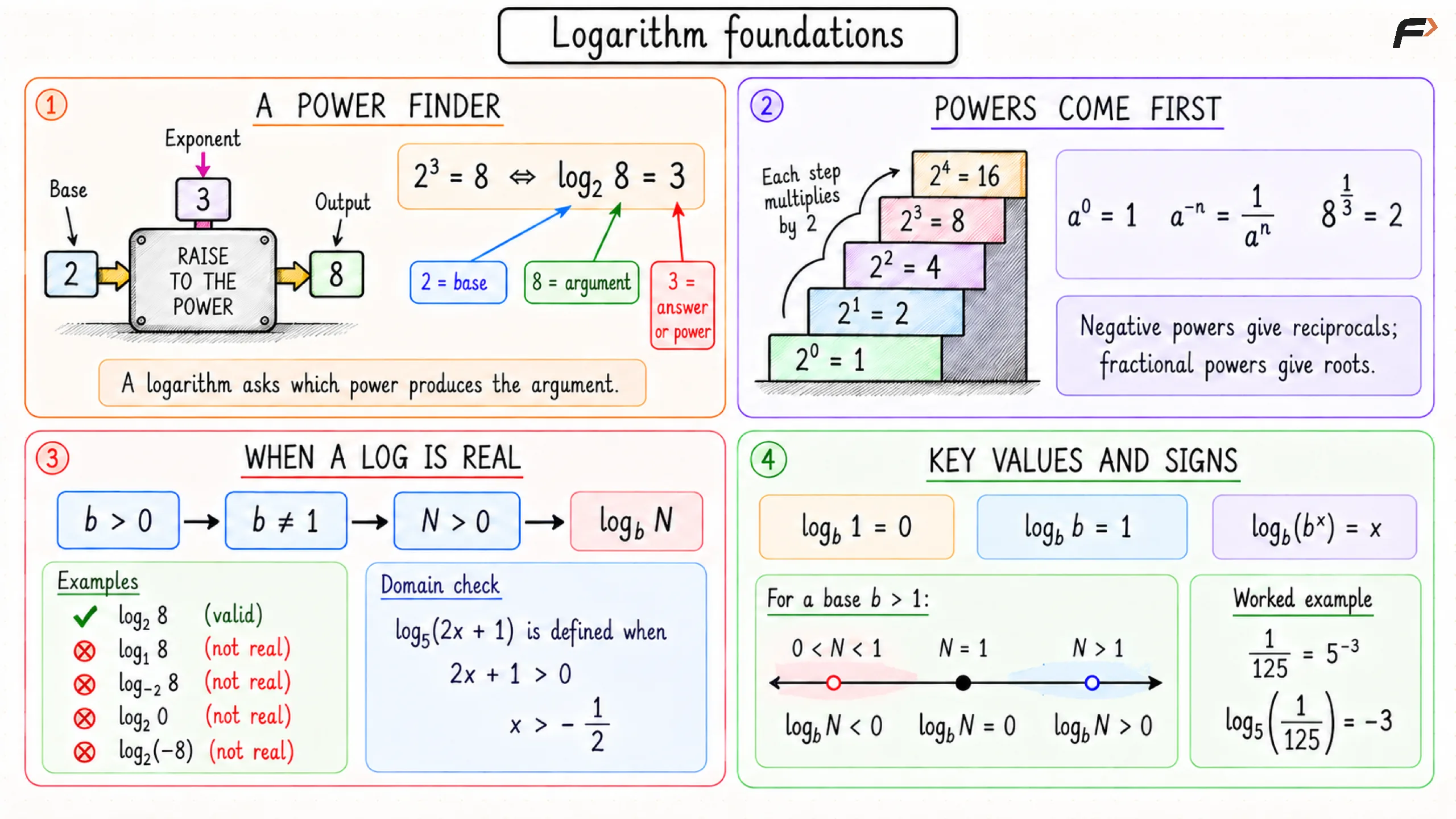
Logarithm foundations: powers, domain conditions and key values
Basics: Powers Come Before Logarithms
A power such as has two main parts. The number 3 is the base, and 4 is the exponent or power. It means that 3 is multiplied by itself four times:
The exponent tells us how many equal factors of the base are being multiplied. This idea is important because a logarithm works backward. If an exponential statement says, “the base and power produce this number,” a logarithmic statement asks, “which power produced this number?”
Some small powers are worth recognising:
| Exponential form | Value |
|---|---|
Zero, negative and fractional powers
For every nonzero number :
A negative power means a reciprocal:
For example, . A fractional power means a root. For example:
This is true because . Negative and fractional powers explain why logarithm answers can be negative or fractional.
What a Logarithm Really Means
The definition of a logarithm is:
The double arrow means that both statements say exactly the same thing. Read as “log base of .” It asks for the power on that gives .
Example: Find .
What we know: The base is 2 and the argument is 128.
What we are finding: We need the power on 2 that produces 128.
Why this method applies: A logarithm is an exponent written in another form. We can list powers of 2 until we reach the argument.
Slow solution: The powers grow as follows:
Continuing gives , , and . Therefore:
Meaning of the answer: The number 7 is the exponent needed on base 2 to make 128.
Moving between logarithmic and exponential form
The positions do not change randomly. In , the log base stays the base of the power, the log answer becomes the exponent, and the argument becomes the result:
Example: Find if .
What we know: The base is , the argument is 64, and the log value is 3.
What we are finding: We need the valid value of the base .
Why this method applies: Changing to exponential form places the unknown base in an ordinary power equation.
Slow solution: Keep each part in its correct place:
The cube of 4 is 64 because . Hence:
Meaning of the answer: Base 4 raised to power 3 gives 64, so the logarithmic statement is true.
Conditions for a Real Logarithm
Not every base and argument creates a real logarithm. For to be defined in real numbers, three conditions must hold:
The base must be positive because ordinary real powers of a negative base do not give a smooth, complete log function. The base cannot be 1 because is always 1, so it cannot produce different positive numbers. The argument must be positive because a positive base raised to any real power stays positive.
This means is valid, but , , , and are not real logarithms.
Example: Find all values of for which is defined.
What we know: The base 5 is already positive and is not 1. The argument is .
What we are finding: We need the values of that keep the argument positive.
Why this method applies: A logarithm can only take a positive argument. We therefore require the entire expression inside the log to be greater than zero.
Slow solution: Write and solve the condition:
Subtract 1 from both sides:
Divide both sides by positive 2. Because we divide by a positive number, the inequality sign does not change:
Meaning of the answer: Every number greater than makes positive, so the logarithm exists for exactly those values.
The Three Basic Logarithm Values
The definition immediately gives three useful facts.
First, every valid base raised to zero gives 1:
Second, every number raised to one stays the same:
Third, a logarithm and an exponential with the same valid base undo each other:
For example, , , and . These are not facts to memorise separately. Each one comes directly from asking what power on 7 gives the argument.
Positive, Zero and Negative Log Values
For a base greater than 1, the size of the argument gives a useful clue:
- If , then .
- If , then .
- If , then .
The last line follows from negative powers. A positive base greater than 1 needs a negative exponent to create a positive fraction smaller than 1.
Example: Find .
What we know: The base is 5 and .
What we are finding: We need the exponent on 5 that makes .
Why this method applies: The argument is the reciprocal of a power of the base. A reciprocal changes a positive exponent into a negative exponent.
Slow solution: Rewrite the argument using base 5:
The logarithm now reads:
Meaning of the answer: Raising 5 to gives , so the log value is .
Why Logarithm Laws Work
Logarithm laws are exponent laws written in a new language. Their base must be the same, valid base, and every argument involved must be positive.
Product law: addition outside means multiplication inside
The product law is:
To see why, suppose and . Then and . Multiplying gives:
So the power needed to make is . That is why the two logs add.
Example: Given and , find .
What we know: The available values are for 2 and 3. Here, a log written without a base means common logarithm, so its base is 10.
What we are finding: We need to rewrite 24 using factors whose log values are known.
Why this method applies: The product law can split the log of a product, and the power law can bring exponents in front.
Slow solution: Factor 24 using 2 and 3:
Now split the product:
Use the power law, which is explained below:
Substitute the known values:
Calculate each part before adding:
Therefore:
Meaning of the answer: Since is approximately 24, the common logarithm of 24 is approximately 1.3801.
Quotient law: division inside means subtraction outside
The quotient law is:
If and , then:
Division of equal bases subtracts exponents, so division inside a log becomes subtraction outside.
Example: Simplify in two ways.
What we know: Both 32 and 4 are powers of 2.
What we are finding: We want to see that direct division and the quotient law give the same result.
Why this method applies: The argument is a quotient and all values are positive.
Slow solution: Directly, , so:
Using the law:
Meaning of the answer: Both paths show that equals the quotient .
Power law: an exponent inside becomes a multiplier outside
The power law is:
If , then . The new exponent is , so the log value is multiplied by .
Example: Given and , find .
What we know: The number 72 can be made from powers of 2 and 3.
What we are finding: We need its common logarithm.
Why this method applies: Factoring lets us use the product and power laws with the known values.
Slow solution: Write 72 as:
Apply the product law and then the power law:
Substitute and calculate:
Meaning of the answer: The power 1.8572 on base 10 produces approximately 72.
What the log laws do not say
There is no law that splits a sum or difference inside a logarithm. In general:
For a quick check, , but , which is . Since 20 and 100 are different, the two sides cannot be equal.
Common Logarithms and Decimal Numbers
When no base is written, usually means . This is called the common logarithm. Because the base is 10:
Powers of 10 make decimal calculations easier. Moving the decimal point can be written as multiplication by a power of 10. For example:
Example: Given and , find .
What we know: The decimal can be written using 48 and a negative power of 10. Also, .
What we are finding: We need the common logarithm of a positive decimal smaller than 1.
Why this method applies: Rewriting the decimal as factors lets us use known log values. Since the number is between 0 and 1, we should expect a negative answer.
Slow solution: Rewrite the decimal:
Apply the product and power laws:
Since :
Calculate the positive part first:
Then subtract 3:
Meaning of the answer: A negative common log is sensible because a negative power of 10 gives a positive number smaller than 1.
Natural logarithm
The notation means logarithm with base , where is approximately 2.718. It is called the natural logarithm. The same product, quotient and power laws work for because they work for every valid log base. In many aptitude sets, common logs appear more often, but recognising prevents confusion.
Same Powers and Fractional Log Values
When the base and argument can both be written as powers of one smaller base, compare their exponents:
This works because . To equal , we need , so .
Example: Find .
What we know: Both 4 and 32 are powers of 2: and .
What we are finding: We need the exponent on 4 that gives 32.
Why this method applies: Writing both values with base 2 turns the statement into an equality of exponents.
Slow solution: Let . Then:
Replace both sides with powers of 2:
Using gives:
The bases are equal, so the exponents must be equal:
Meaning of the answer: Raising 4 to power gives 32.
Change of Base Formula
A calculator may have only log and ln keys, but a logarithm can have any valid base. The change of base formula rewrites it using a convenient base :
To understand it, let , so . Taking log base of both sides gives . Dividing by leaves the formula above.
Example: Compare and using common logs.
What we know: , , , and .
What we are finding: We need to decide which log value is larger.
Why this method applies: The two logarithms have different bases. Change of base writes both in the same common-log language, so their numerical values can be compared.
Slow solution: For the first value:
Substitute the known values:
For the second value:
Since :
Meaning of the answer: Base 2 needs a larger power to reach 9 than base 3 needs to reach 16.
Reversed Logs Are Reciprocals
Change of base gives:
Reversing the base and argument gives:
The numerator and denominator swap, so the values are reciprocals:
Therefore:
Example: Find .
What we know: The base and argument have swapped places. Also, .
What we are finding: We need the product of the two log values.
Why this method applies: Swapping the base and argument creates reciprocal values.
Slow solution: First:
For the reversed log, , so:
Multiply:
Meaning of the answer: One log measures the forward exponent and the other measures the exact reverse, so their product is 1.
Chain or Telescoping Products
A chain forms when the argument of one logarithm becomes the base of the next:
Using change of base shows why:
The middle is one factor in the numerator and one in the denominator, so it cancels. This repeated cancellation is called telescoping.
Example: Find .
What we know: The argument 16 becomes the next base, and then the argument 2 becomes the next base.
What we are finding: We need the value of the full product.
Why this method applies: The factors form an unbroken logarithm chain.
Slow solution: Join the first two links:
Join the remaining link:
We already know and , so:
Meaning of the answer: All middle links disappear, leaving only the first base 4 and the final argument 32.
Solving a Basic Logarithmic Equation
An equation such as becomes:
After solving the ordinary equation, put the answer back into the original argument. This last check makes sure the argument is positive and no invalid value has entered the work.
Example: Solve .
What we know: The base is 3, the argument is , and the log value is 4.
What we are finding: We need the value of that makes the statement true.
Why this method applies: There is one logarithm, so changing directly to exponential form removes it.
Slow solution: Convert the form:
Since :
Add 1 to both sides because this keeps the equation balanced:
Divide both sides by 2:
Check the argument:
Meaning of the answer: When , the argument is 81, and , so the original logarithm equals 4.
Logarithms of Algebraic Fractions
When the entire argument is a fraction, convert the logarithm to exponential form first. Then solve the fraction equation. The denominator cannot be zero, and the entire fraction must be positive.
Example: Solve
given that .
What we know: The full fraction is the log argument, and the condition keeps its denominator positive.
What we are finding: We need the value of .
Why this method applies: One logarithm equals a number, so exponential form turns the expression into an ordinary fraction equation.
Slow solution: Convert the log:
Because , the denominator is not zero. Multiply both sides by :
Open the bracket:
Subtract from both sides and add 4 to both sides:
The value 9 is greater than 2. The original argument is , which is positive.
Meaning of the answer: At , the logarithm becomes .
Combining Logs Before Solving
When logs with the same base are added, the product law can combine them:
Before combining them, write the domain conditions for each original argument. Combining does not remove those conditions.
Example: Solve
What we know: Both logarithms use base 2. Their arguments require and , so the stronger condition is .
What we are finding: We need every value of that satisfies both the equation and the domain.
Why this method applies: Equal bases and addition allow the product law.
Slow solution: Combine the logs:
Convert to exponential form:
Open the bracket and move everything to one side:
Factor the quadratic. We need two numbers whose product is and sum is . They are and 2:
So the algebra gives or . Now use the original domain . The value would put negative numbers inside the logs, so it is rejected. The valid answer is:
Meaning of the answer: With , the left side is .
When the quadratic does not factor neatly
The same method may produce a quadratic that needs the quadratic formula:
For example, combining gives , or . The exact roots are:
The domain requires , so only is valid. It is about 6.91. An approximation should never be replaced by an unrelated nearby whole number unless the instruction clearly asks for rounding.
Equal Logarithms with the Same Base
For a fixed valid base, one positive argument gives only one log value. Therefore:
This rule is safe only after checking that both and are positive.
Example: Solve .
What we know: The bases are the same and valid. The right argument is positive.
What we are finding: We need the value of that makes the arguments equal.
Why this method applies: Equal logarithms with the same base must come from equal positive arguments.
Slow solution: Equate the arguments:
Subtract 3 and divide by 2:
Check: .
Meaning of the answer: Both sides become , so is valid.
Comparing Logarithms Without Decimal Values
Sometimes nearby powers show the answer more clearly than a calculator. For a base greater than 1, larger positive arguments have larger log values.
For example, compare and . We know:
Also, and . Since powers of 4 increase as the exponent increases, the power needed to reach 20 must be greater than 2. Therefore:
This method is strongest when an argument sits close to an easy power of its base.
Example: Decide which is smaller: or .
What we know: because . Also, .
What we are finding: We need the smaller of the two powers.
Why this method applies: The value 7 is close to the known power , so we can compare without calculating a decimal.
Slow solution: Since and base 2 is greater than 1, the power on 2 needed to reach 7 is less than the power needed to reach 8:
But . Therefore:
Meaning of the answer: is the smaller value because it is a power slightly below 3.
Logarithm Inequalities and the Direction Rule
The base decides whether a logarithm rises or falls as its argument grows.
Case 1: The base is greater than 1
When , larger arguments give larger logarithms. The function is called increasing. Therefore:
The inequality direction stays the same, provided both arguments are positive.
Case 2: The base is between 0 and 1
When , larger arguments give smaller logarithms. The function is called decreasing. Therefore:
The direction reverses. For instance, powers of decrease: , , and . A larger exponent produces a smaller result.
Example: Solve
What we know: The base lies between 0 and 1. The argument must also satisfy .
What we are finding: We need all values of that make the logarithm positive.
Why this method applies: Zero can be written as because every valid base to power 0 is 1. Since the base is below 1, comparing the logs reverses the argument inequality.
Slow solution: Rewrite zero in logarithmic form:
So:
The base is between 0 and 1, so the argument direction reverses:
At the same time, the argument must remain positive:
Put the two conditions together:
Subtract 4 throughout:
Meaning of the answer: Only values between and make the argument lie between 0 and 1, which produces a positive log for base .
Common Mistakes
Using zero or a negative argument
and are not real values. Always check every original argument before accepting an algebraic answer.
Allowing base 1 or a negative base
A real logarithm base must satisfy and . When the base contains a variable, these conditions must be solved too.
Splitting a sum inside a log
The product law works for multiplication, not addition. Never change into .
Combining logs with different bases
cannot be joined using the product law because the bases differ. First use change of base if a common base is useful.
Forgetting the original domain after combining
In , both and must be positive. It is not enough for their product to be positive, because two negative factors would make a positive product but neither original log would exist.
Treating as a fraction of logs
The correct law is subtraction:
It is not . A ratio of logs belongs to the change of base formula and has a different meaning.
Forgetting to reverse an inequality for a base below 1
For , the log function decreases. The argument comparison reverses, and the positive-argument condition must still be included.
Rounding an exact value too early
Keep values such as exact until the final step. Early rounding can change a comparison or hide the correct answer.
Formulas and Cheat Sheet
| Idea or situation | Formula or rule | Condition |
|---|---|---|
| Log definition | , , | |
| Log of 1 | Valid base | |
| Log of its own base | Valid base | |
| Log and exponent undo each other | Valid base | |
| Product law | Same valid base; | |
| Quotient law | Same valid base; | |
| Power law | Valid base; | |
| Same smaller base | Bases and arguments must be valid | |
| Change of base | valid bases; | |
| Reversed logs | Both logs defined | |
| Reversed-log product | and neither is 1 | |
| Chain property | Every log defined | |
| Longer chain | Links must match exactly | |
| Equal same-base logs | and same valid base | |
| Base greater than 1 | and | |
| Base between 0 and 1 | and | |
| Common logarithm | ||
| Natural logarithm | ||
| Negative exponent |
Safe Shortcuts
Recognise an exact power first: If the argument is an exact power of the base, read the exponent directly. For example, because .
Use nearby powers for a quick range: For a base greater than 1, if , then . This is safe only when the base is greater than 1. For a base below 1, the order reverses.
Reverse pair gives 1: Replace with 1 only when the base and argument have swapped exactly and both logs are defined.
Collapse a complete chain: In , cancel the matching middle links to get . The order must form one unbroken chain.
Compare powers instead of using decimals: If both base and argument are powers of one smaller number, use . Do this only after the common power base is clear.
Factor before using given common-log values: If values such as and are known, factor the target into powers of 2 and 3. Use only multiplication, division and powers because log laws do not split sums.
Write the domain before doing algebra: For every variable argument, write “argument ” first. This small step quickly removes roots that look correct in algebra but are invalid in the original logarithm.
Shortcuts should shorten correct reasoning. They should never replace the definition, domain check or base condition.
Frequently Asked Questions
What is a logarithm in simple words?
A logarithm is a power finder. asks, “What power on gives ?” For example, because .
What are the three conditions of a logarithm?
For to be a real number, the base must be positive, the base must not be 1, and the argument must be positive. In symbols, , , and .
Why is the log of 1 always zero?
Every valid base raised to zero equals 1. Since a logarithm asks for the needed power, .
Why can a logarithm be negative?
A negative log value means the argument is made by a negative power of the base. For example, because .
What is the difference between log and ln?
log without a written base usually means base 10. ln means base , where . Their main laws are the same because both are logarithms with valid bases.
Can we take the logarithm of zero?
No. A positive base raised to a real power never becomes zero, so there is no real exponent that a logarithm could return.
Can we split the log of a sum?
No. There is no general rule for splitting . The familiar log laws apply to products, quotients and powers.
Why do logarithm answers sometimes need a domain check?
Algebra may produce values that make an original log argument zero or negative. Those values cannot be used in a real logarithm, so every final answer must be checked in the original expression.
When does a logarithm inequality reverse?
It reverses when the base lies between 0 and 1. Such a log function decreases as its argument grows. The argument must remain positive throughout the work.
How do I calculate a logarithm with an unusual base?
Use change of base: or . Use the same new base in both the numerator and denominator.
What does a telescoping logarithm product mean?
It is a chain such as . Matching middle values cancel after change of base, leaving .
Summary
A logarithm is another way to write an exponent. Begin by asking which power of the base gives the argument, and always check that the base is positive and not 1 and that every argument is positive.
The product, quotient and power laws come directly from exponent rules. Change of base explains reversed logs and telescoping chains. For equations, convert to exponential form or combine same-base logs, solve slowly, and check every result in the original expression. For inequalities, remember that bases greater than 1 keep the direction, while bases between 0 and 1 reverse it.