HCF and LCM: Complete Beginner Guide with Easy Examples
The Highest Common Factor, or HCF, is the greatest positive number that divides each given number exactly. The Least Common Multiple, or LCM, is the smallest positive number that is a multiple of each given number. HCF is also called the Greatest Common Divisor, or GCD.
For example, 6 divides both 18 and 30, and no larger number divides both exactly, so their HCF is 6. The first positive number that both 18 and 30 divide exactly is 90, so their LCM is 90.
To understand these ideas fully, we will begin with exact division, factors, multiples and prime numbers. We will then build through calculation methods, equal groups, repeating events, remainders, decimals, fractions and the relation between HCF and LCM.
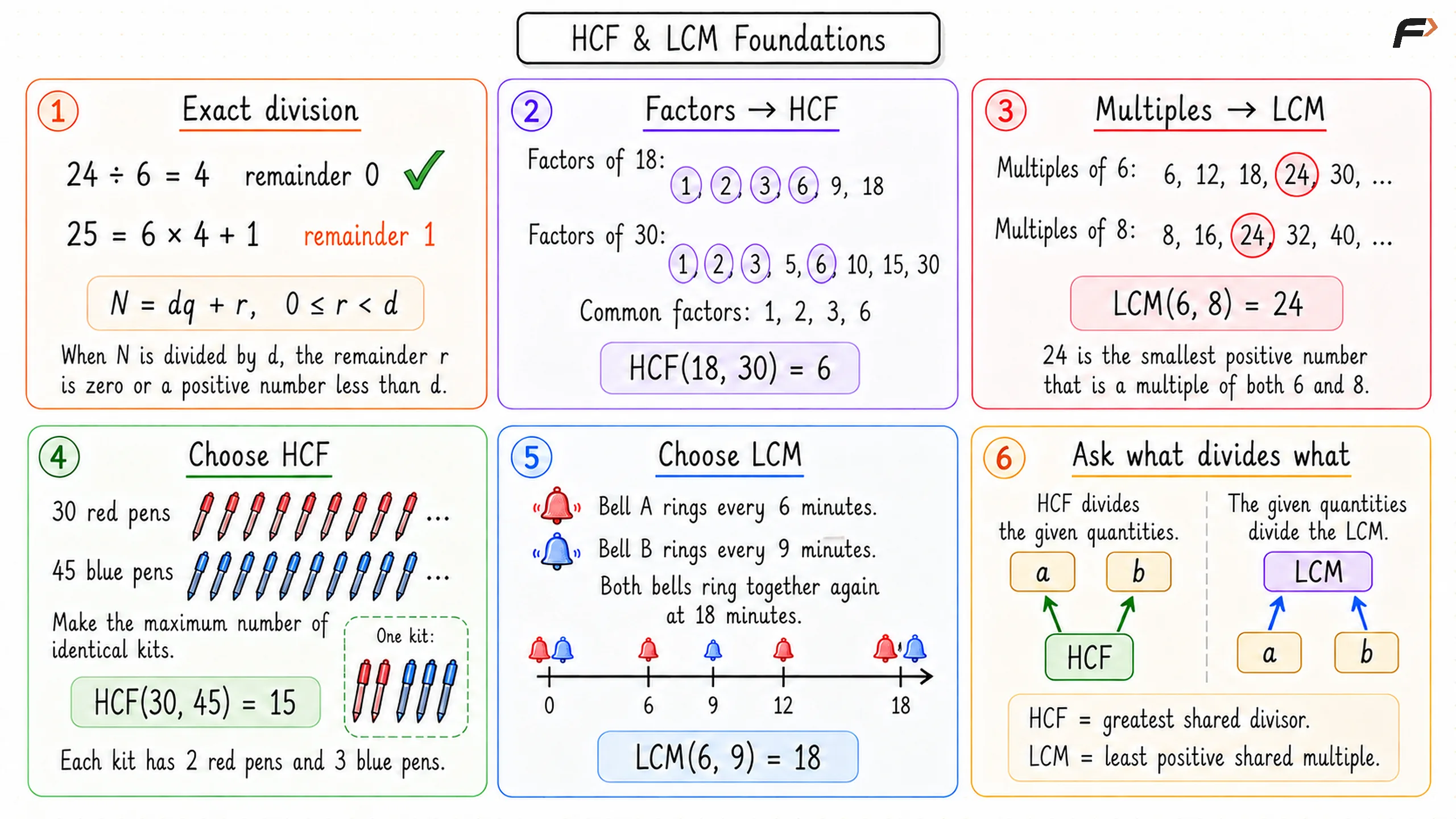
HCF and LCM foundations with factors, multiples and grouping
Basics: Exact Division and Remainders
A number is exactly divisible by another number when the division leaves remainder 0. For example:
This division is exact, so 6 divides 24. By contrast:
The remainder is not zero, so 6 does not divide 25 exactly.
Every whole-number division can be written using the Division Algorithm:
Here, is the number being divided, is the divisor, is the whole-number quotient and is the remainder. The remainder must satisfy .
For example:
This form will become important later when remainders are connected with HCF and LCM.
Factors and Common Factors
A factor of a number divides it exactly. The positive factors of 12 are:
Each value divides 12 without leaving anything over.
A common factor divides every number in a group. The factors of 18 are , while the factors of 30 are . Their common factors are:
The greatest value in this common list is 6. Therefore:
What the HCF means
The HCF is not only a number from a calculation. It tells us the greatest equal size or the maximum number of equal groups that can be made without leftovers.
If 30 red pens and 45 blue pens must be placed into the maximum number of identical groups, the number of groups must divide both 30 and 45. The greatest possible group count is therefore their HCF.
Example: Find the HCF of 24 and 36 by listing factors.
What we know: We need the greatest number that divides both values exactly.
What we are finding: We are looking for the largest common factor.
Why this method applies: The numbers are small enough for their factors to be listed without a long calculation.
Slow solution: List the positive factors of 24:
List the positive factors of 36:
The common factors are and 12. The greatest of these is 12.
Meaning of the answer: The HCF is 12. Any number larger than 12 fails to divide at least one of the two values.
Multiples and Common Multiples
A multiple is made by multiplying a number by a positive whole number. The positive multiples of 6 begin:
The positive multiples of 8 begin:
A common multiple appears in both lists. The first positive common multiple of 6 and 8 is 24. Therefore:
What the LCM means
The LCM tells us the first positive total that can be split exactly according to every given group size. It also tells us the first time that repeating cycles meet again.
If one bell rings every 6 minutes and another rings every 9 minutes, a common ringing time must be a multiple of both 6 and 9. The first positive common time is their LCM.
Example: Find the LCM of 4 and 10 by listing multiples.
What we know: We need the first positive value that both 4 and 10 divide exactly.
What we are finding: We are looking for the smallest common multiple.
Why this method applies: The values are small, so the repeating lists meet quickly.
Slow solution: Write a few multiples of 4:
Write a few multiples of 10:
The first positive value in both lists is 20.
Meaning of the answer: The LCM is 20. Both and are whole numbers.
Choosing Between HCF and LCM
HCF and LCM solve opposite kinds of grouping.
Use HCF when a fixed total must be broken into the greatest equal size or the maximum number of identical groups. The chosen value must divide the given quantities.
Use LCM when smaller repeating groups must build the least shared total or when cycles must meet again. The chosen value must be divisible by the given quantities.
The words “greatest” and “least” alone are not enough. First decide what must divide what.
Example: A container must measure both 252 litres and 396 litres exactly. Find the greatest possible container size.
What we know: One container size must divide both quantities without a partial container.
What we are finding: We need the greatest exact measuring size.
Why this method applies: The required size is a common factor of the two quantities. Because the greatest size is required, we use HCF.
Slow solution: Prime factorise both values:
The common prime powers are and :
Check the measurements:
Meaning of the answer: A 36-litre container measures each quantity exactly, and no larger container can do this for both.
Example: A shipment must be packed exactly in groups of 15, 20 or 24 items. Find the smallest possible shipment.
What we know: The shipment total must be divisible by every group size.
What we are finding: We need the smallest shared total.
Why this method applies: The total is a common multiple, so the smallest valid total is the LCM.
Slow solution: Prime factorise:
For the LCM, keep the highest power of each prime that appears: , and .
Meaning of the answer: A shipment of 120 items can be split into groups of 15, 20 or 24 with no leftovers.
Prime Numbers and Prime Factorisation
A prime number is a whole number greater than 1 with exactly two positive factors: 1 and itself. Examples are 2, 3, 5, 7 and 11.
Prime factorisation means writing a number as a product of primes. For example:
Prime factorisation shows how many copies of each prime are inside a number. This makes HCF and LCM easy to compare.
For HCF, use only the primes found in every number, and take the smallest shared exponent. For LCM, use every prime that appears, and take the largest exponent found in any number.
Example: Find the HCF and LCM of 24 and 36 by prime factorisation.
What we know: The same two prime factorisations can give both answers.
What we are finding: We need the greatest shared factor and the least shared multiple.
Why this method applies: Prime powers show exactly which building blocks are shared and how many copies are needed.
Slow solution: Write both numbers in prime-power form:
For the HCF, take the smaller exponent of each common prime:
For the LCM, take the larger exponent of each prime:
Meaning of the answer: The greatest common factor is 12, while the first positive common multiple is 72.
Division Method for LCM
The division method, sometimes called the ladder method, finds the LCM of several numbers together.
Write the numbers in one row. Divide by a prime that divides at least one number. A number that is not divisible by that prime stays unchanged. Continue until every number becomes 1. Multiply all the prime divisors used on the left.
This works because the process collects every prime factor needed by at least one number, using the greatest number of copies needed anywhere.
Example: Find the LCM of 12, 18 and 30 using the division method.
What we know: The LCM must contain enough prime factors for all three values to divide it.
What we are finding: We need the smallest shared multiple.
Why this method applies: The division method tracks the prime factors of all three numbers at the same time.
Ladder figure: Read each row from top to bottom. The prime on the left divides every divisible value in that row; any value it does not divide is carried down unchanged.
Slow solution: Divide by 2:
Divide by 2 again. Only 6 changes:
Divide by 3:
Divide by 3 again:
Finally divide by 5:
Multiply the divisors used:
Meaning of the answer: The LCM is 180. Each of 12, 18 and 30 divides 180 exactly.
Division Method for HCF
The HCF of two numbers can also be found by repeated division. This method is called the Euclidean Algorithm.
Divide the larger number by the smaller number. Then divide the previous divisor by the remainder. Keep repeating. When the remainder becomes 0, the last nonzero remainder is the HCF.
This works because replacing a larger number by its remainder does not change the common factors. If , every number dividing both and also divides .
Example: Find the HCF of 252 and 396 by repeated division.
What we know: We can avoid writing full prime factorisations.
What we are finding: We need the greatest common divisor.
Why this method applies: Repeated division is quick for larger values.
Slow solution: Divide the larger number by the smaller:
Now divide 252 by the previous remainder 144:
Continue:
The remainder is now 0. The last nonzero remainder was 36.
Meaning of the answer: The HCF is 36.
Co-prime Numbers and Reduced Forms
Two numbers are co-prime when their HCF is 1. They do not need to be prime themselves. For example, 8 and 9 are both composite, but their only common positive factor is 1.
If two numbers have HCF , they can be written as:
After the full HCF is removed, and are called the reduced forms. They must be co-prime. If they shared another factor, the original numbers would have an HCF larger than .
Example: Two positive integers have HCF 12, sum 180, and consecutive reduced forms. Find the numbers.
What we know: Write the numbers as and . The reduced forms and are consecutive and co-prime.
What we are finding: We need the reduced forms first, then the original numbers.
Why this method applies: Removing the known HCF shows the parts that control the ratio between the numbers.
Slow solution: Use the sum:
Take 12 common:
Divide by 12:
The consecutive positive integers with sum 15 are 7 and 8. They are co-prime, so they are valid reduced forms.
Restore the HCF:
Meaning of the answer: The numbers are 84 and 96. Their HCF is 12, and dividing each by 12 gives consecutive values 7 and 8.
HCF and LCM from a Ratio
If numbers are in the ratio , we may write them as and . However, equals the HCF only when and are co-prime.
For a ratio such as , the parts share factor 2. The ratio should first be reduced to . Otherwise, the common factor is counted in both the ratio parts and .
Example: Three numbers are in the ratio , and their HCF is 14. Find their LCM.
What we know: The ratio parts 2, 3 and 5 have HCF 1, so they are co-prime as a group.
What we are finding: We need the actual numbers and their first shared multiple.
Why this method applies: With co-prime ratio parts, the common multiplier is exactly the given HCF.
Slow solution: Multiply each ratio part by 14:
The LCM of the co-prime ratio parts is:
The common HCF factor 14 appears once in the LCM of the original numbers:
Meaning of the answer: The original numbers are 28, 42 and 70, and their LCM is 420.
Product Relation for Two Numbers
For two positive integers and :
To see why, compare prime exponents. For each prime, the HCF uses the smaller exponent and the LCM uses the larger exponent. Adding the smaller and larger exponents gives the same total as adding the exponent from and the exponent from .
This relation is guaranteed for two positive integers. It must not be used in the same form for the product of three or more numbers.
Example: The HCF of two numbers is 18, their LCM is 630, and one number is 90. Find the other number.
What we know: We know one number, the HCF and the LCM.
What we are finding: We need the missing second number.
Why this method applies: The product relation connects exactly these four values for two positive integers.
Slow solution: Let the other number be :
Divide both sides by 90:
Since , cancel 18 safely:
Check the values. The HCF of 90 and 126 is 18, and their LCM is 630.
Meaning of the answer: The other number is 126.
Checking whether given HCF and LCM values are possible
For two positive integers, the HCF must divide the LCM. If does not divide , no pair of positive integers can have HCF and LCM .
If the product and HCF are given, first calculate . The result must be a positive integer, and must divide .
Example: Two integers have product 31,104 and HCF 24. Find the LCM and check whether such a pair can exist.
Slow solution: Use :
The result is a whole number. Also:
So 24 divides 1296. The values are possible. One valid pair is 24 and 1296.
Meaning of the answer: The LCM is 1296, and the required conditions for a positive-integer pair are satisfied.
Maximum Identical Groups
When several types of objects must be split into the maximum number of identical groups, the number of groups must divide every quantity. Therefore, the maximum group count is the HCF.
After finding the group count, divide each original quantity by it to find how many of each item go into one group.
Example: Make the maximum number of identical kits from 84 sensors, 126 relays and 210 fuses. Find the total number of components in each kit.
What we know: Every component must be used, and every kit must contain the same number of each component type.
What we are finding: We need the maximum kit count first, then the items in one kit.
Why this method applies: The number of kits must divide 84, 126 and 210 exactly, so the greatest valid count is their HCF.
Slow solution: Prime factorise:
The shared prime factors are 2, 3 and 7:
So 42 identical kits can be made. Find the contents of one kit:
The total in one kit is:
Meaning of the answer: Each of the 42 identical kits contains 10 components in all.
Greatest Equal Length and Largest Square Tile
When lengths must be cut into the longest equal pieces, the piece length must divide every original length. The longest possible piece is their HCF.
For square tiles, one side of the tile must fit exactly along both the length and breadth. The largest tile side is therefore the HCF of the two dimensions.
Example: Ropes of 9.6 m, 14.4 m and 16.8 m are cut into the longest possible equal pieces. Find the total number of pieces.
What we know: Every piece must have the same length, and no rope may have a leftover part.
What we are finding: We need the greatest piece length and then the piece count.
Why this method applies: The piece length is a common factor of all three rope lengths.
Slow solution: Multiply each measurement by 10 to remove the decimals:
Find the HCF:
The smallest shared powers are and :
Because all original lengths were multiplied by 10, divide the HCF by 10:
Find the pieces from each rope:
Add them:
Meaning of the answer: The longest equal piece is 2.4 m, and the ropes make 17 pieces in total.
Example: A floor is 8.4 m long and 6 m wide. Find the number of largest square tiles that cover it without cutting.
Slow solution: Multiply both dimensions by 10:
The HCF is 12, so the actual tile side is m.
The number of tiles along the length is:
The number along the breadth is:
Multiply rows by columns:
Meaning of the answer: The largest tile has side 1.2 m, and 35 such tiles cover the floor.
Repeating Events and Meeting Again
When events repeat after fixed intervals, every occurrence time is a multiple of its interval. The first positive time at which all events happen together again is the LCM of their intervals.
All time units must match before calculating. Convert seconds to minutes or minutes to hours only after finding the common interval, unless converting earlier makes every value a whole number.
Example: Three runners complete laps in 48 seconds, 60 seconds and 72 seconds. Find when they next meet at the starting line.
What we know: A runner reaches the starting line after a whole number of complete laps.
What we are finding: We need the first positive time that is a full-lap time for all three runners.
Why this method applies: The meeting time must be a common multiple of all three lap times.
Slow solution: Prime factorise:
Take the highest required power of each prime:
Convert seconds to minutes:
Meaning of the answer: All three runners next return to the starting line together after 12 minutes.
Finding a clock time
Example: Buses leave every 18, 24 and 30 minutes. They leave together at 8:00 a.m. Find the next common departure time.
Slow solution: The LCM is:
Add 6 hours to 8:00 a.m.:
Meaning of the answer: The next common departure is at 2:00 p.m.
Counting the starting time
If the wording asks for the first, second or fourth common event, check whether the starting moment is counted. When all events are already together at the stated starting time, that moment is normally the first common occurrence.
Example: Trains leave every 20, 30 and 45 minutes. They first leave together at 6:00 a.m. Find the fourth common departure.
Slow solution: Their common interval is:
Count the starting time as the first occurrence:
- First: 6:00 a.m.
- Second: 9:00 a.m.
- Third: 12:00 noon.
- Fourth: 3:00 p.m.
Meaning of the answer: The fourth common departure is 3:00 p.m.
Least Distance for Complete Rotations
The circumference of a wheel is the distance it travels in one complete rotation. A distance over which two wheels both complete whole rotations must be a multiple of both circumferences. The least such distance is their LCM.
Example: Two wheels have circumferences 1.5 m and 2 m. Find the least distance over which both complete whole rotations.
What we know: Each circumference is the distance for one full rotation.
What we are finding: We need the first shared distance containing whole rotations for both wheels.
Why this method applies: The distance must be a common multiple of 1.5 and 2.
Slow solution: Multiply both decimals by 10:
Find the integer LCM:
Undo the scaling by dividing by 10:
Check the rotation counts:
Meaning of the answer: At 6 m, the first wheel completes 4 rotations and the second completes 3 rotations.
Marked teeth on gears
For gears with marked teeth touching at the start, the marked teeth meet again after a number of tooth movements equal to the LCM of their tooth counts.
Example: Gears have 24 and 36 teeth. Find how many rotations the 24-tooth gear makes before the marked teeth meet again.
Slow solution: Find the common tooth movement:
One rotation of the first gear moves 24 teeth through the contact point. Therefore:
Meaning of the answer: The 24-tooth gear makes 3 complete rotations before the marked teeth meet again.
HCF and LCM of Decimals
HCF and LCM are easiest to find using whole numbers. When decimals are given, multiply every value by the same power of 10 so they all become integers.
If the greatest number of decimal places is , multiply every value by . Find the integer HCF or LCM, then divide the result by .
Using the same scale for every value is essential. Scaling one value differently would change their relationship.
Example: Find the HCF of 1.2, 1.8 and 3.0.
What we know: Every value has at most one decimal place.
Why this method applies: Multiplying all values by 10 changes them to whole numbers without changing their relative size.
Slow solution: Scale the values:
Find the integer HCF:
Undo the scale:
Check:
Meaning of the answer: The HCF is 0.6.
Least or Greatest Common Multiple Near a Limit
Every common multiple of given numbers is a multiple of their LCM. Once the LCM is known, a range or digit condition becomes a problem of finding the nearest multiple of the LCM.
If leaves remainder after division by LCM , then is the nearest multiple at or below . When , the next multiple is .
Example: Find the least four-digit number divisible by both 18 and 24.
What we know: The number must be a common multiple, and the smallest four-digit number is 1000.
Why this method applies: All common multiples are multiples of .
Slow solution: First find:
Divide 1000 by 72:
The distance to the next multiple is:
Add this distance:
Meaning of the answer: The least four-digit common multiple is 1008.
Example: Find the greatest common multiple of 16 and 24 that is less than 1000.
Slow solution: Their LCM is 48. Divide the upper limit:
Subtract the remainder:
Because the limit says “less than 1000,” 960 is valid.
Meaning of the answer: The greatest common multiple below 1000 is 960.
Least Number to Add for Common Divisibility
If a number must become divisible by several divisors, it must reach a multiple of their LCM. Find the remainder after division by the LCM, then complete the gap to the next multiple.
Example: Find the least number to add to 12,345 so the result is divisible by 72, 90 and 120.
What we know: The final value must be a common multiple of all three divisors.
What we are finding: We need the smallest positive increase.
Why this method applies: Reaching a multiple of the LCM makes all three divisions exact at once.
Slow solution: Find the common step size:
Divide 12,345 by 360:
The remainder 105 says the value is already 105 past the previous multiple. The uncompleted part of the 360-step gap is:
Check:
Meaning of the answer: Adding 255 reaches the next multiple of 360, so the result is divisible by all three numbers.
Same Remainder with Several Divisors
Suppose a number leaves the same remainder when divided by , and . Then is exactly divisible by all three divisors:
The standard least number above the remainder is:
There is one condition to check. A remainder must be smaller than every divisor, so .
Strictly, the positive number itself also leaves remainder when divided by every larger divisor. Many aptitude statements intend the least number greater than all the divisors or the first value obtained after one full common cycle. The wording or answer choices normally make that intent clear.
Example: Find the least number greater than the divisors that leaves remainder 8 when divided by 12, 15 and 20.
What we know: Subtracting 8 from the required value must leave a common multiple.
Why this method applies: Removing the common remainder changes all three divisions into exact divisions.
Slow solution: Find:
Restore the remainder:
Check:
Meaning of the answer: The first value after a full common cycle is 68.
Number below a common multiple
If a value is less than a common multiple, find the required common multiple and subtract .
Example: Find the greatest number below 5000 that is 7 less than a common multiple of 12, 18 and 30.
Slow solution: Their LCM is 180. The greatest multiple of 180 below 5000 is:
Subtract 7:
Meaning of the answer: The maximum valid number is 4853, which is 7 below the common multiple 4860.
Greatest Divisor with Given Remainders
If a number leaves remainder when divided by , then subtracting the remainder gives an exact multiple of :
When the same unknown divisor is used for several numbers, subtract each stated remainder. The required divisor must divide all adjusted values. The greatest possible divisor is their HCF.
Every stated remainder must be smaller than the final divisor. This check is important because a remainder cannot be equal to or greater than its divisor.
Example: Find the greatest number that divides 985 and 1435, leaving remainders 5 and 7 respectively.
What we know: The same divisor produces different known remainders.
What we are finding: We need the greatest possible common divisor after removing the leftovers.
Why this method applies: Subtracting each remainder changes both values into exact multiples of the unknown divisor.
Slow solution: Remove the remainders:
Now find the HCF:
The shared part is :
Both remainders 5 and 7 are smaller than 28, so the result is valid.
Meaning of the answer: The greatest possible divisor is 28.
Example: A divisor leaves remainders 2, 3 and 4 when dividing 122, 183 and 244. Find the greatest divisor.
Slow solution: Remove each remainder:
Find the HCF:
The largest remainder is 4, which is smaller than 60.
Meaning of the answer: The greatest possible divisor is 60.
Number of Common Divisors
Every common divisor of two numbers divides their HCF. Therefore, the number of common divisors equals the number of positive divisors of the HCF.
If:
then the number of positive divisors is:
We add 1 because the exponent of a prime in a divisor may be chosen from 0 up to its maximum value.
Example: Find how many positive integers divide both 72 and 120.
What we know: Every common divisor must divide the HCF.
What we are finding: We need a count, not the greatest common divisor itself.
Why this method applies: Counting the divisors of the HCF counts every possible common divisor exactly once.
Slow solution: Find the HCF:
Now count the divisors of 24:
Meaning of the answer: There are 8 positive integers that divide both 72 and 120.
Number of Pairs with a Given HCF and LCM
Let the two numbers be and , where is their HCF and are co-prime. Their LCM is then .
If the given LCM is , then:
Since and must be co-prime, each complete prime-power block in must go entirely to one side. Splitting a prime power would put that prime into both reduced forms.
If contains distinct prime factors, each block has two choices: it goes to or to . Therefore, the number of ordered pairs is . For unordered pairs, swapping the values does not create a new pair, so the count is when .
Example: Two numbers have HCF 12 and LCM 720. Find the number of ordered pairs.
What we know: Write the numbers as and , with co-prime.
What we are finding: Ordered pairs count and separately.
Why this method applies: The complete prime-power blocks decide how the non-common part is split between the numbers.
Slow solution: Find the product of the reduced forms:
Prime factorise:
There are three prime-power blocks: , 3 and 5. Each block can go to or , giving:
The co-prime unordered factor pairs are , , and . Reversing each gives four more ordered pairs.
Meaning of the answer: There are 8 ordered pairs of positive integers with the given HCF and LCM.
HCF and LCM of Fractions
Before finding HCF or LCM of fractions, reduce every fraction to lowest terms. This condition prevents a numerator and denominator from carrying an avoidable common factor.
For reduced positive fractions:
The LCM of fractions must be a whole-number multiple of every given fraction. The formula makes the top large enough to contain every numerator and the bottom as large as possible while still fitting every denominator relation.
Example: Find the LCM of , and .
What we know: All three fractions are already in lowest terms.
What we are finding: We need the smallest positive fraction that is a whole-number multiple of each given fraction.
Why this method applies: The fractions meet the lowest-terms condition, so the fraction LCM formula is safe.
Slow solution: Find the LCM of the numerators:
Find the HCF of the denominators:
Place these values in the formula:
Check one fraction:
The result is a whole number, as required.
Meaning of the answer: The LCM of the three fractions is .
Common Mistakes
Choosing by the words “greatest” or “least” alone
First decide whether the required value divides the given quantities or is divisible by them. HCF divides the quantities. LCM is divided by the quantities.
Taking every prime factor for HCF
HCF uses only primes shared by all numbers, with the smallest shared exponent. A prime missing from even one number cannot appear in the HCF.
Taking only common primes for LCM
LCM must include every prime needed by any number, using the largest exponent found.
Treating ratio parts as the HCF without reducing them
The common multiplier equals the HCF only when the ratio parts are co-prime. Reduce the ratio first.
Using the product relation for more than two numbers
The formula is for two positive integers. It does not extend directly to the product of three numbers.
Forgetting to undo decimal scaling
If every value was multiplied by , divide the final HCF or LCM by .
Adding a common remainder without checking its size
A remainder must be smaller than every divisor. Also check whether the wording allows the remainder itself as a small solution or intends the first value after a full LCM cycle.
Forgetting to subtract different remainders separately
For a common unknown divisor, subtract the stated remainder from its own dividend. Do not subtract one remainder from every number unless the remainders are actually the same.
Counting the next event from the wrong starting point
If all cycles are together at the stated start, decide whether that starting moment is counted as the first occurrence.
Using fraction formulas before reducing fractions
Reduce every fraction to lowest terms before applying HCF or LCM formulas for fractions.
Confusing ordered and unordered pairs
In ordered pairs, and are different. In unordered pairs, they are the same pair.
Formulas and Cheat Sheet
| Concept | Formula or rule | Condition or meaning |
|---|---|---|
| Exact division | , | Exact division has |
| HCF from prime powers | Take common primes with smallest exponents | The prime must appear in every number |
| LCM from prime powers | Take all primes with largest exponents | Include enough factors for every number |
| Two-number product relation | Two positive integers only | |
| Missing second number | is HCF and is LCM | |
| Possible HCF and LCM | The HCF must divide the LCM | |
| Reduced forms | Numbers with | Remove the full HCF |
| Ratio with co-prime parts | Numbers | Ratio must be reduced |
| Decimal HCF or LCM | Scale by , calculate, then divide by | Use the same for every value |
| Repeating events | Next shared interval | All events begin together and units match |
| Greatest multiple at or below | is the LCM step size | |
| Distance to next multiple | If the remainder is 0, the least addition is 0 | |
| Same remainder | Standard cycle value | is smaller than every divisor; check small-solution wording |
| Greatest divisor with remainders | Final divisor must exceed every remainder | |
| Number of positive divisors | ||
| Number of common divisors | Count divisors of the HCF | |
| Pair count from HCF and LCM | Ordered , unordered | distinct primes in ; unordered formula assumes |
| HCF of reduced fractions | Reduce all positive fractions first | |
| LCM of reduced fractions | Reduce all positive fractions first | |
| Rotations from common distance | Both measurements use the same unit |
Safe Shortcuts
- If one number divides the other exactly, their HCF is the smaller number and their LCM is the larger number.
- For two co-prime numbers, the HCF is 1 and the LCM is their product.
- Use listing only for small values. Use prime factorisation or repeated division for larger values.
- For maximum identical groups, use the HCF of all quantities, then divide each quantity by the group count.
- For the first shared time, distance or cycle, use LCM after making all units the same.
- To reach the previous common multiple, subtract the remainder after division by the LCM.
- To reach the next common multiple, add LCM minus remainder. If the remainder is zero, add zero.
- For an unknown divisor with remainders, subtract each remainder first and then find the HCF.
- For two numbers with a known HCF and LCM, cancel common factors before multiplying to keep the arithmetic small.
- For pair counting, count the distinct prime-power blocks in . Do not count repeated copies of the same prime as separate blocks.
- Reduce all fractions before using the HCF or LCM formula for fractions.
A shortcut is safe only when its condition is satisfied. It should shorten correct reasoning, not replace the meaning of the method.
Frequently Asked Questions
What is HCF?
HCF is the greatest positive number that divides every given number exactly. It is also called GCD, or Greatest Common Divisor.
What is LCM?
LCM is the smallest positive number that is divisible by every given number. It is the first positive common multiple.
What is the main difference between HCF and LCM?
HCF is a shared divisor of the given numbers. LCM is a shared multiple of the given numbers. HCF usually breaks totals into equal parts, while LCM joins repeating groups into the first shared total.
How do I know whether to use HCF or LCM?
Ask what must divide what. Use HCF when the required value divides every given quantity. Use LCM when every given value must divide the required total, time or distance.
Can HCF be greater than the smallest given number?
No. A common factor cannot be greater than a positive number that it must divide. The HCF is at most the smallest given number.
Can LCM be smaller than the greatest given number?
No. A positive common multiple must be at least as large as every positive number that divides it. The LCM is at least the greatest given number.
Are HCF and GCD the same?
Yes. Highest Common Factor and Greatest Common Divisor are two names for the same value.
What are co-prime numbers?
Co-prime numbers have HCF 1. They do not need to be prime themselves. For example, 8 and 9 are co-prime.
Is the product of two numbers always HCF multiplied by LCM?
Yes, for two positive integers. Do not apply this same formula directly to three or more numbers.
How do I find HCF and LCM of decimals?
Multiply every decimal by the same power of 10 until all become whole numbers. Find the integer HCF or LCM, then divide the result by that same power of 10.
How do I find HCF and LCM of fractions?
First reduce every fraction. HCF of fractions is HCF of numerators divided by LCM of denominators. LCM of fractions is LCM of numerators divided by HCF of denominators.
Why is LCM used for repeating events?
Every event occurs at multiples of its interval. Their first shared positive time is the least common multiple of all intervals.
Why is HCF used for maximum equal groups?
The group count or equal size must divide every available quantity. The greatest value that does so is their HCF.
What should I do when remainders are given with an unknown divisor?
Subtract each remainder from its dividend. The unknown divisor then divides all adjusted values exactly, so the greatest possible divisor is their HCF.
What should I do when the same remainder is required for several divisors?
Subtract the common remainder from the required number. The remaining part must be a common multiple of all divisors. Check whether the wording intends the first value after a full LCM cycle.
Summary
HCF begins with common factors. It is the greatest value that divides every given number exactly. LCM begins with common multiples. It is the first positive value that every given number divides exactly.
Prime factorisation gives both values by comparing prime exponents. Repeated division is another useful HCF method, while the ladder method is useful for LCM. Co-prime reduced forms explain ratios, the two-number product relation and pair counting.
HCF handles greatest equal measurements, maximum identical groups, largest square tiles and greatest unknown divisors. LCM handles smallest shared totals, repeating events, complete rotations and common divisibility. Remainders, decimal scaling and fraction rules work safely only when their stated conditions are checked.