Geometry: Complete Beginner Guide with Easy Examples
Geometry is the study of shapes, sizes, positions and distances. It helps us describe a line, measure an angle, find the space inside a shape, and understand how different parts of a figure are connected. Each official geometry term has one exact meaning, so we will keep those names and explain them in easy words.
For example, a rectangle has a length and a breadth. Multiplying them gives the area, which means the space inside the rectangle. Adding all four sides gives the perimeter, which means the distance around it. The same shape can therefore have different measurements for different needs.
We will begin with points, lines, angles and units. Then we will move step by step through quadrilaterals, triangles, polygons, circles, coordinate geometry, combined figures and solid shapes.
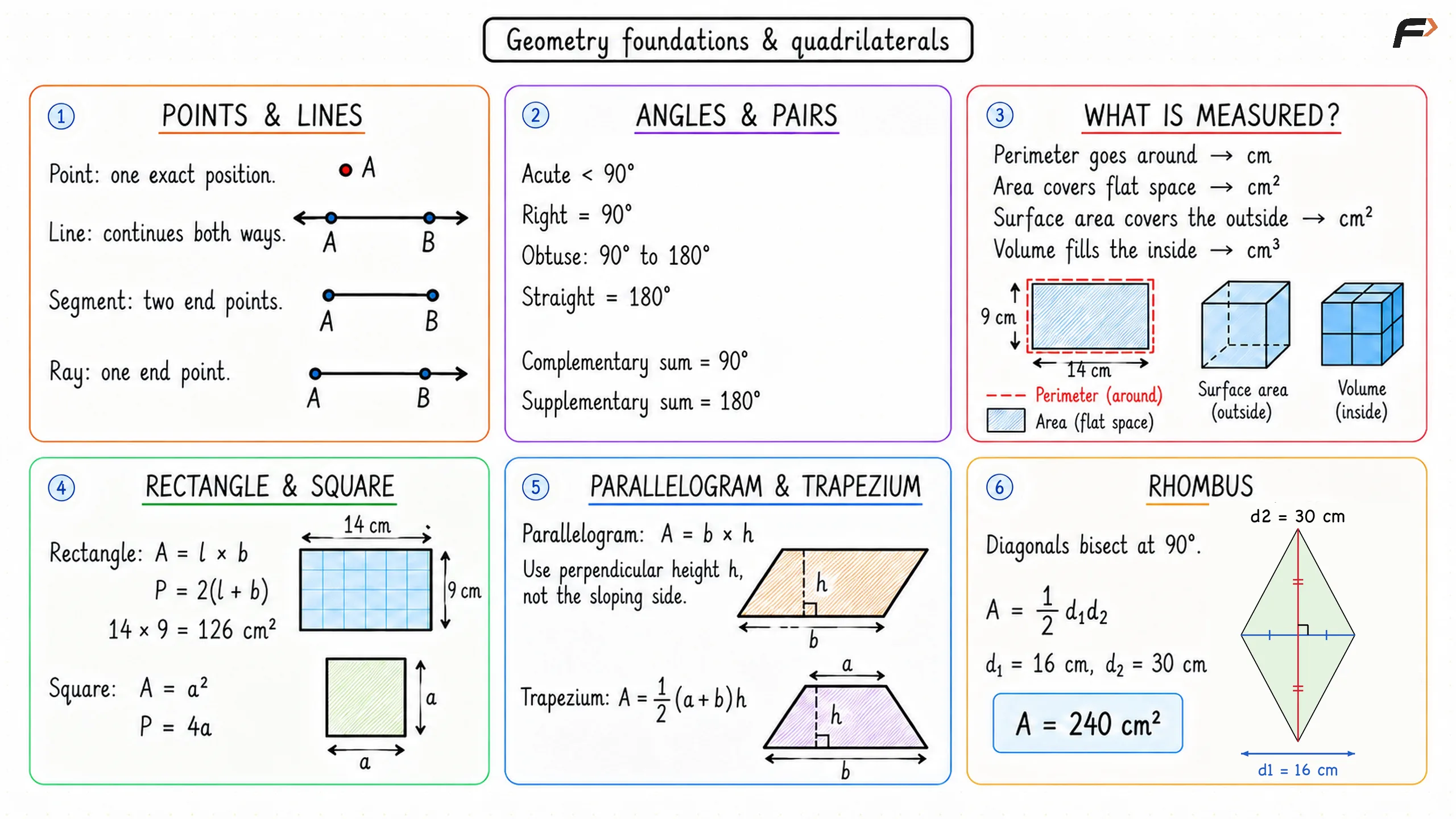
Geometry foundations, lines, angles and quadrilaterals
Basics: Point, Line, Line Segment and Ray
A point shows one exact position. It has no length or width. We name it with a capital letter such as A or B.
A line is straight and continues forever in both directions. A line segment is a fixed part of a line with two end points. A ray begins at one point and continues forever in one direction.
These names matter because a side of a triangle is a line segment, not a full line. It has two ends and a length that we can measure.
Parallel and perpendicular lines
Parallel lines stay the same distance apart and never meet, even if we make them longer. The opposite sides of a rectangle are parallel.
Perpendicular lines meet at a right angle. A right angle measures . The horizontal and vertical sides at a corner of a rectangle are perpendicular.
Transversal and Parallel-Line Angles
A transversal is a line that crosses two or more other lines. When a transversal crosses two parallel lines, the repeated angle pattern gives three important rules.
- Corresponding angles are in the same relative position at the two crossings, and they are equal.
- Alternate interior angles lie between the parallel lines on opposite sides of the transversal, and they are equal.
- Co-interior angles lie between the parallel lines on the same side of the transversal, and they add to .
Example: A transversal crosses two parallel lines. One angle is . Its corresponding angle and alternate interior angle are each . The co-interior angle beside it is:
Meaning of the answer: Equal-position angles remain equal, while the same-side interior pair completes a straight angle.
Angles and Degrees
An angle is formed when two rays meet at one point. The meeting point is called the vertex. Angles are measured in degrees, written with the symbol .
- An acute angle is smaller than .
- A right angle is exactly .
- An obtuse angle is greater than but smaller than .
- A straight angle is .
- A reflex angle is greater than but smaller than .
- A complete angle is one full turn, which is .
Two angles on a straight line add to . Angles around one point add to . These two facts will help us understand polygons and circles later.
Angle Pairs
- Complementary angles add to .
- Supplementary angles add to .
- A linear pair consists of two adjacent angles whose outer arms form a straight line, so the angles add to .
- Vertically opposite angles are the opposite angles formed when two lines cross, and each opposite pair is equal.
Example: If one angle in a linear pair is , the other is . The angle vertically opposite the angle is also .
Perimeter, Area, Surface Area and Volume
These four names measure different things.
Perimeter means the total distance around a flat shape. Imagine walking along every side and returning to the starting point. Perimeter uses ordinary length units such as centimetres or metres.
Area means the flat space covered inside a shape. We count how many small unit squares can fit inside it, so area uses square units such as or .
Surface area means the total area of the outside faces of a solid shape. It also uses square units.
Volume means the space inside a solid shape. We count unit cubes, so volume uses cubic units such as or .
Do not remove the words “square” and “cubic.” An area of and a volume of do not describe the same kind of measurement.
Rectangle
A rectangle is a four-sided shape with four right angles. Its opposite sides are equal and parallel. The longer side is often called the length , and the shorter side is called the breadth .
The area is found by making rows of unit squares. If 14 squares fit along the length and 9 fit along the breadth, there are squares in all:
The perimeter adds two lengths and two breadths:
Example: A rectangle is 14 cm long and 9 cm wide. Find its area.
What we know: The length is 14 cm and the breadth is 9 cm.
What we are finding: We need the space inside the rectangle.
Why we use this idea: A rectangle can be filled with equal square boxes. Multiplying the number of boxes in one row by the number of rows gives the full area.
Slow solution: Use the rectangle area formula:
Meaning of the answer: The rectangle covers 126 square centimetres.
Finding a missing side from a diagonal
A diagonal joins two opposite corners. In a rectangle, a diagonal, the length and the breadth form a right triangle. The diagonal is the hypotenuse, so Pythagoras Theorem can find a missing side.
Example: A rectangle has diagonal 25 cm and length 24 cm. Find its area.
What we know: The diagonal is 25 cm and the length is 24 cm. The breadth is missing.
What we are finding: We first need the breadth and then the area.
Why we use this idea: The diagonal makes a right triangle inside the rectangle.
Slow solution: Let the breadth be . Use Pythagoras Theorem:
Subtract 576 from both sides:
A length cannot be negative, so cm. Now find the area:
Meaning of the answer: The missing breadth is 7 cm, and the rectangle covers 168 square centimetres.
Square
A square has four equal sides and four right angles. If one side is , then adding four equal sides gives:
The area is side multiplied by side:
Example: The perimeter of a square is 48 cm. Find its area.
What we know: All four sides are equal, and together they measure 48 cm.
What we are finding: We need one side first, because area uses the side.
Why we use this idea: Dividing the full perimeter by 4 gives the length of one equal side.
Slow solution: Find the side:
Now multiply the side by itself:
Meaning of the answer: The square has side 12 cm and area 144 square centimetres.
Parallelogram
A parallelogram is a four-sided shape in which both pairs of opposite sides are parallel. Opposite sides are also equal.
Its area is not sloping side multiplied by base. We need the perpendicular height, which is the shortest straight distance from the base to the opposite side.
One way to see why is to cut the small triangle from one sloping end and move it to the other end. The shape becomes a rectangle with the same base, the same height and the same area.
Example: A parallelogram has base 13 cm and perpendicular height 8 cm. Find its area.
What we know: The base is 13 cm and the height measured at a right angle is 8 cm.
What we are finding: We need the space inside the parallelogram.
Why we use this idea: Rearranging the parallelogram makes a rectangle without changing its area.
Slow solution: Multiply the base and perpendicular height:
Meaning of the answer: The parallelogram covers 104 square centimetres.
Trapezium
A trapezium is a four-sided shape with one pair of parallel sides. Some books use the word trapezoid for the same shape. The two parallel sides may have different lengths.
For area, add the parallel sides, take half of their total, and multiply by the perpendicular height:
Here, and are the parallel sides and is the perpendicular height. The value is the average length of the two parallel sides.
Example: The parallel sides of a trapezium are 12 cm and 18 cm. Its height is 10 cm. Find its area.
What we know: The two parallel sides are 12 cm and 18 cm. The distance between them is 10 cm.
What we are finding: We need the area inside the trapezium.
Why we use this idea: A trapezium changes from one width to another. The formula uses the average of those two widths.
Slow solution: Add the parallel sides:
Take half and multiply by the height:
Meaning of the answer: The trapezium covers 150 square centimetres.
Rhombus
A rhombus is a four-sided shape with all four sides equal. Its opposite sides are parallel. Its diagonals cross at right angles and cut each other into equal halves.
The diagonals split a rhombus into four right triangles. This gives the area formula:
Here, and are the two diagonals.
Example: A rhombus has diagonals 16 cm and 30 cm. Find its area.
What we know: Both diagonal lengths are known.
What we are finding: We need the area inside the rhombus.
Why we use this idea: The diagonal formula uses the four right triangles made inside the rhombus.
Slow solution: Multiply the diagonals and take half:
Meaning of the answer: The rhombus covers 240 square centimetres.
Triangle Basics
A triangle is a closed shape with three sides and three angles. A side may be used as the base. The height is the perpendicular distance from that base to the opposite corner.
The perimeter of a triangle is the sum of its three side lengths:
The area is:
A triangle has half the area of a parallelogram with the same base and height. This is why the formula contains .
Example: A right-angled triangle has base 18 cm and height 7 cm. Find its area.
What we know: The base and perpendicular height are given.
What we are finding: We need the space inside the triangle.
Why we use this idea: A triangle is half of a matching parallelogram or rectangle with the same base and height.
Slow solution: Multiply the base and height, then take half:
Half of 18 is 9, so:
Meaning of the answer: The triangle covers 63 square centimetres.
Types of triangles by sides
- An equilateral triangle has three equal sides.
- An isosceles triangle has two equal sides.
- A scalene triangle has three different side lengths.
Types of triangles by angles
- An acute triangle has three acute angles.
- A right-angled triangle has one right angle.
- An obtuse triangle has one obtuse angle.
Angle Sum Property of a Triangle
The three interior angles of every triangle add to :
One way to understand this is to cut off the three corners of a paper triangle and place them side by side. Together they form a straight angle.
Example: Two angles of a triangle are and . Find the third angle.
What we know: All three angles must total .
What we are finding: We need the angle left after using the two known angles.
Why we use this idea: The Angle Sum Property works for every triangle.
Slow solution: Add the known angles:
Subtract from :
Meaning of the answer: The third angle is .
Exterior Angle Theorem
When one side of a triangle is extended, the angle outside the triangle is an exterior angle. It equals the sum of the two interior angles that are not next to it:
Example: If the two opposite interior angles are and , the exterior angle is:
Triangle Inequality
The Triangle Inequality says that the sum of any two side lengths of a triangle must be greater than the third side. For sides , and , all three checks must be true:
Example: Lengths 4 cm, 7 cm and 12 cm cannot form a triangle because , which is not greater than 12. Lengths 5 cm, 7 cm and 9 cm pass all three checks and can form a triangle.
Isosceles Triangle
An isosceles triangle has two equal sides. The angles opposite those equal sides are also equal.
Example: An isosceles triangle has perimeter 42 cm. Each equal side is 15 cm. Find the base.
What we know: The two equal sides together measure cm.
What we are finding: We need the third side, called the base.
Why we use this idea: Perimeter is the sum of all three sides.
Slow solution: Subtract the two known sides from the full perimeter:
Meaning of the answer: The base of the triangle is 12 cm.
Equilateral Triangle
An equilateral triangle has three equal sides and three equal angles. Since the angles total , each angle is .
For side length , its perpendicular height is:
Its area is:
Example: If an equilateral triangle has side 8 cm, its height is cm and its area is .
Pythagoras Theorem
Pythagoras Theorem works only in a right-angled triangle. The side opposite the right angle is called the hypotenuse, and it is the longest side.
If the two shorter sides are and , and the hypotenuse is , then:
The squares mean areas of squares drawn on the three sides. The theorem says that the two smaller square areas together equal the large square area on the hypotenuse.
Example: The two perpendicular sides of a right triangle are 9 cm and 12 cm. Find the hypotenuse.
What we know: The two shorter sides are 9 cm and 12 cm.
What we are finding: We need the side opposite the right angle.
Why we use this idea: A right angle is present and two side lengths are known.
Slow solution: Let the hypotenuse be :
Take the positive square root because a length is positive:
Meaning of the answer: The longest side is 15 cm.
Common Pythagorean triplets: The whole-number side sets , , and form right triangles. Equal multiples such as also form right triangles. Use a triplet only after confirming which side is the hypotenuse and that a right angle is present.
Heron's Formula
Heron's Formula finds the area of a triangle when all three side lengths are known. First find the semiperimeter:
Then calculate:
Example: A triangle has sides 13 cm, 14 cm and 15 cm. Its semiperimeter is cm. Therefore:
Meaning of the answer: The triangle covers 84 square centimetres without first finding its height.
Median of a Triangle
A median is a line segment drawn from one vertex to the midpoint of the opposite side. The midpoint divides that side into two equal lengths.
A median divides a triangle into two smaller triangles with equal areas. The two triangles have equal bases and the same perpendicular height, so is equal for both.
Example: A triangle has area . A median divides it into two triangles. Find the area of each smaller triangle.
What we know: A median makes two equal-area triangles.
What we are finding: We need one half of the full area.
Why we use this idea: Equal bases and the same height give equal areas.
Slow solution: Divide the full area by 2:
Meaning of the answer: Each smaller triangle has area 48 square centimetres.
Triangle Centres
- The centroid is the point where the three medians meet. It divides each median in the ratio , with the longer part next to the vertex.
- The orthocentre is the point where the three altitudes meet. An altitude is a perpendicular line from a vertex to the opposite side or its extension.
- The incentre is the point where the three angle bisectors meet. It is equally distant from the three sides and is the centre of the incircle.
- The circumcentre is the point where the perpendicular bisectors of the three sides meet. It is equally distant from the three vertices and is the centre of the circumcircle.
Similar Triangles
Similar triangles have the same shape but may have different sizes. Their matching angles are equal, and their corresponding sides, which means sides in the same position, have one common ratio.
The AA similarity rule says that two triangles are similar when two angles of one triangle equal two angles of the other. The third angles must then also be equal because each triangle has angle sum .
If the side ratio is , every matching length uses that ratio. Their areas use the square of the side ratio because area has two length directions:
For similar three-dimensional solids with corresponding length ratio , volumes use the cube of the length ratio:
Example: Two similar triangles have corresponding side ratio . A side of the smaller triangle is 12 cm. Find the matching side of the larger triangle.
What we know: The smaller matching side has 3 ratio parts, and those 3 parts are worth 12 cm.
What we are finding: We need the length of the larger matching side, which has 5 parts.
Why we use this idea: Corresponding sides of similar triangles follow the same side ratio.
Slow solution: Find the value of one part:
The larger side has 5 parts:
Meaning of the answer: The corresponding side of the larger triangle is 20 cm.
Example: Two similar triangles have corresponding side ratio . The smaller area is . Find the larger area.
What we know: The side ratio is , not the area ratio.
What we are finding: We need the area that matches the larger side ratio part.
Why we use this idea: For similar figures, area changes by the square of the length ratio.
Slow solution: Square both side-ratio parts:
The smaller 16 parts equal 64 square centimetres. One part is:
The larger area has 49 parts:
Meaning of the answer: The larger triangle has area 196 square centimetres.
Angle Bisector Theorem
An angle bisector divides one angle into two equal angles. In triangle , if bisects angle and meets side at , the Angle Bisector Theorem says:
In simple words, the opposite side is divided in the same ratio as the two sides touching the divided angle.
Example: In triangle , bisects angle . If cm, cm and cm, find .
What we know: The side ratio around angle is . The full opposite side is 20 cm.
What we are finding: We need the first part .
Why we use this idea: The Angle Bisector Theorem gives .
Slow solution: The ratio has 5 parts in all. One part is:
has 2 parts:
Meaning of the answer: The angle bisector divides into lengths 8 cm and 12 cm.
Incircle and Inradius
An incircle is a circle drawn inside a triangle so that it touches all three sides. The centre is called the incentre, and the radius is called the inradius.
For a right triangle with perpendicular sides and and hypotenuse :
This shorter formula comes from the general rule , where is the semiperimeter. Semiperimeter means half of the perimeter. For a beginner, the shorter right-triangle formula is easier once the hypotenuse is known.
Example: A right triangle has perpendicular sides 9 cm and 12 cm. Find its inradius.
What we know: The two shorter sides are 9 cm and 12 cm. The hypotenuse is not yet known.
What we are finding: We need the radius of the circle touching all three sides inside the triangle.
Why we use this idea: The triangle is right-angled, so the right-triangle inradius formula applies after finding the hypotenuse.
Slow solution: First use Pythagoras Theorem:
Now use the inradius formula:
Meaning of the answer: The incircle has radius 3 cm.
Circumcircle and Circumradius
A circumcircle is a circle that passes through all three vertices of a triangle. Its centre is the circumcentre, and its radius is the circumradius.
For a right triangle, the midpoint of the hypotenuse is equally far from all three vertices. So the hypotenuse is the diameter of the circumcircle:
Example: A right triangle has hypotenuse 26 cm. Find its circumradius.
What we know: In a right triangle, the hypotenuse is the circumcircle's diameter.
What we are finding: We need the radius, which is half of the diameter.
Why we use this idea: This property is special to a right triangle.
Slow solution: Divide the hypotenuse by 2:
Meaning of the answer: The circumcircle has radius 13 cm.
Polygons and Regular Polygons
A polygon is a closed flat shape made only from straight line segments. A triangle has 3 sides, a quadrilateral has 4, a pentagon has 5, a hexagon has 6, and so on.
A quadrilateral has four sides, and its interior angles add to . More generally, the sum of the interior angles of an -sided polygon is:
A regular polygon has all sides equal and all interior angles equal. Because every corner looks the same, all its exterior angles are also equal.
Exterior angles
An exterior angle is the turning angle made when one side is extended. Imagine walking around a polygon. At each corner you turn to follow the next side. After one full round, all those turns add to .
For any polygon:
For a regular polygon with sides:
Example: Each exterior angle of a regular polygon is . Find the number of sides.
What we know: One full turn is , and every exterior angle is equal.
What we are finding: We need the number of equal turns in .
Why we use this idea: Every side gives one exterior angle in a regular polygon.
Slow solution: Divide the full turn by one angle:
Meaning of the answer: The polygon has 8 sides. Its official name is an octagon.
Interior angles
An interior angle lies inside the polygon. At one corner, the interior angle and its matching exterior angle form a straight angle:
For a regular polygon:
Example: Find each interior angle of a regular 12-sided polygon.
What we know: There are 12 equal exterior angles.
What we are finding: We need the matching interior angle.
Why we use this idea: Finding the exterior angle first gives the interior angle through a straight line.
Slow solution: Each exterior angle is:
Subtract it from :
Meaning of the answer: Every interior angle is .
Regular Hexagon
A regular hexagon has 6 equal sides and 6 equal angles. Lines from its centre to all vertices divide it into 6 equal equilateral triangles.
An equilateral triangle with side has area:
So a regular hexagon has area:
Example: A regular hexagon has side 10 cm. Use to find its area.
What we know: The hexagon contains 6 equilateral triangles, each with side 10 cm.
What we are finding: We need the total area of all 6 triangles.
Why we use this idea: The centre-to-vertex lines split the regular hexagon into equal equilateral triangles.
Slow solution: Find the total area:
Since :
Meaning of the answer: The regular hexagon covers about 259.8 square centimetres.
Circle Basics
A circle is the set of all points at the same distance from one fixed point. The fixed point is the centre.
The radius is a line segment from the centre to the circle. The diameter passes through the centre and joins two points on the circle:
The circumference is the distance around the circle. The number (pi) connects a circle's circumference and diameter. We often use or :
The area inside the circle is:
Example: A circle has radius 7 cm. Use to find its circumference.
What we know: The radius is 7 cm.
What we are finding: We need the distance around the circle.
Why we use this idea: Circumference is found from the radius using .
Slow solution: Put the values into the formula:
The 7 in the numerator and denominator divide out:
Meaning of the answer: One full trip around the circle is 44 cm.
Example: A circle has circumference 88 cm. Use to find its diameter.
What we know: Circumference equals multiplied by diameter.
What we are finding: We need the diameter .
Why we use this idea: The diameter form uses the given circumference directly.
Slow solution: Write the formula with the known values:
Multiply by to leave alone:
Meaning of the answer: The circle is 28 cm wide through its centre.
Sector and Arc Length
A sector is the part of a circle between two radii and the curved edge joining them. It looks like a pizza slice. The angle at the centre is the central angle.
An arc is the curved part of the circle. A sector with angle takes of the full circle.
The perimeter of a sector contains the arc and two radii:
Example: A sector has radius 14 cm and central angle . Use to find its area.
What we know: A full circle is . The sector is of the full circle.
What we are finding: We need one-fourth of the circle's area.
Why we use this idea: A sector takes the same fraction of the circle's area as its central angle takes of .
Slow solution: Use the sector area formula:
Since and :
Meaning of the answer: The quarter-circle sector covers 154 square centimetres.
Example: A sector has radius 21 cm and central angle . Use to find its perimeter.
What we know: The curved arc is of the full circumference. The perimeter also has two straight radii.
What we are finding: We need the total length of the curved and straight boundary.
Why we use this idea: Using only arc length would miss the two straight sides.
Slow solution: Find the arc length first:
Now add two radii:
Meaning of the answer: The complete boundary of the sector measures 86 cm.
Chord and Perpendicular from the Centre
A chord is a line segment joining two points on a circle. A diameter is the longest chord because it passes through the centre.
The Perpendicular from the Centre to a Chord Theorem says that a perpendicular line from the centre to a chord divides the chord into two equal parts.
Tangent and Radius
A tangent is a straight line that touches a circle at exactly one point. The radius drawn to the point of contact is perpendicular to the tangent, so the angle between them is .
Example: From an external point , a tangent touches a circle at . If the centre is , then . Therefore, triangle is right-angled at , and Pythagoras Theorem can be used when two of its three side lengths are known.
Example: A chord is 24 cm long and is 5 cm from the centre. Find the radius.
What we know: The perpendicular from the centre cuts the 24 cm chord into two 12 cm halves.
What we are finding: We need the radius, which becomes the hypotenuse of a right triangle.
Why we use this idea: Half the chord, the centre-to-chord distance and the radius make a right triangle.
Slow solution: Use Pythagoras Theorem:
Meaning of the answer: The circle has radius 13 cm.
Common chord of two circles
When two circles cross, the line joining their two crossing points is the common chord. The line joining the two centres is perpendicular to this chord and cuts it into equal halves.
Example: Two circles have radii 13 cm and 15 cm. Their centres are 14 cm apart. Find the distance from the centre of the 13 cm circle to the common chord.
What we know: Let the needed distance be . The distance from the other centre to the chord is . Both circles share the same half-chord length.
What we are finding: We need .
Why we use this idea: Pythagoras Theorem gives the same half-chord square from both circles, so we can set those expressions equal.
Slow solution: For the 13 cm circle:
For the 15 cm circle:
Set them equal:
Open the square:
The terms appear on both sides, so remove them:
Meaning of the answer: The common chord is 5 cm from the centre of the 13 cm circle.
Thales' Theorem
Thales' Theorem says that an angle made by the endpoints of a diameter at any point on the semicircle is a right angle. In simpler words, a triangle drawn inside a semicircle with the diameter as one side is always right-angled.
Example: A triangle is drawn inside a semicircle. Its diameter is one side of the triangle, and the other two sides are 8 cm and 15 cm. Find the diameter.
What we know: Thales' Theorem makes the diameter the hypotenuse.
What we are finding: We need the hypotenuse of a right triangle.
Why we use this idea: The diameter-side triangle is right-angled.
Slow solution: Use Pythagoras Theorem:
Meaning of the answer: The semicircle has diameter 17 cm.
Inscribed Circle and Leftover Area
A circle is inscribed in a square when it lies inside the square and touches all four sides. The circle's diameter is then equal to the square's side.
Example: A circle of radius 7 cm is inscribed in a square. Use to find the area inside the square but outside the circle.
What we know: The diameter is cm, so the square's side is 14 cm.
What we are finding: We need the part of the square not covered by the circle.
Why we use this idea: Leftover area equals the larger area minus the area removed from it.
Slow solution: Find the square's area:
Find the circle's area:
Subtract:
Meaning of the answer: The four corner parts outside the circle have total area 42 square centimetres.
Combined Figures
A combined figure is made from two or more simple shapes. Do not search for one new formula. Break the figure into shapes whose formulas are already known.
- Add areas when pieces are joined without overlapping.
- Subtract an area when a piece is cut out or left empty.
- Check whether a shared length is a radius, diameter, side, height or diagonal.
Example: A rectangle is 28 cm by 14 cm. A semicircle is attached outside one 14 cm side, using that side as its diameter. Use to find the total area.
What we know: The figure contains one rectangle and one semicircle. The semicircle's diameter is 14 cm, so its radius is 7 cm.
What we are finding: We need the area of both joined pieces.
Why we use this idea: The pieces do not overlap, so their areas are added.
Slow solution: Find the rectangle's area:
Find half of the circle's area:
Add the two areas:
Meaning of the answer: The complete joined figure covers 469 square centimetres.
Path Inside a Rectangle
A path of equal width along all four inner sides leaves a smaller rectangle in the middle. If the path width is , it uses from both ends of each dimension:
The path area is the outer area minus the inner area.
Example: A rectangular garden is 30 m by 20 m. A 2 m wide path runs inside along all four sides. Find the path's area.
What we know: The path takes 2 m from the left and right, and 2 m from the top and bottom.
What we are finding: We need the outer garden area that is not part of the middle rectangle.
Why we use this idea: Subtracting the untouched middle from the full garden leaves exactly the path.
Slow solution: Find the full area:
Find the inner dimensions:
Find the inner area:
Subtract:
Meaning of the answer: The path covers 184 square metres.
Coordinate Geometry Basics
Coordinate geometry places shapes on a number grid. The horizontal line is the x-axis, and the vertical line is the y-axis. They meet at the origin, written as .
A point gives two moves. The -coordinate tells us how far to move left or right. The -coordinate tells us how far to move down or up.
Distance Formula
For points and , the horizontal change is and the vertical change is . These changes form the two shorter sides of a right triangle. Pythagoras Theorem gives the straight-line distance:
Example: Find the distance between and .
What we know: The horizontal change is , and the vertical change is .
What we are finding: We need the straight-line distance, not the distance travelled along grid lines.
Why we use this idea: The two coordinate changes and the straight distance form a right triangle.
Slow solution: Find both changes:
Use the Distance Formula:
Meaning of the answer: The two points are 10 units apart in a straight line.
Midpoint Formula
The midpoint lies exactly halfway between two points. Its coordinates are the averages of the two x-values and the two y-values:
Example: The midpoint of and is . Find .
What we know: The midpoint's x-coordinate 8 is the average of 4 and .
What we are finding: We need the missing x-coordinate.
Why we use this idea: A midpoint averages matching coordinates separately.
Slow solution: Use only the x-coordinate part:
Multiply both sides by 2:
Subtract 4:
The y-coordinate also checks correctly because .
Meaning of the answer: The second point is .
Area of a triangle on the coordinate axes
When one side lies on the x-axis and another lies on the y-axis, they meet at . Their lengths can be used as base and height.
Example: Find the area of the triangle with vertices , and .
What we know: The segment from to has length 8. The segment from to has length 6. The axes are perpendicular.
What we are finding: We need the area of the right triangle.
Why we use this idea: The x-axis side and y-axis side act as base and perpendicular height.
Slow solution: Use the triangle area formula:
Meaning of the answer: The triangle covers 24 square coordinate units.
Solid Geometry: Face, Edge and Vertex
A solid shape has three dimensions: length, width and height. A flat surface is called a face. A line where two faces meet is an edge. A corner where edges meet is a vertex.
Surface area measures the outside covering. Volume measures the space inside. A tank's capacity is therefore a volume, not an area.
Cube
A cube has 6 equal square faces. If its side is , one face has area . All 6 faces give:
The volume is:
Example: A cube has total surface area . Find its volume.
What we know: Six equal square faces together have area 150 square centimetres.
What we are finding: We need the side first and then the volume.
Why we use this idea: Total surface area gives , while volume needs .
Slow solution: Find :
The positive side length is:
Now find the volume:
Meaning of the answer: The cube can hold 125 cubic centimetres of space.
Cylinder
A cylinder has two equal circular faces and one curved surface joining them. A tin can is a familiar example.
The curved surface area leaves out the top and bottom circles. If the curved sheet is opened flat, it becomes a rectangle. Its length is the circle's circumference , and its height is :
The volume is circular base area multiplied by height:
Example: A cylinder has radius 7 cm and height 12 cm. Use to find its curved surface area.
What we know: Only the curved side is needed. The two circular faces are not included.
What we are finding: We need the area of the curved sheet around the cylinder.
Why we use this idea: Opening the curved side makes a rectangle with length and height .
Slow solution: Use :
Divide out the 7:
Meaning of the answer: The curved side covers 528 square centimetres. The top and bottom circles are not counted.
Example: A cylindrical tank has radius 3.5 m and height 8 m. Use to find its capacity.
What we know: Capacity means the volume inside the tank.
What we are finding: We need circular base area multiplied by height.
Why we use this idea: Every level of the cylinder has the same circular area.
Slow solution: Use the volume formula:
Since :
Meaning of the answer: The tank can hold 308 cubic metres.
Cone
A cone has one circular base and one pointed top called the apex. Its vertical height goes straight from the apex to the centre of the base. Its slant height runs along the sloping surface from the apex to the edge of the base.
A cone with the same base and height as a cylinder has one-third of the cylinder's volume:
The radius, vertical height and slant height form a right triangle:
The total surface area includes both the curved surface and circular base:
Example: A cone has radius 7 cm and vertical height 9 cm. Use to find its volume.
What we know: Volume uses the vertical height, not the slant height.
What we are finding: We need one-third of .
Why we use this idea: A cone holds one-third of the volume of a cylinder with the same circular base and height.
Slow solution: Put the values into the formula:
Divide 9 by 3 and one 7 by the denominator 7:
Meaning of the answer: The cone holds 462 cubic centimetres.
Example: A cone has radius 5 cm and vertical height 12 cm. Use to find its total surface area.
What we know: The slant height is missing. Total surface area needs the curved surface and the base.
What we are finding: We need first and then .
Why we use this idea: Radius, height and slant height make a right triangle.
Slow solution: Find the slant height:
Now use the total surface area formula:
Meaning of the answer: The curved surface and circular base together cover 282.6 square centimetres.
Frustum of a Cone
A frustum of a cone is the shape left when the pointed top of a cone is cut off by a cut parallel to the base. It has a larger circular base of radius , a smaller circular top of radius , and height .
Its volume is:
The three terms inside the bracket are important. Use the square of each radius and the product of the two radii.
Example: A frustum has radii 14 cm and 7 cm and height 6 cm. Use to find its volume.
What we know: , and .
What we are finding: We need the space inside the frustum.
Why we use this idea: The figure has two different circular ends, so the ordinary cone formula does not fit it.
Slow solution: Find the bracket first:
Now use the formula:
Since and :
Meaning of the answer: The frustum holds 2,156 cubic centimetres.
Common Mistakes
Mixing perimeter and area
Perimeter is the distance around a flat shape and uses length units. Area is the space inside and uses square units.
Using the sloping side as a parallelogram height
Area needs the perpendicular height, not the sloping side. Look for the right-angle mark or the shortest distance between parallel sides.
Using a diameter as a radius
The radius is half of the diameter. Check which one is given before using or .
Forgetting the two straight sides of a sector
Arc length is only the curved edge. Sector perimeter is arc length plus two radii.
Using the side ratio directly as the area ratio
For similar triangles, square both parts of the side ratio to get the area ratio.
Using Pythagoras Theorem without a right angle
The theorem works only for a right-angled triangle.
Subtracting a path width only once
An inside path along all four sides removes the width twice from the length and twice from the breadth.
Mixing vertical height and slant height of a cone
Cone volume uses vertical height . Curved and total surface area use slant height .
Forgetting square and cubic units
Use square units for area and surface area. Use cubic units for volume.
Rounding too early
Keep , square roots and fractions exact until the last step when possible. Early rounding can change the final answer.
Formulas and Cheat Sheet
| Concept | Formula | When to use it |
|---|---|---|
| Rectangle perimeter | Length and breadth | |
| Rectangle area | Rectangle | |
| Square perimeter | Side | |
| Square area | Square | |
| Parallelogram area | must be perpendicular height | |
| Trapezium area | are parallel sides | |
| Rhombus area | Both diagonals known | |
| Triangle area | is perpendicular to base | |
| Triangle angle sum | Every triangle | |
| Pythagoras Theorem | Right triangle only; is hypotenuse | |
| Similar-triangle area ratio | Corresponding side ratio is | |
| Angle Bisector Theorem | bisects angle | |
| Right-triangle inradius | Right triangle only | |
| Right-triangle circumradius | Right triangle only | |
| Exterior-angle sum | Any polygon, one turn at each vertex | |
| Regular polygon exterior angle | equal angles | |
| Regular polygon interior angle | Regular polygon | |
| Regular hexagon area | Side | |
| Diameter and radius | Circle | |
| Circumference | Distance around circle | |
| Circle area | Space inside circle | |
| Sector area | Central angle | |
| Arc length | Curved part of sector | |
| Sector perimeter | Full sector boundary | |
| Distance Formula | Two coordinate points | |
| Midpoint Formula | Point halfway between two points | |
| Cube total surface area | Six square faces | |
| Cube volume | Side | |
| Cylinder curved surface area | Curved part only | |
| Cylinder volume | Capacity or space inside | |
| Cone volume | Vertical height | |
| Cone slant height | Right circular cone | |
| Cone total surface area | Curved surface plus base | |
| Frustum volume | Cone frustum with two radii |
Safe Shortcuts
Recognise common right-triangle triples: , , , and their equal multiples can save square calculations. Use this only when the triangle is right-angled.
Cancel before multiplying with : If a radius or diameter contains a factor of 7, divide it with the denominator first. This keeps the numbers small.
Use the missing-angle subtraction: In a triangle, add the two known angles and subtract from .
Use exterior angles for a regular polygon: Each exterior angle is . Then subtract from if the interior angle is needed.
Use diameter directly for circumference: When diameter is given, use instead of first finding and then using .
Use half the chord immediately: A perpendicular from the centre divides a chord into two equal parts. This is safe only when the line is perpendicular and starts at the centre.
For a right triangle's circumradius, halve the hypotenuse: This is safe only for a right triangle.
For joined or cut figures, write plus or minus before calculating: Add attached non-overlapping pieces. Subtract holes, paths or shapes removed from a larger shape.
Shortcuts should make correct work shorter. They do not replace checking the shape, right-angle condition, units or meaning of each length.
Frequently Asked Questions
What is geometry in simple words?
Geometry studies shapes, lengths, angles, positions and space. It includes flat figures such as triangles and circles and solid figures such as cubes and cylinders.
What is the difference between perimeter and area?
Perimeter is the distance around a flat shape. Area is the space inside it. Perimeter uses length units, while area uses square units.
What is the difference between area and volume?
Area measures flat space or the outside covering of a solid. Volume measures the space inside a solid and uses cubic units.
When can Pythagoras Theorem be used?
Use it only in a right-angled triangle. The hypotenuse must be the side opposite the angle.
Why is the area of a triangle half of base times height?
Two matching triangles can join to make a parallelogram with the same base and height. One triangle is half of that parallelogram.
What is a corresponding side?
Corresponding sides are sides in the same position in two similar figures. They face equal angles and follow the same side ratio.
Why is the area ratio of similar triangles squared?
Area has two length directions. If every length changes by a factor of , both directions change by , so area changes by .
What is the difference between a chord and a diameter?
Both join two points on a circle. A diameter must pass through the centre. A chord does not have to pass through the centre.
What is a sector of a circle?
A sector is the part between two radii and their connecting arc. It looks like a slice of pizza.
What is the difference between an incircle and a circumcircle?
An incircle lies inside a triangle and touches all three sides. A circumcircle goes around a triangle and passes through all three vertices.
What is the difference between vertical height and slant height?
Vertical height goes straight down at a right angle to the base. Slant height runs along the sloping surface of a cone.
How should a combined geometry figure be handled?
Break it into familiar shapes. Add the areas of pieces that are joined and subtract the areas of holes or removed pieces.