Dice Reasoning: Rules, Nets and Solved Examples
A die is a cube with a number, letter, colour, dot pattern or symbol on each of its six faces. In aptitude exams, the word dice is often used for both one cube and several cubes. The central task is usually to decide which faces are opposite, which are adjacent, or how the cube looks after it is turned.
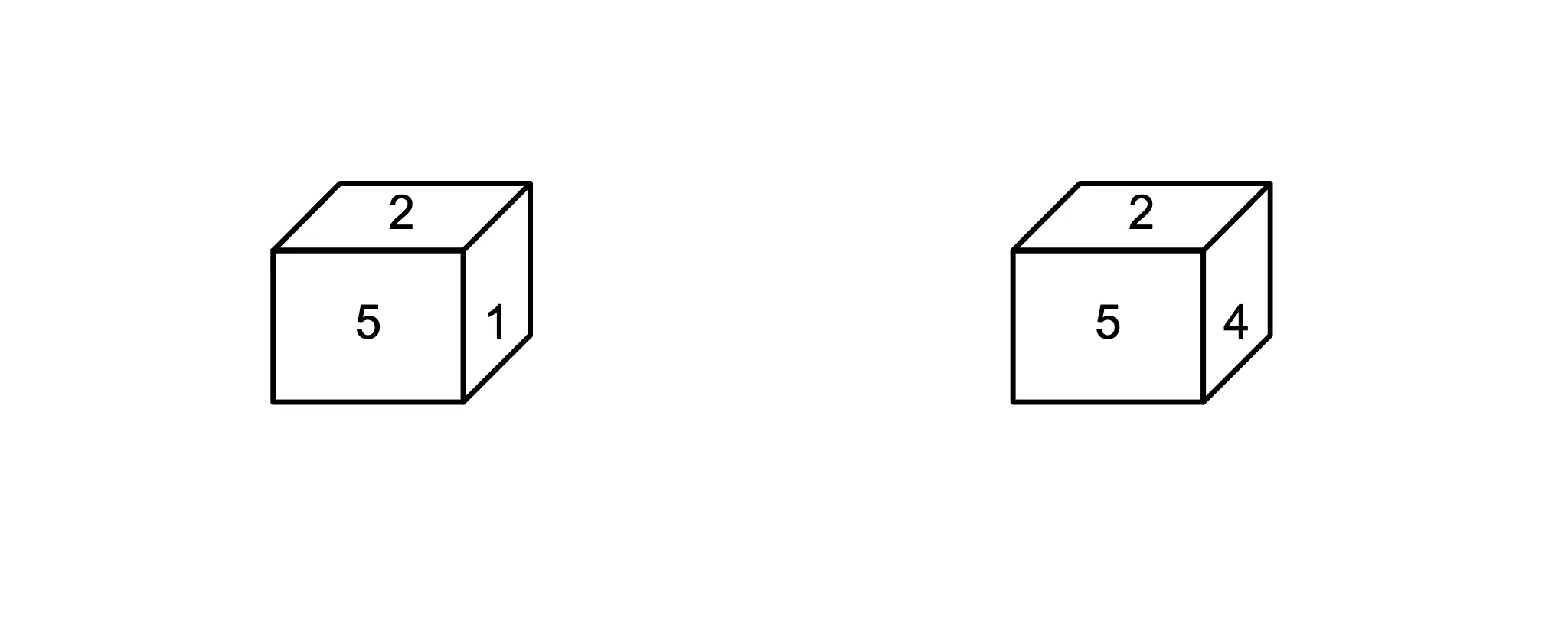
Suppose two views show the same two faces, 2 and 5, while the third visible face changes from 1 to 4. Those unchanged faces act like a hinge. The two changing faces, 1 and 4, must be opposite. This simple comparison is more reliable than trying to picture the entire cube at once.
The same spatial ideas work with numbers, dots, letters, colours and symbols. This article begins with the parts of a cube, then develops the main comparison rules, dice nets, rotation checks and the advanced cases needed for aptitude questions.
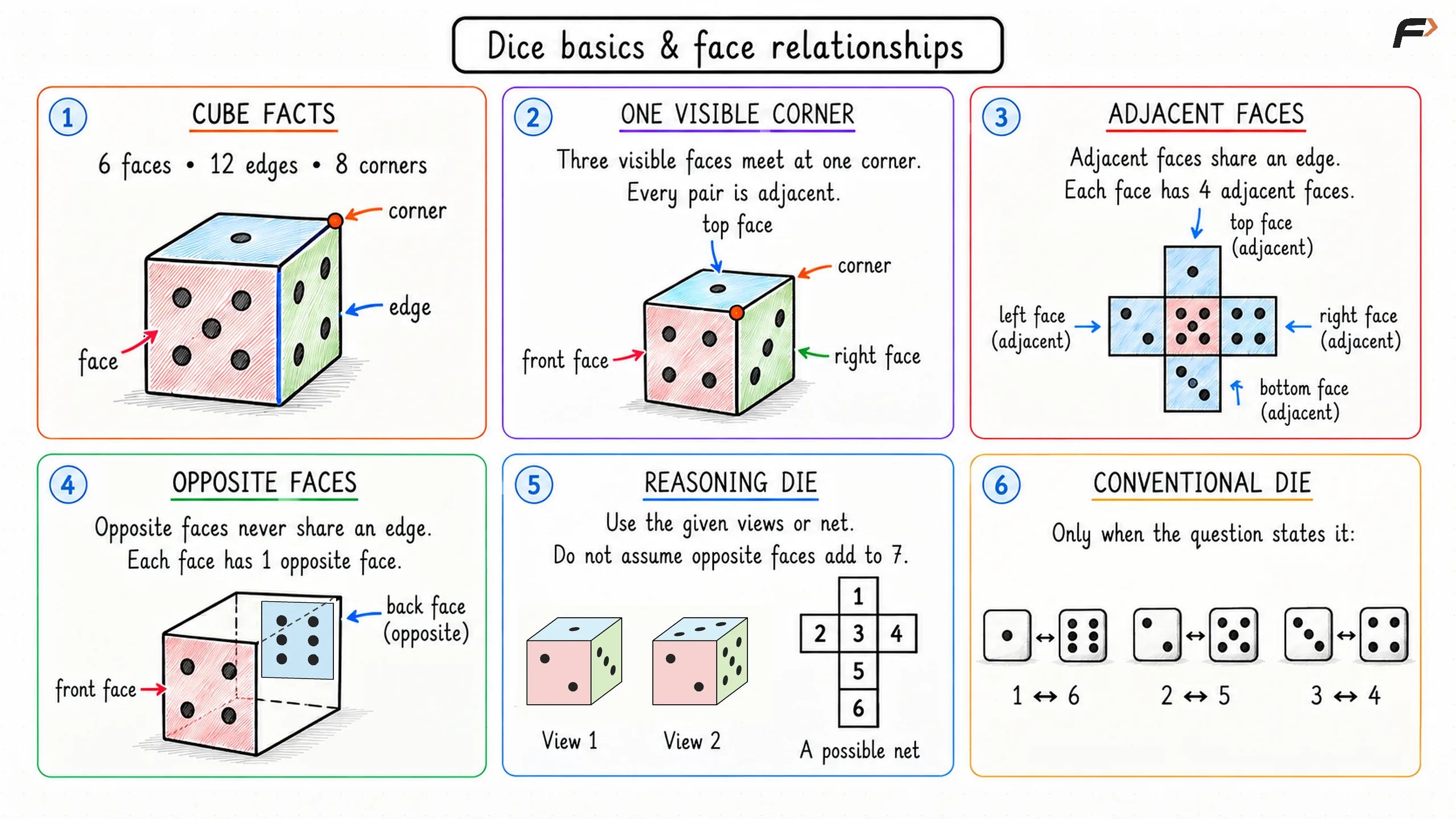
Dice basics and face relationships
Basics: Faces, Edges, Corners and Views
A cube has six square faces, twelve edges and eight corners. Pick any one face and imagine holding it toward you. Four faces wrap around its top, bottom, left and right edges. The sixth face is hidden directly behind it, so that face is opposite.
One drawing of a die normally shows three faces meeting at one corner: a top face, a front face and a side face. Because those three faces meet at the same corner, every pair among them is adjacent. The other three faces are hidden. Turning the die changes which faces are visible, but it never changes which labels touch or lie opposite.
Two words are especially important:
- Adjacent faces share an edge and can appear together in one corner view.
- Opposite faces never share an edge and can never appear together in one corner view.
Every face therefore has exactly four adjacent faces and exactly one opposite face. This fact supports nearly every method in the topic.
Ordinary dice and conventional dice
Many reasoning sets use the labels 1 to 6 without promising the usual physical-die arrangement. In such a set, do not assume that opposite faces add to 7. Find the opposite pairs from the supplied views or net.
If a problem explicitly says that the die is a standard conventional die, then the opposite pairs are 1 and 6, 2 and 5, and 3 and 4. Use this convention only when the wording clearly allows it.
Comparing Different Positions of the Same Die
When several drawings show the same die, begin by comparing labels rather than trying to rotate the whole cube mentally. First circle the labels repeated in two views. Two repeated labels lead to the two common faces rule. One repeated label leads to the one common face rule. If neither comparison is convenient, collect the four neighbours of one face and use elimination.
The labels may be numbers, letters, colours, dots or symbols. The comparison method stays the same because it depends on position, not on the type of label.
Two Common Faces Rule
This is the quickest rule. If two views have the same two visible faces, keep that common pair together. The third face shown in the first view is opposite the third face shown in the second view.
To see why, imagine gripping the shared edge between the two common faces. One changing face lies at one end of the cube, while the other changing face lies at the far end. Rotating the die around the shared edge can reveal one or the other, but the two changing faces never meet. They are opposite.
Example: Study the two positions below and find the face opposite to 1.
Two dice views demonstrating the two common faces rule
Read the comparison in three small steps:
- The repeated faces are 2 and 5.
- Ignore those repeated faces and look at what remains. The first view leaves 1, while the second leaves 4.
- The two remaining faces lie on opposite sides of the fixed pair, so 1 is opposite to 4.
The important point is that 1 and 4 are not paired merely because they are different. They are paired because the other two visible faces are the same in both views.
One Common Face Rule
Sometimes two views share exactly one visible face. That common face has four neighbours arranged like a ring around it. The two views show different parts of this same ring. Keep the common face in the same orientation, move around it in one chosen direction, and compare the neighbour positions.
Direction matters because reversing only one view produces a mirror image, not a rotation of the same die. If you begin clockwise in the first view, remain clockwise in the second view. Faces that occupy matching places in the two orders form opposite pairs.
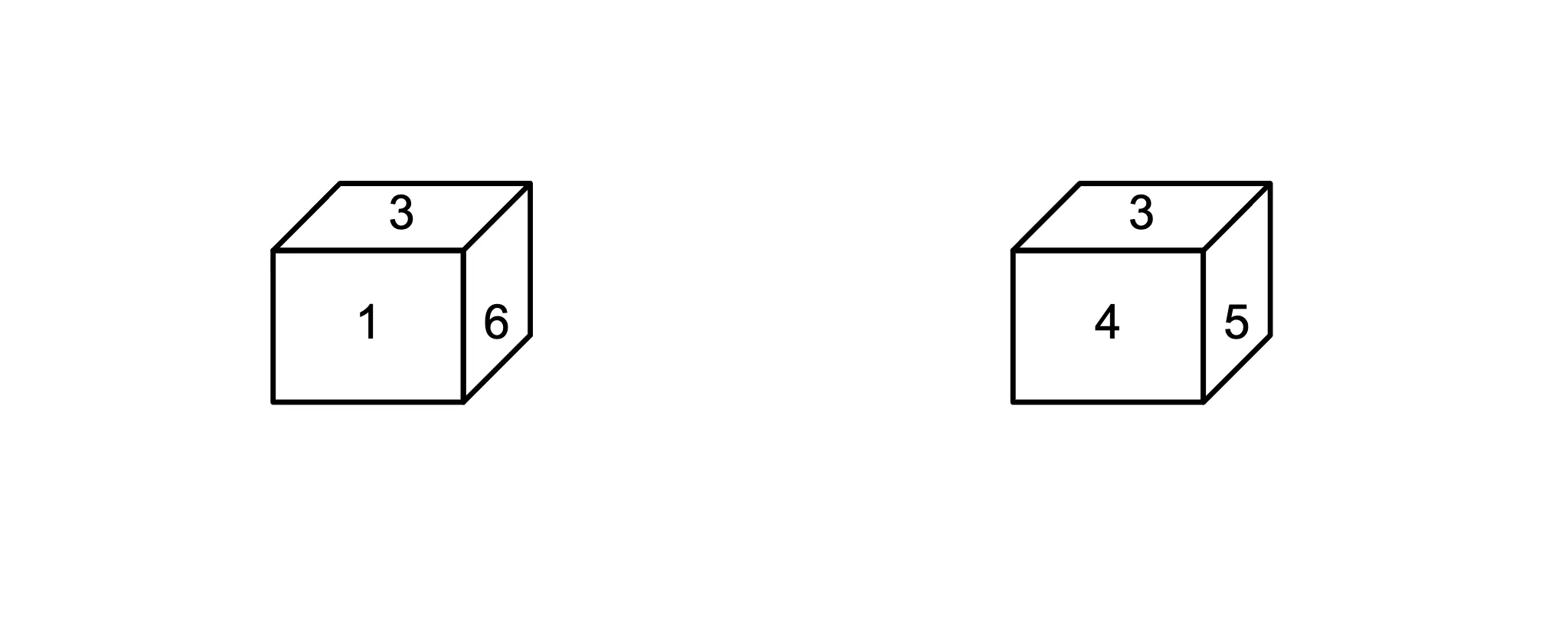
Example: Study the two positions below and find the face opposite to 5.
Two dice views demonstrating the one common face rule
Start by treating 3 as a fixed reference point. The clockwise order in the first view is
The clockwise order in the second view is
Now compare one position at a time. The first neighbour after 3 is 1 in the first view and 4 in the second, so 1 is opposite to 4. The next neighbour is 6 in the first view and 5 in the second, so 6 is opposite to 5. We are looking for the partner of 5, therefore the answer is 6.
The same method works for symbols and colours. A star can be opposite a plus sign just as easily as one number can be opposite another.
Finding an Opposite Face from Four Neighbours
A face touches exactly four other faces. Once those four neighbours have been identified, every adjacent position is already occupied. The only unused label cannot touch the chosen face, so it must be opposite.
This method is often easier than matching rotations across three or four views. Write a neighbour list beside the chosen face and add only new labels. A repeated label confirms an old neighbour but does not fill another position.
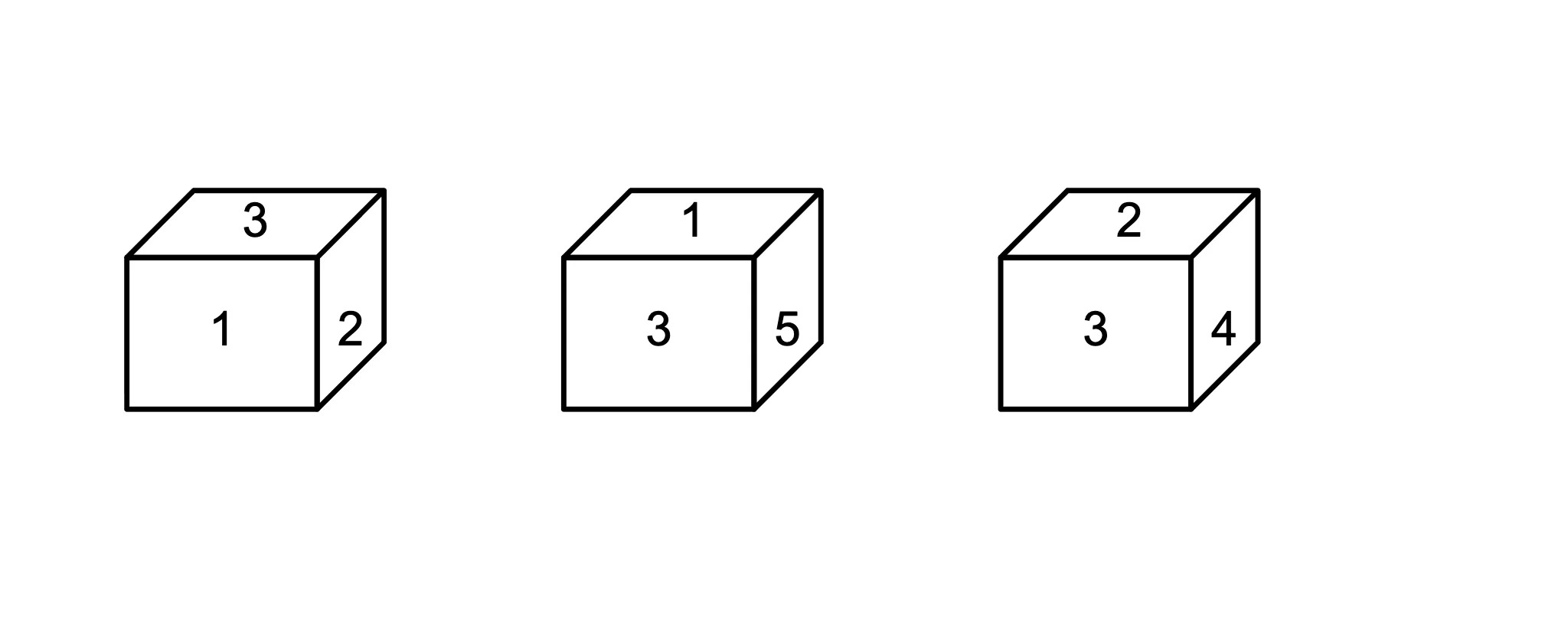
Example: Study the three positions below and find the face opposite to 3.
Finding the opposite face by listing four adjacent faces
Build the neighbour list gradually:
- The first view shows 1 and 2 touching 3.
- The second view adds 5. The repeated 1 is counted only once.
- The third view adds 4. The repeated 2 is again counted only once.
The four distinct neighbours of 3 are now 1, 2, 4 and 5. A face has no room for another neighbour. From the six labels, only 6 remains, so 6 must be opposite to 3.
This elimination method is especially useful when no convenient pair of views has two common faces.
Dice Nets and How Folding Works
A dice net is a flat arrangement of six connected squares that can fold into a cube. Every shared line between two squares becomes a hinge. Squares joined by a hinge become adjacent faces, while squares that fold to opposite sides of the cube become opposite faces.
Choose one square as the base and imagine leaving it flat on a table. Its neighbours fold upward like walls. Any extra square attached beyond a wall folds across to close the cube. You rarely need to finish this entire movement because a straight strip or a pair of crossing lines often reveals two opposite pairs, and elimination gives the third.
Straight-Line Alternate Face Rule
When four faces form one straight continuous strip in a valid cube net, that strip wraps around the cube like a belt. The first face lies across from the third, while the second lies across from the fourth. Therefore, in the order A, B, C, D, the opposite pairs are A with C and B with D. The two faces outside the strip close the remaining open sides and become the third opposite pair.
Example: Fold the net below mentally and find all three opposite pairs.
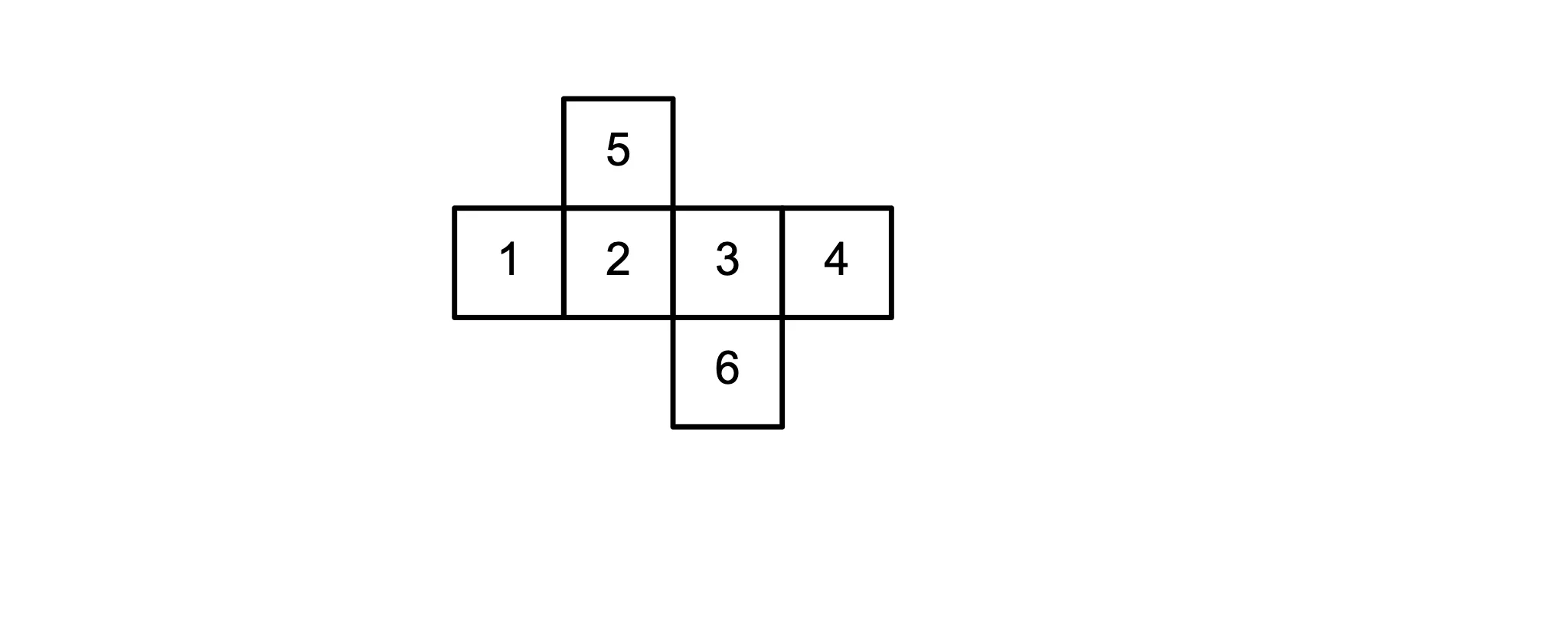
A cube net demonstrating alternate opposite faces in a straight strip
Imagine wrapping the strip around the four side positions of the cube. Face 1 reaches the side directly across from face 3. Face 2 similarly reaches the side directly across from face 4. That gives two pairs before the attached faces are considered.
The result is:
- 1 opposite 3
- 2 opposite 4
- 5 opposite 6
Do not use this rule merely because four labels can be traced in some winding route. They must form the relevant straight continuous strip in a valid net.
Nets with Two Crossing Lines
Some nets contain a central square with arms extending in two directions. The squares on opposite sides of the centre fold upward as opposite walls. Each straight line through the centre can therefore reveal one opposite pair. Once two pairs are known, the two unused faces must form the final pair.
Example: Study the cross-shaped net below and find the face opposite to the patterned face.
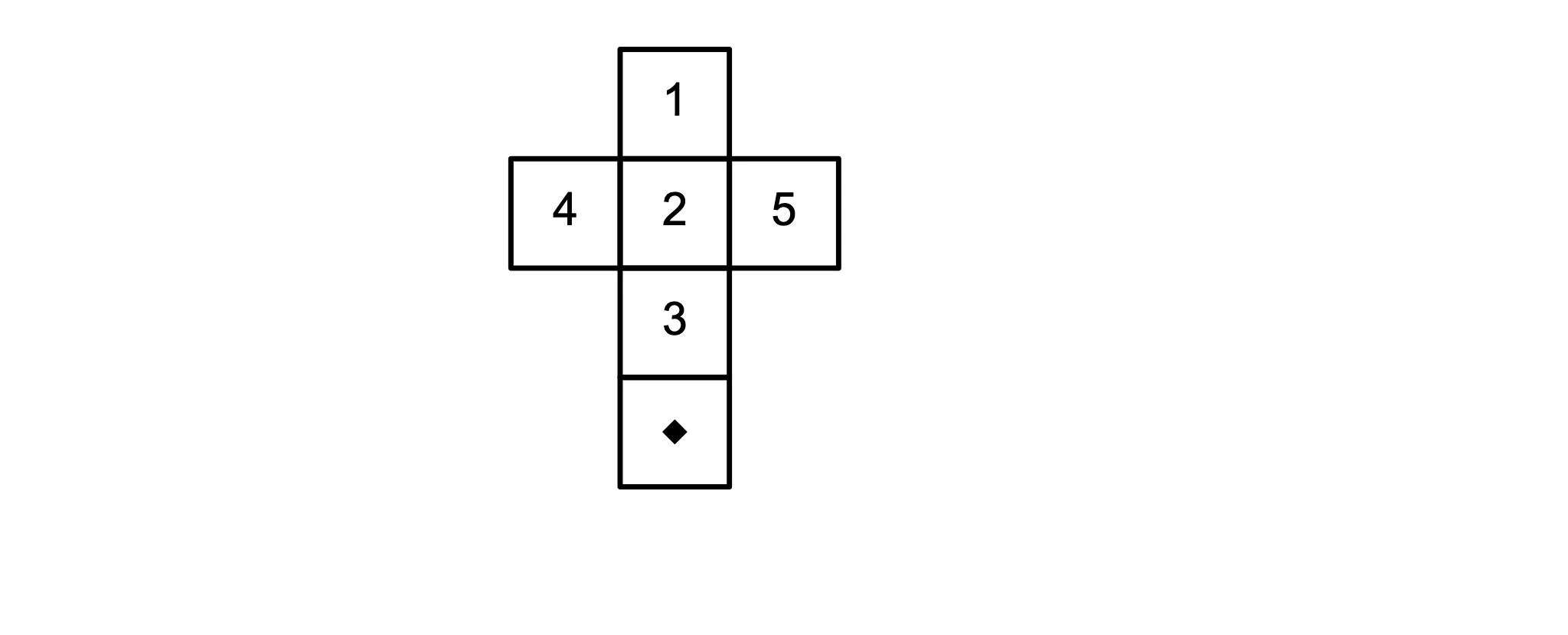
A cross-shaped cube net with two straight-line opposite pairs
Leave 2 flat as the base. Face 1 folds upward from one side and face 3 folds upward from the opposite side, so 1 and 3 face each other across the cube. The same fold places 4 and 5 on opposite walls. Four labels are now paired. The only faces not used in an opposite pair are 2 and the patterned face, so those two must close the bottom and top of the cube. The pattern is therefore opposite to 2.
Staircase Nets
A staircase net has squares connected in a chain that changes direction. It does not wrap around the cube in the same simple way as a straight strip, so the straight-line shortcut must not be copied blindly. Fix one middle square, fold its neighbours upward, and then follow the remaining hinges. In the particular six-square staircase shown in the example, labels three positions apart become opposite.
Example: Study the staircase net below and find the face opposite to 3.
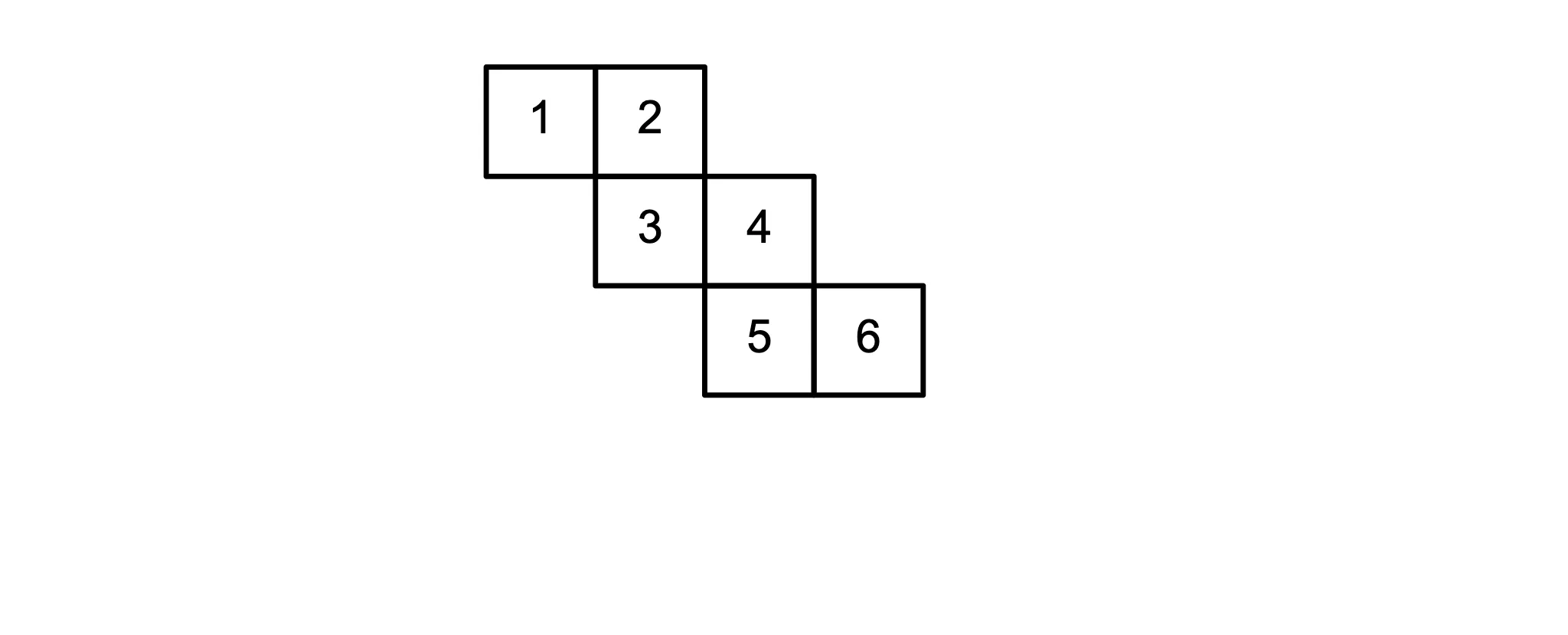
A staircase cube net with its three opposite-face pairs
Start with 3 as a reference face and fold 2 and 4 along its two edges. Continuing the chain carries 6 to the side directly across from 3. Repeating the same fold relation for the other labels gives 1 opposite 4 and 2 opposite 5. Therefore, 3 is opposite to 6.
The connected order alone is not enough for every possible net. Use this spacing shortcut only when the drawing has the same valid staircase shape.
Deciding Whether a Cube Can Be Formed
After finding all three opposite pairs, a proposed corner view can be checked without mentally folding every option. Three faces shown at one corner all touch one another. Therefore, the corner must contain one face from each opposite pair. If it contains both members of any opposite pair, that option is impossible.
The reverse statement needs care. A set of three labels containing no opposite pair is a possible corner set, but a directional symbol may still have the wrong orientation. For plain numbers, letters or colours, the opposite-pair check is usually enough.
Example: Study the net and options below. Decide which proposed cube can be formed.
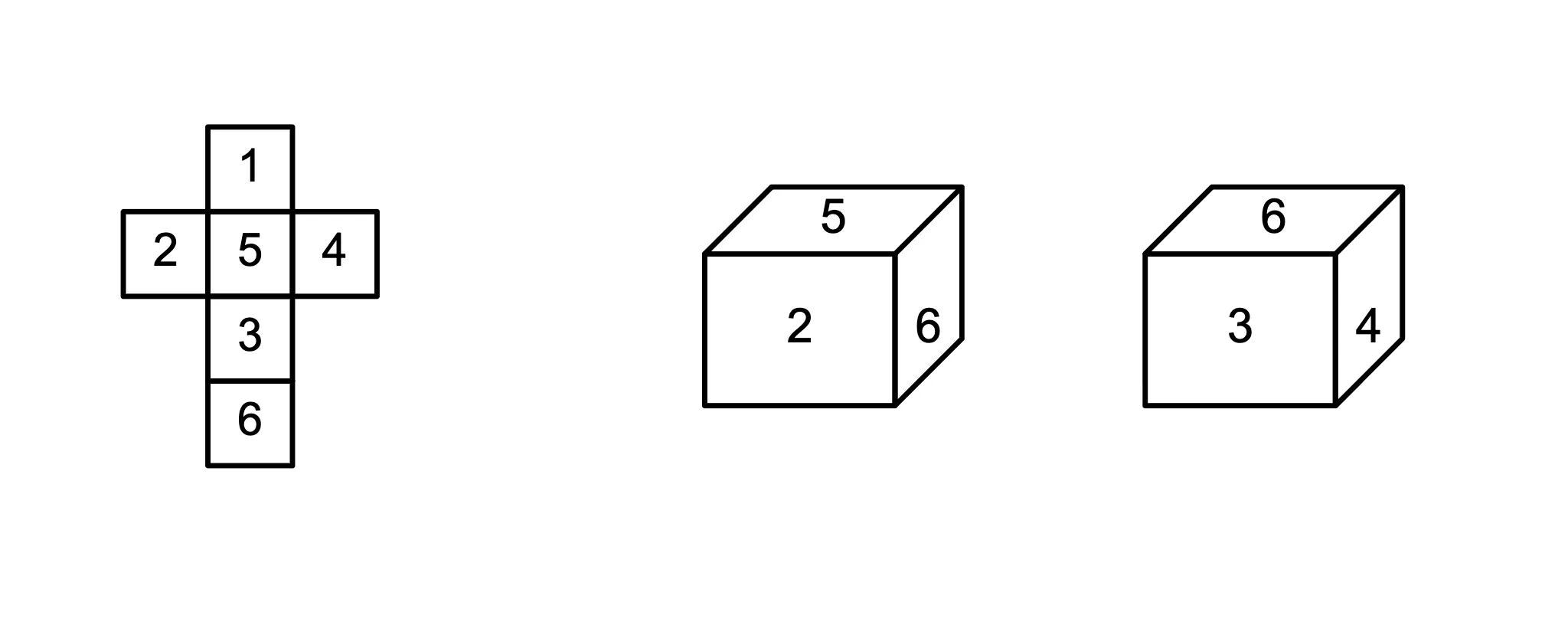
Checking which proposed cube can be formed from a net
Check the options against the opposite-pair list:
- Option A contains both 5 and 6, so it joins opposite faces and is impossible.
- Option B contains both 1 and 3, so it is also impossible.
- Option C contains 6, 3 and 4. These come from three different opposite pairs, so they can meet at one corner.
- Option D again contains both 5 and 6, so it is impossible.
Only Option C survives the adjacency test.
Rotating a Known Three-Face View
When a question gives a target top and side face, first find a supplied view containing both labels. That view already tells you which third face shares their corner. Rotate all three faces together as one rigid group. Never move one label while leaving the other two behind.
A useful mental model is a three-position cycle around the visible corner. If a view has top A, front B and right C, one corner-turn can move C to the top, B to the right and A to the front. Notice that the order cycles. It does not reverse like a mirror image.
Example: Follow the turn shown below and find the new front face.
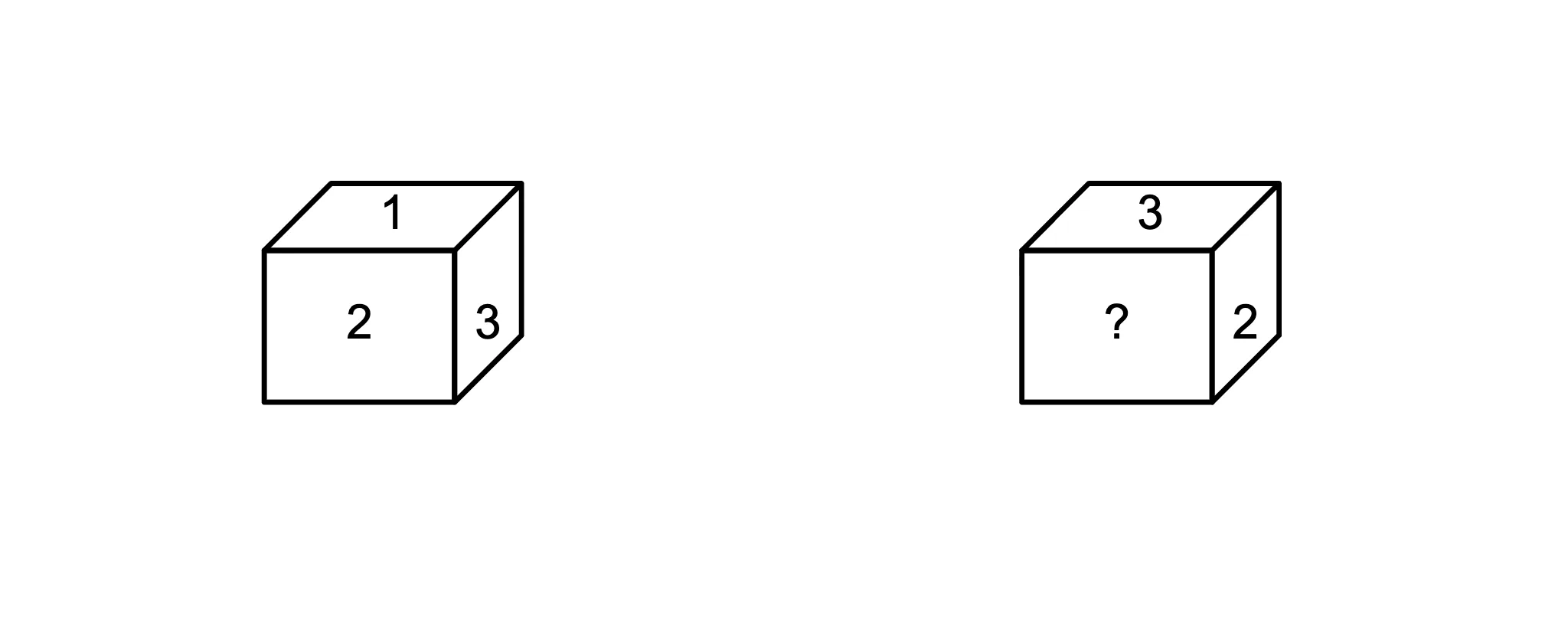
Rotating a known three-face dice view to find the new front face
Track the three visible positions together:
- Right face 3 moves to the top.
- Front face 2 moves to the right.
- The only remaining member of the original corner, face 1, moves from the top to the front.
The new front face is therefore 1. Swapping only 2 and 3 would be invalid because a real cube turn moves every face at the same time.
Symbols with Direction
An arrow, triangle or letter can carry two separate pieces of information: the square face on which it is printed and the direction it points on that square. Track these as two records. A symbol may move to the correct face but still be upside down, which makes the option wrong.
If the cube turns while a reference face remains at the front, the surrounding faces may exchange top, bottom, left and right positions. The printed symbol rotates with its face. It does not stay upright relative to the page.
Example: Follow the symbol rotation below. Find the triangle's final face and direction.
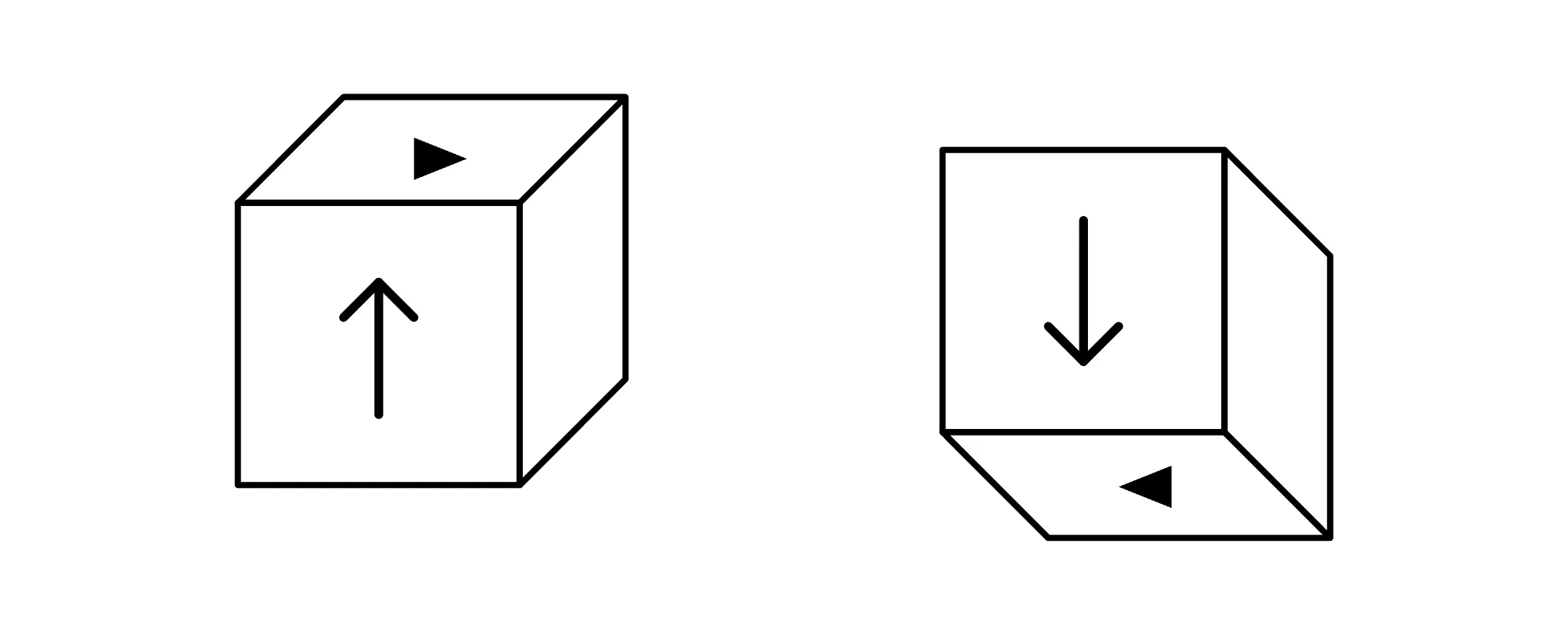
Tracking both the face and direction of symbols during a dice rotation
Because the front arrow remains on the front but turns from up to down, the cube has made a half-turn around an axis running through the front and back faces. During this half-turn, the top and bottom exchange places, and the left and right sides also exchange places.
The triangle begins on the top, so it moves to the bottom. Its printed direction is carried through the same half-turn, changing from right to left. The complete answer is therefore: bottom face, pointing left.
When the Information Gives More Than One Possibility
Not every set determines one exact opposite face. Sometimes the strongest valid conclusion is a small set of possibilities. Do not force a unique answer when the views do not provide enough information.
Example: Study the information below and state the strongest definite conclusion about the face opposite to B.
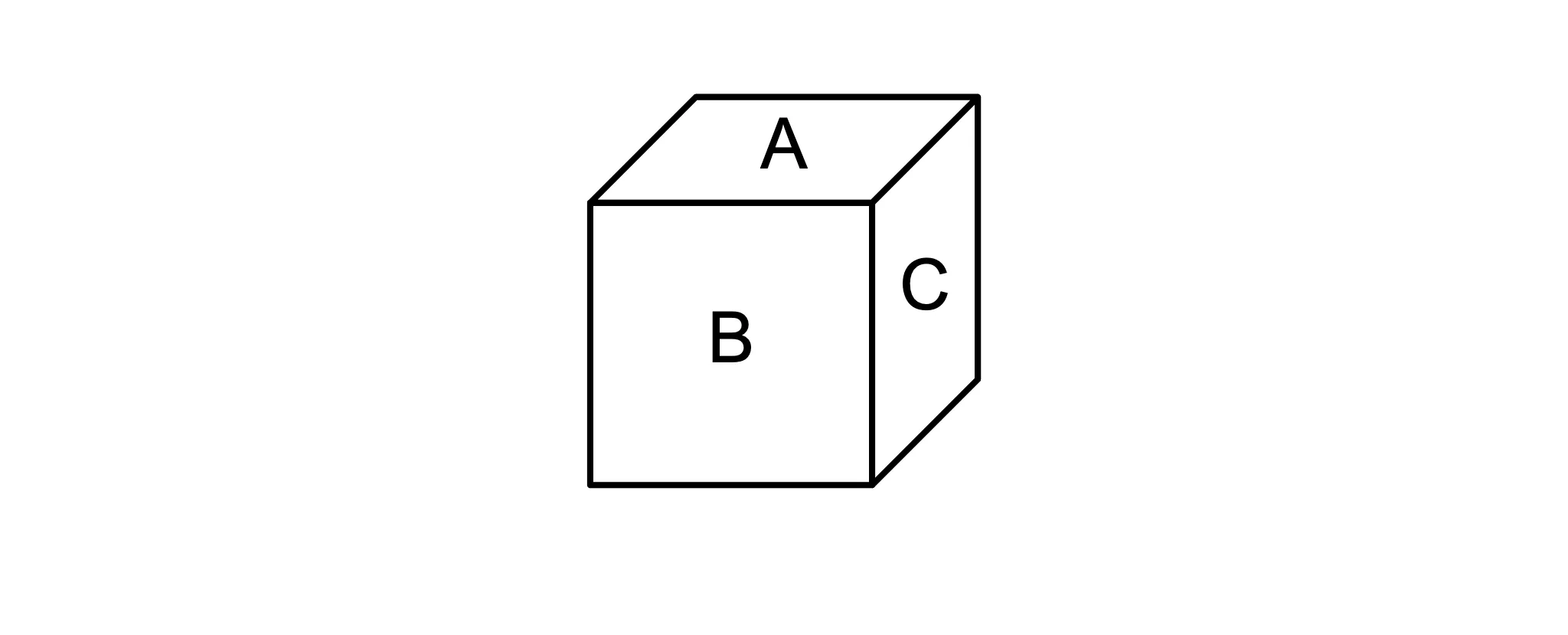
A dice reasoning example with two possible opposite faces
Separate what is certain from what is still unknown:
- The visible view proves that A and C are neighbours of B.
- A is opposite D. Since one face cannot have two opposites, D cannot also be opposite B. It must be another neighbour of B.
- Three neighbours of B are now known: A, C and D.
- The remaining labels are E and F, but no view tells us which one is B's fourth neighbour.
If E is the fourth neighbour, F is opposite B. If F is the fourth neighbour, E is opposite B. Both arrangements fit the information, so the strongest valid conclusion is that B is opposite to either E or F.
Common Mistakes
Assuming opposite faces add to 7
The sum-to-7 rule belongs only to a conventional numbered die. In a reasoning set with its own views or net, use the supplied arrangement unless the problem explicitly states the convention.
Treating opposite faces as adjacent
Opposite faces can never appear together in one three-face corner view. This is the fastest rejection test for net-folding options.
Reading the two sequences in different directions
The one common face rule requires the same direction in both views. Clockwise must be compared with clockwise, not clockwise with anticlockwise.
Pairing faces merely because they disappeared
When two views have only one common face, the remaining labels do not pair arbitrarily. Their circular positions around the fixed face decide the opposite pairs.
Counting the same neighbour twice
When using the four-neighbour method, build a set of distinct neighbours. Repeating a label in another view adds no new information.
Applying a net shortcut to the wrong shape
The straight-strip and staircase rules depend on the exact connections in the net. A turning path is not automatically the same as a straight row.
Checking labels but ignoring symbol direction
A symbol cube may have the correct three faces but the wrong printed orientation. Track the symbol's direction through every turn.
Forcing a unique answer
If two labels remain possible and no view separates them, the answer is a pair of possibilities. Certainty must come from the given information, not from a guess.
Safe Shortcuts
- Two labels repeat in both views: When the same two faces are visible in both positions, pair the two changing faces as opposites.
- One label repeats: Fix the common face and compare the circular orders in the same direction. Use this only when the orientation of the two views is read consistently.
- Four neighbours are known: The only unused label is opposite the chosen face. This works only after four distinct adjacent faces have been confirmed.
- A valid net has a straight strip of four: Pair alternate squares in that strip. Do not extend the shortcut to a bent path.
- Testing a proposed corner: Reject it immediately if it contains an opposite pair.
These shortcuts shorten correct spatial reasoning. They should not replace the condition check that makes each rule valid.
Frequently Asked Questions
What is the difference between a die and dice?
Traditionally, die is singular and dice is plural. Aptitude books often use “a dice” for one cube, so both wordings may appear in exam material.
How many faces are adjacent to one face of a die?
Every face is adjacent to four faces. The sixth face is opposite to it.
Do opposite faces of every numbered die add to 7?
No. They add to 7 on a conventional die. A reasoning question may assign the numbers differently, so follow the given views or net unless the convention is stated.
What is the two common faces rule?
If two views show the same two faces, the third visible faces are opposite. The two common faces act as a fixed hinge between the views.
What is the one common face rule?
Keep the single common face fixed. Read the surrounding faces in the same direction in both views, then pair faces in corresponding positions as opposites.
How do I find the opposite face in a dice net?
Look first for a straight strip or a cross through a central square. Pair faces that fold onto opposite sides, then use elimination to identify the remaining pair.
How can I tell whether a cube can be formed from a net?
Find the three opposite pairs. A proposed corner is impossible if any opposite pair appears together among its three visible faces.
Can three adjacent faces appear in a different order after rotation?
Yes, they can cycle around their shared corner. However, a mirror reversal is not produced by rotation, so directional symbols and ordered corner views need closer checking.
What should I do if several dice views are given?
Compare the most useful pair first. Prefer two views with two common faces, then a pair with one common face. Extra views can confirm the result or reveal the remaining neighbours.
How do I solve questions involving arrows or triangles?
Track both the occupied face and the printed direction. The symbol rotates with its square face when the cube turns.
Summary
Dice reasoning is built on one fixed fact: every face has four neighbours and one opposite. Compare repeated faces to discover opposite pairs, use net connections to understand folding, and reject any proposed corner that joins opposite faces. For rotations and directional symbols, move the whole cube as one rigid object. When the information leaves more than one valid possibility, state only what can be proved.