Coding and Decoding: Complete Beginner Guide with Easy Examples
Coding means changing a word, number or message by following a rule. Decoding means discovering that rule or using it to recover the original information.
Suppose:
Each letter has moved one place forward:
Once the rule is known, the same rule can be applied to another word.
Coding and decoding is not about guessing a word that looks right. A correct rule must explain every part of the given example in the same order. This article begins with alphabet positions and simple shifts, then builds into rearrangement, opposite letters, number codes, alternating rules, coded sentences, symbols and multi-step patterns.
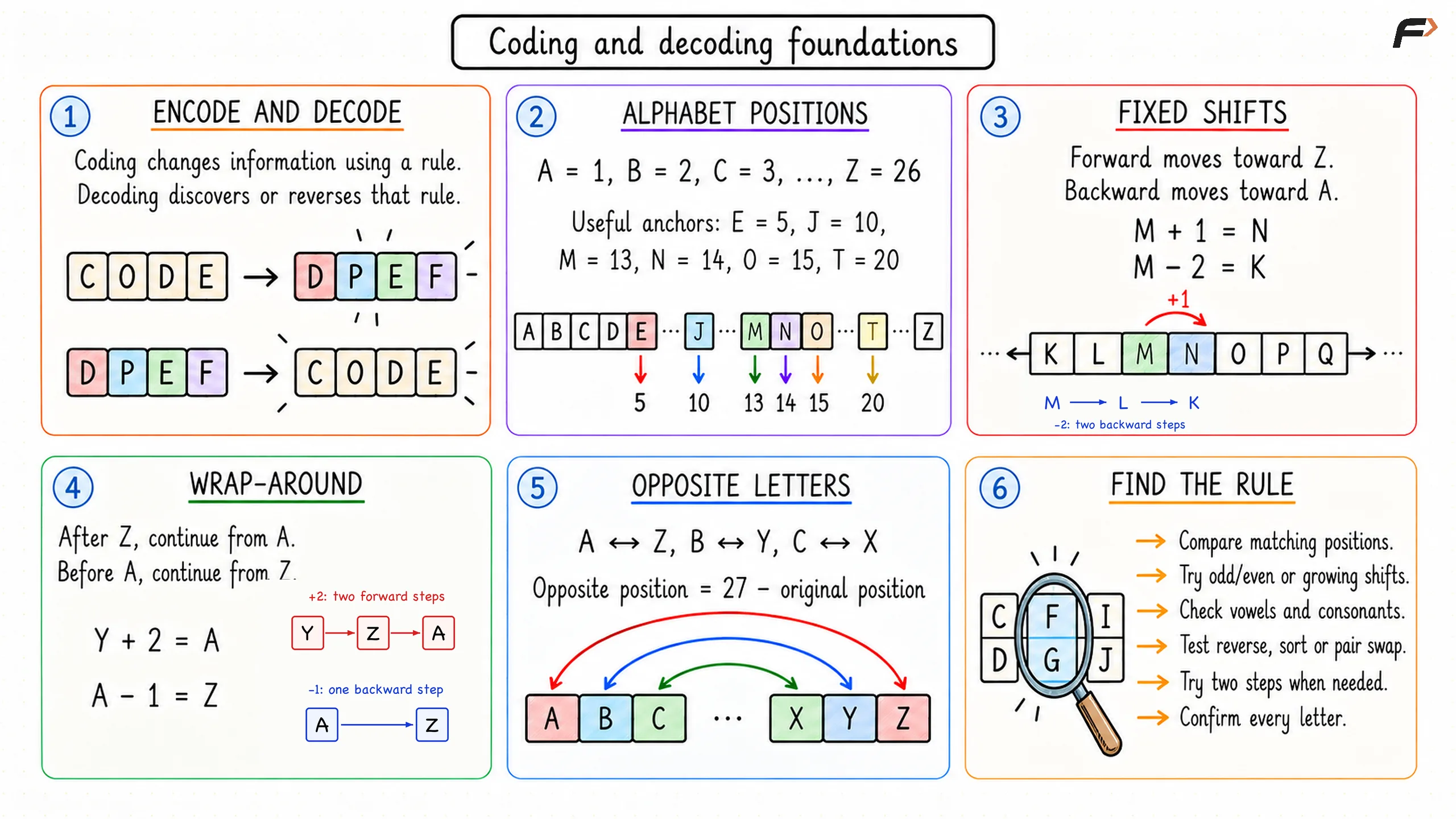
Coding and decoding foundations with alphabet positions, shifts, wrap-around and opposite letters
Basics: Encoding, Decoding and the Rule
To encode means to change normal information into a coded form. To decode means to understand or reverse that change.
For example, if every letter moves two places forward:
To decode , move every letter two places backward:
The original word is .
The same rule must be used consistently. If the first letter moves by , but later letters need unrelated shifts, then a simple rule is not correct.
Alphabet Positions
Every English letter has a position:
Some useful middle positions are:
Do not feel that all positions must be memorised at once. Start from letters you know and count carefully. With practice, common positions become automatic.
Forward and Backward Movement
A forward shift moves toward . A backward shift moves toward .
For example:
The sign means forward, and means backward.
Alphabet Wrap-Around
The alphabet is treated like a circle when a movement passes an end.
Moving forward after returns to :
Moving backward before returns to :
This is called wrap-around. It is not a special new rule. It simply lets the same shift continue through the end of the alphabet.
A Reliable Method for Finding a Code
Use this order instead of trying random ideas.
Step 1: Compare matching positions
Write the original and coded letters one under the other. Check whether every letter moves by the same amount.
Step 2: Check position-based movement
If one fixed shift fails, check odd and even positions or increasing shifts such as .
Step 3: Check letter type
Vowels and consonants may follow different rules.
Step 4: Check order changes
The word may be reversed, sorted alphabetically, or divided into swapped pairs.
Step 5: Check a two-step rule
The code may rearrange letters first and shift them afterward.
Step 6: Confirm every letter
Do not accept a rule because it fits only the first two letters. It must explain the complete example.
Fixed Forward Shift
In a fixed shift, every letter moves forward by the same number of places.
Example: If becomes , encode .
Slow solution:
- moves one place forward to .
- moves one place forward to .
- moves one place forward to .
- moves one place forward to .
- Keep the new letters in their original positions.
Answer:
Meaning: Nothing is reversed or rearranged. Each letter is simply replaced by the next alphabet letter.
A shift of two places
Example: If becomes , encode .
Slow solution:
The second also becomes , and becomes .
Answer:
Meaning: Repeated source letters receive the same coded letter because their rule and positions are the same.
Fixed Backward Shift
The same idea works in the backward direction.
Example: If becomes , encode .
Slow solution:
Join the letters:
Answer:
Meaning: The movement before continues from , so no exception is made for the third letter.
A backward shift of two places
Example: If becomes , encode .
Slow solution:
Answer:
Meaning: The first and last both become , confirming that the same fixed rule is used.
Reversing the Word
Sometimes letters do not change at all. Only their order changes.
Example: If becomes , encode .
Slow solution:
Write from right to left:
Answer:
Meaning: Reversal changes positions but keeps every letter unchanged.
Arranging Letters Alphabetically
Another order rule sorts letters from toward .
Example: If becomes , encode .
Slow solution:
The letters of are . Starting with the earliest alphabet letter gives:
Answer:
Meaning: The code is an ordered arrangement, not a letter shift.
Opposite Letters
Opposite letters are equally far from opposite ends of the alphabet:
Their position values add to :
Example: If becomes , encode .
Slow solution:
- is second from the start, so is second from the end.
- is position , so its opposite is position , which is .
- is position , so its opposite is position , which is .
- is fourth from the start, so its opposite is .
Answer:
Meaning: Opposite coding replaces letters but keeps their positions in the word unchanged.
Word-to-Number Code by Adding Positions
A word can be coded as the sum of its alphabet positions.
Example: If is coded as , find the code for .
Slow solution:
Answer:
Meaning: The output is one total number, not three values written beside each other.
Joining Values Instead of Adding Them
Sometimes position values are written next to each other. This is called concatenation, which simply means joining items without adding them.
Example: If is coded as , find the code for .
Slow solution:
- First letter .
- Last letter .
- has letters.
- Join , and :
Answer:
Meaning: The places of the digits show separate pieces of information. No arithmetic is performed between them.
Two-Step Rule: Reverse, Then Shift
In a two-step code, order matters. Reversing after shifting may give a different result from shifting after reversing.
Example: If becomes , encode .
Slow solution:
- Reverse :
- Shift every reversed letter forward once:
- Join the coded letters:
Answer:
Meaning: The letters are first placed in reverse positions and only then changed.
Reverse, then move backward
Example: If becomes , encode .
Slow solution:
- Reverse the source word:
- Move each reversed letter one place backward:
- Join the letters:
Answer:
Meaning: The is fourth after reversal, and its backward movement wraps to .
Alternating Odd and Even Positions
An alternating rule switches between two movements. Odd positions are and so on. Even positions are and so on.
Example: If becomes , encode .
Slow solution:
- Position 1: .
- Position 2: .
- Position 3: .
- Position 4: .
- Position 5: .
Answer:
Meaning: The rule belongs to positions, not to the letters themselves.
Different alternating shift sizes
Example: If becomes , encode .
Slow solution:
Answer:
Meaning: Wrap-around lets the even-position move backward to without breaking the rule.
Vowel and Consonant Rules
Vowels are . Other alphabet letters are consonants. Some codes use letter type instead of word position.
Example: If becomes , encode .
Slow solution:
- is a consonant, so .
- is a vowel, so .
- is a consonant, so .
- is a vowel, so .
- is a vowel, so .
Answer:
Meaning: Two neighbouring vowels do not alternate automatically. Both follow the vowel rule.
Consonants and vowels with different shift sizes
Example: If becomes , encode .
Slow solution:
Answer:
Meaning: The two vowels and both move backward, while the three consonants move forward.
Increasing Position Shifts
The movement can grow with the letter position.
Example: If becomes , encode .
Slow solution:
Answer:
Meaning: The amount of movement is set by the position, so later letters move farther.
Increasing backward shifts
Example: If becomes , encode .
Slow solution:
The third movement wraps backward through . Continue:
Answer:
Meaning: The two source letters receive different codes because they occur in different positions.
Swapping Adjacent Pairs
Divide the word into pairs from the left and exchange the two letters in each pair.
Example: If becomes , encode .
Slow solution:
Join the changed pairs:
Answer:
Meaning: Pair order changes, but the order of the three pair blocks stays the same.
Pair Swap Followed by a Shift
Example: If becomes , encode .
Slow solution:
- Divide into pairs:
- Swap each pair:
- Move every letter forward once:
Answer:
Meaning: The two letters wrap to after the pair arrangement is complete.
Reverse Followed by Opposite Letters
Example: If becomes , encode .
Slow solution:
- Reverse :
- Replace each letter by its opposite:
Answer:
Meaning: Repeated letters remain repeated after both become .
Alphabetical Order Followed by a Shift
Example: If becomes , encode .
Slow solution:
- Sort :
- Move every letter forward two places:
Answer:
Meaning: Sorting places the repeated letters together, and both wrap forward to .
More Detailed Number Codes
Number codes may use selected letters, word length, products or separate groups. The sample must prove every part of the rule.
Example: If is coded as , find the code for .
Slow solution:
- The middle three letters of are .
- Their positions are:
- Add them:
- Add the word length, which is :
Answer:
Meaning: The outside letters are not used directly in the sum. They affect the code only because they are counted in the five-letter length.
Example: If is coded as , find the code for .
Slow solution:
Answer:
Meaning: Only the outside letters are multiplied. The middle letters affect the code only through the word length.
Two-part number code
Example: If is coded as -, find the code for .
Slow solution:
- Outside letters of are and :
- Middle letters are , and :
- Keep the two totals separate:
Answer: -
Meaning: The dash separates two groups. It is not subtraction.
Coded Language Using Common Words
In coded-language problems, complete words are replaced by short codes. Repeated words help us identify repeated codes.
Example:
- “red blue green” is coded as “pa lo me”.
- “green yellow red” is coded as “me tu pa”.
Find the code for “blue”.
Slow solution:
- The common words are red and green.
- The common codes are pa and me.
- This matches red with pa and green with me in the given order here.
- In the first sentence, blue is the only word left.
- “lo” is the only code left.
Answer:
Meaning: Removing already matched pairs leaves a single word and a single code.
Three coded sentences
Example:
- “smart coder wins” is coded as “ne pa zo”.
- “smart logic works” is coded as “ne ku re”.
- “fast coder works” is coded as “la pa re”.
Find the code for “logic”.
Slow solution:
- First and second sentences share smart. Their common code is , so smart .
- First and third share coder. Their common code is , so coder .
- Second and third share works. Their common code is , so works .
- The second sentence now has only logic and unmatched.
Answer:
Meaning: Three comparisons confirm the common codes before the remaining code is assigned.
Symbol Codes as Instructions
A symbol may stand for an instruction such as “add ” or “square the current result.” Read whether the instructions act one after another.
Example: Suppose @ means “add ,” # means “multiply the current result by ,” and the dollar sign means “subtract .” Evaluate the symbol chain 6 @ # $.
Slow solution:
- Apply @:
- Apply # to the current result:
- Apply $:
Answer:
Meaning: The full operation is , because every new symbol uses the current result.
Square, subtract and divide
Example: Suppose & means “square the current result,” % means “subtract ,” and ! means “divide by .” Evaluate &%!.
Slow solution:
Answer:
Meaning: The operation is , not .
Advanced Multi-Step Codes
Harder codes combine several simple ideas. The safe method is to identify and test one stage at a time.
Reverse, then alternate shifts
Example: becomes . Encode using the same rule.
Slow solution:
- Reverse :
- Apply :
Answer:
Meaning: Odd and even positions are counted after reversal, because reversal is the first stage.
Opposite letters followed by position shifts
Example: becomes . Encode .
Slow solution:
- opposite is ; .
- opposite is ; .
- opposite is ; through wrap-around.
- opposite is ; .
- opposite is ; .
- opposite is ; .
- opposite is ; .
Answer:
Meaning: The opposite step depends on the letter, while the second step depends on its position.
Reverse, pair swap and backward shift
Example: becomes . Encode .
Slow solution:
- Reverse :
- Split into and swap complete pairs:
- Move every letter two places backward:
Answer:
Meaning: The odd final is not swapped, but it still receives the final shift.
Sort, then use vowel and consonant shifts
Example: becomes . Encode .
Slow solution:
- Sort :
- Apply the letter-type rule:
Answer:
Meaning: Vowel and consonant labels are checked after sorting, although the type of each letter itself does not change.
Coding Data Sufficiency
Sometimes the task is not merely to find a possible code. It is to decide whether the given examples force one clear rule.
One example can support many invented rules. In normal coding exercises, answer options and the expected simple pattern help select the intended rule. In data sufficiency, the information must be strong enough to produce one definite result under the stated conditions.
Example: Find the code for .
Statement I: .
Statement II: .
Slow solution:
From Statement I:
The clear rule is . Apply it:
Statement I is sufficient.
Now reset and use only Statement II:
This also gives the complete rule, so Statement II is sufficient by itself.
Answer: Either statement alone is sufficient.
Meaning: The statements do not need to be combined because each independently supplies the same usable rule.
When even both statements do not fix a code
Example: Find the code for .
Statement I: .
Statement II: .
Slow solution:
- Test Statement I alone. The letters are rearranged, but one example does not state which positions must be selected for another word. More than one special rule could produce from .
- Test Statement II alone. Reversal explains , but this does not agree with Statement I.
- Combine them. A common reversal rule fails on , while a special rule created for is not confirmed by .
- Therefore, the code for the target is not forced to one value.
Answer: Cannot be determined.
Meaning: Two examples are not automatically sufficient. They must support the same clear rule.
Common Mistakes
Accepting a rule that fits only the first letter
Check every letter or every number in the sample. One mismatch means the rule is incomplete or wrong.
Forgetting alphabet wrap-around
Continue from after in a forward shift, and from before in a backward shift.
Confusing letter movement with letter order
First check whether letters changed, moved to new positions, or both.
Applying two steps in the wrong order
“Reverse then shift” may differ from “shift then reverse” when position-based rules are involved.
Mixing odd-even rules with vowel-consonant rules
Odd and even depend on position. Vowel and consonant depend on the letter itself.
Starting position counts from zero
In these patterns, the first letter is position , not position .
Losing repeated letters while sorting
Alphabetical arrangement keeps every occurrence. Two letters remain two letters.
Adding joined number values
Check whether values are summed or simply written beside each other.
Treating a dash as subtraction automatically
A code such as - can contain two separate totals. Read the pattern before doing arithmetic.
Assuming coded-word order matches normal-word order
In coded language, use common words and common codes. Do not rely only on position unless the system states that order is preserved.
Using BODMAS when symbols are sequential machine instructions
If each symbol acts on the current result, follow that stated sequence. If symbols replace ordinary binary operators, then normal mathematical order may apply.
Forcing a complicated pattern
Try fixed shifts and simple rearrangements first. A long rule is acceptable only when every simpler rule fails and every stage is supported.
Believing one possible rule is always uniquely proven
In data sufficiency, the information must force the requested code, not merely allow one imaginative explanation.
Formulas and Cheat Sheet
| Concept | Rule or notation | Simple meaning |
|---|---|---|
| Alphabet position | Number value of a letter | |
| Forward shift | New position | Move toward |
| Backward shift | New position | Move toward |
| Wrap-around | Continue cyclically through and | Alphabet acts like a circle |
| Opposite letter | Opposite position | , |
| Reverse | Read from last letter to first | Order changes, letters stay same |
| Alphabetical arrangement | Sort from toward | Keep repeated letters |
| Odd-even code | Apply one rule to and another to | Rule depends on position |
| Vowel-consonant code | Apply rules by letter type | Vowels are |
| Increasing shift | Position receives shift | |
| Adjacent pair swap | Swap inside each pair | |
| Word-position sum | Add chosen alphabet positions | Output is a number |
| Concatenation | Join values without adding | |
| Coded language | Common word common code | Use sentence overlap |
| Sequential symbol code | Apply each instruction to current result | Preserve stated order |
| Data sufficiency | Test each statement independently | Need one definite result |
Safe Shortcuts
- Write original and coded words in two aligned rows.
- Mark each direct movement as or .
- If one fixed shift fails, check odd-even positions and vowel-consonant types.
- If direct comparison looks random, test reverse, alphabetical order or pair swapping.
- For a two-step code, write the intermediate word before the final change.
- Use to find an opposite letter quickly.
- Preserve repeated letters during reversal or sorting.
- For word-to-number codes, label which letters and which operation create each number.
- In coded language, circle repeated words and repeated codes before assigning anything.
- For symbol machines, rewrite the symbols as full instructions with brackets.
- Test a proposed rule against every part of the sample before using it.
- In data sufficiency, reset before checking the second statement alone.
A shortcut is safe only when the whole sample confirms it. It should reduce repeated work after the rule is proved, not turn the rule into a guess.
Frequently Asked Questions
What is coding and decoding in reasoning?
Coding changes information using a rule. Decoding finds or reverses that rule.
How do I find a coding-decoding pattern?
Compare matching positions first, then check fixed shifts, odd-even shifts, letter types, reversal, sorting, pair swapping and two-step combinations.
What are alphabet positions?
They are the number values through .
What is alphabet wrap-around?
It means continuing from after moving forward past , or continuing from after moving backward past .
What are opposite letters?
Opposite letters are equally far from opposite alphabet ends, such as and , and , or and .
How do I quickly find an opposite letter?
Subtract its alphabet position from . The result is the opposite letter's position.
What is an alternating letter code?
It uses one rule for one set of positions and another rule for the next set, commonly odd and even positions.
How is a vowel-consonant code different from an odd-even code?
Vowel-consonant coding depends on the letter type. Odd-even coding depends on where the letter appears.
What should I do when a direct shift does not work?
Check whether the word was reversed, sorted, split into pairs or transformed in more than one stage.
How do I solve coded-language sentences?
Compare sentences, identify repeated words and match them with repeated codes. Then use the unmatched words and codes.
Does code order always match sentence word order?
No. Unless order is clearly stated, use overlaps instead of assuming the first word always has the first code.
How do I solve symbol coding?
Replace each symbol with its stated instruction. Decide whether symbols act sequentially on the current result or stand for ordinary mathematical operators.
What is concatenation in number coding?
Concatenation means joining values. For example, joining , and gives .
How do I know whether number values should be added or joined?
Test both ideas against the complete sample. The correct operation must reproduce the given code exactly.
Can one word example prove only one possible rule?
Mathematically, many invented rules can fit one example. Reasoning exercises expect the simplest consistent rule supported by the pattern and options. Data sufficiency needs stronger proof of one definite result.
What is the best way to avoid mistakes in multi-step coding?
Write every intermediate stage on a separate line and check it against the sample before moving to the next stage.
Summary
Coding and decoding is the study of rule-based changes. Begin with alphabet positions, forward and backward shifts, and wrap-around. Then check order rules such as reversal, alphabetical arrangement and adjacent pair swaps.
If one simple rule does not fit, test odd-even positions, vowel-consonant rules, increasing position shifts or a two-step combination. For number codes, decide whether values are added, multiplied, grouped or joined. For coded language, use common words and common codes. For symbol instructions, follow the exact order stated.
The most important habit is full verification. A rule is useful only when it explains every letter, number, word or symbol in the sample without hidden exceptions.