Clocks
Clock aptitude studies how the hour, minute and second hands move around a clock face. The main ideas are the position of each hand, the angle between two hands, the time at which they meet, and the error shown by a fast or slow clock.
For example, at 2:20 the minute hand is exactly on the 20-minute mark, but the hour hand is not exactly on 2. Twenty minutes have passed, so the hour hand has already moved one-third of the way from 2 to 3.
We will begin with the clock face, degrees and hand speeds. Then we will build through smaller and reflex angles, minute spaces, mirror images, coincidences, right angles, repeated positions and faulty clocks.
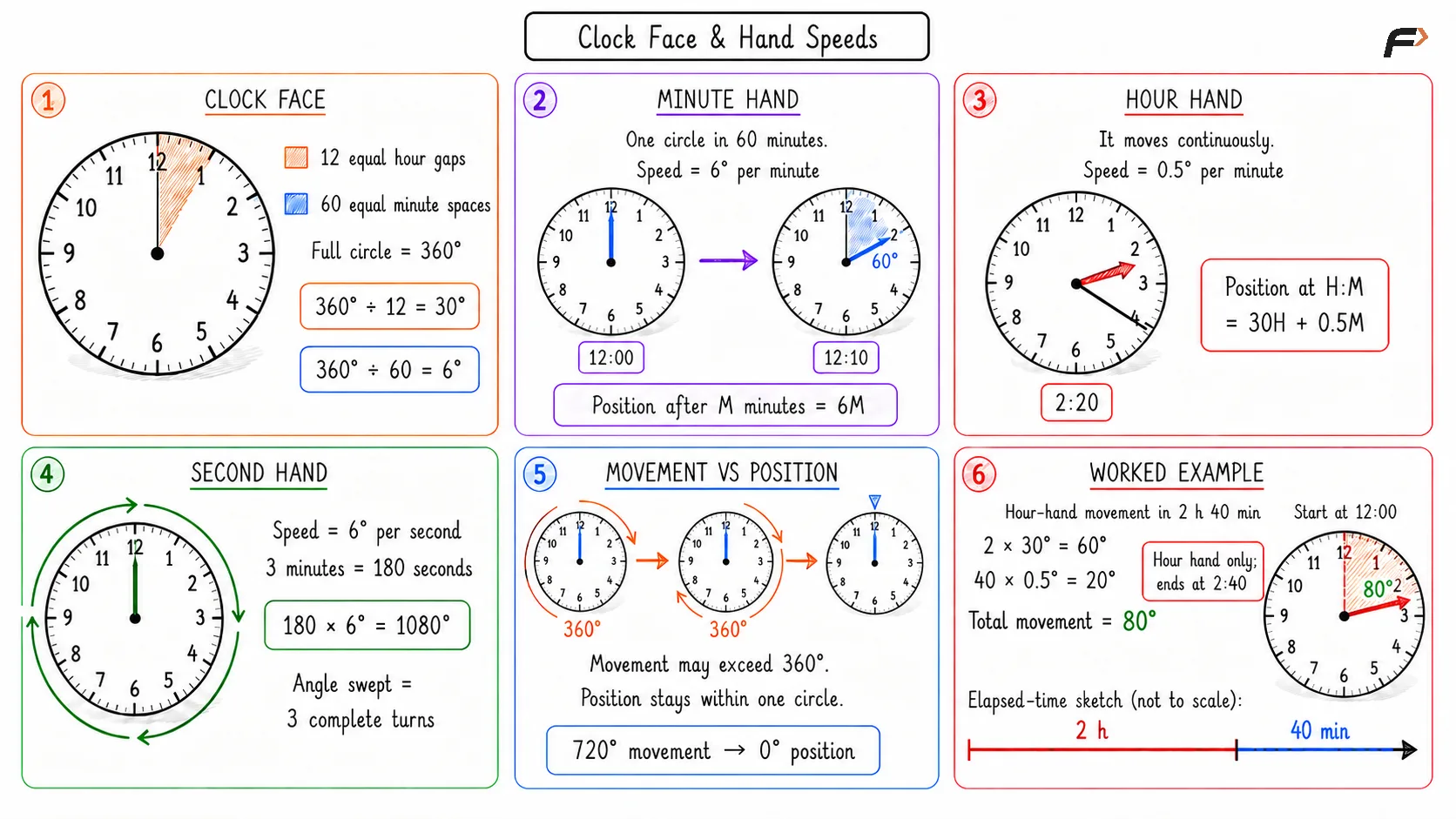
Clock face and hand speeds
Basics: The Clock Face and a Full Circle
An ordinary clock face is a circle divided into 12 equal hour gaps and 60 equal minute gaps. One complete turn around a circle is .
The angle between two neighbouring hour numbers is:
The angle between two neighbouring minute marks is:
Therefore, one hour gap contains five minute spaces because .
We measure hand positions clockwise from 12. The 12 o'clock direction is or . The number 3 is at , 6 is at , and 9 is at .
How Fast Each Hand Moves
Each hand completes a circle in a different amount of time.
Minute hand speed
The minute hand completes in 60 minutes. Therefore, in one minute it moves:
If minutes have passed after the hour, its position is:
Hour hand speed
The hour hand completes in 12 hours. In one hour it moves:
It does not jump from one number to the next. It moves continuously. Since it covers in 60 minutes, it moves:
per minute.
At , its position is:
For 12 o'clock, use in angle calculations. For example, 12:20 uses and .
Second hand speed
The second hand completes in 60 seconds, so it also moves per second.
Example: Through how many degrees does the hour hand move in 2 hours 40 minutes?
What we know: The hour hand moves per hour and per minute.
What we are finding: We need its total movement, not its final clock-face position.
Why this method applies: The two parts of the elapsed time can be converted into angles and added.
Slow solution: In 2 hours, the hour hand moves:
In 40 minutes, it moves:
Add both movements:
Meaning of the answer: The hour hand turns through in 2 hours 40 minutes.
Example: Find the total angle swept by the second hand in 3 minutes.
What we know: Three minutes contain seconds.
What we are finding: “Angle swept” means the full movement, including complete turns.
Why this method applies: The second hand moves each second.
Slow solution: Multiply the time by the speed:
This is three complete circles because .
Meaning of the answer: The second hand sweeps . We do not reduce it to because total movement is being measured.
Position Is Different from Movement
A hand's movement may be greater than because it can complete several rounds. Its position on the clock face is always somewhere within one circle.
For example, after two complete rounds the second hand returns to its starting position. Its movement is , but its final position is the same as .
Read the wording carefully. “How far did the hand turn?” asks for movement. “Where is the hand?” or “What angle does it make from 12?” asks for position.
Angle Between the Hour and Minute Hands
At , calculate both hand positions from 12 and take their positive difference:
Combining the minute terms gives the direct form:
The value is one of the two angles between the hands. The other is .
The smaller angle is:
The larger angle, also called the reflex angle, is:
Why the hour hand must move with the minutes
At 2:30, the hour hand is halfway between 2 and 3. Keeping it exactly at 2 would lose of movement because .
This is the most common source of wrong clock angles. The minute part must always be added to the hour-hand position.
Example: Find the smaller angle at 2:20.
What we know: The hour is 2 and the minutes are 20.
What we are finding: We need the smaller of the two angles between the hands.
Why this method applies: Finding each hand's exact position includes the hour hand's movement after 2 o'clock.
Slow solution: Find the minute-hand position:
Find the hour-hand position:
Take the difference:
Since , it is already the smaller angle.
Meaning of the answer: The smaller angle at 2:20 is .
Example: Find the smaller angle at 9:15.
Slow solution: The minute hand is at:
The hour hand is at:
The direct difference is:
This is greater than , so it is the larger way around the clock. Find the smaller angle:
Meaning of the answer: The smaller angle is , which is obtuse because it is between and .
Acute, Right, Obtuse, Straight and Reflex Angles
The size of an angle gives it a name:
- An acute angle is less than .
- A right angle is exactly .
- An obtuse angle is greater than but less than .
- A straight angle is exactly .
- A reflex angle is greater than but less than .
Example: Find the reflex angle at 10:50.
What we know: We must find the larger angle, not the smaller one.
Why this method applies: The two angles around a point add to .
Slow solution: The minute hand is at:
The hour hand is at:
The smaller gap is:
Subtract it from a full circle:
Meaning of the answer: The reflex angle at 10:50 is .
Minute Spaces Between the Hands
A minute space is the small gap between two neighbouring minute marks. One minute space equals .
The minute hand's position in minute spaces is simply . The hour hand is at five spaces for each completed hour and moves of a minute space every minute:
After finding the positive difference, subtract it from . Compare the two answers and choose the smaller separation.
Example: Find the smaller separation in minute spaces at 9:18.
What we know: The minute hand is at space 18.
What we are finding: We need the number of small clock gaps, not degrees.
Why this method applies: Measuring both hand positions in the same minute-space unit avoids converting from degrees at the end.
Slow solution: The hour-hand position is:
The direct separation is:
The other way around is:
Choose the smaller value.
Meaning of the answer: The hands are separated by minute spaces.
Example: At 2:24 the hand angle is . Convert it to minute spaces.
Slow solution: One minute space is , so:
Meaning of the answer: The hands are 12 minute spaces apart.
Relative Speed of the Hands
The minute hand moves at per minute, while the hour hand moves at per minute. Both move clockwise, so the minute hand gains on the hour hand at:
This relative speed tells us how quickly the gap between the two hands changes.
If the minute hand must gain degrees, the time required is:
This one idea explains coincidences, opposite positions and right angles.
When the Hands Coincide
The hands coincide when they lie exactly on top of each other. At , the hour hand is degrees ahead of the minute hand. The minute hand must close this gap at per minute.
Therefore, the first coincidence after o'clock occurs after:
For , this gives 60 minutes, which is exactly 12:00. There is no separate coincidence strictly between 11:00 and 12:00.
Example: Find the first time after 1:00 when the hands coincide.
What we know: At 1:00, the hour hand is ahead.
What we are finding: We need the time the faster minute hand takes to close that gap.
Why this method applies: The gap closes at the relative speed of per minute.
Slow solution: Divide the gap by the relative speed:
Meaning of the answer: The hands first coincide at .
Time between two coincidences
After one coincidence, the minute hand must gain one complete circle, or , to meet the hour hand again:
In 12 hours, the hands coincide 11 times. Endpoint wording still matters when only part of the 12-hour period is counted.
Example: How many times do the hands coincide from 12:00 to the next 12:00 when the starting 12:00 is excluded and the ending 12:00 is included?
Slow solution: The hands make 11 new coincidences in the next 12 hours. Excluding the starting coincidence removes the one at the beginning, while including the ending coincidence counts the one at the next 12:00.
Meaning of the answer: The hands coincide 11 times in the stated interval.
Example: How many coincidences occur between 6:00 and 12:00 when 6:00 is excluded and 12:00 is included?
Slow solution: Coincidences occur once between 6 and 7, 7 and 8, 8 and 9, 9 and 10, and 10 and 11. That gives five. The next coincidence is exactly at 12:00, and the endpoint is included.
Meaning of the answer: The total is 6 coincidences.
When the Hands Form a Right Angle
The hands are perpendicular when they form a right angle of .
At a general time , solve:
The two signs hidden inside the absolute value represent the two sides of the hour hand. Within one hour, there may be zero, one or two valid values of . Keep only values from 0 to less than 60 minutes.
Example: Find the first time after 5:00 when the hands are perpendicular.
What we know: At 5:00, the hour hand is ahead of the minute hand.
What we are finding: We need the first time this gap becomes .
Why this method applies: The minute hand closes the gap at per minute.
Slow solution: The gap must fall from to , so it must shrink by:
Divide by the relative speed:
Meaning of the answer: The first right angle occurs at .
First and second right angles in an hour
At 3:00, the hands already form a right angle. If the starting instant is counted, it is the first right angle. The next one occurs after the minute hand passes the hour hand and becomes ahead.
Example: Find the second instant at or after 3:00 when the hands form a right angle.
Slow solution: At 3:00, the hour hand is ahead, so that is the first instant. For the second instant, the minute hand must go from behind to ahead. Its total relative gain is:
The time is:
Meaning of the answer: The second right angle occurs at .
Example: Find the second time after 6:00 when the hands are perpendicular.
Slow solution: At 6:00, the hands are apart. The first right angle occurs after the minute hand gains . The second occurs after it gains in total, moving from behind to ahead:
Meaning of the answer: The second right angle after 6:00 occurs at .
Time between consecutive right angles
The two right-angle positions are apart in relative movement. Therefore, consecutive right angles are separated by:
The hands form 22 right angles in 12 hours.
Example: How many right angles occur from just after 9:00 to 3:00, with 9:00 excluded and 3:00 included?
What we know: The interval is 6 hours, or 360 minutes. A right angle already exists at 9:00, but it is excluded.
Why this method applies: Each next right angle occurs after minutes.
Slow solution: Divide the interval by the spacing:
The eleventh new right angle lands exactly at 3:00, which is included.
Meaning of the answer: The hands form a right angle 11 times in the stated interval.
When the Hands Are Opposite
The hands are opposite when they form a straight angle of . Use:
As with right angles, solve both possible directions and keep only minute values within the required hour.
After one opposite position, the next opposite position occurs after the minute hand gains a complete relative to the hour hand. Therefore, opposite positions repeat every minutes and occur 11 times in 12 hours.
Example: Find the first time after 4:00 when the hands are opposite.
What we know: At 4:00, the hour hand is ahead. The minute hand must become ahead on the other side for the first future opposite position.
Slow solution: Its required relative gain is:
So:
Meaning of the answer: The first opposite position after 4:00 is at .
Mirror Image of a Clock
A vertical mirror placed in front of a clock flips left and right. The actual time and its mirror time add to 12:00 on a 12-hour clock.
For ordinary times with nonzero minutes, it is convenient to borrow one hour and write:
Then:
At exact hours, subtract from 12:00 directly. The mirror of 12:00 is 12:00, not 0:00.
Example: Find the mirror image of 2:45.
What we know: A vertical mirror is being used.
What we are finding: We need the reflected reading, not the actual time.
Why this method applies: Actual and mirror readings complete 12 hours together.
Slow solution: Write 12:00 as 11:60 and subtract:
The minute hand on 9 reflects to 3, which shows 15 minutes. This agrees with the subtraction.
Meaning of the answer: The mirror image is 9:15.
Example: Find the mirror image of 7:35.
Slow solution: Subtract:
Meaning of the answer: The reflected time is 4:25.
Mirror time is not water image time
A vertical mirror reverses left and right. A water image would reverse top and bottom. The subtraction rule taught here is for a vertical mirror placed in front of the clock.
Correct, Fast and Slow Clocks
A correct clock shows the true time. A clock that gains time runs fast and shows a time ahead of the truth. A clock that loses time runs slow and shows a time behind the truth.
If a clock gains or loses minutes in true hours, its error after true hours changes in the same ratio:
Keep time units consistent. If is in hours, use in hours too.
Example: A clock loses 4 minutes every 8 hours. Find its error after 40 true hours.
What we know: Losing time means the clock is behind.
What we are finding: We need the accumulated error after five equal time groups.
Why this method applies: The clock loses time at a constant rate.
Slow solution: Find the number of 8-hour groups:
Each group creates a loss of 4 minutes:
Meaning of the answer: The clock is 20 minutes slow after 40 true hours.
Example: A clock gains 7 minutes every 14 hours. How far from the true time is it after 28 hours?
Slow solution: The elapsed time is twice 14 hours, so the gain is twice 7 minutes:
Meaning of the answer: The clock is 14 minutes fast.
Finding the Time Shown by a Faulty Clock
First find the correct clock time after the true elapsed time. Then add the gain or subtract the loss.
For elapsed times longer than 12 or 24 hours, reduce the true time carefully. On a 12-hour display, adding 12 hours returns to the same reading. Adding 24 hours also returns to the same reading with the same a.m. or p.m. position.
Example: A clock is correct at 5:00 and gains 6 minutes every 12 hours. What will it show after 24 true hours?
What we know: After 24 true hours, the correct reading returns to 5:00. The clock gains at a constant rate.
Why this method applies: We need both the correct future time and the accumulated gain.
Slow solution: Twenty-four hours contains two groups of 12 hours:
The total gain is:
Add the gain to the correct reading:
Meaning of the answer: The fast clock shows 5:12.
Example: A watch is correct at 8:00 and loses 5 minutes every 15 hours. What will it show after 30 true hours?
Slow solution: The watch loses:
After 30 true hours, the correct clock time is 6 hours after 8:00 because . The correct reading is 2:00. Subtract the loss:
Meaning of the answer: The slow watch shows 1:50.
Finding True Time from a Faulty Reading
When the faulty clock's displayed elapsed time is given, simply adding the stated loss may be wrong. The stated gain or loss is measured over true time, so we need a rate ratio.
Suppose a clock loses minutes in true minutes. During those true minutes, it shows only minutes. Therefore:
If it gains minutes, it shows minutes during true minutes:
Example: A clock loses 6 minutes every 12 true hours. It shows an elapsed time of 474 minutes. Find the true elapsed time.
What we know: Twelve hours is 720 true minutes. The slow clock shows only 714 minutes during that time.
What we are finding: We need the true elapsed time behind a displayed elapsed time.
Why this method applies: The loss rate is based on true time, so displayed time and true time must be compared as a ratio.
Slow solution: Write the rate ratio:
If 119 shown minutes need 120 true minutes, then 474 shown minutes need:
The true value is larger than 474, which makes sense because the clock is slow.
Meaning of the answer: The true elapsed time is minutes.
Separation Between Two Faulty Clocks
When two clocks start together, compare how far each moves away from the correct time.
If one clock gains minutes per day and another loses minutes per day, they move in opposite directions. Their separation grows by:
minutes per day.
If both gain or both lose, subtract the smaller rate from the larger rate because they move in the same direction relative to the truth.
Example: One clock gains 9 minutes per day and another loses 6 minutes per day. Find their separation after 48 hours.
What we know: Forty-eight hours is 2 days. One clock moves ahead and the other moves behind.
Why this method applies: Their errors grow on opposite sides of the correct time, so the sizes are added.
Slow solution: In one day, the separation is:
In two days:
Meaning of the answer: The clock readings are 30 minutes apart after 48 true hours.
Example: Clock A gains 11 minutes per day and Clock B loses 13 minutes per day. Find their separation after 60 hours.
Slow solution: Convert the time to days:
The daily separation is:
Therefore:
Meaning of the answer: The readings are 60 minutes apart.
Common Mistakes
Keeping the hour hand exactly on the hour number
The hour hand moves every minute. At , always include .
Using the direct difference as the smaller angle
If the difference is greater than , subtract it from .
Reducing a total angle swept to one circle
When total movement is requested, complete turns must remain in the answer.
Mixing degrees and minute spaces
One minute space equals . Make sure both hand positions use the same unit before subtracting.
Using 6 instead of 5.5 as relative speed
The hour hand also moves. The minute hand gains only per minute.
Keeping an impossible time within an hour
When an equation gives or , that value does not lie in the stated hour.
Forgetting interval endpoints
Check whether the starting time and ending time are included, especially for coincidences and right angles.
Using the mirror formula for a water image
The rule is for a vertical mirror in front of the clock.
Treating gain as slow or loss as fast
A gaining clock is ahead. A losing clock is behind.
Applying error to displayed time instead of true time
When the faulty clock's displayed elapsed time is given, use the shown-to-true rate ratio.
Adding two faulty-clock errors in every case
Add errors when one gains and one loses. If both move in the same direction, subtract their rates.
Formulas and Cheat Sheet
| Concept | Formula or rule | Condition or meaning |
|---|---|---|
| Hour gap | Between neighbouring hour numbers | |
| Minute space | Between neighbouring minute marks | |
| Minute-hand speed | per minute | One circle in 60 minutes |
| Hour-hand speed | per minute | in 60 minutes |
| Second-hand speed | per second | One circle in 60 seconds |
| Minute-hand position | minutes after the hour | |
| Hour-hand position | Use for 12 in angle work | |
| Direct hand difference | ||
| Smaller angle | Result from to | |
| Reflex angle | Larger angle between the hands | |
| Hour hand in minute spaces | One hour gap is 5 spaces | |
| Relative speed | per minute | Minute hand relative to hour hand |
| Time for relative gain | minutes | Both hands move clockwise normally |
| Coincidence after | minutes | First meeting after o'clock |
| Time between coincidences | minutes | One full relative circle |
| Coincidences in 12 hours | 11 | Check included endpoints |
| Right-angle equation | ||
| Time between right angles | minutes | Consecutive right-angle positions |
| Right angles in 12 hours | 22 | Check included endpoints |
| Opposite-hands equation | ||
| Mirror time | Vertical mirror; handle exact hours carefully | |
| Faulty-clock error | Error in true units, after true units | |
| Slow clock rate | Shown : true | and use the same unit |
| Fast clock rate | Shown : true | and use the same unit |
| Opposite faulty errors | Separation rate | One clock gains and one loses |
| Same-direction errors | Separation rate |
Safe Shortcuts
- At , use for the direct difference. Then subtract that answer from and choose the smaller angle.
- At exact hours, the minute hand is at and the hour hand is at .
- Convert degrees to minute spaces by dividing by 6, and spaces to degrees by multiplying by 6.
- For meeting and angle-time calculations, use relative speed per minute only when both hands move normally clockwise.
- Hands coincide 11 times and form right angles 22 times in 12 hours, but always check whether endpoints are included.
- For a vertical mirror, subtract from 11:60 when minutes are nonzero. Check 12:00 and exact hours separately.
- For a constant faulty-clock rate, grouping is quickest when elapsed time is an exact multiple of the stated period.
- When one clock gains and another loses, add their error rates. When both gain or both lose, subtract the rates.
- If displayed elapsed time is given instead of true elapsed time, use the rate ratio rather than simply adding the error.
A shortcut is safe only when its condition is clear. It should shorten correct reasoning, not replace an understanding of hand movement and time rate.
Frequently Asked Questions
How do I calculate the angle between clock hands?
At , calculate . The smaller angle is the smaller of and .
Why does the hour hand move by 0.5 degrees per minute?
The hour hand covers between two hour numbers in 60 minutes. Therefore, it moves per minute.
What is the relative speed of the hour and minute hands?
The minute hand gains on the hour hand at per minute.
What is a minute space on a clock?
A minute space is the gap between two neighbouring minute marks. It equals .
What is a reflex angle on a clock?
The reflex angle is the larger angle between the two hands. It equals minus the smaller angle.
How many times do clock hands coincide in 12 hours?
They coincide 11 times in 12 hours. Endpoint rules can change the count in a shorter interval.
How many times are clock hands at right angles in 12 hours?
They form right angles 22 times in 12 hours.
When do the hands first coincide after H o'clock?
They first coincide after minutes, where is the hour number from 0 to 11.
How do I find mirror time on a clock?
For a vertical mirror and nonzero minutes, subtract the actual time from 11:60. At exact hours, subtract from 12:00 directly.
What does it mean when a clock gains time?
A gaining clock runs fast and shows a time ahead of the true time.
What does it mean when a clock loses time?
A losing clock runs slow and shows a time behind the true time.
How do I find faulty-clock error after a given true time?
Multiply the stated gain or loss by elapsed true time divided by the stated true-time period.
Why is true time greater than shown time for a slow clock?
A slow clock records fewer minutes than actually pass. Therefore, a displayed elapsed time represents a larger true elapsed time.
How do I compare two faulty clocks?
If one gains and one loses, add their error rates. If both gain or both lose, subtract the smaller rate from the larger rate.