Ages: Concepts, Formulas, and Clear Examples
Age mathematics connects a person's present age to another age, another point in time, or the average age of a group. An age relationship may use the present, the past or the future. It may contain a ratio, a sum, a difference, or a statement such as “twice as old.”
Age relationships become much simpler when every value is brought to the present. If a person is years old now, the same person was years old years ago and will be years old after years. That small timeline idea is the base of the entire topic.
For example, suppose Asha is years old today. Her ages can be written as:
| Time | Asha's age |
|---|---|
| 5 years ago | |
| Present | |
| After 7 years |
Once the words are translated into expressions like these, an age relationship usually becomes one equation.
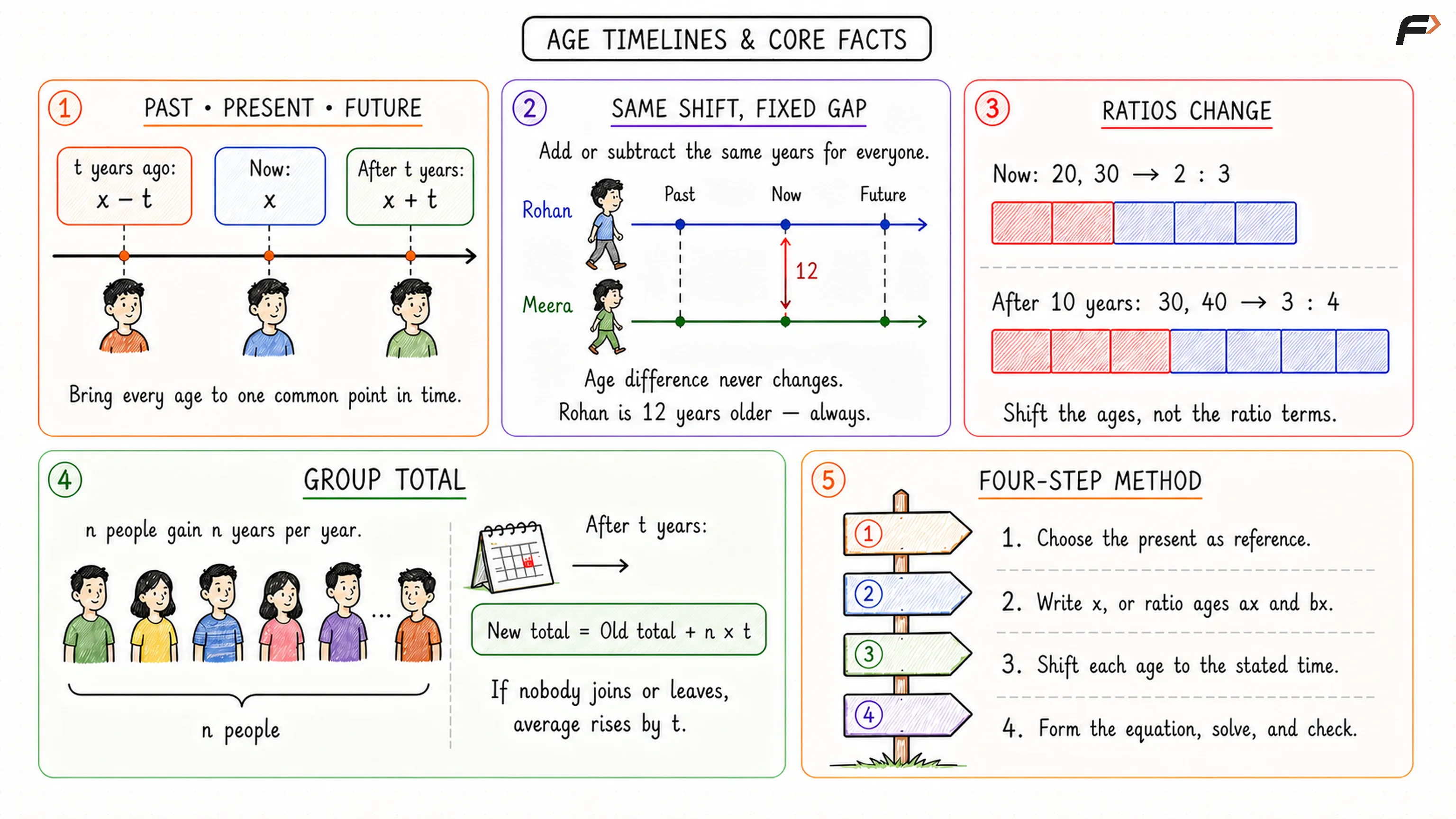
Age timelines and core facts for solving age problems
The Three Facts Behind Every Age Problem
Before using longer age relationships, keep these three facts clear.
Everyone grows by the same number of years
If two people are considered 6 years later, add 6 to both ages. For a point 4 years in the past, subtract 4 from both ages.
This means the difference between two people's ages never changes. If Rohan is 12 years older than Meera today, he was 12 years older five years ago and will still be 12 years older ten years later.
Ratios usually change with time
Suppose the present ages are 20 and 30. Their ratio is . After 10 years, their ages become 30 and 40, and the ratio becomes .
So we add or subtract years from the ages, not from the terms of the ratio. A present ratio of does not become after 5 years.
A group's total age changes predictably
If a group contains people, its total age increases by years in one year. After years, it increases by years:
If nobody joins or leaves, the group's average age also increases by exactly years after years.
A Simple Method for Solving Age Problems
Most age problems can be solved with the same four steps:
- Choose the present as the reference point.
- Represent unknown present ages with , or with ratio terms such as and .
- Move each age to the stated point in time.
- Turn the final statement into an equation and solve it.
Suppose the present age ratio of Kavya and Isha is , and after 6 years it becomes . Write their present ages as and . After 6 years they will be and , so:
Cross-multiplying gives . Therefore, Kavya's present age is years.
Notice the flow: ratio first, time shift second, equation last.
Present Age Ratio with a Future or Past Ratio
This is one of the most common age problem types. If the present ratio is , write the ages as and . Then apply the same time shift to both ages.
Case 1: ratio after some years
Example: Paarth and Riva are presently in the ratio . After 4 years, their ratio will be . Find Riva's present age.
Their present ages are and . After 4 years:
Riva's present age is:
Case 2: ratio some years ago
Example: Samar and Aanvi are presently in the ratio . Five years ago, their ratio was . Find Aanvi's present age.
Solving gives , so Aanvi is years old.
The sign is the only change: use for the future and for the past.
Finding When a Required Age Ratio Will Occur
Sometimes the present ages are known while the future time at which they reach a given ratio is missing.
Let the required number of years be . Add to both present ages.
Example: Neena is 20 years old and Kunaal is 28 years old. After how many years will their ages be in the ratio ?
So the ratio becomes after 4 years. A quick check gives .
Sum and Difference of Two Ages
When both the present sum and the age gap are given, the two ages can be found without a long equation. If the sum is and the older person is years older:
For example, Fiza and Rishi are 60 years old in total, and Fiza is 12 years older. Their ages are:
This works because the sum contains two copies of the younger age and one extra age gap.
Age Difference with a Past or Future Ratio
When the age difference is given, using one variable is usually cleaner than using two.
If the younger person's age is and the older person is years older, their present ages are:
Case 1: future ratio
Example: Riya is 12 years older than Vihaan. After 12 years, their ages will be in the ratio . Find Riya's present age.
Let Vihaan's present age be . Then Riya's age is . After 12 years:
Solving gives . Therefore, Riya is years old.
Case 2: past ratio
Example: Rahul is 20 years older than Reena. Five years ago, their ages were in the ratio .
Let Reena's present age be . Rahul's present age is . Five years ago:
This gives , so Rahul is 45 years old.
Total Age with a Ratio in Another Year
When the present total is given but the ratio belongs to another year, move the total to that year first. This often avoids two variables.
For two people, the total changes by over years. For three people, it changes by .
Case 1: future total and ratio
Example: Ajay and Bhaavna are 60 years old in total. After 8 years, their ages will be in the ratio .
After 8 years, their total age will be:
There are ratio parts. Each part is . Bhaavna's age after 8 years is , so her present age is:
Case 2: past total and ratio
Example: Chaaru and Vivaan are 80 years old in total. Ten years ago, their ages were in the ratio .
Their total age ten years ago was:
Vivaan's age then was . His present age is years.
Mixed-Time Age Comparisons
A mixed-time comparison connects one person's future age with another person's past age. Read each side separately before writing the equation.
Case 1: total age is given
Example: Eira and Vihaan are 73 years old in total. After 5 years, Eira will be twice as old as Vihaan was 3 years ago. Find Eira's present age.
Let Eira's present age be . Vihaan's present age is .
- Eira after 5 years:
- Vihaan 3 years ago:
Now write exactly what the sentence says:
Solving gives . Eira's present age is 45 years.
Case 2: age difference is given
Example: Vaani is 16 years older than Sahil. After 4 years, Vaani will be twice as old as Sahil was 5 years ago.
Let Sahil be years old now. Vaani is .
This gives . The important part is not the algebra; it is placing and on the correct people.
Ages Adjusted in Opposite Directions
Some relationships do not describe a real past or future year. Instead, years are added to one person's age and subtracted from another person's age. Treat those as separate adjustments exactly as written.
Example: Vanya and Nikhil are 68 years old in total. If 4 is added to Vanya's age and 4 is subtracted from Nikhil's age, the resulting ages are in the ratio . Find Nikhil's present age.
Let Nikhil's present age be . Then Vanya's age is . The adjusted ages are and :
Solving gives . Unlike a genuine future-age movement, we do not add 4 to both people here because the two ages are deliberately changed in opposite directions.
Converting Fractional Age Statements into Ratios
A statement such as “three-fourths of A's age equals two-thirds of B's age” is easier to use after converting it into a ratio.
If:
then cross-multiplication gives:
Therefore:
Example: Three-fourths of Neha's age equals two-thirds of Rishi's age, and their total age is 68 years.
Their ratio is . The total number of parts is 17, so one part is . Neha's age is years.
In general, if , then . The coefficients reverse when converted into a ratio.
Three-Person Age Ratios
The same ratio method works for three or more people. Add all ratio terms before finding one part.
Case 1: present total
Example: The ages of Meera, Raj, and Rishi are in the ratio , and their total age is 80 years.
The total number of parts is:
One part is , so Rishi's age is:
Case 2: total after some years
Example: The present ages of Neel, Maanav, and Pihu are in the ratio . After 4 years, their total age will be 90 years.
The present total is:
There are 13 ratio parts, so one part is 6. Pihu is presently and will be 40 years old after 4 years.
Ratio and Product of Ages
If two ages are in the ratio , write them as and . If their product is :
Example: Two ages are in the ratio , and their product is 588.
The ages are 21 and 28, so their sum is 49 years. We take the positive value of because an age cannot be negative.
Equally Spaced Ages
When consecutive ages have the same gap, they form an arithmetic sequence.
For five ages with common gap , it is convenient to write:
Their average and middle age are both .
Case 1: five people
Example: Five ages have a gap of 3 years between consecutive people, and their total is 80 years. The average age is , so the ages are:
The youngest is 10 years old.
Case 2: four people
Example: Four ages have a gap of 4 years and a total of 72 years. Write them as:
Their sum gives , so . The oldest age is years.
Average Age of an Unchanged Group
Average age is:
If the same people remain in the group, each person becomes years older after years. Therefore, the average also rises by .
The total-based method is especially useful when a person joins, leaves, or is replaced.
Average Age When a Person Joins
Find the original group's total at the required time, find the new group's total at that same time, and subtract.
Example: The average present age of 7 designers is 22. After 2 years, one person joins and the average of all 8 becomes 25. Find the new person's present age.
Original total now:
Original 7 after 2 years:
Total of all 8 after 2 years:
The new person is years old at that time, so the person's present age is years.
Average Age When a Person Leaves
Compare the total of the complete group with the total of the remaining group at the same point in time.
Example: Eight coders have a present average age of 26. After 3 years, one leaves, and the remaining seven have an average age of 30.
All eight after 3 years:
Remaining seven after 3 years:
The person who leaves is years old after 3 years, so the present age is years.
Average Age When One Person Is Replaced
The number of people stays the same, so the change in total equals:
This gives a useful shortcut:
Example: The average age of 12 volunteers is 26. A 30-year-old volunteer is replaced, and the average becomes 25.
The average falls by 1, so the total falls by years. The new person must therefore be 12 years younger than the person replaced:
This shortcut is faster than calculating both full totals.
When A Was as Old as B Is Now
This wording describes two different times. Find how many years separate those times, then move the other person's age by the same amount.
Example: Meera is 44 years old. When Meera was as old as Arun is now, Arun was 12. Find Arun's present age.
Let Arun's present age be . Meera was years old years ago. Arun was 12 at that time, so:
A quick way to see the same relation is that Arun's present age lies halfway between 12 and 44.
Age Problems with Two Time Ratios
If neither the present ratio nor the present total is given, two ratios at two different times can create two equations.
Example: Six years ago, Meera and Raj were in the ratio . After 6 years, their ratio will be .
Let their present ages be and :
Solving the two equations gives and .
Write both equations around the same present ages. Do not assign unrelated ratio variables to the two years.
Data Sufficiency with Ages
In data sufficiency, the goal is not always to calculate the age. The goal is to decide whether the supplied information is enough to determine it uniquely.
Test each statement separately: Can more than one valid answer still fit this information?
For example:
- “Kavya and Isha are in the ratio ” is not enough. They could be 12 and 20, 18 and 30, or many other pairs.
- “After 6 years, their ratio is ” is also not enough by itself.
- Together, the two ratios give one equation in one scale factor, so the present ages can be found uniquely.
On the other hand, a statement such as “Nila is 28 years old” is sufficient on its own when Nila's present age is the required value. Do not combine statements automatically; test each one independently first.
Useful Ways to Work with Ages
- Draw a tiny timeline. Write “past — present — future” and place each age under the correct point. This prevents most sign errors.
- Use ratio parts only for the year in which the ratio is given. A ratio of means and at that specific time.
- Use the constant age gap. If one person is 12 years older, keep that difference instead of introducing two variables.
- Move totals instead of individuals. For two people, add or subtract ; for three people, use .
- Convert averages into totals immediately when someone joins, leaves, or is replaced.
- Use the replacement shortcut. A change of in the average of people changes the total by .
- Reverse fractional coefficients. If , then .
- Check age validity. Past ages must remain positive, and an older person should not suddenly become younger in your answer.
- Verify the original sentence. Substitute the ages back into the ratio or mixed-time condition; this usually takes only a few seconds.
How to Identify the Problem Type Quickly
| If we know... | Start with... |
|---|---|
| Present ratio and future/past ratio | , , then add or subtract the same years |
| Age difference | Younger , older |
| Total age and later ratio | Move the total to that year, then divide into ratio parts |
| “After how many years” | Add an unknown to both present ages |
| A fraction of one age equals a fraction of another | Convert the relation into a ratio first |
| Average with joining or leaving | Convert every average into a total at the same time |
| Replacement | Change in total change in average |
| Equal gaps between ages | Write an arithmetic sequence |
| “When A was as old as B is now” | Find the time gap between A's present age and B's present age |
| Two statements | Test each statement separately before combining them |
Formulas and Cheat Sheet
| Situation | Formula or method | Condition |
|---|---|---|
| Present age | Use the present as the common starting point | |
| Age years ago | The past age must remain valid | |
| Age after years | Add the same to everyone involved | |
| Age difference | stays constant | Both people grow older at the same rate |
| Ratio with sum | , | Both ages are measured at the same time |
| Ratio with difference | One part | The two ratio numbers must be different |
| Total age of a group | Total average number of people | Average and group size refer to the same time |
| Unchanged group after years | New average old average | Nobody joins, leaves, or is replaced |
| One person joins | New person's age new total old total | Convert both averages into totals first |
| One person leaves | Leaving person's age old total new total | Both totals must be measured at the change time |
| One person is replaced | Age difference change in average | The group size remains |
| Equally spaced ages | Average middle age | The ages form a complete equally spaced list |
Safe Shortcuts
- Use the fixed age gap: The difference between two people's ages never changes. If A is 6 years older than B now, A was 6 years older in the past and will still be 6 years older in the future.
- Split a known sum by ratio parts: If two ages are in the ratio and their sum is , their ages are and .
- Use the difference to find one ratio part: If ages are in the ratio and their difference is , one ratio part is . Multiply it by and to get the ages.
- Move an unchanged group forward together: If nobody joins or leaves, the average age rises by exactly after years. Every person has become years older.
- Turn averages into totals: Use total age average age number of people. This is the quickest safe method when a person joins, leaves, or is replaced.
- Use the replacement change: For a group of people, the age difference between the new and replaced person is the change in average.
- Shift every relevant age on the same timeline: For “ years ago,” subtract from each relevant present age. For “after years,” add to each one.
A shortcut is safe only when every age has been placed at the same correct point in time. It should shorten correct reasoning, not replace it.
Frequently Asked Questions
What is the basic formula for age problems?
There is no single formula for every question. The basic timeline rule is: present age , age years ago , and age after years .
Does the difference between two ages ever change?
No. Both people grow older at the same rate, so the difference between their ages remains constant.
Why does an age ratio change over time?
The same number of years is added to both ages, and adding the same number to two unequal values generally changes their ratio.
How does a group's average age change after some years?
If nobody joins or leaves, the average rises by the same number of years. If the group changes, calculate totals before and after the change.
What is the fastest way to avoid mistakes in age questions?
Bring every age to one common point in time, usually the present, and check that every plus or minus sign matches the words in the question.