A list of student records is given. Each record contains a student name and a marks value. Rearrange the complete list in non-decreasing order of marks.
If two students have equal marks, arrange such students in lexicographical order of names. Return the sorted list of student records.
Example 1
Input: students = [["Aman", 88], ["Riya", 95], ["Kabir", 88], ["Meera", 70]]
Output: [["Meera", 70], ["Aman", 88], ["Kabir", 88], ["Riya", 95]]
Explanation: Marks are ordered as 70, 88, 88, and 95. Equal marks 88 are arranged by name, so Aman appears before Kabir.
Example 2
Input: students = [["Zara", 91]]
Output: [["Zara", 91]]
Explanation: A single student record already satisfies the required order.
Brute Force Approach
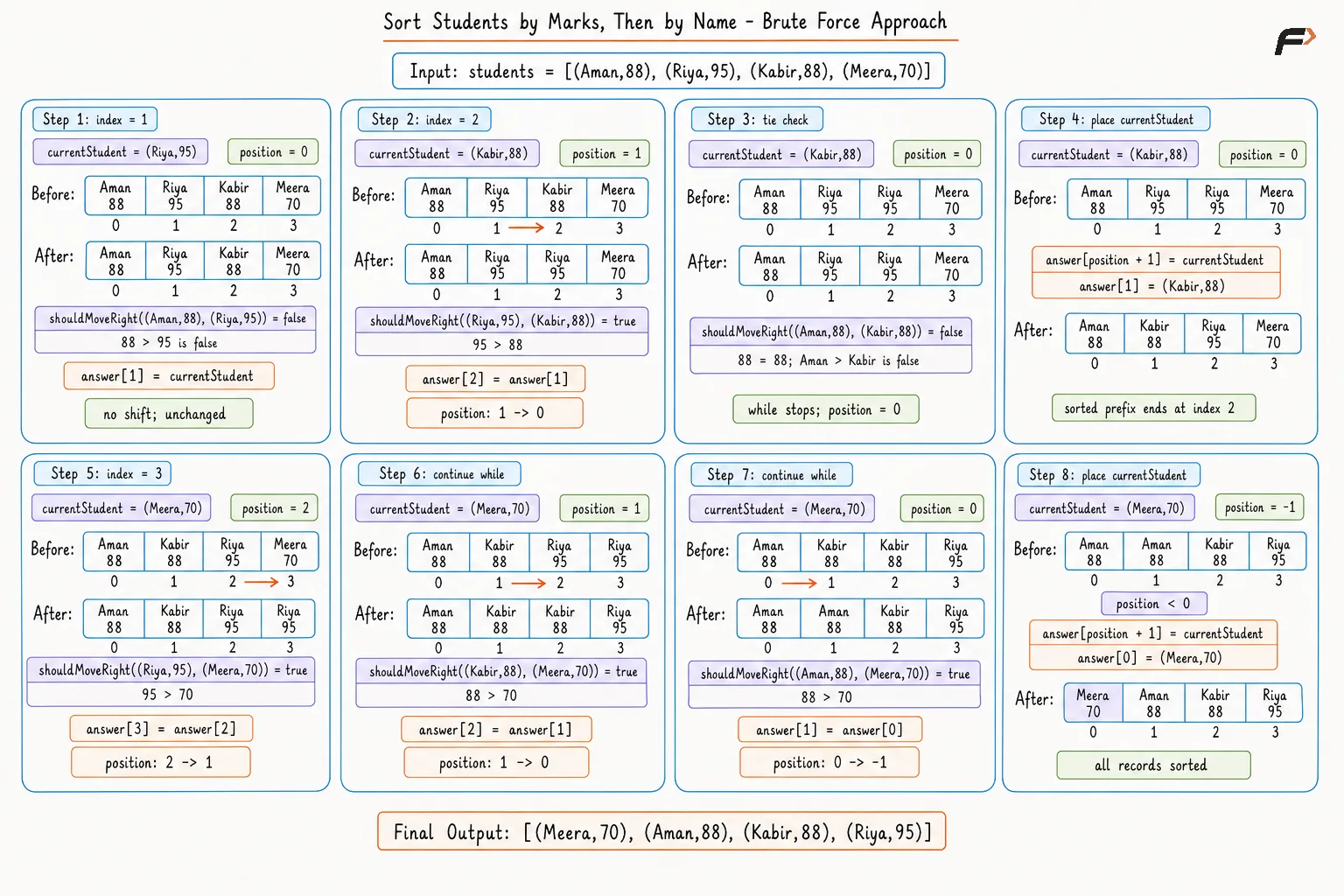
The easiest observation is small but useful: a student record should move left only when a previous record has larger marks, or when equal marks have a larger name. The name and marks must travel together, so every record stays complete during movement.
A stable insertion process keeps a sorted prefix. The next student is saved, larger records shift one position right, and the saved student is placed into the open position. Equal marks are handled carefully through the name comparison.
The idea feels friendly for learning because each pass answers one local question: does the saved student belong before the current prefix student?
Algorithm
A copied list named
answeris created so the original student list remains unchanged outside the method.The number of students is stored in
nso every record after the first record can be inserted into the sorted prefix.Every index from
1throughn - 1is treated as the next student record needing a correct position inside the prefix.The current student record is saved, and
positionis placed at the previous prefix index.Prefix records are shifted right while marks are larger, or while equal marks have a lexicographically larger name.
The saved student record is placed after the last record having smaller marks or an equal-valid name order.
The sorted copy is returned after every student record has been inserted into the prefix.
Dry Run
Sort Students by Marks, Then by Name - Brute Force Approach
Solution
#include <bits/stdc++.h>using namespace std;class Solution {public: // Sorts student records through stable insertion by marks and name. vector<pair<string, int>> sortStudents(vector<pair<string, int>>& students) { vector<pair<string, int>> answer = students; int n = answer.size(); // Each pass inserts one record into the sorted prefix. for (int index = 1; index < n; index++) { pair<string, int> currentStudent = answer[index]; int position = index - 1; // Larger marks or larger names for equal marks must move right. while (position >= 0 && shouldMoveRight(answer[position], currentStudent)) { answer[position + 1] = answer[position]; position--; } // The saved record is placed after every valid earlier record. answer[position + 1] = currentStudent; } return answer; }private: // Checks whether the left record belongs after the right record. bool shouldMoveRight(pair<string, int> left, pair<string, int> right) { // Larger marks must appear later in non-decreasing marks order. if (left.second > right.second) { return true; } // Equal marks are ordered by lexicographical name. if (left.second == right.second && left.first > right.first) { return true; } return false; }};// Driver codeint main() { // Input array vector<pair<string, int>> students = {{"Aman", 88}, {"Riya", 95}, {"Kabir", 88}, {"Meera", 70}}; // Solution object creation Solution obj; // Result printing vector<pair<string, int>> answer = obj.sortStudents(students); for (int index = 0; index < answer.size(); index++) { cout << "[" << answer[index].first << ", " << answer[index].second << "]"; // A separator is printed between neighboring records. if (index + 1 < answer.size()) { cout << " "; } } cout << endl; return 0;}Complexity Analysis
Time Complexity: O(N2), where N is the number of student records, because each student record can be compared with all earlier records during insertion.
Space Complexity: O(N), because a copied list of student records is maintained before sorting.
Better Approach
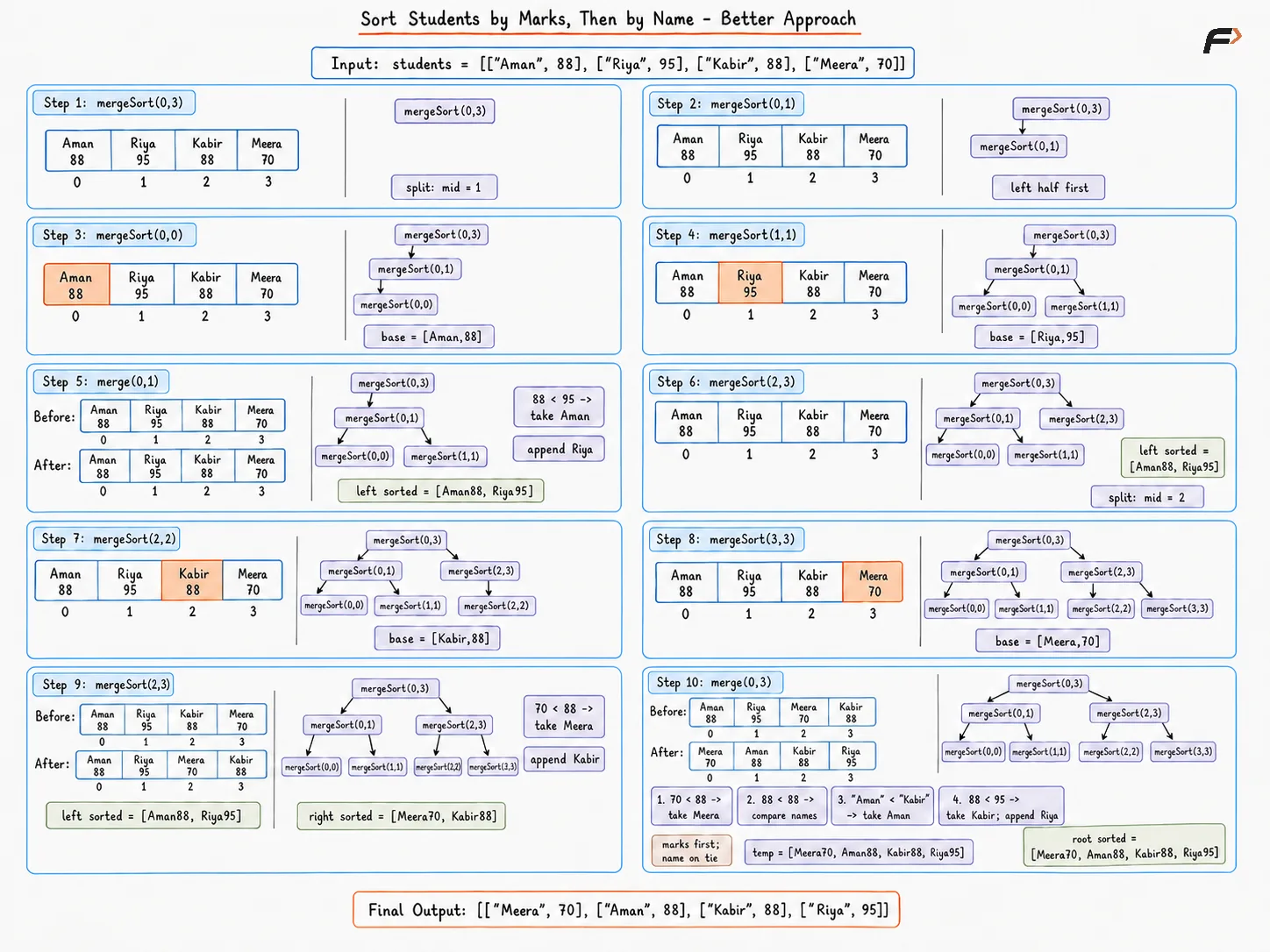
Stable insertion can shift many student records one position at a time. Merge sort reduces repeated movement by splitting the list into smaller ranges, sorting both halves, and joining the sorted halves in linear passes.
During each merge, marks are checked first and names are checked only for equal marks. The earlier record moves directly into temporary storage. Equal marks and equal names choose the left record, so completely identical ordering keys keep original relative order without a sorting callback.
Algorithm
Begin with a copied list named
answerand a temporary list of equal size, so complete student records can move without changing the caller-owned list.Start merge sort on the full index range because every student record belongs to the final marks-and-name order.
Stop a recursive call at a range containing at most one record because a single record already forms a sorted range.
Split every larger range at the middle index and sort both halves recursively, so each merge receives two correctly ordered ranges.
Compare current records by marks first and names after equal marks, so the exact primary and secondary rules are applied directly.
Move the earlier record into the temporary list and copy every remaining record after one half finishes, so no name-marks pair becomes separated or skipped.
Copy the merged range back into
answer, so completed ranges can support larger merges, and returnanswerafter the full range becomes sorted.
Dry Run
Sort Students by Marks then by Name better appraoch
Solution
#include <bits/stdc++.h>using namespace std;class Solution {private: // Merges two ranges by marks and name. void mergeRanges(vector<pair<string, int>>& answer, vector<pair<string, int>>& temp, int left, int middle, int right) { int leftIndex = left; int rightIndex = middle + 1; int writeIndex = left; // Current records provide the next student. while (leftIndex <= middle && rightIndex <= right) { // Direct field checks choose the earlier student. if (answer[leftIndex].second < answer[rightIndex].second || (answer[leftIndex].second == answer[rightIndex].second && answer[leftIndex].first <= answer[rightIndex].first)) { temp[writeIndex] = answer[leftIndex]; leftIndex++; } else { temp[writeIndex] = answer[rightIndex]; rightIndex++; } writeIndex++; } // Remaining left records keep sorted order. while (leftIndex <= middle) { temp[writeIndex] = answer[leftIndex]; leftIndex++; writeIndex++; } // Remaining right records keep sorted order. while (rightIndex <= right) { temp[writeIndex] = answer[rightIndex]; rightIndex++; writeIndex++; } // The merged range replaces the old range. for (int index = left; index <= right; index++) { answer[index] = temp[index]; } } // Sorts one student range through merge sort. void mergeSort(vector<pair<string, int>>& answer, vector<pair<string, int>>& temp, int left, int right) { // A one-record range already has sorted order. if (left >= right) { return; } int middle = left + (right - left) / 2; // Both halves become sorted before merging. mergeSort(answer, temp, left, middle); mergeSort(answer, temp, middle + 1, right); // Two sorted halves form one sorted range. mergeRanges(answer, temp, left, middle, right); }public: // Sorts a copy through direct merge sort. vector<pair<string, int>> sortStudents( vector<pair<string, int>>& students) { vector<pair<string, int>> answer = students; int n = answer.size(); vector<pair<string, int>> temp(n); // A larger list needs recursive splitting. if (n > 1) { mergeSort(answer, temp, 0, n - 1); } return answer; }};// Driver codeint main() { vector<pair<string, int>> students = { {"Aman", 88}, {"Riya", 95}, {"Kabir", 88}, {"Meera", 70} }; Solution obj; vector<pair<string, int>> answer = obj.sortStudents(students); for (pair<string, int> student : answer) { cout << "[" << student.first << ", " << student.second << "] "; } cout << endl; return 0;}Complexity Analysis
Time Complexity: O(N log N), merge sort uses O(log N) levels and merges all N student records once per level.
Space Complexity: O(N), the temporary list stores N records while the recursion stack uses O(log N) additional space.
Optimal Approach
Manual insertion shows the ordering rule clearly, but shifting records one by one becomes slow for large lists. A built-in sorting routine already knows how to arrange records efficiently. The only missing piece is the comparison rule.
The comparator checks marks first. Smaller marks must come earlier. When marks match, names decide the order, giving a predictable result for every tie.
The solution becomes calm and direct: keep each student record whole, then give the sorting routine a rule for choosing the earlier record.
Algorithm
A copied list named
answeris created so the original student list remains unchanged outside the method.A comparator or sorting key is prepared to compare student records by marks first.
Name comparison is used only when marks are equal, so ties become deterministic.
The built-in sorting routine is applied to
answerwith the custom comparison rule.During sorting, complete student records are rearranged while names and marks remain together.
The sorted list is returned after the sorting routine finishes all required comparisons.
Dry Run
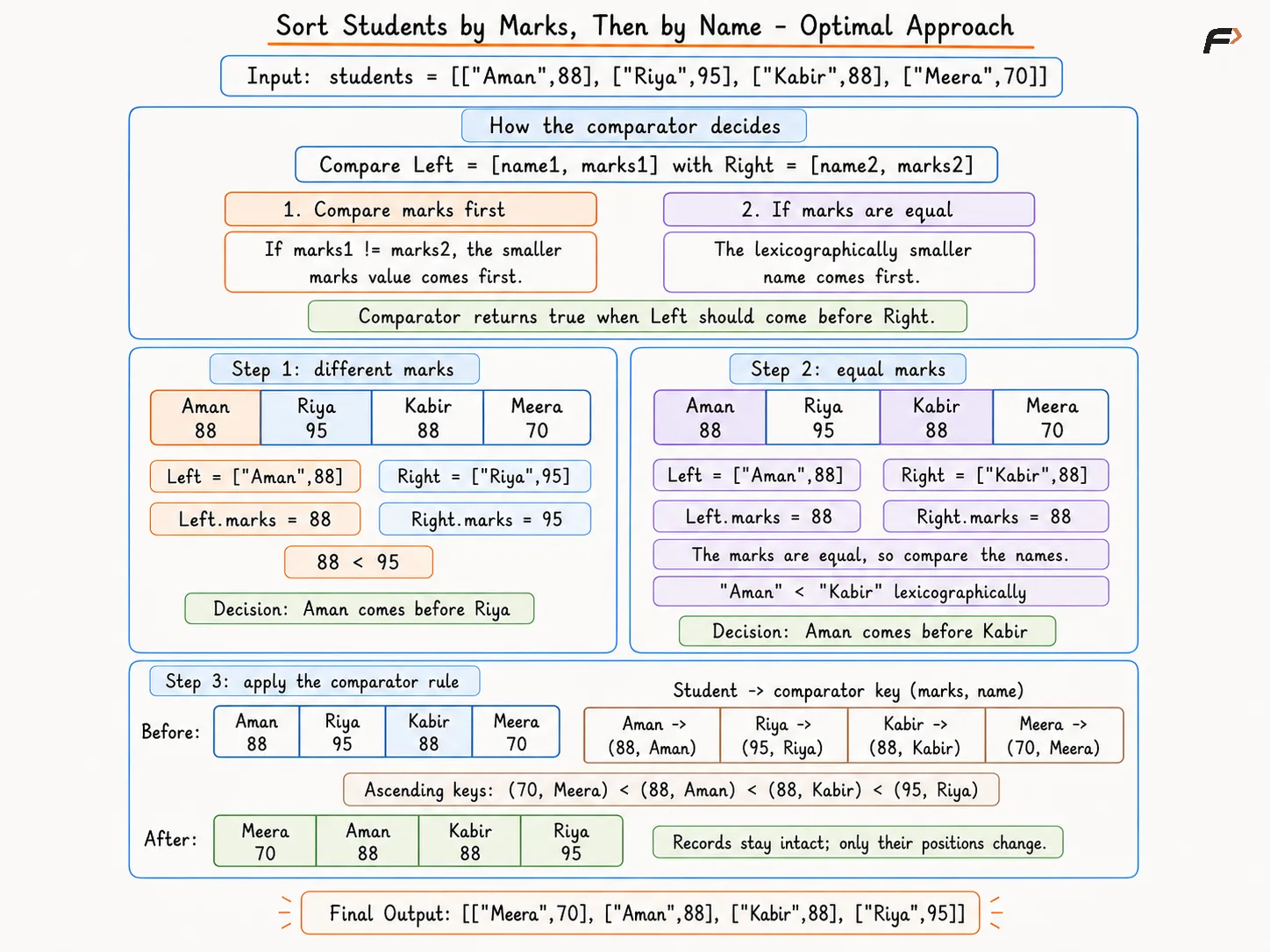
Image 1
Solution
#include <bits/stdc++.h>using namespace std;class Solution {public: // Sorts student records by marks first and name second. vector<pair<string, int>> sortStudents(vector<pair<string, int>>& students) { vector<pair<string, int>> answer = students; sort(answer.begin(), answer.end(), [](pair<string, int> left, pair<string, int> right) { // Equal marks are ordered by lexicographical name. if (left.second == right.second) { return left.first < right.first; } return left.second < right.second; }); return answer; }};// Driver codeint main() { // Input array vector<pair<string, int>> students = {{"Aman", 88}, {"Riya", 95}, {"Kabir", 88}, {"Meera", 70}}; // Solution object creation Solution obj; // Result printing vector<pair<string, int>> answer = obj.sortStudents(students); for (int index = 0; index < answer.size(); index++) { cout << "[" << answer[index].first << ", " << answer[index].second << "]"; // A separator is printed between neighboring records. if (index + 1 < answer.size()) { cout << " "; } } cout << endl; return 0;}Complexity Analysis
Time Complexity: O(N log N), because comparison sorting arranges N student records through logarithmic-depth comparison work.
Space Complexity: O(N), because a copied list of student records is maintained before sorting. Extra internal sorting storage depends on the language runtime.
Interview follow-up Questions
The common comparator variant sorts marks in non-decreasing order. Descending marks require reversing the marks comparison while keeping name comparison unchanged or adjusted according to the requested tie rule.
Be the first to add a comment.