Given an N×M binary maze, a source cell, and a destination cell, find the minimum number of moves needed to reach destination from source.
A cell containing 1 is walkable, while a cell containing 0 is blocked. Movement is allowed one cell at a time in four directions: up, right, down, and left. Return -1 if no valid route exists.
Example 1
Input: grid = [[1,1,1,1],[1,1,0,1],[1,1,1,1],[1,1,0,0],[1,0,0,1]], source = [0,1], destination = [2,2]
Output: 3
Explanation: A shortest route is (0,1)->(1,1)->(2,1)->(2,2), containing three moves.
Example 2
Input: grid = [[1,0,1],[1,0,1],[1,0,1]], source = [0,0], destination = [2,2]
Output: -1
Explanation: The blocked middle column separates source from destination.
Approach
Every walkable maze cell represents a graph vertex, while each valid orthogonal movement represents a unit-cost edge. Breadth First Search explores cells in increasing move count, so the first discovery and distance assignment of the destination gives the shortest distance.
A distance matrix initialized with -1 stores both visitation state and shortest distance. Marking neighbors before queue insertion prevents duplicate processing without modifying the maze.
Algorithm
Store the maze dimensions and return
-1when the source or destination is blocked, as no valid path can exist.Initialize an
N×Mdistance matrix with-1, where-1represents an unvisited cell.Set the source distance to
0, return0when source and destination match, and add the source coordinates to a queue.Continue processing while the queue contains cells and remove the front coordinates for level-order exploration.
Examine the four orthogonal neighbors and ignore out-of-bounds, blocked, or previously visited cells.
Assign
distance[current]+1to every valid neighbor before queue insertion; return the assigned distance immediately after destination discovery.Return
-1when the queue becomes empty without discovering the destination.
Dry Run
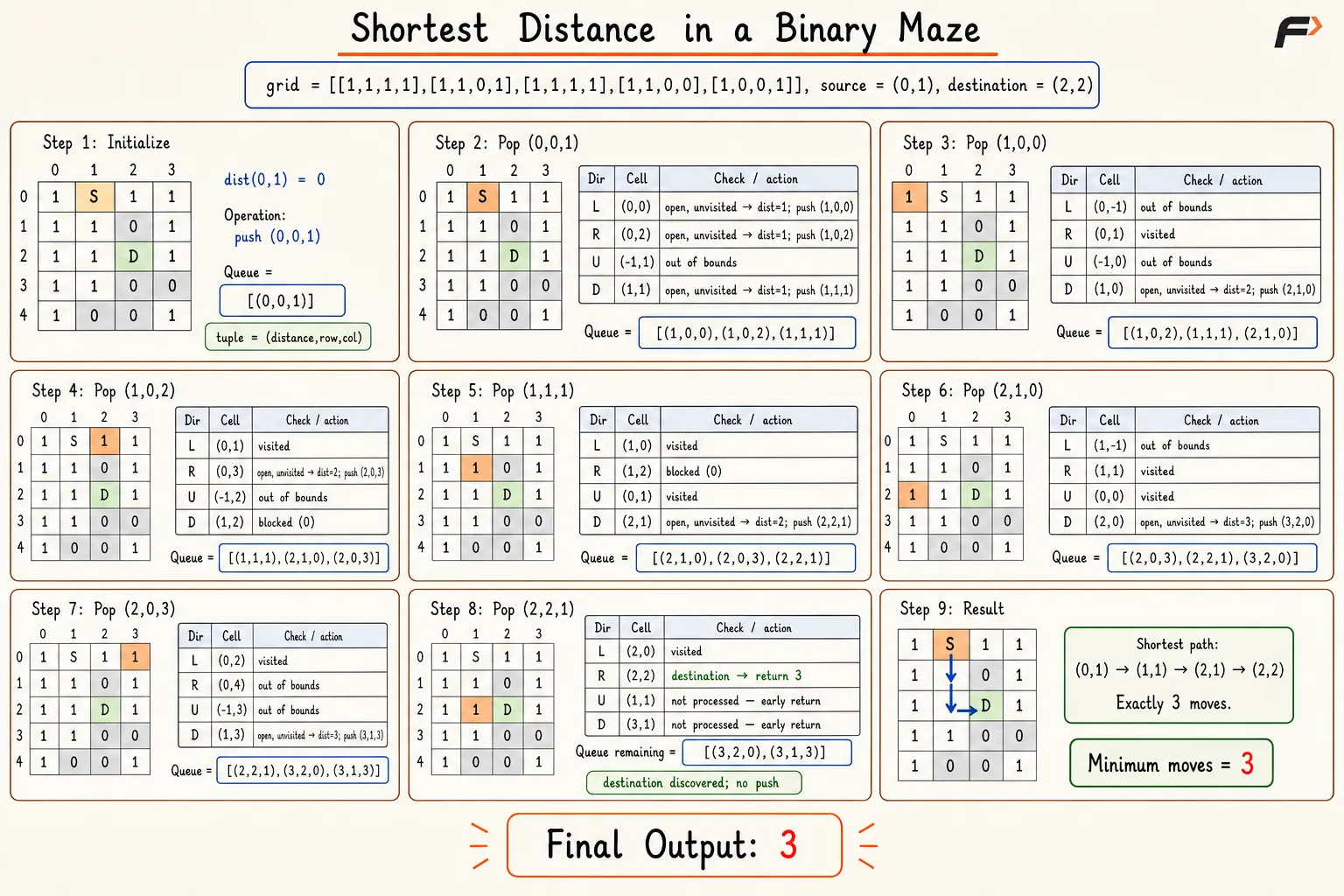
shortest-distance-binary-maze-lrud-corrected
Solution
#include <bits/stdc++.h>using namespace std;class Solution {public: // Return minimum moves from source to destination in a binary maze. int shortestPath(vector<vector<int>>& grid, pair<int, int> source, pair<int, int> destination) { int rows = grid.size(); int cols = grid[0].size(); // Reject a blocked source or destination. if (grid[source.first][source.second] == 0 || grid[destination.first][destination.second] == 0) { return -1; } // Equal endpoints require zero moves. if (source == destination) { return 0; } vector<vector<int>> dist(rows, vector<int>(cols, -1)); queue<pair<int, int>> q; // Start BFS at distance zero. dist[source.first][source.second] = 0; q.push(source); int dRow[4] = {-1, 0, 1, 0}; int dCol[4] = {0, 1, 0, -1}; // Explore walkable cells in increasing distance order. while (!q.empty()) { auto [row, col] = q.front(); q.pop(); // Check all four orthogonal neighbors. for (int direction = 0; direction < 4; direction++) { int nextRow = row + dRow[direction]; int nextCol = col + dCol[direction]; // Skip cells outside maze boundaries. if (nextRow < 0 || nextRow >= rows || nextCol < 0 || nextCol >= cols) { continue; } // Skip blocked or previously visited cells. if (grid[nextRow][nextCol] == 0 || dist[nextRow][nextCol] != -1) { continue; } int nextDistance = dist[row][col] + 1; dist[nextRow][nextCol] = nextDistance; // First destination discovery gives minimum distance. if (nextRow == destination.first && nextCol == destination.second) { return nextDistance; } q.push({nextRow, nextCol}); } } // Queue exhaustion means destination is unreachable. return -1; }};// Driver code.int main() { vector<vector<int>> grid = { {1, 1, 1, 1}, {1, 1, 0, 1}, {1, 1, 1, 1}, {1, 1, 0, 0}, {1, 0, 0, 1} }; pair<int, int> source = {0, 1}; pair<int, int> destination = {2, 2}; Solution sol; cout << sol.shortestPath(grid, source, destination); return 0;}Complexity Analysis
Time Complexity: O(N×M), where N and M are the numbers of rows and columns; every maze cell enters the queue at most once and checks four neighbors.
Space Complexity: O(N×M), where the distance matrix and BFS queue can each store up to N×M cells.
Interview follow-up Questions
BFS processes unit-cost moves in increasing distance order, so first destination discovery is optimal.
Be the first to add a comment.