Given an integer N. Return the integer formed by replacing every digit 0 with 1 in the decimal representation of N.
Example 1
Input: N = 102003
Output: 112113
Explanation: Every 0 in 102003 is replaced with 1, resulting in 112113.
Example 2
Input: N = 204
Output: 214
Explanation: The 0 in 204 is replaced with 1, giving 214.
Approach
The main idea is to replace every 0 digit with 1 while keeping all other digits unchanged. The integer can first be converted into a string so that each digit can be accessed and checked easily.
A new string res can be used to store the modified number. This keeps the original digit order unchanged while replacing every occurrence of 0 with 1. Finally, the modified string is converted back into an integer and returned as the answer.
Algorithm
Convert the given integer into a string using
to_string().Initialize an empty string to store the modified number.
Traverse the string character by character.
If the current character is
'0', replace it with'1'.Otherwise, keep the current character unchanged.
Convert the modified string back into an integer using
stoi()and return the result.
Dry Run
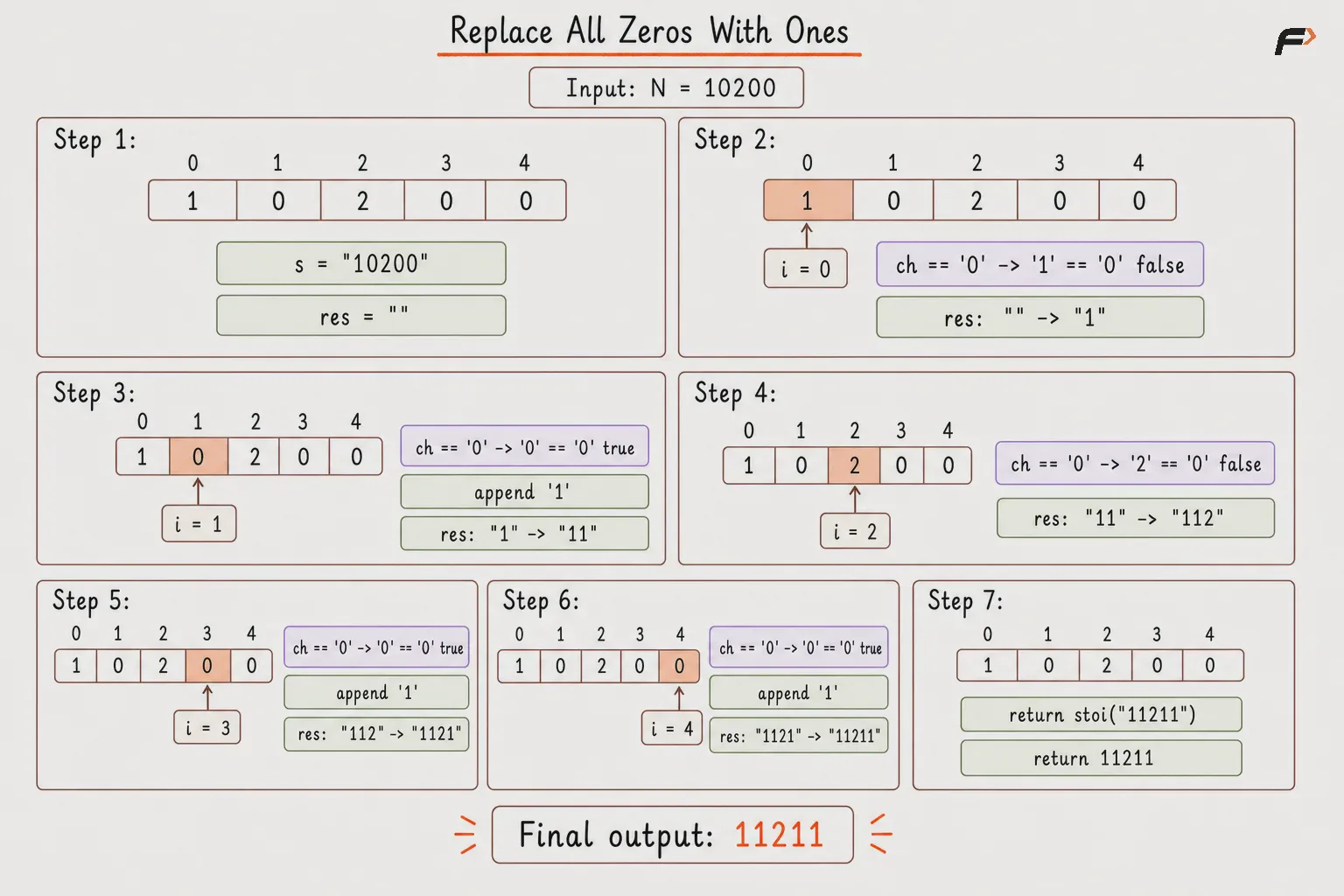
Replace All Zeros With Ones
Solution
#include <bits/stdc++.h>using namespace std;class Solution {public: // Function to replace all 0s with 1s int replaceZerosWithOnes(int N) { // Convert the integer into a string string s = to_string(N); // Store the modified number string res = ""; // Traverse each character of the string for (char ch : s) { // Replace 0 with 1 if (ch == '0') { res += '1'; } // Keep other digits unchanged else { res += ch; } } // Convert the modified string back to an integer return stoi(res); }};// Driver code startsint main() { Solution sol; cout << sol.replaceZerosWithOnes(102003) << endl; return 0;}Complexity Analysis
• Time Complexity: O(D), where D represents the number of digits in the given integer. Each digit is visited exactly once while building the modified string.
• Space Complexity: O(D), as an additional string is used to store the modified digits.
Interview follow-up Questions
Yes. Each digit can be extracted using modulo and division, replaced when it is 0, and then used to reconstruct the number. However, the string-based approach is simpler and easier to understand.
Be the first to add a comment.