Given a DNA string s, return all 10-letter-long substrings that occur more than once. The answer can be returned in any order.
Example 1
Input: s = "AAAAACCCCCAAAAACCCCCCAAAAAGGGTTT"
Output: ["AAAAACCCCC", "CCCCCAAAAA"]
Explanation: Both "AAAAACCCCC" and "CCCCCAAAAA" appear more than once in the DNA string.
Example 2
Input: s = "AAAAAAAAAAAAA"
Output: ["AAAAAAAAAA"]
Explanation: The substring "AAAAAAAAAA" appears multiple times, but it should be added only once in the answer.
Brute Force Approach
Every valid answer must be a substring of exactly length 10. So instead of checking all substring lengths, only one fixed-size window matters. Start from index 0, take the next 10 characters, then move one step forward and repeat.
Now the question becomes simple: “Has this 10-letter sequence appeared before?”
A seen set can answer that quickly. But if the same repeated sequence appears many times, it should still be added to the answer only once. That is why a second set, repeated, is used.
Algorithm
If the string length is less than
10, return an empty answer because no valid 10-letter substring can exist.Create a
seenset to store every 10-letter sequence found for the first time.Create a
repeatedset to store sequences that have already repeated. This prevents adding the same answer again and again.Slide a window of size
10from left to right. This checks every possible DNA sequence of the required length.If the current sequence is already in
seen, add it torepeatedbecause it has appeared at least twice.Otherwise, add it to
seenbecause this is the first time that sequence has appeared.Return all strings from the
repeatedset.
Dry Run
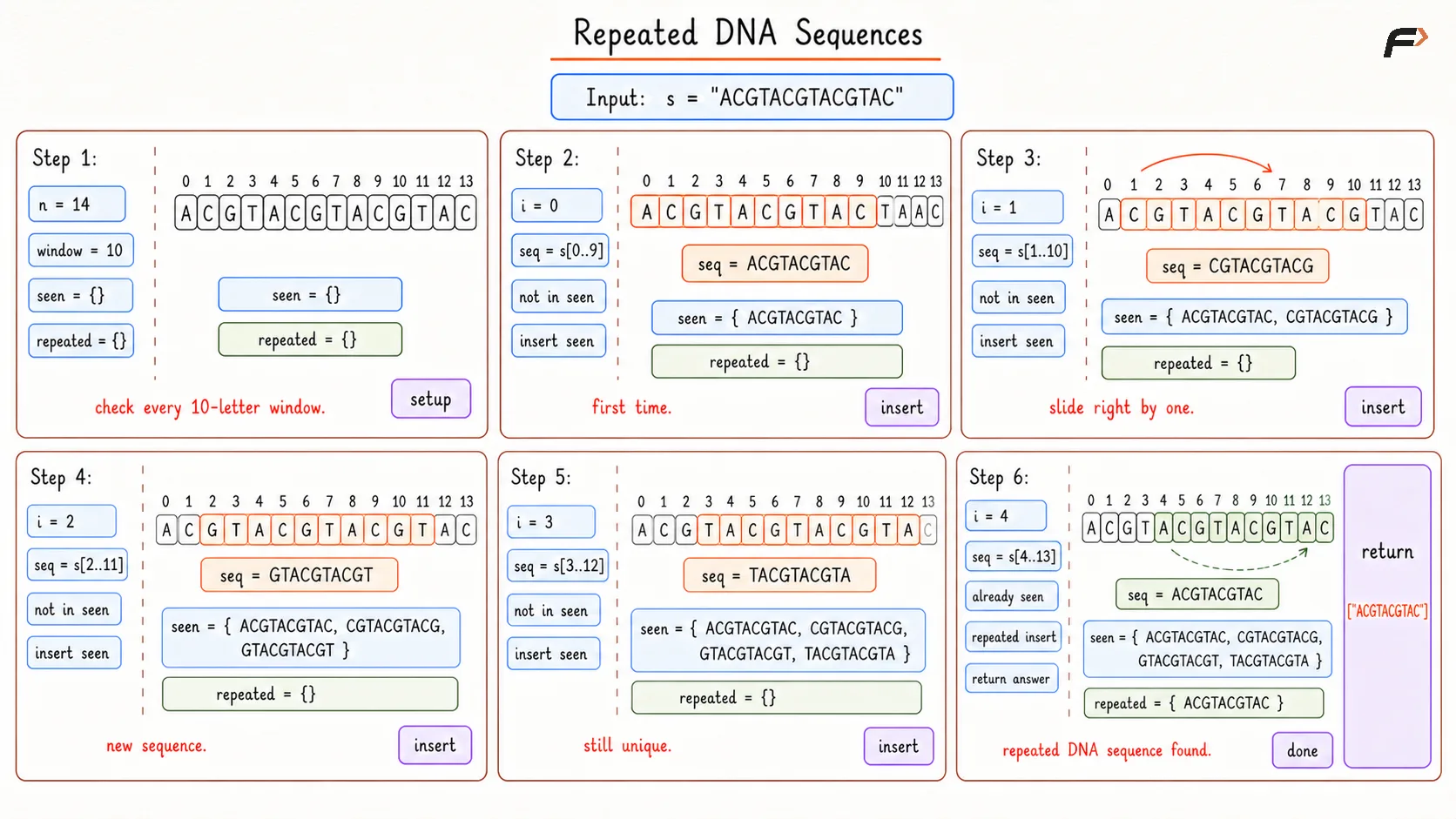
Compute Ncr Brute Dry Run
Solution
#include <bits/stdc++.h>using namespace std;class Solution {public: /* Finds all 10-letter DNA sequences that appear more than once. */ vector<string> findRepeatedDnaSequences(string s) { // Stores sequences that have appeared at least once. unordered_set<string> seen; // Stores repeated sequences only once. unordered_set<string> repeated; /* If the string has fewer than 10 characters, no 10-letter DNA sequence can be formed. */ if (s.length() < 10) { return {}; } for (int i = 0; i <= (int)s.length() - 10; i++) { // Current window is the 10-letter DNA sequence being checked. string sequence = s.substr(i, 10); /* If this sequence was already seen, it is a repeated DNA sequence. */ if (seen.count(sequence)) { repeated.insert(sequence); } else { /* If this is the first appearance, store it for future checks. */ seen.insert(sequence); } } return vector<string>(repeated.begin(), repeated.end()); }};int main() { // Driver code starts string s = "AAAAACCCCCAAAAACCCCCCAAAAAGGGTTT"; Solution obj; vector<string> answer = obj.findRepeatedDnaSequences(s); for (string sequence : answer) { cout << sequence << " "; } return 0;}Complexity Analysis
Time Complexity: O(n) because there are n - 9 windows, and each substring has fixed length 10.
Space Complexity: O(n) because the sets can store many different 10-letter sequences.
Optimal Approach
The hash set approach stores actual strings. That is easy to understand, but DNA has a special property: it uses only 4 characters.
Four characters can be represented using only 2 bits:
A = 0, C = 1, G = 2, T = 3
A DNA sequence of length 10 therefore needs only 20 bits. So each 10-letter substring can be represented as one integer.
As the window moves, the bitmask is updated by adding the new character and keeping only the last 20 bits. This avoids building a new substring just for checking whether the sequence was seen.
Algorithm
If the string length is less than
10, return an empty answer because no valid window exists.Convert every DNA character into a small number from
0to3. This works because there are only four possible DNA letters.Keep a rolling integer
maskthat represents the latest DNA window.For each character, shift the current mask left by
2bits and add the encoded value of the new character. This makes room for the new DNA letter.Keep only the last
20bits of the mask because only the latest10characters matter.Once at least
10characters have been processed, check whether this mask has appeared before.If the mask is already seen, add the current 10-letter substring to the answer set.
Otherwise, store the mask as seen for future windows.
Dry Run
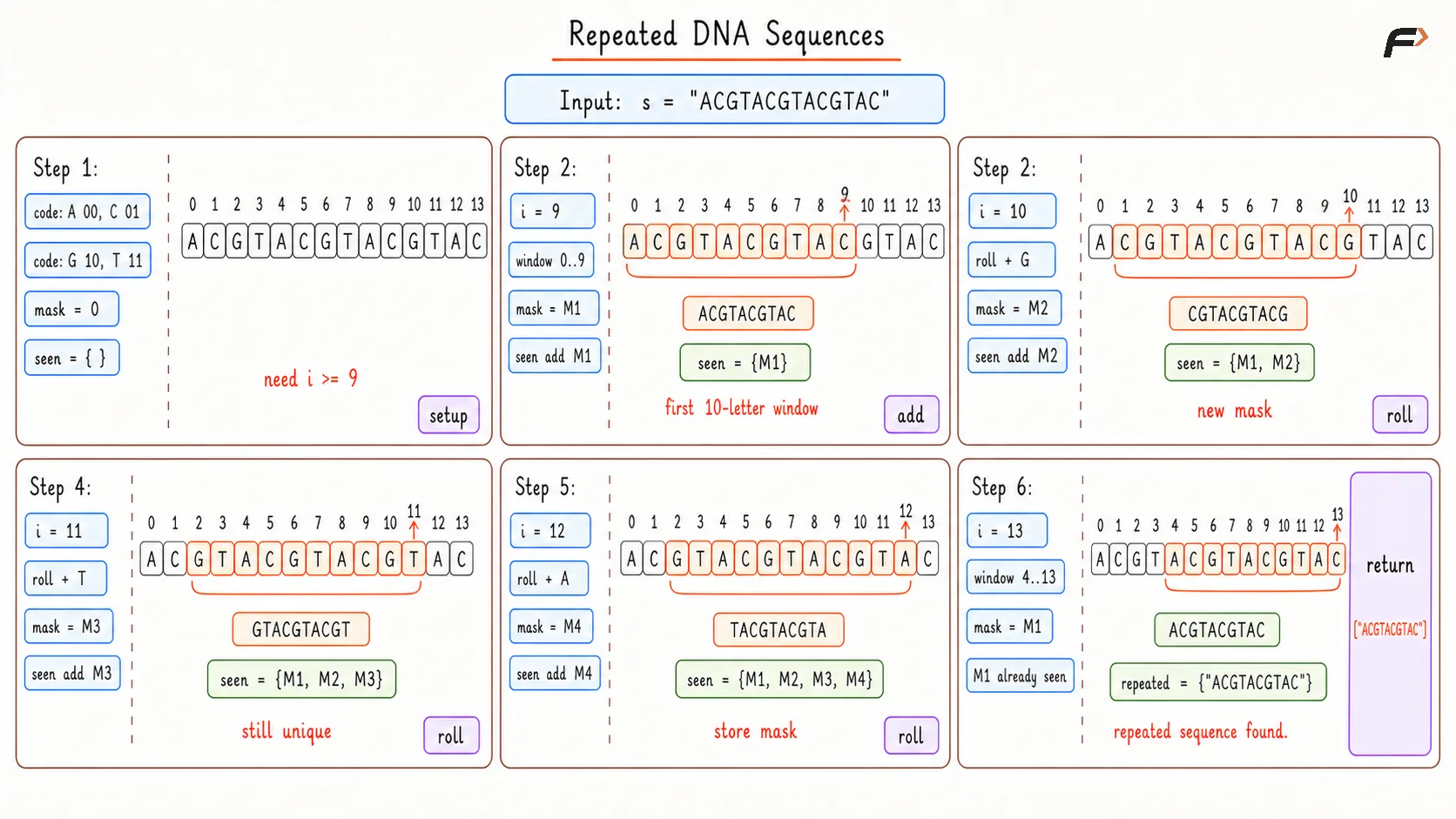
Compute Ncr Optimal Dry Run
Solution
#include <bits/stdc++.h>using namespace std;class Solution {private: /* Converts a DNA character into a 2-bit value. */ int getValue(char ch) { // A is represented by 0. if (ch == 'A') { return 0; } // C is represented by 1. if (ch == 'C') { return 1; } // G is represented by 2. if (ch == 'G') { return 2; } // T is represented by 3. return 3; }public: /* Finds repeated DNA sequences using a compact 20-bit rolling mask. */ vector<string> findRepeatedDnaSequences(string s) { /* If the string has fewer than 10 characters, no valid DNA sequence can be formed. */ if (s.length() < 10) { return {}; } // Stores masks that have appeared at least once. unordered_set<int> seen; // Stores repeated strings only once. unordered_set<string> repeated; // Mask stores the latest 10-character DNA window. int mask = 0; // This keeps only the rightmost 20 bits. int lastTwentyBits = (1 << 20) - 1; for (int i = 0; i < s.length(); i++) { /* Shift left to make space for the new character, then add the 2-bit value of that character. */ mask = ((mask << 2) | getValue(s[i])) & lastTwentyBits; /* A complete 10-letter window is available only after index 9. */ if (i >= 9) { // Current 10-letter sequence is needed only for the answer. string sequence = s.substr(i - 9, 10); /* If the same mask appeared before, this DNA sequence is repeated. */ if (seen.count(mask)) { repeated.insert(sequence); } else { /* If this mask is new, store it so later windows can be compared with it. */ seen.insert(mask); } } } return vector<string>(repeated.begin(), repeated.end()); }};int main() { // Driver code starts string s = "AAAAACCCCCAAAAACCCCCCAAAAAGGGTTT"; Solution obj; vector<string> answer = obj.findRepeatedDnaSequences(s); for (string sequence : answer) { cout << sequence << " "; } return 0;}Complexity Analysis
Time Complexity: O(n) because each character is processed once.
Space Complexity: O(n) because the seen masks and repeated answers may grow with the input size.
Interview follow-up Questions
One set tracks sequences seen before, and the other set prevents duplicate repeated sequences from being added many times.
Be the first to add a comment.