Given an integer N, determine whether it is a Perfect Number or not. Return true if it is a Perfect Number, otherwise return false.
A Perfect Number is a positive integer that is equal to the sum of its positive divisors, excluding the number itself.
Example 1
Input: n = 6
Output: true
Explanation: The proper divisors of 6 are 1, 2, and 3. Their sum is 6, so 6 is a Perfect Number.
Example 2
Input: n = 12
Output: false
Explanation: The proper divisors of 12 are 1, 2, 3, 4, and 6. Their sum is 16, which is not equal to 12.
Brute Force Approach
The first observation is very direct: every proper divisor of N must lie between 1 and N - 1. So one simple way to solve the problem is to check every number in that range and collect the ones that divide N exactly.
The next observation is that a number should be added to the divisor sum only when it leaves remainder 0. Once that is clear, the full idea becomes straightforward: walk through all possible proper divisors, keep adding the valid ones, and finally compare the sum with N.
Algorithm
Start with a variable
sumas0, because no proper divisor has been added yet. This variable will store the total of all valid divisors found so far.Check every number from
1toN - 1, because the number itself must not be included in the sum of proper divisors.For each number
i, test whetherN % i == 0. That check is necessary because only exact divisors should contribute to the sum.Whenever
idividesNexactly, additosum. This builds the total of all proper divisors one by one.After all possible divisors have been checked, compare
sumwithN. If both are equal, returntrue; otherwise, returnfalse.
Key Points
If
N <= 1, the answer is alwaysfalsebecause a Perfect Number must be positive and must have proper divisors that can sum back to it.
Dry Run
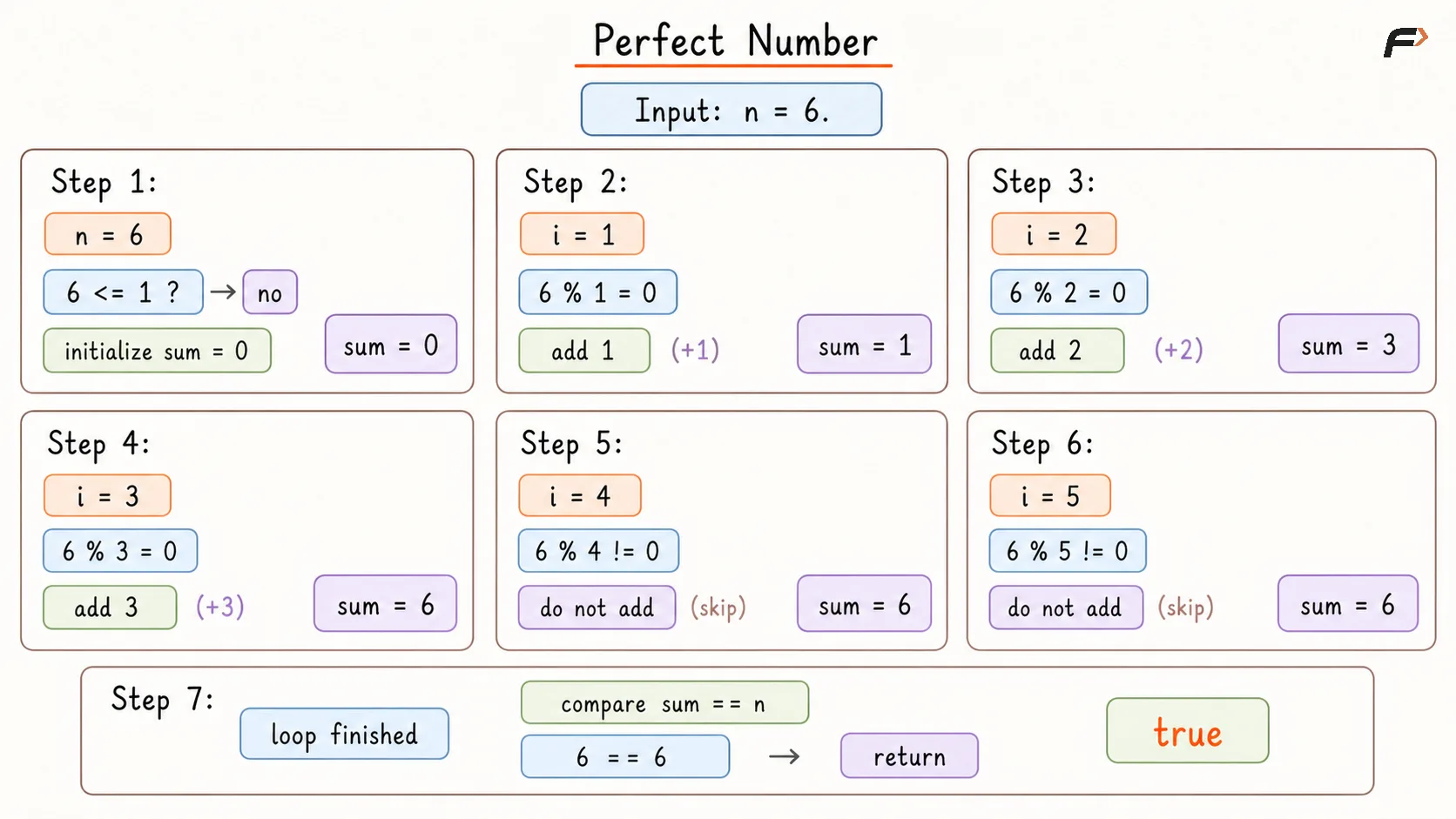
Perfect Number Brute Force Dry Run
Solution
#include <bits/stdc++.h>using namespace std;class Solution {public: /* Returns true if n is a Perfect Number by checking every proper divisor. */ bool isPerfectNumber(int n) { /* Numbers less than or equal to 1 cannot be perfect. */ if (n <= 1) { return false; } /* Stores the sum of all proper divisors found so far. */ int sum = 0; for (int i = 1; i < n; i++) { /* Add only those values that divide n exactly. */ if (n % i == 0) { sum += i; } } return sum == n; }};// Driver code startsint main() { int n = 28; Solution obj; cout << (obj.isPerfectNumber(n) ? "true" : "false") << endl; return 0;}Complexity Analysis
Time Complexity: O(N), because every number from 1 to N - 1 may be checked.
Space Complexity: O(1), because only a few variables are used.
Optimal Approach
The important observation here is that divisors usually come in pairs. If i divides N, then N / i also divides N. For example, for 28, the pairs are (1, 28), (2, 14), and (4, 7).
That means checking all numbers up to N - 1 is unnecessary. Only the smaller side of each pair needs to be searched, which means checking up to sqrt(N) is enough. Whenever one divisor is found, its paired divisor can also be added immediately. The only careful case is a perfect square, where both values in the pair become the same and should be added only once.
Algorithm
First, handle the case
N <= 1by returningfalse, because such numbers cannot be Perfect Numbers.Start the divisor sum with
1, because1is always a proper divisor of every number greater than1, and it should be included from the beginning.Check every number
istarting from2whilei * i <= N. This limit matters because any larger divisor would already have a smaller paired divisor.If
idividesN, add its contribution to the sum. In the normal case, bothiandN / ishould be added because both are proper divisors.Before adding both values, check whether
i * i == N. If that happens, only addionce, because the pair has collapsed into the same divisor.After all divisor pairs have been processed, compare the final sum with
N. If both are equal, returntrue; otherwise, returnfalse.
Key Points
N = 1is not a Perfect Number.For a perfect square, the square root divisor must be added only once.
Dry Run
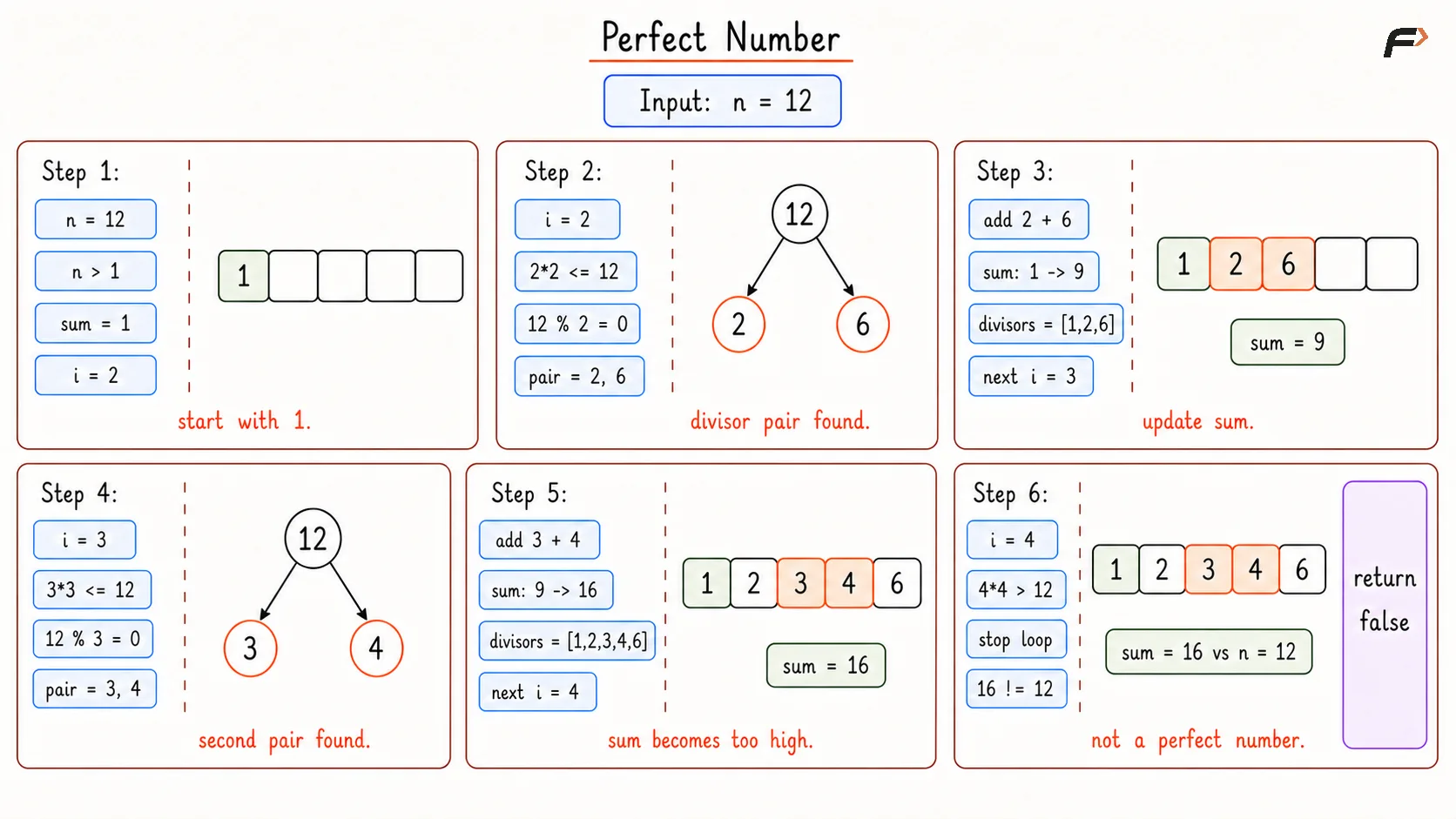
Perfect Number Optimal Dry Run
Solution
#include <bits/stdc++.h>using namespace std;class Solution {public: /* Returns true if n is a Perfect Number by using divisor pairs up to sqrt(n). */ bool isPerfectNumber(int n) { /* Numbers less than or equal to 1 cannot be perfect. */ if (n <= 1) { return false; } /* Starts with 1 because it is always a proper divisor for n > 1. */ int sum = 1; for (int i = 2; i * i <= n; i++) { /* Only exact divisors can contribute to the divisor sum. */ if (n % i == 0) { /* Add the divisor only once when i is the square root of n. */ if (i * i == n) { sum += i; } else { /* Add both paired divisors because both are proper divisors. */ sum += i + (n / i); } } } return sum == n; }};// Driver code startsint main() { int n = 28; Solution obj; cout << (obj.isPerfectNumber(n) ? "true" : "false") << endl; return 0;}Complexity Analysis
Time Complexity: O(sqrt(N)), because only divisors up to the square root are checked.
Space Complexity: O(1), because no extra data structure is needed.
Interview follow-up Questions
That is part of the definition of a Perfect Number. Only proper divisors are added, and proper divisors always exclude the number itself.
Be the first to add a comment.